It’s vs. Its helps many English learners and English students avoid grammar mistakes by explaining one simple grammar rule with clear rules and everyday examples.For many people learning English, It’s and Its look nearly identical at first glance, but their difference in meaning is important. While helping writers improve their writing, I have often seen someone paused mid-sentence, scratching their heads, and wondering which form to use. This common conundrum creates confusion, embarrassment, and worry, yet the answer is simple. It’s is a contraction for it is or it has, while Its is the possessive possessive form that shows possession, ownership, or something that belongs to another object. A single apostrophe, though only a tiny punctuation mark, has remarkable power because one tiny apostrophe can change an entire sentence. A useful rule is to replace It’s with it is or it has. If it sounds right, you have the correct form; otherwise, use the version for showing ownership.
In everyday conversation, conversation, everyday writing, and fast writing, people often start mixing the two or mix up one word with another without stopping to think twice. For instance, it’s raining is correct because it means it is raining, while its raining is incorrect. Another example is that the dog wagged its tail because the tail belongs to the dog, but “dog chased it’s tail” is incorrect because the apostrophe creates a contraction, not ownership. These examples show how missing letters, contractions, and punctuation work together in language. Although both forms sound the same, the real problem is that they look identical, allowing the mistake to keep slipping through, especially when you type quickly and the sentence appears acceptable or feels natural.
This small error can easily appear in casual texting, but it becomes much more noticeable in a resume, blog post, school paper, or business email. Readers often notice these errors in the first few lines, making the writing seem careless. The good news is that the rule is not hard to understand, and you do not need advanced grammar knowledge to master it. A clear test, a reliable habit, and remembering to clear up any doubt before you finish will improve your writing skills. Understanding the overlap between semantics, context, punctuation, and sentence structure, together with regular practice, proofreading, editing, proofreading habit, correct usage, common usage, comparison, guide, explanation, communication, clarity, accuracy, consistency, vocabulary, spelling, usage, learning, education, NIP, and readability, helps build lasting writing confidence and greater confidence anywhere in the world while reducing every typo.
Understanding “It’s” — The Contraction
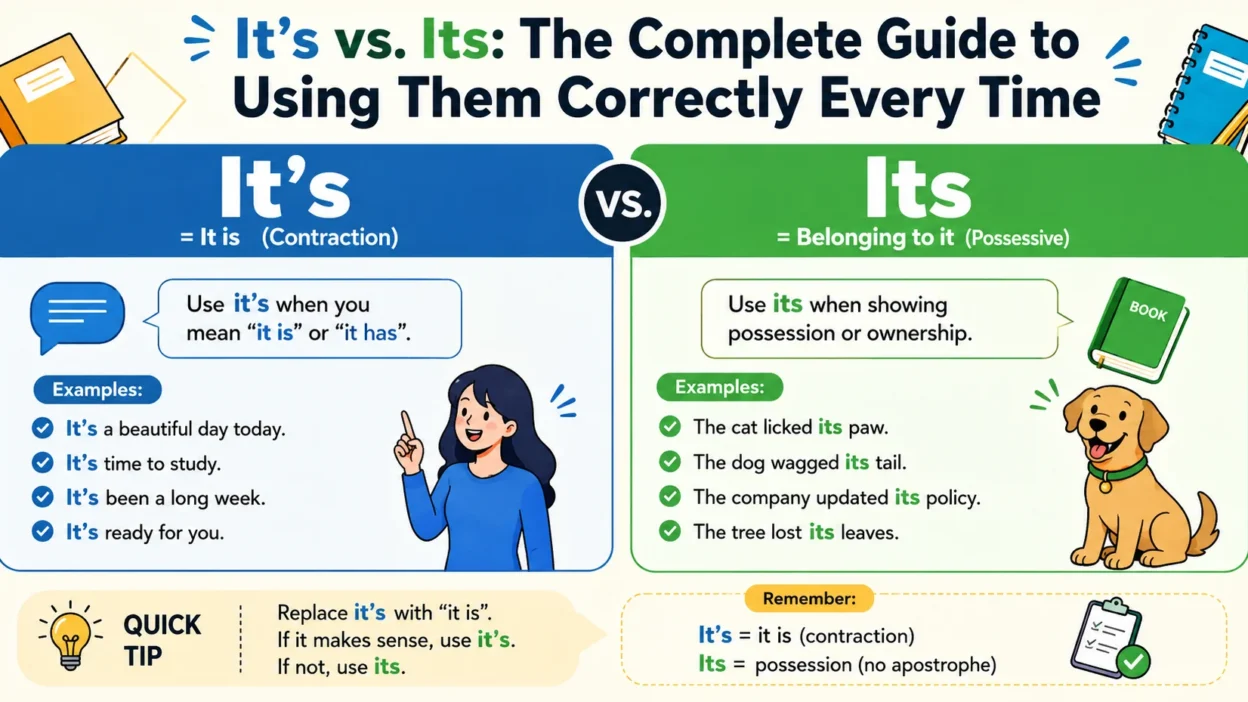
It’s is a contraction that combines the words “it is” or “it has” into a shorter, more natural form. The apostrophe replaces the missing letters, making the sentence flow smoothly while keeping the meaning clear. If you can replace it’s with “it is” or “it has” and the sentence still makes perfect sense, then it’s is the correct choice.
“It’s” Means “It Is”
The apostrophe in it’s stands for missing letters. In this case, it’s is a contraction of it is.
That means you can usually check the sentence by expanding it. If it is fits, then it’s is the correct choice.
Here are a few clear examples:
- It’s cold outside. → It is cold outside.
- It’s a beautiful day. → It is a beautiful day.
- It’s time to leave. → It is time to leave.
This is the easiest way to remember the rule. If the sentence still works when you replace it’s with it is, you have the right word.
“It’s” Also Means “It Has”
Less often, it’s can also mean it has. You will usually see this in perfect tense structures.
Examples:
- It’s been a long day. → It has been a long day.
- It’s already started. → It has already started.
- It’s never happened before. → It has never happened before.
This second use is common in speech and informal writing. It still follows the same rule. The apostrophe shows missing letters.
Everyday Examples of “It’s” in Conversation
You hear and read it’s all the time because English speakers use contractions constantly in natural speech. They make sentences feel smoother and less stiff.
A few everyday examples:
- It’s okay.
- It’s fine.
- It’s not ready yet.
- It’s going to rain.
- It’s been a while.
These examples sound natural because people usually say them out loud with the full meaning in mind. That is why the contraction feels so normal.
Common Sentence Patterns Using “It’s”
A few sentence patterns come up again and again:
- It’s + adjective
Example: It’s possible. - It’s + noun phrase
Example: It’s a problem. - It’s + verb participle
Example: It’s gone, it’s started, it’s finished.
When you see one of these patterns, the contraction is probably correct. The key is still the same: try expanding it to it is or it has.
Understanding “Its” — The Possessive Pronoun
Its is a possessive pronoun that shows ownership or belonging without using an apostrophe. It tells you that something belongs to or is connected with it, just as his, hers, ours, and theirs express possession. Whenever an object, animal, company, or place owns or has something, its is the correct form to use.
Showing Ownership Without an Apostrophe
Its shows possession. It tells you that something belongs to, comes from, or is connected to it.
Examples:
- The cat licked its paws.
- The company updated its policy.
- The tree dropped its leaves.
Notice what happens here. The word is acting like his, her, their, or your. Those words show ownership too, and none of them needs an apostrophe. Its works the same way.
Why Possessive Pronouns Never Need Apostrophes
This is where a lot of writers get tripped up. In English, apostrophes do not belong to possessive pronouns. That means:
- his not his’
- hers not her’s
- ours not our’s
- yours not your’s
- its not it’s
That last example causes the most trouble because most possessives do use apostrophes in other forms. People learn rules like the student’s book or the company’s goal and then overlay the apostrophe to its. But its is already a possessive pronoun. It does not need extra punctuation.
Real-Life Examples of “Its” Used Correctly
Here are some natural examples where its is the only correct choice:
- The robot lost its charger.
- The restaurant changed its menu.
- The bird returned to its nest.
- The phone updated its software.
- The school announced its new schedule.
Each sentence shows ownership or a close relationship. None of them means it is or it has. That is the difference.
Common Objects, Animals, Businesses, and Technology Examples
People often use its when talking about things that do not have gender or when describing an institution, brand, or object.
Examples:
- Animals: The dog chased its tail.
- Businesses: The company raised its prices.
- Technology: The laptop lost its battery life.
- Nature: The storm changed its direction.
- Objects: The chair lost its cushion.
These examples are useful because they show how flexible the word is. Anything that can be treated as a singular “it” can use its for possession.
Side-by-Side Comparison: It’s vs. Its
A quick comparison helps the rule stick.
| Word | Type | Meaning | Example |
| it’s | Contraction | it is or it has | It’s raining. |
| its | Possessive pronoun | belonging to it | The dog wagged its tail. |
That table covers the core rule in the simplest possible way.
Here is the easiest memory trick:
If you can replace it with “it is” or “it has,” use it’s.
If you are showing possession, use its.
That one habit solves most mistakes.
How Context Helps You Choose the Right Word
Sometimes the sentence structure gives you the answer before you even run the test.
Look at these pairs:
- It’s a new phone.
Replace with it is. The sentence works. - The phone lost its charger.
Replace with it is. The sentence breaks. So its is correct.
Another pair:
- It’s been a long week.
Replace with it has. The sentence works. - The business changed its logo.
Replace with it has. The sentence fails. So its is correct.
The context test is powerful because it makes grammar practical. You do not need to memorize fancy terminology. You just need to ask a simple question: Does this sentence mean “it is,” “it has,” or possession?
The Grammar Rule Behind It’s and Its
The grammar rule is simple once you understand it. It’s is a contraction that means “it is” or “it has,” while its is a possessive pronoun that shows ownership. A quick way to check your writing is to replace it’s with “it is” or “it has.” If the sentence still makes sense, use it’s. If the sentence shows that something belongs to it, then its is the correct choice.
How English Contractions Work
A contraction is a shortened form of two words. English creates contractions by removing letters and replacing them with an apostrophe.
Examples:
- do not → don’t
- cannot → can’t
- you are → you’re
- it is → it’s
The apostrophe stands in for the missing letters. That is all it does.
Because it’s is a contraction, it always contains an apostrophe. Without the apostrophe, the word becomes the possessive form its.
Understanding Possessive Pronouns
Possessive pronouns show ownership without naming the owner again.
Examples:
- mine
- yours
- his
- hers
- ours
- theirs
- its
These words already carry the meaning of possession. They do not need apostrophes because they are not possessive nouns. That distinction matters.
A common mistake is to think every possessive word needs an apostrophe. That is not true. Apostrophes apply to many possessive nouns, but not to possessive pronouns.
Why “Its” Is an Exception to the Apostrophe Rule
People often learn a simplified rule early on: “Add apostrophe plus s to show possession.” That rule works a lot of the time, but not always. Its is one of the major exceptions.
Compare these:
- The girl’s bag
- The teacher’s notes
- The company’s policy
- Its color
The first three use apostrophe s because they are possessive nouns. The last one uses its because it is a possessive pronoun.
That is why this mistake is so common. The grammar rule is real, but it is not universal.
Common Mistakes People Make
One of the most common grammar mistakes is using it’s and its interchangeably because they sound exactly alike. Many writers automatically add an apostrophe to its, assuming all possessive words need one, while others forget that it’s is only a contraction for “it is” or “it has.” Taking a moment to check whether the sentence expresses possession or a contraction can help you avoid this frequent error.
Mistakes in Emails
Email mistakes often happen because people type quickly and hit send before checking the sentence.
Wrong:
- Please update it’s records.
Right:
- Please update its records.
Wrong:
- It’s policy has changed.
Right:
- Its policy has changed.
In business writing, this error can stand out. It looks like a small typo, but it can weaken the writer’s credibility.
Mistakes in Academic Writing
Students sometimes mix up the two forms in essays, reports, and research papers.
Wrong:
- The machine improved it’s performance.
Right:
- The machine improved its performance.
Wrong:
- The country changed it’s laws.
Right:
- The country changed its laws.
Teachers often notice this mistake because it happens in papers where precision matters.
Mistakes on Social Media
Social media is fast, casual, and full of contractions, so this mistake shows up all the time.
Wrong:
- Look at it’s new outfit.
Right:
- Look at its new outfit.
Wrong:
- The cat found it’s way home.
Right:
- The cat found its way home.
Since social media encourages quick posting, people often skip proofreading. That is exactly when this error slips in.
Mistakes in Business Documents
Business writing needs clarity. A simple apostrophe error can distract from the message.
Wrong:
- The brand updated it’s mission statement.
Right:
- The brand updated its mission statement.
Wrong:
- The team finished its work early.
Right:
- The team finished its work early.
In polished writing, tiny details matter more than people think. Readers may not remember the error itself, but they will remember the feeling that the writing was rushed.
A Simple Decision Rule You Can Trust
Here is the fastest way to choose correctly:
- Replace the word with it is.
- If the sentence still makes sense, use it’s.
- If the sentence does not work and you need possession, use its.
Examples:
- It’s cold. → It is cold.
- The dog scratched its ear. → Not it is ear. So use its.
- It’s been helpful. → It has been helpful.
- The phone lost its battery. → Now it has a battery. So use its.
This one test catches nearly every case.
Mini Case Study: A Small Apostrophe Error With a Big Impact
A marketing team once published a product page that said, “The device lost it’s charger overnight.” The line was short, but several readers noticed the error right away. Some ignored it. Others questioned the quality of the page as a whole.
That is the hidden danger of grammar mistakes. A small error does not just sit there on the page. It changes the way readers judge the rest of the writing.
The message may still be clear, but the polish is gone. For brands, students, job seekers, and professionals, that can matter a lot.
Quick Recap So Far
- It’s means it is or it has.
- Its shows possession.
- Apostrophes do not belong to possessive pronouns.
- The easiest test is to expand the sentence.
- If it is or it has fits, use it’s.
- If the word shows ownership, use its.
Conclusion
Understanding the difference between It’s and Its can make your English writing much clearer and more accurate. Although the two words look almost identical, they serve different purposes. It’s is a contraction of it is or it has, while Its is the possessive form that shows ownership. By remembering this simple rule and proofreading your work, you can avoid one of the most common grammar mistakes and write with greater confidence.
FAQs
Q1. What is the difference between It’s and Its?
It’s is a contraction that stands for it is or it has, whereas Its is the possessive form used to show ownership.
Q2. Why do people often confuse It’s and Its?
Many people confuse them because they look nearly identical and sound the same. Their similar appearance often leads to grammar mistakes, especially during fast writing or when proofreading is skipped.
Q3. How can I quickly check whether It’s is correct?
A simple way is to replace It’s with it is or it has. If the sentence still makes sense, It’s is the correct choice. If not, you should use Its.
Q4. Why doesn’t Its have an apostrophe?
Although many possessive nouns use an apostrophe, Its is a possessive pronoun, so it follows a different rule and does not require one.
Q5. Does using the wrong form really matter?
Yes. Using It’s and Its incorrectly can make your writing appear less polished and may reduce your credibility in academic papers, business emails, blog posts, and other professional or educational writing.