Disoriented or Disorientated can confuse many writers, but both words share the same meaning, and the right choice depends on your audience. At first glance, they look almost identical and have an identical sound, so many people assume there is a major difference. In reality, the distinction comes from regional English rather than grammar. American English usually prefers disoriented, while British English more often uses disorientated. This variant spelling is part of normal regional variation, linguistic variation, and lexical variation across the English language. From my experience editing articles, choosing the form that matches your readers creates more clarity and makes your writing feel more natural.
If you write an academic paper, blog post, business document, or everyday content, keep your writing style consistent from beginning to end. A safer choice for American readers is disoriented, while British readers may expect disorientated. Following common usage, correct usage, and correct use improves communication and helps you communicate your message clearly. This simple comparison, explanation, and example show that both are real words, accepted word forms, and even a synonym in practical use because they express the same core idea. Understanding semantics, NIP, context, usage differences, pronunciation, geography, distinction, and nuances will help you avoid awkward mistakes and write more correctly.
Many people wondering about these spellings eventually figure out that the answer depends on the audience, not on one form being wrong. Both versions are globally recognised, globally understood, interchangeable, and often used, although one may be more common in a particular region. If you see each version in books or online, don’t let the tiny spelling change become a puzzle that leaves you puzzled. The key is to unlock confident writing by choosing one version and using it consistently. This approach removes the conundrum, prevents it from tripping us up, stops us from scratching our heads, and keeps the focus on clear communication instead of spelling differences.
The short answer: is there any difference between disoriented and disorientated?
Yes and no.
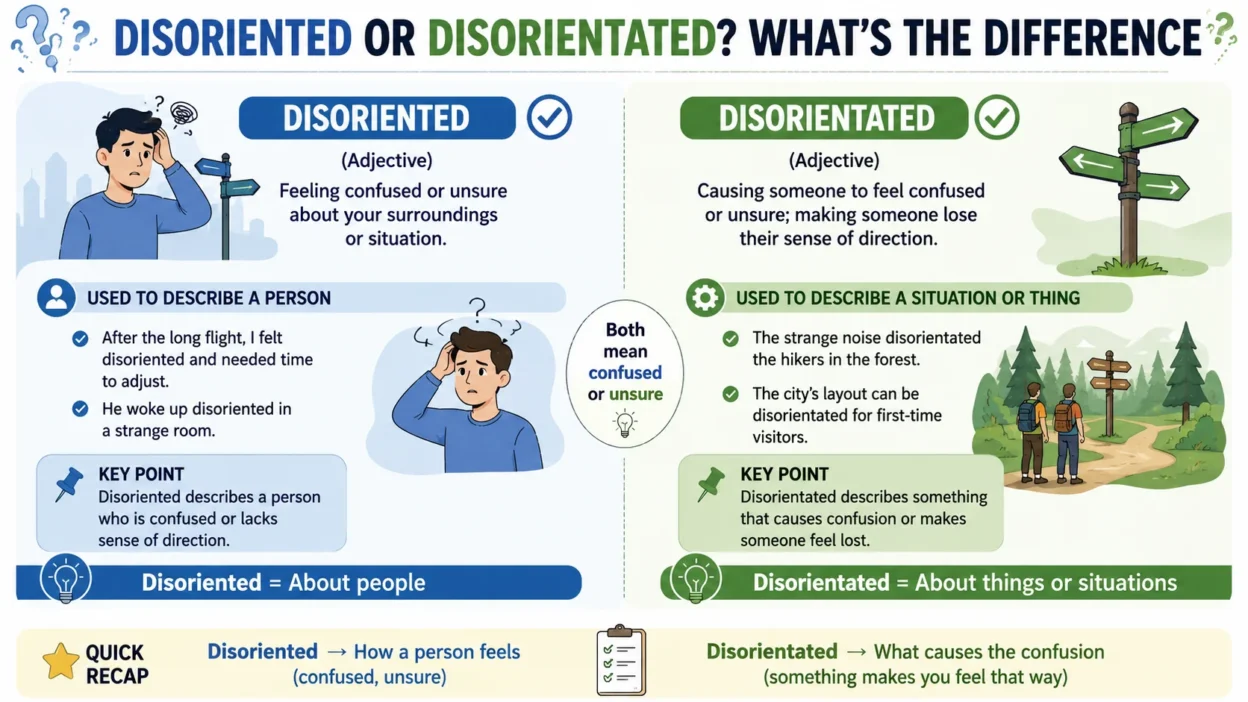
The meaning is basically the same. Both words describe someone or something that has lost a sense of direction, balance, or mental clarity.
The difference is mostly about usage.
- Disoriented is more common in American English
- Disorientated is more common in British English
- In many cases, either word will be understood
- In formal writing, consistency matters more than personal preference
That means this is not a “right vs. wrong” issue. It is more of a “which form fits this audience?” issue.
A simple way to think about it: disoriented is the version most Americans expect to see, while disorientated is the version many British readers are used to. Same idea. Different rhythms.
What does “disoriented” mean?
Disoriented means confused, lost, or unable to tell where you are, what is happening, or how to respond clearly.
It can describe:
- a person who is physically lost
- someone who feels mentally confused
- a patient who seems unable to recognize place or time
- a person who feels thrown off after a sudden event
Common meanings of disoriented
Here is a simple breakdown:
| Meaning | What it usually suggests | Example |
| Physically lost | A person does not know where they are | She felt disoriented after leaving the subway station |
| Mentally confused | A person cannot think clearly | He was disoriented after the accident |
| Temporarily unsettled | A sudden change throws someone off | The new schedule left everyone disoriented |
Everyday examples of disoriented
- After waking up in a strange hotel room, I felt disoriented for a moment.
- The bright lights and loud noise made the child feel disoriented.
- She was disoriented after the long flight and needed time to recover.
Notice how the word works in both physical and mental situations. That flexibility is one reason it is so common.
What does “disorientated” mean?
Disorientated means the same thing as disoriented. It describes confusion, loss of direction, or a disturbed sense of place or mental balance.
The main reason people notice it is because it tends to sound a little more formal or slightly more traditional to some ears. In British English, that rhythm often feels normal. In American English, it may sound less common.
Common meanings of disorientated
| Meaning | What it usually suggests | Example |
| Physical confusion | Someone is unsure where they are | He became disorientated in the dark tunnel |
| Mental confusion | Someone cannot process the situation clearly | She felt disorientated after the sudden news |
| Emotional shock | A stressful event causes a loss of balance | The family was disorientated after the move |
Everyday examples of disorientated
- After the storm, several passengers looked disorientated.
- The loud crash left him disorientated and confused.
- She felt disorientated when the meeting changed direction so quickly.
The word is not “incorrect.” It is simply less standard in American usage and more familiar in British usage.
Disoriented or. disorientated: side-by-side comparison
This is where the difference becomes easy to see.
| Feature | Disoriented | Disorientated |
| Core meaning | Confused, lost, mentally unsettled | Confused, lost, mentally unsettled |
| Common in American English | Yes | Less common |
| Common in British English | Yes | Yes, often more natural |
| Formal writing | Widely accepted | Widely accepted in UK contexts |
| Everyday speech | Very common | Common in UK speech and writing |
| Best for US audience | Yes | Usually avoid unless quoting or matching style |
| Best for UK audience | Acceptable | Often preferred |
The table tells the real story: meaning is shared, but regional preference is different.
Why American English prefers “disoriented”
American English tends to prefer disoriented because it is the shorter, more streamlined form. That matters more than people realize. English often trims or simplifies words over time, and American usage has a strong habit of favoring the shorter option when both forms survive.
That does not mean Americans never use disorientated. They do. But it usually sounds less natural in most American contexts.
Where “disoriented” fits naturally in US English
- news writing
- academic writing
- medical writing
- business communication
- everyday conversation
Example in an American context
- After the power outage, the office felt disoriented and tense.
That sounds normal and direct. It reads cleanly. It does not call attention to itself.
Why British English often uses “disorientated”
British English often keeps disorientated because the longer form has a stronger foothold in everyday UK usage. It is not just a spelling preference. It is a live word in the language community.
In Britain, both forms can appear. But disorientated is often the one that feels most familiar in speech and writing. That is especially true in older texts, British journalism, and some literary writing.
Why this matters
If you are writing for a UK audience and you choose disoriented every time, your writing is still understandable. But it may feel a little less local. On the other hand, using disorientated in a US audience can feel slightly off, even though nobody will misunderstand it.
That is the heart of the issue. The words are not fighting over meaning. They are fighting over habit.
A quick historical note on disorientated
Both words come from the same root idea: orientation.
Orientation means direction, position, or alignment. When someone is disoriented, they have lost that orientation. The form disorientated follows a pattern that appears in some English verbs and adjectives, especially in British usage.
Linguistically, this kind of variation is normal. English often produces more than one accepted form for the same concept. Think of pairs like:
- color / colour
- realize / realise
- traveling / travelling
The difference between disoriented and disorientated works in a similar way. One form becomes more dominant in one region. The other survives in another.
When should you use disoriented?
Use disoriented when you are writing for:
- an American audience
- a general international audience with US defaults
- medical or technical writing in the US
- online content aimed at American readers
- resumes, reports, or articles in American English
Best-fit situations
Medical or health writing
- The patient was disoriented after the fall.
News writing
- Witnesses said the driver appeared disoriented.
General explanation
- I felt disoriented after changing time zones.
Why it works so well
It is concise. It is familiar. It rarely distracts the reader. That makes it a strong default choice when you are not writing for a specifically British audience.
When should you use disorientated?
Use disorientated when you are writing for:
- a British audience
- UK-based publications
- Commonwealth contexts that prefer British spelling and usage
- fiction or dialogue that should sound regionally authentic
- texts that already use British English consistently
Best-fit situations
British journalism
- The crowd looked disorientated after the announcement.
Fiction with UK voice
- She felt disorientated as she stepped into the empty station.
Regional consistency
- If the rest of the document uses British spelling, keep this form consistent.
One important warning
Do not mix disoriented and disorientated randomly in the same piece unless there is a reason. If you start with British English, stay with British English. If you start with American English, stay with American English. Consistency makes your writing feel polished.
What about clarity, style, and rhythm?
Good writing isn’t just about choosing the correct word. It is also about how naturally your sentences flow. “Disoriented” tends to sound shorter and more direct, which suits American English, while “disorientated” has a slightly longer rhythm that many British readers find familiar. Whichever form you choose, stay consistent throughout your writing so your message remains clear, polished, and easy to read.
Example comparison
- The loud noise left him disoriented.
- The loud noise left him disorientated.
Both are correct in the right context. But depending on your audience, one may feel smoother. The shorter form often feels tighter in US writing. The longer form can feel slightly fuller in UK writing.
This is not about logic alone. It is also about reader expectation.
A practical case study: writing for different audiences
Imagine you’re writing the same article for two different audiences. If your readers are primarily in the United States, using “disoriented” will sound more natural and familiar because it is the standard American form. However, if you’re writing for readers in the United Kingdom, “disorientated” will better match British English and local editorial conventions. Choosing the version your audience expects makes your writing feel more authentic, improves readability, and creates a smoother reading experience without changing the meaning.
Version for an American website
After the crash, the witness seemed disoriented and unable to answer questions clearly.
This sounds natural for a US audience. It is direct and easy to read.
Version for a British magazine
After the crash, the witness seemed disorientated and unable to answer questions clearly.
This version feels more at home in UK English. The meaning stays the same. The audience fit changes.
That is the best way to think about the choice. The issue is not correctness alone. It is fit.
Common mistakes people make
Even though this pair is simple, writers still make a few common mistakes.
Assuming one form is wrong
Both forms are legitimate. The real mistake is treating one as nonsense just because you do not use it personally.
Mixing regional styles
You would not normally write:
- The patient was disoriented in the hospital, then disorientated after the interview.
That kind of switching feels messy unless you have a clear reason.
Overthinking the word choice
Do not let this one pair slow you down too much. In most cases, choose the form that matches your audience and move on.
Using the word where a simpler word works better
Sometimes lost, confused, or shaken is a better choice.
For example:
- Instead of saying, “He was disoriented by the announcement,” you might say, “He was confused by the announcement.”
That is not always better, but it is worth asking.
Words that are often close in meaning
These words are related to disoriented and disorientated, but they are not exact substitutes in every case.
- Confused — broader and more general
- Lost — often physical or emotional
- Dizzy — more about physical sensation
- Bewildered — stronger sense of puzzlement
- Thrown off — informal and conversational
Quick comparison
| Word | Main idea | Tone |
| Disoriented | Lost sense of direction or clarity | Neutral, formal |
| Confused | Not understanding something | Neutral |
| Dizzy | Feeling spin or imbalance | Physical |
| Bewildered | Deeply puzzled | Stronger, literary |
| Thrown off | Surprised or unsettled | Informal |
Real-life usage examples
Seeing these words in real-life situations makes the difference much easier to understand. In American English, you’ll often read or hear “disoriented,” while British English more commonly uses “disorientated.” Regardless of the spelling, both words describe someone who feels confused, lost, or temporarily unable to think or navigate clearly.
Disoriented
- The patient looked disoriented after waking from surgery.
- I felt disoriented when the train stopped in the wrong city.
- The sudden change in plans left everyone disoriented.
Disorientated
- The hiker became disorientated in the fog.
- She sounded disorientated after the long meeting.
- The children were disorientated by the unfamiliar building.
These examples show the same meaning in different regional forms.
A simple rule you can trust
When in doubt, use this:
- Use disoriented for American English
- Use disorientated for British English
- Stay consistent within the same document
- Match the tone and audience of your writing
That rule will keep you safe in most real-world situations.
Conclusion
Choosing between disoriented and disorientated is simpler than it first appears. Both words have the same meaning and are correct. The only real difference is regional preference. Disoriented is the standard choice in American English, while disorientated is more common in British English. To keep your writing clear and professional, pick the form that matches your audience and use it consistently throughout your document.
FAQs
Q1.Is disoriented or disorientated correct?
Both are correct. Disoriented is preferred in American English, while disorientated is more common in British English.
Q2.What is the difference between disoriented and disorientated?
There is no difference in meaning. The only distinction is regional usage and spelling preference.
Q3.Should I use disoriented in American English?
Yes. If you are writing for an American audience, disoriented is the standard and more widely used form.
Q4.Why do British writers use disorientated?
British English traditionally favours disorientated as the more common spelling, although disoriented is also widely understood.
Q5.Can I use disoriented and disorientated interchangeably?
Yes. Both words have the same meaning and are interchangeable. For the best writing style, choose one spelling and use it consistently throughout your content.