The phrase “This Is She” or “This Is Her” shows how English grammar, pronoun choice, and speech create different impressions in daily talks. When you answer a phone call and someone asks for you, choosing the correct expression can feel confusing. Traditional grammar considers “This is she” the formal choice because she works as a subject pronoun after the linking verb is. However, many people use “This is her” in everyday conversation because it feels smoother and more natural. The difference depends on the situation, tone, and level of formality.
In spoken English, people often focus on clear communication rather than strict grammar rules. When a friend calls and asks who is speaking, most native speakers naturally respond with the phrase that feels comfortable. “This is she” may sound more formal, professional, or old-fashioned, while “This is her” is common in casual conversations. Understanding pronoun case, sentence structure, and context helps English learners avoid mistakes and improve confidence when speaking on the telephone or introducing themselves in person.
Learning this grammar point also improves writing skills, language knowledge, and professional communication. English learners can understand that both expressions have a place depending on the setting. Formal situations may require traditional grammar accuracy, while modern spoken English often prefers natural expressions. By studying examples, grammar lessons, and real-life conversations, students and writers can develop better clarity, stronger vocabulary, and a deeper understanding of how English changes over time.
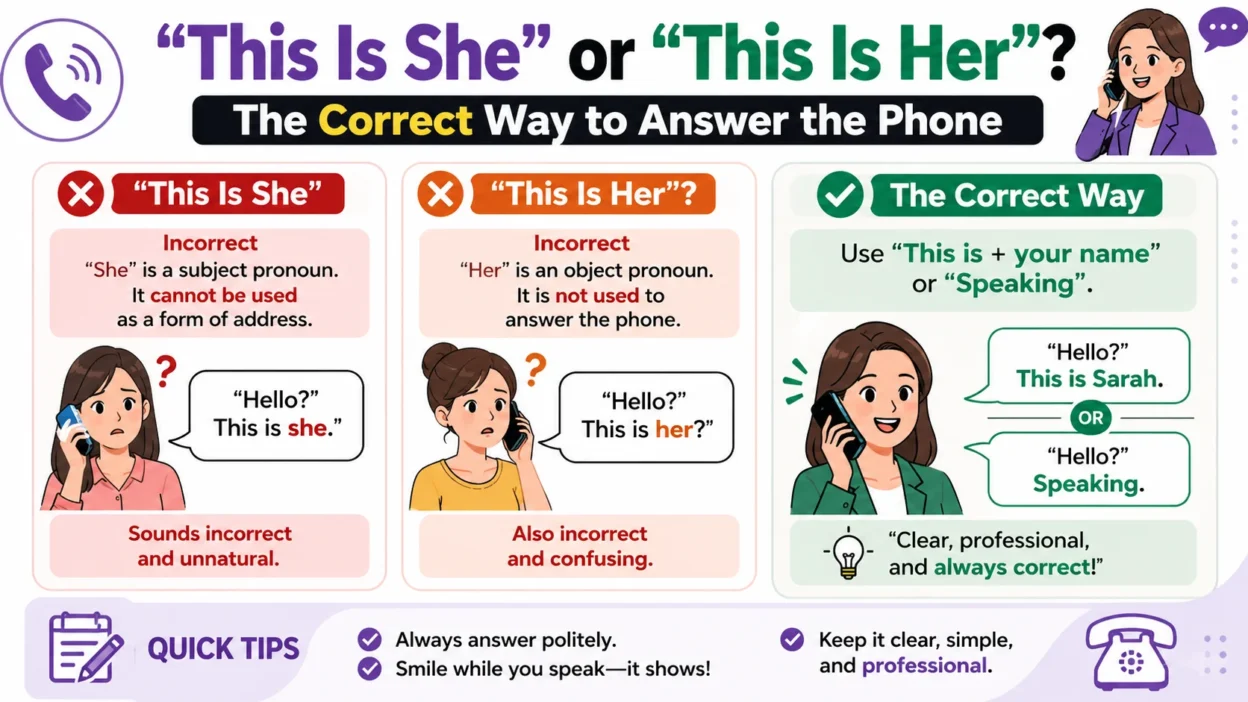
The Quick Answer to “This Is She” or “This Is Her”
Here is the shortest useful answer.
- “This is she” is the traditional grammatical form
- “This is her” is the common spoken form
- “Yes, this is [Name]” is often the safest neutral choice
- “Speaking” works well in casual and professional calls
If you are in a formal setting, “This is she” sounds polished and careful. If you are in a relaxed conversation, “This is her” sounds natural and friendly. If you want to avoid the issue completely, just say your name.
That is the practical answer. But the grammar behind it is worth understanding, because once you see the pattern, the confusion disappears.
Why “This Is She” or “This Is Her” Confuses So Many People
English pronouns change form depending on their role in the sentence.
- She is the subject form
- Her is the object form
That part is easy enough. You would say:
- She called me
- I called her
In the first sentence, she does the action. In the second, her receives the action.
The phone-answering problem gets tricky because “This is…” does not work like a normal action sentence. The verb is is a linking verb. It connects two things instead of showing an action. So the sentence is not saying that somebody is doing something to the person. It is identifying the person.
That is the key idea.
When you say “This is she,” you are using a subject-style pronoun after a linking verb. Traditional grammar is like that. When you say “This is her,” you are using the object form in a place where many speakers feel it sounds more natural.
Both forms exist. They just belong to different habits of English.
The real reason the phrase feels awkward
Most people learn one rule in school and hear another rule in real life.
School grammar says the pronoun after is should often stay in the subject form. Real conversation says people usually choose the version that sounds easiest on the tongue. That creates a tug-of-war in the brain. You know one form is “correct.” The other form sounds better.
That is enough to make anybody hesitate on a phone call.
Why it actually matters
It does not matter in a dramatic, life-changing way. No one is likely to collapse on the floor if you use the “wrong” form.
Still, the choice does matter in smaller ways.
It can affect:
- how formal you sound
- how confident you seem
- how polished your speech feels
- how comfortable the sentence is to say
In a job interview call, a school office call, or a customer service setting, the phrase you choose sends a small signal. People hear tone before they analyze grammar. That is why the choice matters more than it first appears.
Why “This Is She” Is Grammatically Correct
Traditional grammar treats “This is she” as the correct answer because is is a linking verb. A linking verb connects the subject to a complement. It does not act like a normal action verb.
In a sentence like “The winner is she,” the word after is is not an object in the ordinary sense. It identifies the subject. That is why formal grammar often prefers the subject form of the pronoun.
You can think of the structure like this:
- This = she
- The caller = she
- The person on the phone = she
In that kind of sentence, the pronoun acts like a naming label. It follows the same logic as “It is I” or “The speaker is he.”
The rule most people forget
People remember that her is the object form. They forget that the verb to be is special.
Compare these:
- I saw her
- I called her
- This is she
The first two sentences use her because she receives the action. The last sentence works differently. It identifies a person rather than acting on one.
That is the part people miss. They hear the word her and think, “That sounds right because it sounds normal.” But grammar does not always work that way.
Simple comparison examples
Here are a few helpful comparisons:
- It is I
- The person on the line is she
- The winner is he
- The guest was I sounds formal and old-fashioned, but it follows the same logic
These examples all share the same pattern. The pronoun after a linking verb stays in the subject form in strict traditional grammar.
So why does “This is she” sound stiff?
Because it is formal.
That is not a flaw. It is just the style of the sentence. Some phrases sound elegant in writing but less natural in speech. “This is she” belongs in that category for many speakers.
It can sound polished, but it can also sound like something from a textbook or an old-fashioned office call. In casual conversation, that makes it feel slightly rigid.
That does not make it wrong. It just makes it less relaxed.
Why Most People Say “This Is Her” Anyway
This is where real life takes over.
People speak the way people speak. In everyday conversation, the smoothest phrase usually wins. “This is her” feels easier because it fits ordinary speech better for many speakers.
There is nothing mysterious about that. Spoken English often favors rhythm, comfort, and speed. A sentence that feels natural will often beat a sentence that follows a strict rule but sounds awkward in the moment.
Spoken English favors comfort
When somebody calls and says, “May I speak to Anna?” the response “This is her” comes out quickly and naturally.
It sounds calm. It sounds easy. It does not feel like a grammar exam.
That is part of the reason it has become so common. Real conversation rewards the phrase that rolls off the tongue smoothly. People do not want to pause and think about pronoun cases when the phone is already ringing.
Frequency shapes what sounds correct
The more often people hear a phrase, the more normal it feels.
That is one of the odd little truths of language. A phrase can sound “right” simply because it appears often in speech. Many speakers have heard “This is her” enough times that it no longer feels unusual.
That does not erase the traditional grammar rule. It just explains the gap between classroom English and real-world English.
Real-world insight
Most people do not stop mid-call to evaluate your grammar. They hear tone, clarity, and confidence.
If you say “This is her” in a relaxed conversation, nobody will usually blink. If you say “This is she” in a formal setting, nobody will think you are strange. The difference is mostly about style.
That is the honest truth. The debate survives because English has room for both formal structure and natural speech.
Formal or Casual: Choosing the Right Phrase Every Time
The smartest way to think about this is not “Which one is always right?” It is “Which one fits this moment?”
That question leads to better choices.
Formal situations
Use “This is she” in situations that feel careful, polished, or professional.
Good examples include:
- job interview calls
- recruiter follow-ups
- office reception calls
- academic offices
- client conversations
- official phone inquiries
In those settings, the traditional form can sound refined. It shows that you are comfortable with formal English.
Casual situations
Use “This is her” when the conversation feels relaxed.
Good examples include:
- a friend calling
- a family member checking in
- a casual customer call
- a quick return call
- a text-to-call callback with no formality
In those situations, the phrase sounds natural and unforced.
A simple rule you can remember
Here is the easiest decision rule:
- Formal tone → This is she
- Casual tone → This is her
- Not sure → Yes, this is [Name]
- Want the cleanest answer → Speaking
That simple rule removes the stress. It also lets you choose based on tone instead of worrying over grammar at the moment.
Better Alternatives That Sound Natural and Confident
Sometimes the best answer is to avoid the debate entirely.
You do not have to choose between she and her at all. Plenty of natural phone responses sound great and avoid the issue.
“Speaking”
This is one of the shortest and cleanest answers.
Example:
Caller: “May I speak to Maria?”
Response: “Speaking.”
It is simple, direct, and confident. It works in both professional and casual settings.
“Yes, this is [Name]”
This is one of the safest choices you can make.
Examples:
- Yes, this is Maria
- Yes, this is Daniel
- Yes, this is Aisha
It sounds polite and easy to understand. It also avoids the pronoun question completely.
“Hi, this is [Name]”
This works especially well in friendly or slightly warm professional conversations.
Example:
- Hi, this is Maria
It sounds modern and relaxed. It can also soften the tone of the call in a good way.
“You’ve reached [Name]”
This works especially well for voicemail or callback situations.
Example:
- You’ve reached Maria
It sounds clear and tidy. It feels professional without sounding rigid.
Why these alternatives work so well
They work because they are clear. That is the real goal of phone language.
A phone answer does not need to impress people with grammar gymnastics. It needs to identify you quickly and confidently. These alternatives do that without creating any case confusion.
Quick comparison table
| Phrase | Tone | Grammar Style | Best Use |
| This is she | Formal | Traditional | Interviews, office calls, official settings |
| This is her | Casual | Spoken English | Everyday conversations |
| Yes, this is [Name] | Neutral | Clear and direct | Most situations |
| Speaking | Brief and confident | Natural spoken English | Quick replies |
| Hi, this is [Name] | Friendly | Modern and clear | Personal and work calls |
That table gives you a fast answer without overthinking it.
Common Mistakes People Make and How to Avoid Them
The biggest mistake is not a grammar mistake. It is a timing mistake.
People freeze, overthink, and then answer awkwardly. That matters more than the pronoun itself.
Overcorrecting
Some people learn that “This is she” is the formal rule and then use it every single time.
That can sound too stiff in casual speech. It is like wearing a tie to a beach picnic. Nothing is broken, but the vibe is off.
Underthinking
Other people assume “This is her” must be wrong because they remember a school grammar rule.
That is too strict. Spoken English often uses object forms in ways that feel completely natural. The issue is not that one form is illegal. The issue is that one form sounds more formal than the other.
Awkward phrasing
A third mistake is hesitation.
People say things like:
- “Uh… this is her?”
- “This is… she.”
- “Hello, yes, this is… me?”
That hesitation makes the response sound less confident than either standard form would.
Fix it with one simple habit
Pick a go-to response and keep it ready.
For example:
- Speaking
- Yes, this is [Name]
- Hi, this is [Name]
When the phone rings, you do not want to solve a grammar puzzle. You want a quick, smooth answer. A ready-made phrase does that beautifully.
Does It Really Matter? What People Actually Notice
Most people notice your tone before they notice your pronoun.
If you sound calm, clear, and polite, the exact wording usually does not matter much. A caller is not sitting there with a red pen.
Still, the choice can matter in subtle ways.
What leaves a real impression
These three things matter more than the pronoun:
- Confidence
- Clarity
- Politeness
If those are present, the rest is just style.
A useful perspective
Think of the phrase as a wardrobe choice.
- “This is she” is like a formal outfit
- “This is her” is like smart casual
- “Yes, this is [Name]” is like clean everyday wear
None of them is broken. They just fit different rooms.
Case Studies: Real-Life Phone Scenarios
These short examples show how the choice changes depending on context.
Job interview call
A recruiter calls and says, “May I speak with Priya?”
Best response: This is she
Why it works: It sounds polished and formal. It matches the tone of the call and gives a careful first impression.
A slightly more natural option: Yes, this is Priya
That version is less stiff and still professional.
Friend calling
A friend says, “Hey, is Priya there?”
Best response: This is her
Why it works: It sounds relaxed and natural. Nobody expects formal grammar in a friendly call.
You could also say: Hey, it’s Priya
That feels even more conversational.
Unknown business call
A customer service rep says, “Am I speaking with Priya?”
Best response: Yes, this is Priya
Why it works: It is simple, clear, and neutral. It avoids the pronoun issue and sounds professional.
Office receptionist call
Someone asks for an employee by name.
Best response: Speaking
Why it works: It is short, polite, and efficient. It gives the caller immediate confirmation.
Voicemail callback
You return a missed call and want to identify yourself.
Best response: Hi, this is Priya returning your call
Why it works: It sounds natural, warm, and clear. It also gives context right away.
Conclusion
Understanding the difference between “This Is She” and “This Is Her” helps you make better choices in both spoken English and formal writing. While traditional grammar supports “This Is She” because it uses the correct subject pronoun, modern conversations often prefer “This Is Her” because it sounds more natural. The best choice depends on the context, tone, and level of formality. By learning how pronouns, linking verbs, and sentence structure work, you can communicate more clearly and confidently in different situations.
FAQs
Q1. Is “This Is She” Grammatically Correct?
Yes, “This Is She” is considered grammatically correct according to traditional English rules. The word she is a subject pronoun, which matches the structure after the linking verb is.
Q2. Is “This Is Her” Wrong to Use?
No, “This Is Her” is not considered wrong in modern spoken English. Many native speakers use it in everyday conversations because it sounds natural and comfortable.
Q3. Which Phrase Should I Use in Formal Situations?
In formal situations, such as professional calls or official communication, “This Is She” may be a better choice because it follows traditional grammar rules and sounds more formal.
Q4. Why Do Native Speakers Often Say “This Is Her”?
Native speakers often choose “This Is Her” because everyday English communication focuses on natural speech. Over time, spoken language has changed, and this expression has become widely accepted.
Q5. How Can English Learners Remember the Difference?
English learners can remember that “This Is She” follows formal grammar, while “This Is Her” is common in casual speech. Pay attention to the situation, audience, and tone before choosing either expression.