In Summer or In the Summer, the choice depends more on context than strict grammar, and that is what makes English feel flexible and natural. In my experience, many people stop for a moment before they write or speak because both phrases seem correct. In American English, both forms are common, while British English may favour one version in certain situations. The difference is usually about meaning, tone, wording, and whether you are referring to a general habit or a specific time frame. Once you understand this small distinction, your choice becomes much easier, and your sentence sounds more natural, correct, and clear.
You will see both forms in casual conversations, formal writing, books, songs, guides, reference texts, and everyday communication. If you are talking about travel, vacations, trips, or other broad experiences, the phrase you choose should match the context clues, placement, and sentence structure. Paying attention to English grammar, clarity, precision, subtle nuances, and understanding helps you communicate with more confidence and fluency. Over time, this habit strengthens your writing, highlights your main idea, and helps readers understand your meaning without stopping to wonder which expression is right.
Think about the summer season with its warmth, joy, sun, sunny days, jeans, shorts, and ice cream. You might choose in summer for a regular habit, but in the summer works better for a particular period, a specific summer, or an event such as visiting Spain in 2019. That is the real heart of the debate. As the season starts, people swap clothes, enjoy the weather, and express themselves naturally. The language is vibrant, and the best option is the one that matches your context, not a rule carved in stone.
Quick Answer: Is It “In Summer” or “In the Summer”?
The short answer is that both can be correct in American English.
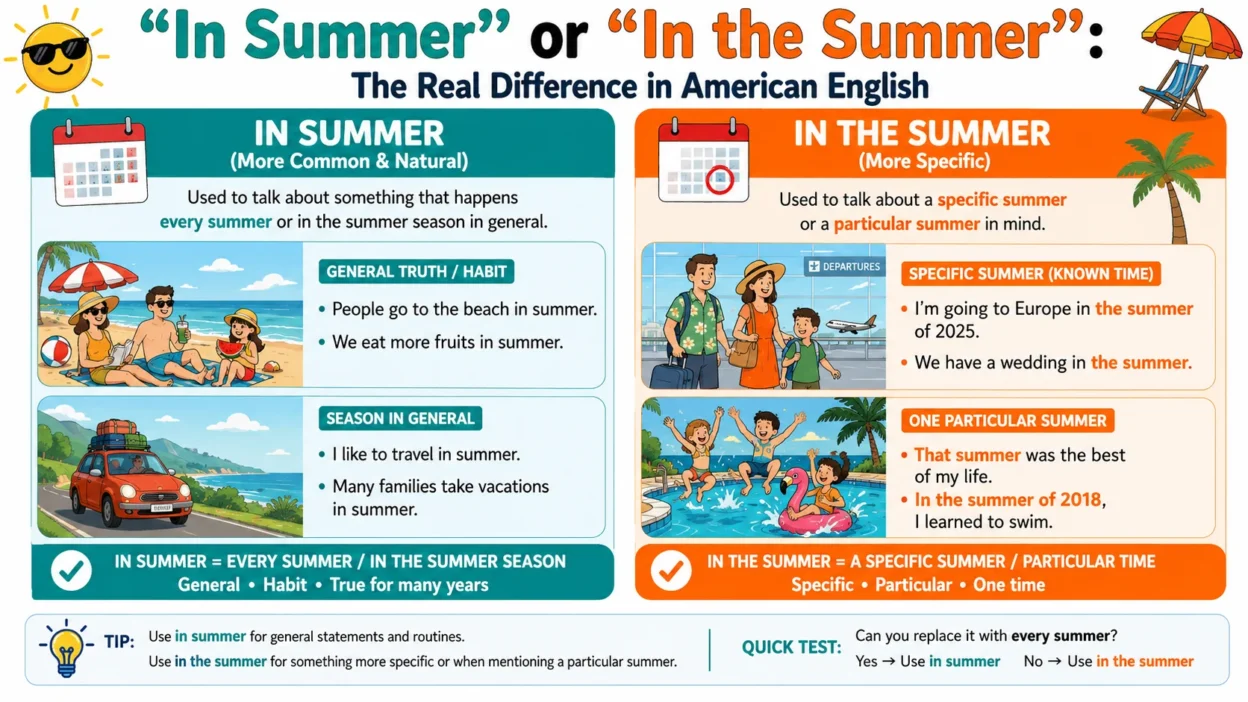
- In summer usually sounds more general and timeless.
- In the summer usually sounds more specific and situational.
Compare these:
- In summer, the days are longer.
This sounds like a general fact about the season. - We traveled to Maine in the summer.
This sounds like a particular summer, or at least a more defined period.
The sentence structure matters too. English often uses “in summer” when the speaker is describing a broad seasonal pattern. It uses “in the summer” when the season feels anchored to a specific event, memory, plan, or year.
That said, native speakers do not always follow a hard wall between the two. Real English is messier than grammar charts. In everyday speech, people often choose whichever version sounds smoother. Still, the difference matters in careful writing.
The Difference Between “In Summer” and “In the Summer”
The easiest way to understand “in summer” vs. “in the summer” is to think about scope.
“In summer” treats summer as a season in a general sense. It works like this:
- In spring, flowers bloom.
- In summer, people travel more.
- In winter, temperatures drop.
These are broad seasonal statements. They do not point to one special summer. They describe a recurring pattern.
“In the summer” makes the season feel more specific. It often suggests:
- a particular summer in the past
- a specific summer in the future
- a defined season in a story or conversation
- a summer tied to a place, plan, or event
Examples:
- We met in the summer of 2023.
- I usually visit my grandparents in the summer.
- The road gets crowded in the summer because of tourists.
In these sentences, the summer feels more concrete. The phrase has a sense of a real stretch of time rather than a general seasonal idea.
When “In Summer” Is the Better Choice
Use in summer when you are describing a habit, a climate pattern, or a general truth.
Examples:
- In summer, the evenings stay bright longer.
- In summer, I like to eat lighter meals.
- In summer, bees are especially active.
These sentences sound natural because they express something ongoing or repeated. No single summer is the focus. The season itself is the point.
This version often works well in:
- general writing
- academic explanations
- weather descriptions
- lifestyle articles
- broad observations
It also helps your writing sound clean and efficient. Sometimes the extra the adds weight that you do not need.
When “In the Summer” Sounds More Natural
Use in the summer when your sentence points to a specific season, memory, event, or plan.
Examples:
- In the summer, we stayed at my aunt’s house by the lake.
- In the summer of 2022, the city hosted a major arts festival.
- I usually take my vacation in the summer.
Here, the phrase feels anchored. It points to a season that matters in the context of the sentence.
This version is often the better fit when:
- you are telling a story
- you are describing a past event
- you are talking about future plans
- you want a warmer, more conversational tone
A sentence like “We went camping in summer” can sound slightly clipped or formal depending on context. “We went camping in the summer” usually sounds more natural in everyday American English when the speaker is referring to a particular trip or a remembered season.
How Meaning Changes with Context
Context does most of the work here. The same phrase can feel different depending on the sentence around it.
Compare these pairs:
| Sentence | Meaning |
| In summer, people spend more time outdoors. | General seasonal habit |
| In the summer, people spend more time outdoors. | Same idea, but slightly more specific or conversational |
| In summer, the humidity can get intense. | Broad climate pattern |
| In the summer of 2024, the humidity felt worse than usual. | Specific year and season |
| She works remotely in summer. | General routine |
| She moved to Denver in the summer. | Specific time of movement |
The grammar is only part of the story. Rhythm matters too. Some writers prefer “in summer” because it sounds lean and direct. Others prefer “in the summer” because it sounds softer and more spoken.
Grammar Rule Behind Both Expressions
The core grammar point is simple: “summer” can work as a season name without an article, but “the summer” gives the season a more definite shape.
English often drops articles with seasons when talking about them in a general way.
Examples:
- in spring
- in summer
- in fall
- in winter
This pattern is common in American English.
But English also uses the article “the” when the season is treated as a specific time block.
Examples:
- in the summer of 2019
- during the summer
- the summer before college
- the summer we moved to Texas
That is why both forms are legitimate. They serve different jobs.
Generic Seasons vs. Specific Time Periods
Think of the difference this way:
- Generic season = the season as a general category
- Specific time period = one particular summer in a story, memory, or plan
Here is the practical rule:
Use no article when the season is general.
Use the article when the season is specific.
Examples of the general form:
- In summer, I wake up earlier.
- In winter, the streets are quieter.
Examples of the specific form:
- In the summer of 2025, I will move abroad.
- In the summer, we stayed inside because of the heat.
The second sentence can still sound general in some contexts. That is why native usage sometimes overlaps. But as a writing rule, the distinction is useful.
The Function of the Definite Article “The”
The word “the” signals something known, defined, or particular. It narrows the meaning.
That is why these phrases feel different:
- summer
- the summer
- the summer of 2024
- the summer before high school
The article makes the season feel like a specific slice of time instead of a broad seasonal category. It works the same way in other expressions:
- in the morning
- in the afternoon
- in the evening
People often say “in the morning” rather than “in morning” because mornings are usually discussed as parts of the day rather than broad categories. With seasons, English gives you more flexibility.
Why Native Speakers Choose One Over the Other
Native speakers usually choose the form that sounds most natural in the moment. They do not stop and recite a grammar rule. They listen to the sentence in their head.
That is why these two sentences can both sound fine, but not equally fine in every setting:
- In summer, I like simple food.
- In the summer, I like simple food.
The first feels broader. The second feels more conversational and grounded. Neither is wrong. The better choice depends on tone and context.
American English or. British English Usage
In American English, “in summer” and “in the summer” are both used, but “in the summer” often feels more conversational in everyday speech. That does not mean “in summer” is rare or incorrect. It is still common in writing, especially when the sentence makes a general seasonal point.
British English often uses “in the summer” more frequently in ordinary speech. American English can be slightly more flexible. Still, the difference is not absolute. Real usage varies by speaker, region, and style.
Here is the practical takeaway:
- American English writing: both are fine, but choose based on specificity and tone
- British English speech: “in the summer” often sounds more natural
- Formal writing: “in summer” can feel concise and polished
- Narrative writing: “in the summer” can feel more vivid and grounded
You do not need to force one style everywhere. Good writing follows meaning first and rule second.
Real-Life Examples in Everyday English
Let’s look at how in summer and in the summer work in real sentences.
| Example | Best Choice | Why |
| In summer, I drink more water. | In summer | General habit |
| We moved to Chicago in the summer. | In the summer | Specific event |
| In summer, the park stays busy until late. | In summer | General seasonal pattern |
| In the summer, we always visited my grandmother. | In the summer | Repeated but tied to a particular season in memory |
| The hotel gets expensive in summer. | In summer | General fact |
| I started the job in the summer of 2021. | In the summer | Specific time reference |
Notice something important: the more specific the sentence becomes, the more likely “the summer” sounds right.
A Simple Way to Remember the Rule
Use this quick test:
Ask yourself, “Am I talking about summer in general, or a specific summer?”
- If it is general, use in summer.
- If it is specific, use in the summer.
That one question solves most cases.
A helpful memory trick:
- Summer without “the” = season as a general idea
- Summer with “the” = one particular summer
It is a small difference. Still, small differences shape polished writing. That is where good English often lives.
Mini Style Note for Writers
If you are writing an article, essay, email, or SEO page, consistency matters more than chasing one “perfect” rule in isolation. Use the version that matches your tone.
For example:
- A general advice article might say, “In summer, hydration matters more.”
- A memoir might say, “In the summer, everything changed.”
- A travel article might say, “In the summer, the city fills with visitors.”
Each one works because each one matches the sentence’s purpose.
Conclusion
Both in summer and in the summer are correct, but they are not always used in the same way. In summer usually refers to something that happens every year or describes a general habit, while in the summer often refers to a particular season or a specific period. Understanding this small difference makes your writing and speech sound more natural. Instead of memorising strict rules, focus on the meaning you want to express and choose the phrase that best fits the context.
FAQs
Q1.Is “in summer” grammatically correct?
Yes. In summer is grammatically correct and is commonly used to talk about general habits, regular activities, or the season as a whole.
Q2.When should I use “in the summer”?
Use in the summer when you are referring to a specific summer or a particular period, such as “I visited Spain in the summer of 2019.”
Q3.Is “in summer” more common in American English or British English?
Both American English and British English are used in summer and in the summer. The choice depends more on context and style than on a strict regional rule.
Q4.Can I use both expressions in everyday conversation?
Yes. Native speakers commonly use both expressions in everyday speech and writing. The best choice depends on whether you are speaking generally or about a specific summer.
Q5.Which sounds more natural: “in summer” or “in the summer”?
Neither expression is always more natural. In summer sounds more natural for general statements, while in the summer is usually better when talking about a particular time, specific event, or defined period.