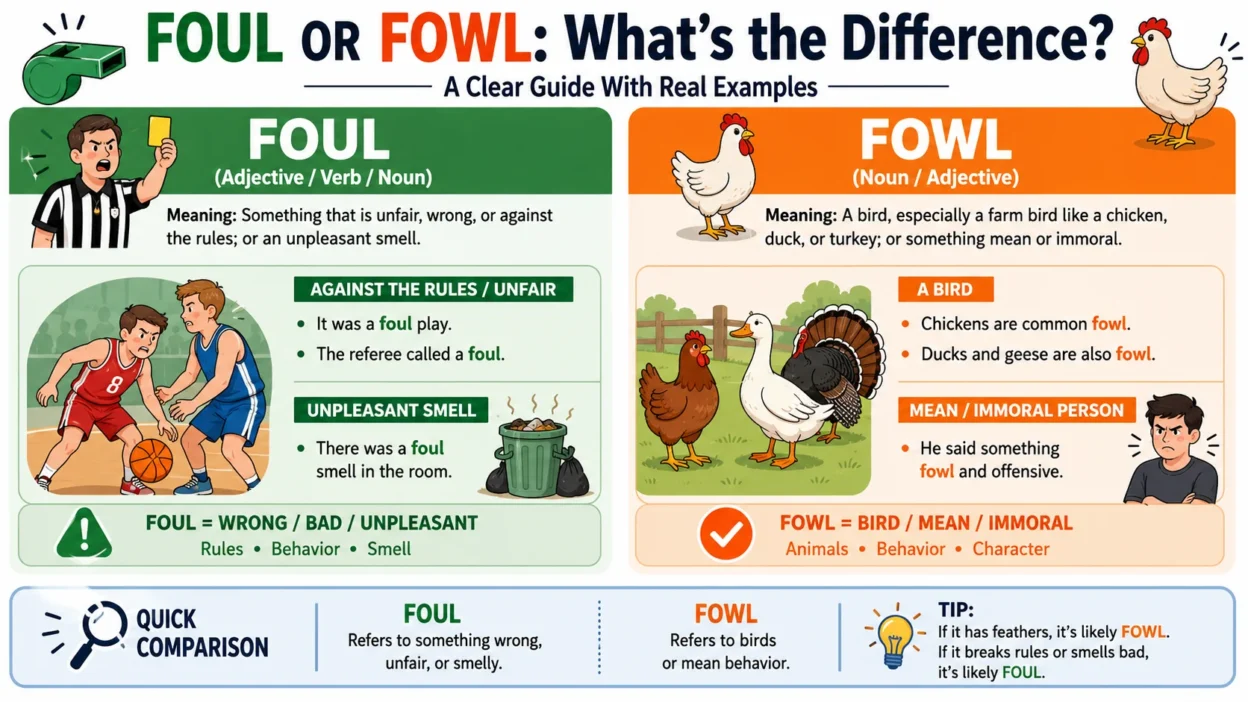
Foul or Fowl can confuse anyone at first, but knowing one simple difference helps you choose the right word every time with confidence. Have you ever paused mid-sentence and wondered which word to write? Foul and fowl are homophones, meaning they sound the same, but have different meanings. In English, these words belong in different corners of the language. Foul describes something dirty, smelly, unpleasant, unfair, or offensive, while fowl refers to birds, especially chickens, ducks, and other birds raised for food or meat. A tiny spelling change can flip the meaning of a sentence completely, making the difference important to learn.
From my own experience, I have seen people confuse these words in everyday writing because they sound exactly alike. A referee may call a foul during a game, while a farmer may raise fowl on farms. A locker room might smell foul, but a soup can contain fowl. These real examples, clear definitions, and useful comparisons present the facts without extra fluff. Even a short story or practical guide often breaks the confusion faster than a long explanation.
Keep these memory tricks in mind because they will help you avoid confusion. Think about dirt, danger, bad behaviour, broken rules, or anything unfair when you read foul. Think about nature, birds, food, farms, and meat when you see fowl. Remembering their unique origins and common uses helps them stick in your mind, improves daily conversations and writing, and lets you use both words correctly with confidence.
Quick Answer: Foul or Fowl in Simple Terms
Here is the fastest way to remember the difference:
- Foul usually means bad, dirty, offensive, or against the rules.
- Fowl means a bird, especially one raised for food or kept on a farm.
A quick example makes it easy to see:
- The player committed a foul during the game.
- The farmer sold fowl at the market.
One letter changes everything.
Why People Confuse Foul and Fowl
People mix these words up for one simple reason: they sound identical. English loves to set traps like that. These are called homophones, which are words that share the same pronunciation but have different meanings and spellings.
That means your ear cannot help you here. You have to rely on meaning and context.
For example, if someone says, “The smell in the kitchen was foul,” you immediately know they are talking about something unpleasant. If someone says, “The kitchen served fowl,” the sentence sounds strange unless the kitchen is serving poultry.
This confusion shows up often in:
- Student writing
- Fast text messages
- Sports writing
- Recipes
- ESL writing
- Proofreading mistakes
A spell checker will not always save you, either. It may accept both words because both are real. That is what makes this pair tricky.
Foul Meaning Explained
Foul is the more flexible word. It works as an adjective, a noun, and even a verb. That makes it useful in everyday English, sports, and formal writing.
At its core, foul carries a negative idea. It usually suggests something dirty, unpleasant, unfair, or improper.
Foul as an Adjective
When foul works as an adjective, it describes something bad or offensive.
Here are common uses:
- Foul smell — a terrible odor
- Foul language — rude or offensive words
- Foul weather — harsh, unpleasant weather
- Foul mood — a bad temper or sour attitude
- Foul play — dishonest or criminal behavior
Examples:
- The room had a foul smell after the trash sat there all day.
- He used foul language during the argument.
- The hikers turned back because of the foul weather.
In each case, the word adds a sense of discomfort or disapproval.
Foul as a Noun
In sports, foul often works as a noun. It means a rule violation.
You hear this in basketball, soccer, baseball, and many other games.
Examples:
- The defender committed a foul.
- The umpire called a foul on the batter.
- That was a clear foul in the final minute.
Here, the word does not mean dirty in a physical sense. It means illegal, unfair, or against the rules.
Foul as a Verb
As a verb, foul means to make something dirty or to obstruct something.
Examples:
- Oil can foul the machinery.
- The blocked drain fouled the water flow.
- His comments fouled the discussion.
This usage appears in technical, environmental, and formal contexts. It is not as common in casual conversation, but it is still important.
Origins of Foul
The word foul has old roots in English and related Germanic languages. Over time, it developed into a word associated with dirt, corruption, and unpleasantness.
That history still shows in modern usage. Even today, the word often suggests something spoiled, stained, or morally wrong.
You can feel that old weight in phrases like:
- foul deed
- foul odor
- foul temper
- foul crime
The word has stayed strong because it is so vivid. It does not just say something is bad. It makes you feel bad.
Contexts for Foul
You will see foul play in several major settings.
Everyday speech
People use it to describe smells, weather, behavior, and moods.
Sports
It appears constantly in rule-based games.
Law and crime
Phrases like foul play can suggest violence, cheating, or criminal activity.
Writing and literature
Writers use it for dramatic effect because it creates a strong emotional tone.
Technical language
Engineers, sailors, and environmental professionals may use foul in specialized ways.
That broad range makes foul a word worth mastering.
Common Uses of Foul in Everyday Language
The word foul shows up in a lot of fixed expressions. These phrases are common enough that you should recognize them on sight.
Foul language
This means offensive, rude, or abusive speech.
- The coach warned the players about foul language.
- She refused to stay in a conversation full of foul language.
Foul smell
This means a strong, unpleasant odor.
- The garbage bin gave off a foul smell.
- The basement had a foul smell after the leak.
Foul weather
This means harsh or unpleasant weather.
- The sailors delayed the trip because of foul weather.
- We stayed inside all afternoon due to foul weather.
Foul play
This often means suspicious or criminal behavior.
- Investigators found no sign of foul play.
- The missing money raised concerns about foul play.
Cry foul
This means to protest unfair treatment.
- The team cried foul after the referee ignored the handball.
- Workers cried foul when the company changed the rules at the last minute.
Run afoul of
This means to clash with rules or authority.
- The company ran afoul of federal regulations.
- He ran afoul of the school code by skipping classes.
Foul in Sports Language
Sports fans hear foul constantly, so this is one of the easiest places to learn it.
In sports, a foul is a rule violation. It may involve contact, interference, or a prohibited move.
Examples by sport:
- Basketball: A player may commit a personal foul.
- Soccer: A player may foul another by tripping or pushing.
- Baseball: A hit may land in foul territory.
- Tennis: A serve may go foul if it lands outside the proper area.
A few clear examples:
- The defender committed a foul in the penalty area.
- The hitter sent the ball into foul territory.
- The referee called a technical foul for unsportsmanlike conduct.
Notice how the word can act differently depending on the sport. That is normal. English does that all the time.
Foul as a Figurative Word
One reason foul lasts so long in English is that it works well beyond its literal meaning.
People use it figuratively to describe more than just dirty things.
Examples:
- foul mood — bad temper
- foul spirit — corrupt or bitter character
- foul deed — immoral action
- foul scheme — dishonest plan
This figurative use gives the word a strong emotional edge. It can sound harsh, sharp, and serious.
A good rule of thumb: if you want to describe something as nasty, unfair, or rotten, foul may be the right word.
Foul in a Sentence: Real-World Examples
Here are practical examples that show how the word works naturally.
- The kitchen smelled foul after the trash overflowed.
- He was ejected for a foul in the second quarter.
- The company denied any foul play in the merger.
- The storm brought foul winds and heavy rain.
- The reporter used foul language on live air, and viewers noticed.
- The engine began to foul the filter after the long trip.
Each sentence uses the same word family, but the meaning shifts based on context. That is the key skill here.
A Helpful Way to Think About Foul
Imagine foul as the word that raises a red flag.
It can point to something:
- dirty
- rude
- illegal
- unfair
- unpleasant
- blocked
- spoiled
If the sentence gives you a bad feeling, foul may be the word behind it.
Think of it like a sour face. The word itself almost looks displeased.
Mini Comparison: Foul or. Fowl at a Glance
| Feature | Foul | Fowl |
| Part of speech | Adjective, noun, verb | Noun |
| Main meaning | Bad, dirty, offensive, against the rules | A bird, especially poultry |
| Common settings | Sports, weather, language, law | Farming, cooking, wildlife |
| Tone | Negative | Neutral or practical |
| Example | The referee called a foul. | The farmer raised fowl. |
This table gives you the basic split. The rest of the article will build on it.
What Comes Next
Now that the meaning of foul is clear, the next step is to understand fowl. That word has a very different life. It belongs to birds, farms, food, and sometimes wildlife.
Once you see that side of the pair, the confusion starts to disappear fast.
Fowl Meaning Explained
Fowl is a noun. Unlike foul, it does not usually act as an adjective or verb in modern everyday English. Its main meaning points to birds, especially birds kept for food.
In plain English, fowl usually means poultry or game birds.
Examples:
- chicken
- duck
- goose
- turkey
- guinea fowl
- quail
- pheasant
The word often appears in farming, cooking, hunting, and nature writing.
Fowl as a General Bird Word
At a broad level, fowl refers to birds, especially ones raised domestically or used as food.
Examples:
- The farm keeps fowl for eggs and meat.
- The restaurant serves roasted fowl on special occasions.
- Hunters spotted wild fowl near the marsh.
This word sounds a little formal or old-fashioned in some settings, but it is still perfectly correct.
Origins of Fowl
The word fowl comes from old English roots and has long been used for birds. Over time, it became especially linked to domestic birds and birds used as food.
That history still shapes how the word works today. When people hear fowl, they usually think of farm birds, kitchen ingredients, or hunting terms.
Fowl in Daily Language
You may not hear fowl every day in casual speech, but you will still see it in certain contexts.
Cooking
Menus and recipes may use it to sound a little more formal.
- The dish featured roasted fowl with herbs.
- The broth came from stewed fowl.
Farming
Farmers and agricultural writers use it often.
- The farmer breeds domestic fowl.
- The coop shelters several kinds of fowl.
Wildlife
Writers may use it for birds in wetlands or natural areas.
- Wild fowl gathered near the lake.
- The marsh attracts water fowl in winter.
Hunting
The term appears in hunting and game management.
- Hunters tracked game fowl through the grasslands.
- Regulations protect migratory fowl in many regions.
A Simple Way to Remember Fowl
Think of fowl as the word for birds you can picture on a farm, a plate, or in the wild.
If feathers and poultry come to mind, fowl is probably the word you need.
If rules, dirt, or bad behavior come to mind, that is foul.
That little mental split saves a lot of mistakes.
Short Checkpoint
Before moving on, remember this:
- Foul = bad, dirty, unfair, offensive
- Fowl = a bird, especially poultry or game birds
That is the heart of the difference.
In the next section, the article will go deeper into fowl types, correct usage, and the easiest ways to spot these words in real writing.
Conclusion
Understanding Foul or Fowl becomes much easier once you connect each word with its meaning instead of its pronunciation. Although they sound the same, foul is linked to things that are dirty, unfair, or offensive, while fowl refers to birds commonly raised for food. A few memory tricks, regular practice, and reading real examples will help you avoid mistakes and use both words confidently in everyday writing and conversations.
FAQs
Q1. What is the difference between foul and fowl?
Foul describes something dirty, smelly, unfair, or offensive, while fowl refers to birds, especially chickens, ducks, and other birds raised for food.
Q2. Why do people confuse foul and fowl?
People confuse them because they are homophones. They sound exactly the same but have completely different meanings and spellings.
Q3. Is foul used only in sports?
No. While a referee may call a foul during a game, the word is also used to describe bad smells, unfair behaviour, offensive language, or anything unpleasant.
Q4. What does fowl mean?
Fowl is a general term for birds, especially those raised on farms for food, such as chickens and ducks.
Q5. How can I remember the difference between foul and fowl?
A simple memory trick is to connect foul with dirt, danger, bad behaviour, or broken rules, and connect fowl with nature, birds, farms, and food. This makes the difference much easier to remember.