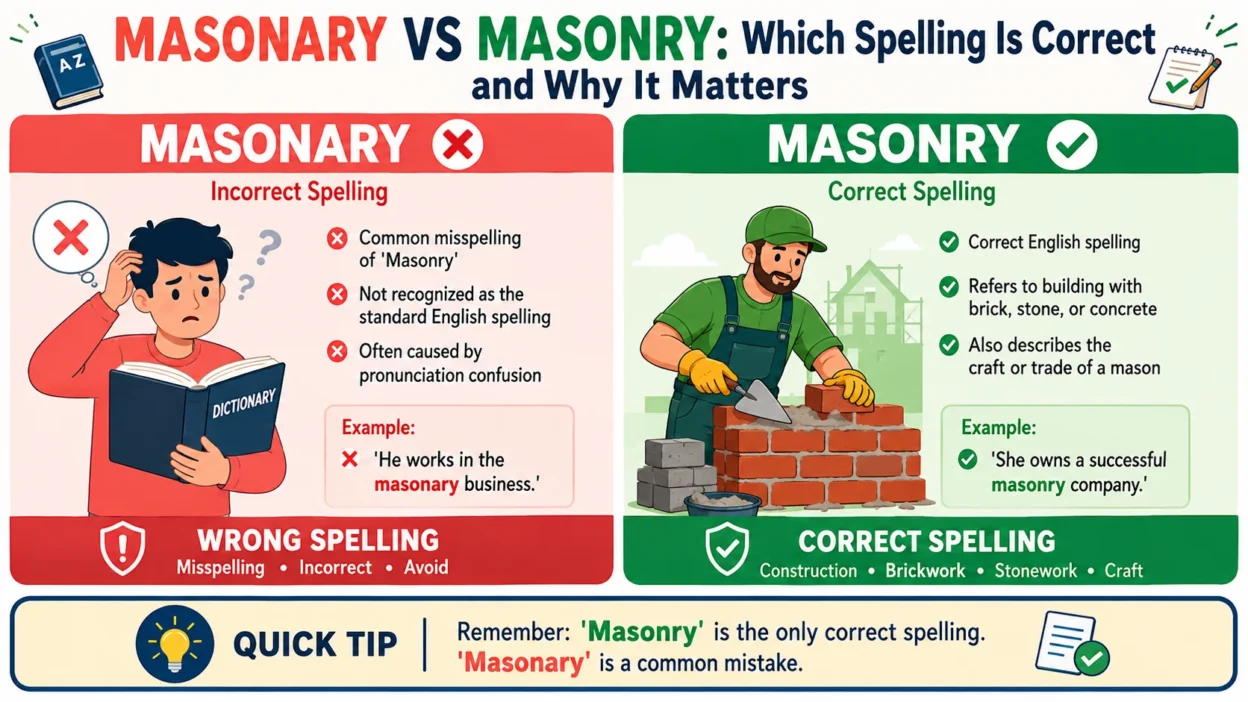
Understanding Masonary vs Masonry helps writers identify the correct spelling of a construction term and avoid mistakes in professional documents. The word masonry refers to the process of building structures with brick, stone, concrete, and other materials joined with mortar. In my experience reviewing writing, many students, writers, and professionals confuse these two similar-looking words because of typing habits and pronunciation. However, masonary is a common misspelling, while masonry is the correct standard English form used in the construction industry.
The correct use of masonry is important in academic writing, professional documents, websites, blogs, and other forms of communication where accuracy matters. Architects, builders, contractors, and stone masons use this term to describe a skilled craft and trade involving brickwork, stonework, and building structures. Checking dictionaries, grammar references, and reliable sources helps confirm the definition, origin, and proper usage of the word. Using the right spelling improves credibility, professionalism, and reader understanding.
The confusion between masonary and masonry can also affect search engine optimisation, digital content, and online visibility. Whether creating a construction report, fixing a blog layout, or working with coding, HTML structure, CSS layout, Jekyll, or Liquid syntax, correct terminology creates clearer results. Learning useful grammar tips, reviewing real examples, and improving vocabulary helps prevent an English mistake and allows readers to use the term confidently in different contexts.
Masonary vs Masonry — Which One Is Correct?
Here’s the clear answer:
- Masonry ✅ (Correct)
- Masonary ❌ (Incorrect)
There’s no regional difference. No alternate spelling. No hidden exception.
Quick Comparison Table
| Word | Correct? | Meaning |
| Masonry | ✅ Yes | Construction using brick or stone |
| Masonary | ❌ No | Misspelling |
If you remember one thing from this entire guide, remember this:
“Masonry” is always correct. “Masonary” is always a mistake.
What Does “Masonry” Mean?
Before going deeper into spelling, it helps to understand the word itself.
Simple Definition
Masonry is the process of building structures using materials like brick, stone, or concrete blocks.
Technical Definition
In construction, masonry refers to a structural system where individual units are laid and bonded together with mortar to form walls and other elements.
Real-Life Examples
- Brick walls in homes
- Stone pathways in gardens
- Concrete block buildings
- Decorative fireplaces
You see masonry every day—even if you don’t always notice it.
Why People Confuse Masonary vs Masonry
This mistake isn’t random. It follows predictable patterns.
Pronunciation Confusion
Say “masonry” out loud. It often sounds like:
“may-sun-air-ee”
That extra “a” sound sneaks in and tricks your brain into spelling it masonary.
Influence of Similar Words
English loves patterns. Words like:
- customary
- stationary
- dictionary
…all end in -ary. So your brain tries to match that structure.
But masonry doesn’t follow that pattern.
Typing Speed and Habit
Fast typing causes errors. Once you type masonary a few times, your brain starts treating it as normal.
Autocorrect doesn’t always save you either.
The Origin of “Masonry” (Why the Spelling Makes Sense)
Sometimes the best way to remember a word is to understand where it came from.
Etymology Breakdown
- Old French: maçonnerie (stonework)
- Latin: maceria (wall or structure)
Notice something? There’s no extra “a” sound in the root structure.
That’s why masonry keeps its spelling clean and consistent.
How the Meaning Evolved
Originally, masonry meant stone construction only.
Over time, it expanded to include:
- Brickwork
- Concrete blocks
- Structural systems
Today, it’s both a craft and an engineering discipline.
How to Use “Masonry” Correctly in Sentences
Knowing the spelling is one thing. Using it naturally is another.
Everyday Examples
- The house features elegant masonry on the exterior.
- He learned basic masonry from his uncle.
- That fireplace uses traditional stone masonry.
Professional Examples
- The building relies on reinforced masonry walls.
- Skilled masonry contractors completed the project.
- The design integrates modern masonry systems.
Real Estate Examples
- “Premium masonry finishes included.”
- “Solid brick masonry construction ensures durability.”
Common Mistakes Related to Masonary vs Masonry
Even people who know the correct spelling still make usage mistakes.
Incorrect Variations
Avoid these:
- masonary
- masonery
- masonary work
Plural Form Confusion
Masonry is uncountable.
That means:
- ❌ masonries
- ✅ types of masonry
- ✅ masonry work
Possessive Form
Rare but correct:
- The masonry’s strength impressed engineers.
Masonry in Construction and Architecture
Masonry isn’t just a word—it’s a major part of construction.
Main Types of Masonry
- Brick Masonry – Common and cost-effective
- Stone Masonry – Strong and visually appealing
- Concrete Masonry – Durable and modern
- Veneer Masonry – Decorative outer layer
Materials Used in Masonry
| Material | Purpose |
| Brick | Structural walls |
| Stone | Strength and aesthetics |
| Concrete Block | Cost-effective construction |
| Mortar | Binds everything together |
Advantages of Masonry Construction
Why has masonry been used for thousands of years? Because it works.
Key Benefits
- Durability – Can last over 100 years
- Fire Resistance – Non-combustible
- Energy Efficiency – Regulates indoor temperature
- Soundproofing – Reduces outside noise
- Low Maintenance – Minimal upkeep needed
Interesting Fact
Many ancient masonry structures have survived for over 1,000 years.
Disadvantages of Masonry Construction
Every method has trade-offs.
Limitations
- Higher labor costs
- Heavy materials
- Slower construction speed
- Difficult to modify later
Masonry vs Bricklaying — What’s the Difference?
This is another common confusion.
Simple Explanation
- Masonry = broad field
- Bricklaying = one specific skill
Comparison Table
| Aspect | Masonry | Bricklaying |
| Scope | Wide | Narrow |
| Materials | Brick, stone, concrete | Only bricks |
| Skills | Multiple techniques | Specialized |
Masonry Tools You Should Know
Masonry requires precision—and the right tools.
Essential Tools
- Trowel
- Level
- Mason’s hammer
- Chisel
- Mortar mixer
Why Masonary vs Masonry Matters in Real Life
This isn’t just grammar—it’s perception.
Business Credibility
Imagine two websites:
- “Expert Masonry Services”
- “Expert Masonary Services”
One looks professional. The other looks careless.
SEO Impact
Search engines prioritize correct spelling. Using masonary can:
- Hurt rankings
- Reduce traffic
- Lower visibility
Client Trust
People judge quickly. A spelling mistake suggests:
- Lack of detail
- Poor quality
- Inexperience
Case Study: One Letter That Costs Business
A single letter can sometimes change the meaning of a word and create confusion in professional communication. In business, small spelling differences may lead to misunderstandings, incorrect documents, or a loss of credibility. This case study shows how paying attention to one missing or extra letter can protect a company’s reputation and prevent costly mistakes.
Contractor A (Correct Spelling)
- Uses “masonry” everywhere
- Clean, professional branding
Result: Higher trust and more leads
Contractor B (Incorrect Spelling)
- Uses “masonary” on website
- Multiple spelling errors
Result: Lower credibility and fewer inquiries
“People trust what looks polished—even before they read deeply.”
Masonry in Modern Design
Masonry isn’t outdated. It’s evolving.
Popular Uses Today
- Feature walls
- Outdoor kitchens
- Decorative facades
- Landscaping structures
Why Designers Still Choose It
- Strong and long-lasting
- Natural, premium look
- Works in modern and traditional designs
Structural Importance of Masonry
Masonry plays a key role in safety.
Load-Bearing Masonry
Supports the building’s weight.
Reinforced Masonry
Uses steel reinforcement for extra strength.
Why It Matters
Proper masonry ensures:
- Stability
- Safety
- Longevity
Famous Masonry Structures Around the World
Masonry has shaped history.
Examples
- Great Wall of China
- Colosseum
- Taj Mahal
These structures prove one thing:
Masonry stands the test of time.
Memory Tricks to Avoid “Masonary”
Keep it simple.
- Think: Mason + ry
- Avoid adding an extra “a”
- Compare with “carpentry”
Is “Masonary” Ever Correct?
No.
It’s always a mistake in standard English.
British vs American English
No difference here.
Both use:
- Masonry ✅
Why “Masonary” Still Appears Online
Even incorrect words spread.
Reasons
- Typing mistakes
- Poor editing
- Copy-paste content
- Lack of proofreading
Conclusion
The difference between masonary and masonry is simple but important. Masonry is the correct spelling used in standard English to describe the construction of structures with brick, stone, concrete, and mortar. Although masonary may appear frequently because of typing habits and pronunciation confusion, it is still an incorrect form. Using the right word in academic writing, professional communication, and online content helps maintain accuracy, credibility, and professionalism. Learning this small spelling difference can improve your overall writing skills and prevent common language mistakes.
FAQs
Q1. Is masonary a correct spelling?
No, masonary is not considered a correct spelling in standard English. It is a common misspelling of masonry, which is the correct term used in construction and related fields.
Q2. What does masonry mean?
Masonry refers to the process or craft of building structures using materials such as brick, stone, concrete, and other units connected with mortar. It can include walls, columns, arches, and decorative features.
Q3. Why do people confuse masonary and masonry?
People often confuse these words because they look similar, sound almost the same, and the extra “a” in masonary feels natural when typing. Pronunciation habits and spelling patterns can lead to this mistake.
Q4. How can I remember the correct spelling of masonry?
A simple way to remember is that masonry is related to a mason, the person who works with bricks and stones. The correct spelling keeps the ending as “-yr”, not “-nary”.
Q5. Where should I use the word masonry?
You should use masonry in construction reports, academic documents, professional writing, websites, blogs, and any context where you describe building work involving brick, stone, concrete, or similar construction materials.