If So vs. If Yes can seem confusing at first, but learning the difference helps you write and speak more naturally every day with confidence. When you start learning the English language, many phrases look almost identical, yet they do not always have the same meaning. If so and if yes are a perfect example. At first glance, they appear interchangeable, but native speakers use them differently in daily writing, speech, speaking, reading, and writing. As I kept practising and improving my language skills, I realised that this small distinction made my communication much clearer. This guide explains the difference through comparison, examples, real examples, real sentences, and simple theory, making language learning easier. It also helps you develop stronger writing skills, speaking skills, and communication skills by showing the correct usage, proper usage, context, and reference for every conditional expression.
Both expressions are conditional phrases and part of conditional grammar in English grammar. If yes usually follows a direct yes-or-no question that expects a clear yes or no, while if so refers back to an earlier idea, question, questions, answer, answers, or response without repeating everything. This flexible phrase offers more flexibility, while if yes has a more limited purpose. Understanding the difference, differences, contrast, and comparison improves effective communication, supports communication improvement, and strengthens professional communication. It also reduces confusion, prevents misunderstandings, and encourages confusion avoidance. Good grammar tips, grammar rules, a usage guide, an explanation guide, and practical communication tips make it much easier to navigate these language nuances with confidence.
I used to think the two expressions meant exactly the same thing, but looking back, I remember how awkward, unnatural, and clunky some sentences felt before I understood the full explanation. Over time, mastering language meant I had to continue working, sharpen my understanding, and express my ideas clearly through clear messages, persuasive messages, and authentic communication. Whether you are creating professional writing, formal writing, casual speaking, or daily writing, this article helps shed light on the topic. It encourages you to improve your habits, make better choices, craft authentic writing, persuasive writing, and meaningful messages that resonate with your audience while increasing audience engagement. Picture a formal suit at a beach picnic—it is not wrong, but it feels out of place. Choosing the right expression works the same way. With English, language, mastering, developing, continuing, skills, knowledge, equipped, working, an essential voice, a balanced approach, and avoiding getting lost, you will naturally want to keep learning. Helped by plain English and real examples, every line becomes easier to follow, regardless of whether you see 2 or two in an example.
If So vs. If Yes at a Glance
Before going deep, here’s the short version.
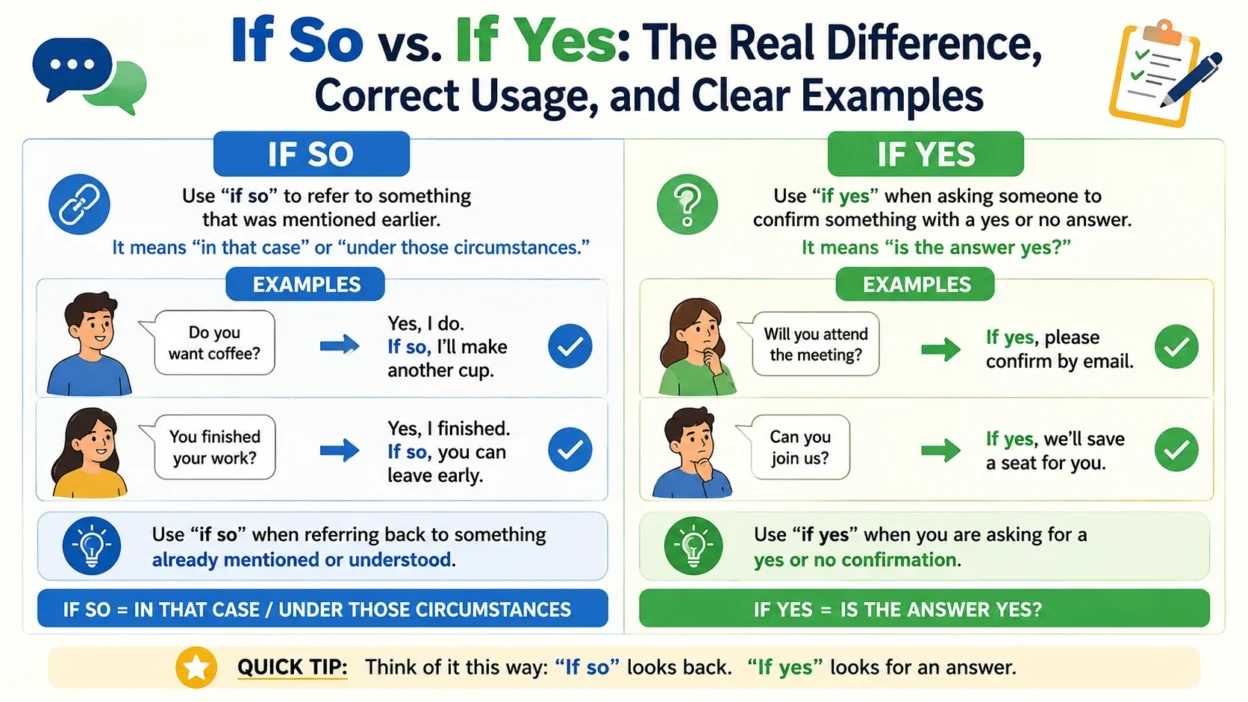
If so means “if that is true” or “if that is the case.” It refers back to something already mentioned.
If yes means “if the answer is yes.” It often appears in forms, instructions, surveys, or decision-based questions.
Here is the simplest way to remember it:
- If so = refers to a statement
- If yes = refers to an answer
That one split explains most of the confusion.
| Phrase | Meaning | Refers To | Common Use | Natural in Everyday English? |
| If so | If that is true / if that is the case | A previous statement | Conversation, email, writing, explanations | Yes |
| If yes | If the answer is yes | A yes-or-no response | Forms, checklists, instructions, surveys | Sometimes |
| If so | More fluid and idiomatic | Information already given | Most general contexts | Yes |
| If yes | More direct and procedural | A direct yes answer | Organized decision steps | Yes in the right context |
What Does “If So” Mean?
If so is one of the most useful linking phrases in English. It works as a short replacement for a longer idea.
Instead of repeating the full statement, English often trims it down. That makes the sentence tighter and easier to read.
For example:
- “The store closes at 6 p.m. If so, we should leave now.”
- “You said the report is ready. If so, send it to me.”
- “If the weather gets worse, the match may be canceled. If so, we’ll stay home.”
In each case, if so refers back to something already said. It does not ask a new question. It does not answer “yes” by itself. It connects the second part of the thought to the first.
A good mental shortcut is this:
If so = “if that statement is true”
That is the heart of it.
How “If So” Refers Back to a Previous Statement
This is where many learners get tripped up. If so does not stand alone. It needs a previous idea to point back to.
Compare these examples:
- “The tickets are still available. If so, I’ll buy two.”
- “She might arrive early. If so, we can start the meeting sooner.”
- “The machine is out of order. If so, call maintenance.”
In each sentence, the second clause depends on the first one. Without the first statement, if so has nothing to attach to.
That is part of what makes it sound so natural. Native speakers use it as a bridge. It keeps the flow smooth and avoids repetition.
Common Sentence Patterns with “If So”
You’ll often see if so in a few regular patterns.
Pattern one: Statement + if so + result
- “The printer is working now. If so, please make three copies.”
Pattern two: Question or condition + if so + action
- “Are you free tomorrow? If so, let’s meet for lunch.”
Pattern three: Possibility + if so + next step
- “The delivery may arrive today. If so, someone should be home.”
This phrase often shows up in writing because it helps keep sentences tight. It’s efficient. It sounds polished. And unlike many grammar rules that feel like they came from a dusty textbook, this one reflects how people actually speak.
Situations Where Native Speakers Prefer “If So”
Native speakers reach for if so in situations like these:
- Explaining consequences
- Following up on a previous sentence
- Writing professional emails
- Giving instructions
- Making a conditional point
- Summarizing a situation without repeating it
Here’s a simple example in a business email:
“Please let me know whether the draft has been approved. If so, we can move to the next stage.”
That sounds natural. Clear. Professional. No extra words needed.
What Does “If Yes” Mean?
If yes sounds similar on the surface. Still, it works differently.
This phrase usually means “if the answer is yes.” It points directly to a yes-or-no answer. Because of that, it often appears in forms, surveys, instructions, and step-by-step processes.
Examples:
- “If yes, tick the box below.”
- “If yes, please provide your contact information.”
- “If yes, continue to the next page.”
- “If yes, explain your answer in the space provided.”
That kind of phrasing is common in procedural writing. It helps organize information neatly.
How “If Yes” Introduces a Direct Answer
Unlike if so, which refers to a statement, if yes is tied to a direct response.
Think of it this way:
- Someone asks a question.
- The answer may be yes.
- The next instruction follows from that yes.
Example:
“Do you have any allergies? If yes, list them below.”
Here, if yes means “if your answer to that question is yes.” It is practical and direct.
That said, it can sound a little mechanical in everyday conversation. A native speaker would often prefer:
- “If so, list them below.”
- “If you do, list them below.”
- “If that’s the case, list them below.”
The exact best choice depends on the context.
Common Situations Where “If Yes” Is Appropriate
You’ll most often see if yes in:
- Application forms
- Medical questionnaires
- Surveys
- Online checkouts
- Instructional documents
- Process charts
- Decision trees
In these settings, the phrase works well because it clearly signals the next step after a yes answer.
Here are a few examples:
- “Have you traveled outside the country in the last 14 days? If yes, provide details.”
- “Do you own a vehicle? If yes, enter the registration number.”
- “Would you like to receive updates? If yes, check the box.”
That is clean procedural language. It fits the purpose.
The Core Difference Between “If So” and “If Yes”
Now for the main point.
The difference is not just style. It is logical.
If so refers to a statement or condition already mentioned.
If yes refers to a yes answer to a question.
That is the real split.
Statement vs. Response
Let’s compare them side by side:
- “The office is closed today. If so, we’ll work from home.”
- “Is the office closed today? If yes, we’ll work from home.”
Both can make sense in a broad way. Still, they do not do the same job.
The first sentence uses a statement and then reacts to it.
The second sentence is more like a question followed by an instruction. That makes it feel more like a checklist or form.
Grammar Difference Explained Simply
Here is the easiest way to think about it:
- If so = if that is true
- If yes = if the answer is yes
The word so stands in for a previously mentioned idea. It refers back. It replaces a chunk of text you do not want to repeat.
The word yes stands in for the answer itself. It does not refer to a previous statement in the same flexible way.
That is why if so appears more often in natural conversation. It sounds smooth and idiomatic.
Why Confusing Them Changes the Meaning
When you swap them carelessly, the sentence may still be understandable. Still, it can sound off.
For example:
- “If yes, we should leave now.”
This can work if the sentence refers to a clear yes-or-no answer.
But in many cases, a native speaker would say:
- “If so, we should leave now.”
That sounds more natural because it refers to a situation rather than a direct answer.
A small word can change the shape of the whole sentence. English is like that. Tiny pieces carry a lot of weight.
Side-by-Side Comparison Table
Here is a clearer breakdown.
| Feature | If So | If Yes |
| Basic meaning | If that is true | If the answer is yes |
| Refers to | A previous statement | A yes-or-no answer |
| Tone | Natural and idiomatic | Direct and procedural |
| Common in speech | Very common | Less common |
| Common in forms or checklists | Sometimes | Very common |
| Best use | Follow-up to a statement | Follow-up to a yes answer |
| Example | “If so, let me know.” | “If yes, check the box.” |
| Sounds natural in emails? | Yes | Yes, in the right context |
| Sounds natural in everyday talk? | Yes | Sometimes, but less often |
A Quick Case Study in Real English
Imagine two versions of the same message.
Version one:
“The package may arrive today. If so, please sign for it.”
Version two:
“Will the package arrive today? If yes, please sign for it.”
The first version sounds smoother because it ties the second sentence to a statement. The second version feels more like a form or instruction sheet.
That difference matters if you care about tone. In a customer email or workplace message, if so usually sounds more polished.
A Small Quote to Keep in Mind
Linguists often point out that English prefers economy when the meaning stays clear. In plain terms, that means English likes to avoid repeating itself.
That is one reason if so works so well. It saves words without losing meaning.
The Core Rule to Remember
If you remember only one thing from this section, keep this:
Use “if so” after a statement. Use “if yes” after a direct yes-or-no question or in a form-like instruction.
That rule will get you through most situations.
First Takeaways on “If So” vs. “If Yes”
Here’s the practical summary so far:
- If so is the more natural choice in general writing and speech.
- If yes belongs more often in structured or procedural writing.
- If so refers back to an earlier idea.
- If yes refers to the answer “yes.”
- The phrases are not truly interchangeable in every context.
In the next section, the usage gets even clearer through real examples, tone differences, and common mistakes. That is where the distinction really starts to click.
Natural Examples So Far
A few clean examples help lock it in:
- “The meeting is delayed. If so, I’ll join later.”
- “Did the client approve the design? If yes, send the final version.”
- “If so, we can move ahead.”
- “If yes, please complete the form below.”
Each one has a different feel. That is the point. Grammar is not just about correctness. It is also about choosing the version that sounds right in the room.
Mini Reference Guide
Use this fast rule when you pause mid-sentence:
- If so: the sentence before it gives the condition
- If yes: the question before it gives the answer
That’s the cleanest way to separate them.
Common Mistake to Avoid
A very common mistake is using if yes where if so would sound more natural.
For example:
- “The new schedule is confirmed. If yes, we should notify the team.”
This sentence is understandable. Still, if so sounds better:
- “The new schedule is confirmed. If so, we should notify the team.”
The second version feels smoother because it follows the statement instead of forcing a yes-based structure that does not really fit.
Where This Matters Most
This distinction matters most in:
- Email writing
- Academic writing
- Business communication
- Instructions
- Customer service language
- Formal messages
In casual chat, people sometimes mix the two and still get by. In polished writing, the difference becomes much more important.
Conclusion
Understanding the difference between if so and if yes makes your English sound more natural and accurate. While both expressions introduce a condition, they are not always interchangeable. If yes works best after a direct yes-or-no question, whereas if so refers back to a previous statement, idea, or situation without repeating it. Once you know where each phrase fits, you can avoid awkward wording and communicate more clearly. With regular practice and exposure to real English, choosing between if so and if yes will soon become second nature.
FAQs
Q1.Is “if so” the same as “if yes”?
No. Although they are related, they are not always interchangeable. If yes follows a question that expects a yes or no answer, while if so refers to a previously mentioned condition or statement.
Q2.When should I use “if yes”?
Use if yes after a direct yes-or-no question. For example: Do you have a passport? If yes, please bring it with you.
Q3.When should I use “if so”?
Use if so when referring back to an earlier idea, condition, or statement without repeating it. For example: Are you interested in the course? If so, register before Friday.
Q4.Is “if so” more common in everyday English?
Yes. If so is generally more common in both spoken and written English because it can refer to many different situations, not just direct yes-or-no questions.
Q5.How can I remember the difference between “if so” and “if yes”?
A simple tip is to remember that if yes needs a direct yes-or-no question, while if so points back to an earlier statement, condition, or idea. If the sentence works without repeating the earlier information, if so is usually the better choice.