When All Is Said and Done helps people see the final result after every discussion, making conversation clearer and more useful every day. This English idiom is a flexible phrase that people often use to wrap up a thought, settle a debate, and focus on what truly matters. After the noise fades away, it becomes easier to step back from the details and see the real outcome. I have found it especially helpful in everyday speech, business communication, public speaking, and polished writing, where a clear signal at the ending keeps everyone on the same page. This guide breaks down what the expression means, where it came from, how to avoid common mistakes, and how it compares with similar expressions through practical examples, a comparison table, short case studies, and real action.
The English language is full of expressions, but this one fits naturally into spoken English, written English, and real-life usage. In the right context, it improves communication, speech, and wording, making your language sound more confident and natural. Through analysis, comparison, and explanation, you can understand its usage in business, public, and everyday situations. Looking at practical examples, table references, and studies also shows why its semantic meaning and contextually relevant use matter. As conversations, phrases, meetings, casual chats, or even a cup of coffee lead to deeper understanding, they help connect ideas, improve the way we talk, and reach agreement more easily.
From my experience, this expression encourages better reasoning, reflection, and judgement before making a decision. It reminds everyone to review the facts, points, what was discussed, considered, and dealt with after everything has happened. Ultimately, finally, and regardless of different opinions, the conclusion, final outcome, result, results, conclusions, or resolution should reflect what is important, essential, and deserves the highest priority. That is why it remains a favourite almost everywhere. Whether someone wants to mean something clearly, emphasise significance, improve interpretation, add perspective, or highlight importance and relevance, this idiom keeps the topic clear. It brings ideas down to earth, reaches a simple level, holds attention, supports signals and summing, and even connects with NIP, entities, keywords, contextually, and semantically while reminding us that the most crucial thing is often keeping everyone safe and protecting safety.
What “When All Is Said and Done” Means
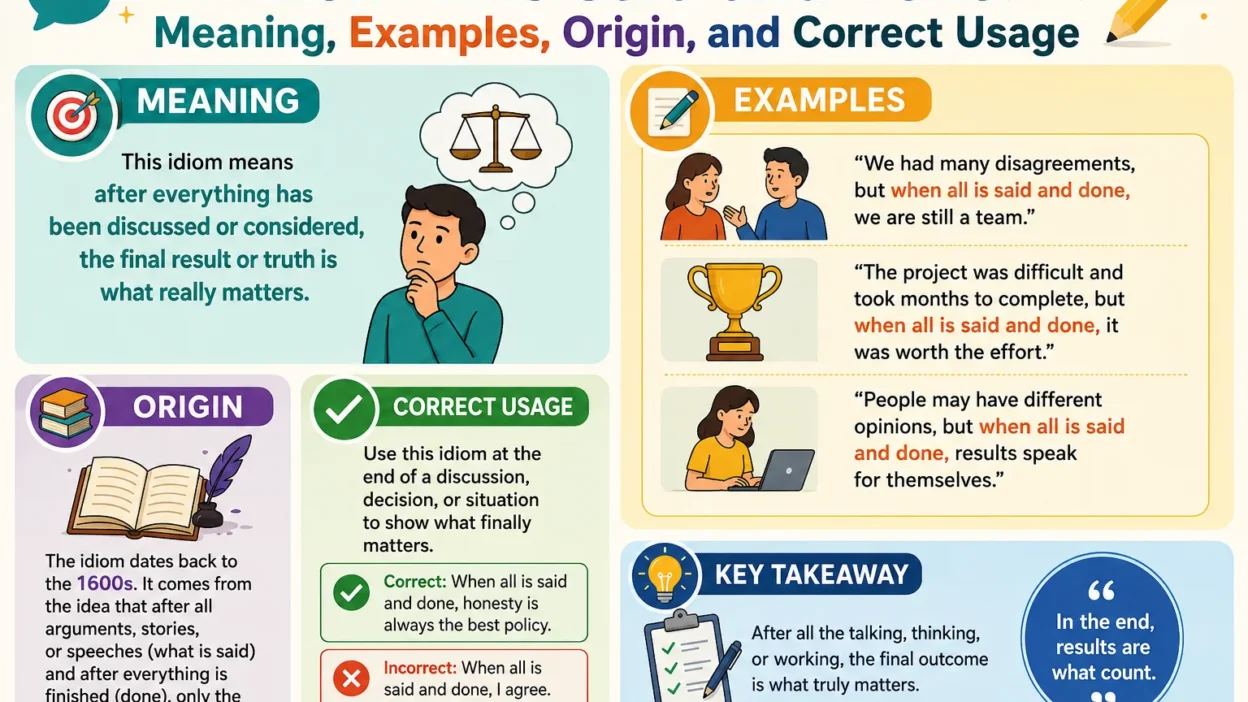
“When all is said and done” is an English idiom that means after everything has been discussed, considered, or completed, the final outcome is what truly matters. People use this expression to highlight the conclusion of a situation instead of focusing on every detail or opinion shared along the way. It encourages you to look at the bigger picture and judge a situation based on its final result. Whether you’re talking about work, relationships, business, or everyday life, this phrase reminds you that the outcome often matters more than the conversation that came before it.
Simple meaning in plain English
“When all is said and done” means after everything has been considered, discussed, or completed. It points to the final truth, final result, or final judgment once all the facts are on the table.
It often carries one of these ideas:
- the final outcome matters most
- the details are important, but the result is the real test
- after all the talking, one thing remains clear
- once the dust settles, the main point becomes obvious
Think of it like this: a long argument may fill the room with noise, but this idiom acts like the switch that turns the noise off. It brings you to the bottom line.
The deeper sense behind the phrase
The phrase does not just mean “finally.” It suggests a process. First comes the discussion. Then comes the action. Then comes the result. Only after all of that can you reach a fair conclusion.
That makes the idiom powerful in both speech and writing. It tells the listener, “Let’s not get lost in the weeds. Let’s look at the big picture.”
Here is the core idea in one sentence:
When all is said and done, the final result tells the real story.
Why it is not the same as “finally”
People sometimes treat this phrase like a fancy replacement for “finally.” That is too narrow.
Compare the two:
- Finally usually means something happens at the end of a sequence.
- When all is said and done means the final outcome matters more than the earlier discussion.
Example:
- Finally, we reached the summit.
- When all is said and done, reaching the summit mattered less than staying safe.
The first sentence marks the end of an event. The second makes a judgment about the event’s meaning.
Where the Idiom Comes From
The exact origin of “when all is said and done” is difficult to identify because it developed naturally through everyday English usage over time. The phrase reflects an old idea that after discussions, actions, and decisions are complete, the final outcome reveals what truly matters. Its simple structure and universal message helped it remain popular for generations. Today, it continues to be used in conversations, writing, and professional communication around the world.
Tracing the expression’s rise
The exact first moment this idiom entered English is hard to pin down with certainty, which is common for old idioms. Expressions like this often grow slowly in spoken language before they show up clearly in writing.
What matters more than a single birth date is the structure of the phrase itself. It reflects an old and very human pattern: talk first, conclude later. That pattern never goes out of style.
The phrase has lasted because it feels balanced and complete. It carries rhythm. It also sounds calm and authoritative, which makes it useful when you want to sound measured rather than emotional.
Why it stayed popular
The idiom has stayed alive for a few simple reasons:
- It is easy to understand once you hear it in context.
- It works in formal and informal settings.
- It helps people summarize complex situations.
- It sounds natural in both speech and writing.
Many idioms fade because they feel awkward or too old-fashioned. This one survived because it still solves a real language problem. People need a clean way to say, “After everything, here is the real point.”
When to Use “When All Is Said and Done”
Use “when all is said and done” when you want to summarize a situation, draw a final conclusion, or emphasize the outcome after everything has been discussed or completed. This idiom fits naturally in everyday conversations, business communication, presentations, and written content where you want to focus on what truly matters in the end. Instead of dwelling on every detail, it helps direct attention to the big picture and the final result. Using this phrase appropriately makes your message sound clear, thoughtful, and more persuasive.
Everyday conversation
In daily speech, the idiom often appears when someone wants to wrap up an opinion or point out the most important fact.
Examples:
- When all is said and done, I think we chose the better restaurant.
- When all is said and done, the trip was worth the stress.
- When all is said and done, good friends matter more than perfect plans.
In conversation, it sounds warm and relatable. It helps you sound thoughtful without sounding stiff.
Workplace, business, academic, and formal writing
This idiom also works well in professional settings, especially when you need a concluding line that feels polished but not overly dramatic.
Examples:
- When all is said and done, the project succeeded because the team stayed flexible.
- When all is said and done, customer trust is more valuable than short-term profit.
- When all is said and done, the evidence supports the original conclusion.
It fits well in reports, presentations, and executive summaries because it signals a final judgment. It also helps you sound clear and confident.
Public speaking
Speakers often use this phrase near the end of a talk to land the final message. It gives the audience a sense of closure.
Example:
- When all is said and done, leadership is less about control and more about responsibility.
That kind of line sticks because it compresses a bigger message into a clean takeaway.
Formality guide
| Context | Works well? | Tone |
| Casual conversation | Yes | Natural, friendly |
| Workplace discussion | Yes | Professional, clear |
| Business presentation | Yes | Polished, persuasive |
| Academic writing | Sometimes | Acceptable in lower-formality prose |
| Legal writing | Sometimes | Use carefully |
| Creative writing | Yes | Flexible, expressive |
The phrase is broad enough for many situations, but you should still match the tone to the audience. In a legal brief or technical paper, a plainer phrase may sometimes work better.
Examples of “When All Is Said and Done” in Sentences
Use “when all is said and done” when you want to summarize a situation, draw a final conclusion, or emphasize the outcome after everything has been discussed or completed. This idiom fits naturally in everyday conversations, business communication, presentations, and written content where you want to focus on what truly matters in the end. Instead of dwelling on every detail, it helps direct attention to the big picture and the final result. Using this phrase appropriately makes your message sound clear, thoughtful, and more persuasive.
Everyday life examples
- When all is said and done, I’m glad I stayed home and rested.
- When all is said and done, a simple meal can be more satisfying than a fancy one.
- When all is said and done, you remember how someone made you feel.
These examples show the phrase in a personal, reflective way.
Business examples
- When all is said and done, the best product is the one people actually use.
- When all is said and done, the company needs cash flow more than headlines.
- When all is said and done, speed matters, but accuracy wins the trust of the client.
In business, the idiom often points to performance, value, or results.
School and education examples
- When all is said and done, consistent study beats last-minute cramming.
- When all is said and done, the strongest essays are the ones with clear structure.
- When all is said and done, learning the process matters more than memorizing answers.
This use is common in advice, essays, and classroom discussion.
Family and relationship examples
- When all is said and done, kindness keeps a family strong.
- When all is said and done, a good apology can heal a lot.
- When all is said and done, trust matters more than winning an argument.
This is one reason the idiom feels human. It speaks to values, not just facts.
Media and opinion examples
- When all is said and done, the movie succeeds because of its story.
- When all is said and done, the team lost because of missed chances, not bad luck.
- When all is said and done, the report shows a clear shift in public opinion.
Writers and commentators use this phrase to close an analysis with authority.
A Close Look at Sentence Structure
The idiom “when all is said and done” is highly flexible and can appear at the beginning, middle, or end of a sentence, depending on the emphasis you want to create. Most writers place it at the beginning of a sentence because it introduces a clear conclusion and prepares the reader for the main point. Regardless of its position, the phrase should always lead to or reinforce a final judgment, key takeaway, or overall outcome. Using it in the right place makes your writing sound natural, polished, and easy to follow.
Where the phrase usually sits in a sentence
The idiom can appear at the beginning, middle, or end of a sentence.
| Placement | Example | Effect |
| Beginning | When all is said and done, the decision was correct. | Strong opening, clear conclusion |
| Middle | The decision was correct, when all is said and done, because it saved time. | Softer, more reflective |
| End | The decision was correct, when all is said and done. | Emphatic ending |
Most of the time, the phrase works best at the beginning because it sets up the conclusion right away.
What follows the idiom
The clause that comes after the idiom usually gives the final judgment.
Examples:
- When all is said and done, the real issue is trust.
- When all is said and done, effort matters more than excuses.
- When all is said and done, the simplest answer is often the right one.
This structure makes the sentence feel complete and balanced.
Similar Expressions and Synonyms
Several English expressions have a meaning similar to “when all is said and done,” although each carries a slightly different tone and purpose. Common alternatives include “at the end of the day,” “in the end,” “ultimately,” “all things considered,” and “once the dust settles.” While these phrases all point to a final conclusion or outcome, “when all is said and done” places greater emphasis on reaching a judgment after everything has been discussed, considered, or completed. Choosing the right synonym depends on the context, audience, and level of formality you want to convey.
Other phrases that overlap in meaning
English has several expressions that can sometimes replace “when all is said and done.” Each one has a slightly different feel.
| Phrase | Meaning | Best use | Tone |
| When all is said and done | Final outcome after everything | General conclusion | Neutral, thoughtful |
| At the end of the day | Bottom line or final opinion | Casual conversation | Informal |
| In the end | Final result | General use | Neutral |
| Ultimately | Final judgment or result | Formal or analytical writing | Formal |
| All things considered | After weighing all factors | Balanced conclusion | Formal |
| After everything | Following all events | Reflective speech | Casual to neutral |
| Once the dust settles | After a difficult period ends | Conflict or change | Figurative |
How the phrases differ in real use
“At the end of the day” is more conversational and a little more informal.
“Ultimately” sounds more formal and often appears in essays or reports.
“In the end” is simpler and more direct.
“When all is said and done” sits in a comfortable middle ground. It sounds polished without sounding too distant.
Best choices by situation
- Use “when all is said and done” for thoughtful summaries.
- Use “at the end of the day” for casual talk.
- Use “ultimately” for formal analysis.
- Use “in the end” for simple, clear conclusions.
Common Mistakes and Misconceptions
Many people misunderstand “when all is said and done” by using it as a simple replacement for “finally” or placing it in situations where no conclusion has been reached. The phrase should be used to highlight a final result, judgment, or lesson after everything has been considered. Avoiding overuse and understanding its true meaning helps your writing sound more natural, accurate, and effective.
Using it too early
One mistake is using the phrase before the discussion is actually complete.
Weak example:
- When all is said and done, we still need to gather the data.
That works only if you are clearly transitioning to a conclusion. Otherwise, it can feel premature.
Better example:
- We discussed the options, the risks, and the cost. When all is said and done, the data still points in one direction.
The idiom works best after the groundwork is laid.
Overusing it
Because it sounds smooth, people sometimes lean on it too often. That can make writing feel repetitive.
Instead of repeating it in every paragraph, mix it with:
- ultimately
- in the end
- all things considered
- after everything
Variety keeps the writing fresh.
Confusing it with a simple time marker
This phrase is not just a way to say “later.” It does more than mark time. It marks a conclusion.
Compare:
- Later, we’ll meet for lunch.
- When all is said and done, the lunch choice probably won’t matter much.
The first sentence talks about time. The second talks about significance.
Using it where precision matters more than style
In some technical, legal, or scientific contexts, a plainer phrase may work better. The idiom is clear, but it can still feel a little literary.
For example, in a research report, “the final result” may be cleaner than “when all is said and done.” Style should never get in the way of clarity.
How to Use It Naturally
Use “when all is said and done” in situations where you want to summarize a discussion, highlight the final result, or focus on the most important point. This phrase sounds most natural when it introduces a concluding idea instead of interrupting a conversation or explanation. Whether you’re speaking with friends, writing a professional message, or creating content, this idiom can make your words feel thoughtful, balanced, and clear. To keep your writing effective, use it when it truly supports your message rather than adding it unnecessarily.
Pair it with a strong conclusion
This idiom works best when it leads into a sentence with substance.
Good examples:
- When all is said and done, honesty builds stronger teams than charm.
- When all is said and done, the customer experience decides whether people return.
These lines sound natural because they end with a clear point.
Keep the language simple around it
The phrase itself already carries weight. You do not need to surround it with heavy wording.
Too formal:
- When all is said and done, the operational synergies will facilitate optimal outcomes.
More natural:
- When all is said and done, teamwork creates better results.
The second version sounds human. The first sounds bloated.
Use it to soften strong claims
This idiom can make a strong opinion feel less harsh.
Example:
- When all is said and done, the plan looks risky.
That is firmer and more balanced than saying, “The plan is bad.” The idiom adds distance and calm.
Match it to your audience
If you are speaking to friends, the phrase will sound easy and familiar. If you are writing for a professional audience, it will sound composed and steady.
That balance is one reason it remains so popular. It adapts.
Case Studies of the Idiom in Real-Life Situations
“When all is said and done” is often used in real-life situations to express a final thought after considering different experiences, choices, or challenges. It helps people focus on the most important result or lesson instead of getting stuck on small details. Whether it involves business decisions, personal experiences, or everyday problems, this idiom highlights the value of looking at the bigger picture and final outcome.
Illustrative case study: a workplace decision
A marketing team spends two weeks debating two campaign ideas. One idea looks flashy. The other looks practical and easier to launch. The team keeps circling the same arguments.
At the end of the meeting, the manager says:
“When all is said and done, the campaign that launches on time is the one that protects the quarter.”
That line shifts the discussion. It does not ignore creativity. It simply reminds everyone that results matter most.
This is a perfect use of the idiom because it brings focus back to the final outcome.
Illustrative case study: a student essay
A student writes an essay about time management. The draft includes many examples, but the conclusion feels weak. The teacher suggests a stronger closing line:
“When all is said and done, discipline matters more than motivation alone.”
That sentence gives the essay a clear ending. It also sounds more mature than a vague summary.
The idiom works here because it creates a neat bridge from discussion to conclusion.
Illustrative case study: a family disagreement
Two siblings argue about which vacation plan was better. One preferred the beach. The other liked the city. After a long back-and-forth, one of them says:
“When all is said and done, we still spent time together, and that was the best part.”
This turns the conversation from competition to reflection. The phrase helps move the focus from preferences to meaning.
A Useful Comparison Table
| Goal | Best phrase | Example |
| Strong final conclusion | When all is said and done | When all is said and done, trust matters most. |
| Casual bottom line | At the end of the day | At the end of the day, we need results. |
| Simple ending statement | In the end | In the end, she chose peace. |
| Formal final judgment | Ultimately | Ultimately, the evidence supports the claim. |
| Balanced summary | All things considered | All things considered, the outcome was fair. |
This table shows something important: no single phrase fits every situation. The best choice depends on tone, audience, and purpose.
Common Collocations and Natural Pairings
The idiom often appears with words that point to judgment, value, and outcome.
Common pairings include:
- When all is said and done, the truth is…
- When all is said and done, the result is…
- When all is said and done, the choice comes down to…
- When all is said and done, the real question is…
- When all is said and done, what matters is…
These pairings work because they keep the sentence focused on the final takeaway.
Conclusion
When All Is Said and Done is a simple but powerful English idiom that helps you highlight the final outcome after every discussion, debate, or series of events. It fits naturally into everyday speech, business communication, public speaking, and writing, making your communication clearer and more effective. Once you understand its meaning, proper usage, and context, you can use this phrase with confidence in both personal and professional situations.
FAQs
Q1. What does “When All Is Said and Done” mean?
When All Is Said and Done means that after everything has been discussed, considered, or completed, the final result or conclusion is what truly matters.
Q2. Is “When All Is Said and Done” an English idiom?
Yes. It is a common English idiom that people use to summarise a discussion and emphasise the final outcome after all arguments, details, facts, or events have been considered.
Q3. Can I use “When All Is Said and Done” in professional writing?
Yes. The phrase works well in business communication, public speaking, and polished writing because it provides a natural way to introduce a summary, explain the result, or present a conclusion.
Q4. What are some expressions similar to “When All Is Said and Done”?
Some similar expressions include “ultimately,” “finally,” “in the end,” “at the end of the day,” and “all things considered.” Each expression focuses on the final outcome, although the meaning, usage, and context may vary.
Q5. When should I avoid using “When All Is Said and Done”?
Avoid using this idiom when a discussion or decision is still in progress. It is most effective after all points have been discussed, considered, and dealt with, allowing you to focus on the final result, resolution, or conclusion.