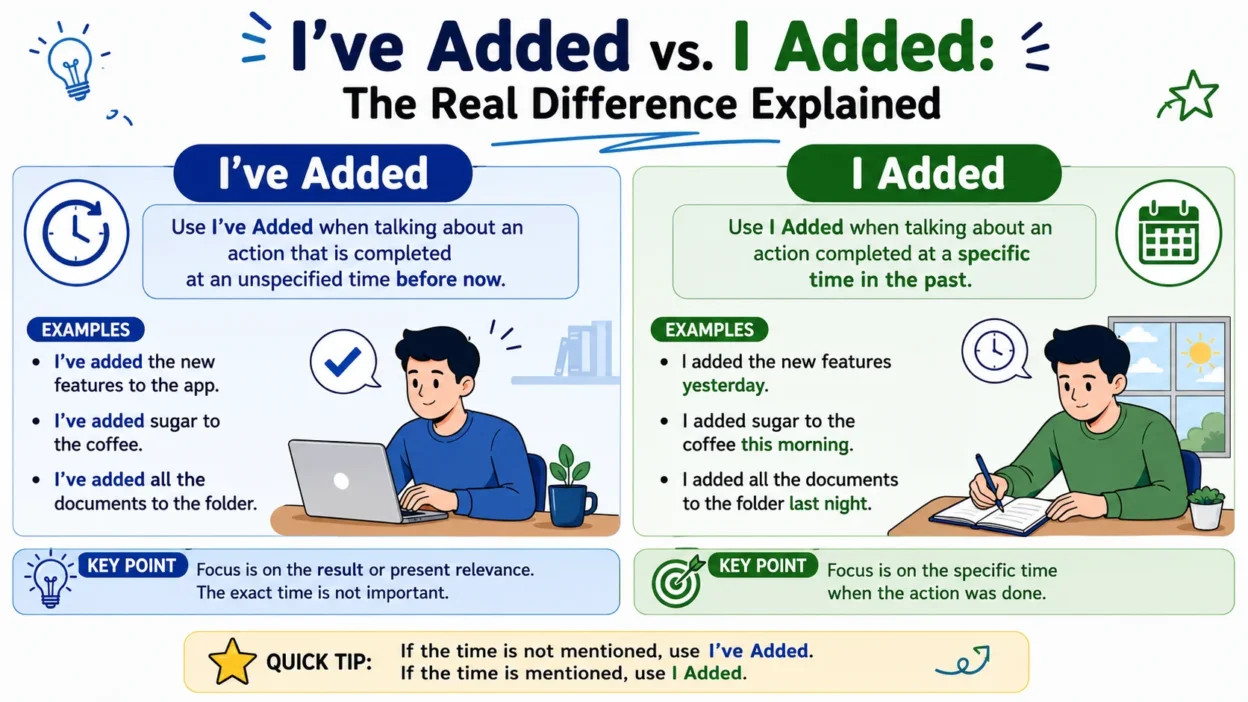
I’ve Added vs. I Added helps learners understand English grammar confusion by showing how two phrases connect past action with present meaning. When I explain English grammar to students, I often see confusion because I’ve Added and I Added look similar but carry different meanings. The key difference comes from present perfect tense and simple past tense. I’ve added links to a past action with the present moment, showing that the result matters now. For example, saying I’ve added your name means the name is now on a list and has a current result. However, I added a description of a completed action in the past connected to a specific time like yesterday.
Understanding these verb forms helps you communicate more naturally in casual situations and professional situations. Many people struggle with writing emails, academic papers, blog posts, and conversations because they don’t understand the context and time reference. Mastering these tenses improves clearer English and polished English. Instead of treating the phrases as interchangeable, focus on the meaning, grammar rules, and examples. In professional writing, everyday conversations, academic work, and business emails, knowing when to use each expression helps you avoid common mistakes and choose the correct usage with confidence. A quick comparison table and helpful tips can make these rules easier to remember.
A pattern I have noticed over the years is that many learners rely on guessing instead of understanding the time connection. They may say “I’ve added yesterday” or “I added just now”, but these examples create problems because they mix different time ideas. When students understand how English tenses, grammar, timing, and meaning affect the message they send, they usually have an aha moment. In a workplace chat, “I’ve added the file” shows a recent action that is still relevant because someone can check it now. In a report about last week, “I added the results on Monday” fits because the action is tied to a specific moment. Through regular practice, small corrections, and learning to feel the tense instead of only memorising it, students become more fluent and confident in English.
I’ve Added vs. I Added: The Short Answer
The quickest rule is this:
- Use “I’ve added” when the result matters now or the time is not specific.
- Use “I added” when the action is finished and you mention, imply, or focus on a past time.
Here’s the simplest way to feel the difference:
- I’ve added the file. → The file is now in place.
- I added the file yesterday. → The action happened in the past, and the past time matters.
That is the heart of the matter. One form feels linked to the present. The other feels completed in the past.
I’ve Added vs. I Added: Why This Difference Matters More Than You Think
This is not just a grammar detail for classroom quizzes. It affects how professional, natural, and accurate your English sounds.
A message like “I’ve added the link” can sound polished and current. It often fits emails, chat updates, and status messages because it tells the reader the result is ready now.
By contrast, “I added the link” sounds more like a completed event in the past. That works well in storytelling, reporting, and any sentence that points to a specific finished moment.
The difference matters because tense shapes meaning. It can also change the feeling of your writing. One tense can sound immediate. The other can sound detached, finished, or narrative.
Think of it like this:
- Present perfect = the action has a foot in the present.
- Simple past = the action stays in the past.
That small distinction helps you sound more precise and more natural.
I’ve Added vs. I Added: The Grammar Behind Both Forms
Before looking at examples, it helps to know the structure of each phrase.
How “I’ve Added” Works
I’ve added is short for I have added. That makes it a present perfect tense.
The basic structure is:
subject + have/has + past participle
Example:
- I have added the notes.
- I ’ve added the notes.
This tense often does a few jobs at once:
- It describes a recent action.
- It shows a result that matters now.
- It refers to an action with no exact past time.
- It can show experience or change up to the present.
How “I Added” Works
I added is the simple past tense.
The structure is:
subject + past tense verb
Example:
- I added the notes.
This tense usually tells you the action is complete in the past. It does not naturally point to the present result the same way present perfect does.
That is why I added often appears with time markers like:
- yesterday
- last night
- two days ago
- in 2024
- earlier this morning
Those phrases place the event in a finished time frame.
I’ve Added vs. I Added: When to Use “I’ve Added”
Use “I’ve added” when the action connects to the present moment. That is the main idea.
Use “I’ve Added” for actions that still matter now
If the result matters right now, present perfect often feels best.
Examples:
- I’ve added your name to the list.
- I’ve added the new section to the report.
- I’ve added the photo to the folder.
Each sentence focuses on the current result. The addition is done, and the present state has changed.
Use “I’ve Added” when the time is not specific
When you do not mention an exact time, present perfect often sounds natural.
Examples:
- I’ve added a few notes.
- I’ve added more details to the draft.
- I’ve added some options for you to review.
The reader does not need to know the exact moment. The important point is that the update exists now.
Use “I’ve Added” for recent changes
If something just happened and you want to highlight the fresh result, present perfect can fit well.
Examples:
- I’ve added the meeting link.
- I’ve added the latest numbers.
- I’ve added the correction you mentioned.
This is very common in workplace communication. It sounds current and useful.
Use “I’ve Added” in professional updates
In emails and chat apps, this tense often feels clean and helpful.
Examples:
- I’ve added your feedback to the document.
- I’ve added the files to the shared folder.
- I’ve added the note to the agenda.
That tone works because the listener usually cares more about the present result than the exact time of the action.
I’ve Added vs. I Added: When to Use “I Added”
Use “I added” when the action belongs clearly to the past.
Use “I Added” for finished actions at a past time
If you mention a time like yesterday, last week, or last month, the simple past is usually the right choice.
Examples:
- I added the link yesterday.
- I added the file last night.
- I added the payment details this morning.
The time marker makes the event feel complete and located in the past.
Use “I Added” when telling a story or sequence
If you are narrating events in order, the simple past often flows better.
Examples:
- I opened the document, added the comments, and sent it back.
- I checked the list, added the missing names, and shared it with the team.
This kind of sequencing is classic simple past territory.
Use “I Added” when the past time is implied
Sometimes the sentence does not show the time directly, but the context still makes the event clearly past.
Example:
- I added a few more details before the meeting started.
Even without a date, the phrase before the meeting started places the action in the past.
I’ve Added vs. I Added: Side-by-Side Comparison
Here is the clearest side-by-side view.
| Feature | I’ve Added | I Added |
| Tense | Present perfect | Simple past |
| Main idea | The result matters now | The action finished in the past |
| Time reference | No exact time, or recent time | Specific past time or finished past context |
| Common use | Updates, emails, current results | Stories, past reports, finished events |
| Feeling | Connected to the present | Anchored in the past |
| Example | I’ve added the file to the folder. | I added the file yesterday. |
This table gives you the core pattern in one glance. If you remember nothing else, remember this:
- Present result now? Use I’ve added
- Finished time in the past? Use I added
I’ve Added vs. I Added: A Timeline That Makes It Click
Sometimes grammar becomes clearer when you picture a timeline.
Present perfect: “I’ve added”
Past ——————– Present ——————– Future
action done
|
v
I’ve added the file
Result is true now
The action happened before now. The important part is that the result still matters at the present moment.
Simple past: “I added”
Past ——————– Present ——————– Future
action done
|
v
I added the file yesterday
Event stays in the past
The action is complete. The sentence points back to a past time and does not lean on the present result.
Mental shortcut
Use this quick test:
- Can you attach the action to now? Use I’ve added
- Can you point to a finished pastime? Use I added
That is often enough to make the right choice fast.
I’ve Added vs. I Added: Common Time Words and Clues
Certain time words naturally push the sentence one way or the other.
Words that often fit “I’ve added”
These words often work well with present perfect:
- already
- just
- recently
- lately
- so far
- yet
- ever
- never
- since
- for
Examples:
- I’ve already added the details.
- I’ve just added the note.
- I’ve added three more examples so far.
Words that often fit “I added”
These words often fit simple past:
- yesterday
- last night
- last week
- last month
- ago
- in 2023
- on Monday
- earlier today
- this morning, when the time is clearly finished
Examples:
- I added the details yesterday.
- I added the note last night.
- I added three more examples on Monday.
These clue words are not the whole rule, but they are strong signals.
I’ve Added vs. I Added: Real-Life Examples You Can Use
Theory matters. Real examples matter more.
Work emails
I’ve added often sounds better in updates.
- I’ve added the revised file to the shared folder.
- I’ve added your comments to the draft.
- I’ve added the client’s note to the agenda.
These sentences tell the reader the work is done and available now.
I added work when the timing matters.
- I added the revised file yesterday.
- I added your comments after the meeting.
- I added the note when I finished the draft.
Team chats
In chat tools like Slack, Teams, or WhatsApp, present perfect often feels quick and natural.
- I’ve added the screenshot here.
- I’ve added the latest numbers.
- I’ve added the updated schedule.
Simple past can still work well when the sentence refers to a finished past action.
- I added the screenshot earlier.
- I added the numbers after lunch.
Customer support replies
Support messages usually care about current status, so present perfect often fits.
- I’ve added your account to the list.
- I’ve added the refund note to your file.
- I’ve added the tracking information below.
But if you are describing a past step, the simple past fits too.
- I added the note after I checked the record.
Freelancer and client communication
These conversations often blend present results and past action.
- I’ve added the final edits to the document.
- I’ve added the design changes you requested.
- I added the first draft last Friday.
The first two stress the current result. The last one places the work in the past.
I’ve Added vs. I Added: Native-Sounding Examples
Here are examples that sound natural in everyday English.
Using “I’ve added”
- I’ve added a few more options for you.
- I’ve added the missing file to the drive.
- I’ve added your name to the guest list.
- I’ve added the final line to the email.
- I’ve added some notes for clarity.
Using “I added”
- I added your name yesterday.
- I added the file last night.
- I added the final line before I sent the email.
- I added some notes after the call.
- I added the missing item this morning.
The difference is not about one being better. It is about the time sense you want to express.
I’ve Added vs. I Added: Common Mistakes to Avoid
A lot of confusion comes from mixing time markers and tense.
Mixing present perfect with finished time expressions
This often sounds off:
- Wrong: I’ve added the file yesterday.
- Better: I added the file yesterday.
Why? Because yesterday gives you a finished pastime. That usually pairs with simple past, not present perfect.
Using simple past when the result is the main point
This can sound less natural in a current update:
- Less natural: I added your file to the folder.
- More natural in context: I’ve added your file to the folder.
If the message is about the current state of the folder, present perfect often flows better.
Forgetting the context
Grammar is not just about the sentence in isolation. Context matters.
Example:
- I added the link.
This works if the discussion is about a past action. - I’ve added the link.
This works better if someone still needs the link now.
That is why good writing listens to the situation, not just the rule.
Overusing one form everywhere
Some learners pick one form and use it for everything. That creates awkwardness.
If every update says I’ve added, the writing can start to feel repetitive. If every sentence says I added, the writing can lose the sense of the current result.
Balance matters.
I’ve Added vs. I Added: British English and American English
This area causes extra confusion because English varieties do not always behave the same way.
In many forms of British English, present perfect appears more often where American English may prefer simple past. That means British speakers may say I’ve added in situations where American speakers sometimes say I added.
Examples:
- British-style: I’ve just added the file.
- American-style: I just added the file.
Both can be correct, but the rhythm and preference may differ by region.
A useful rule here is to remember that context still leads the choice. Even across varieties, the core contrast remains:
- present perfect → present result or non-specific time
- simple past → finished past time
That principle does not disappear.
I’ve Added vs. I Added: A Real Case Study
Here is a practical example from a workplace setting.
Scenario: Marketing team update
A marketing manager is updating the team about a campaign spreadsheet.
Two versions of the same message appear:
- Version A: I added the performance data.
- Version B: I’ve added the performance data.
Reading the difference
Version A sounds like a completed past action. It works well if the message is part of a report or a story about what happened during the day.
Version B sounds like a current update. It tells the team the data is now available and ready to use.
Result
The manager chooses “I’ve added the performance data” because the main purpose is to let the team know the file is ready right now.
That tiny tense choice makes the message feel more immediate and useful.
This is a small example, but it shows a big truth: tense is not decoration. It affects how useful your sentence feels.
I’ve Added vs. I Added: More Examples in Context
Sometimes a few more pairings help the rule settle in.
| Situation | Better Choice | Example |
| Current status update | I’ve added | I’ve added the notes to the document. |
| Past report | I added | I added the notes after the meeting. |
| No exact time given | I’ve added | I’ve added a few more ideas. |
| Finished time mentioned | I added | I added a few more ideas yesterday. |
| Result matters now | I’ve added | I’ve added the attachment. |
| Story or sequence | I added | I added the attachment and then sent the email. |
This table shows the practical pattern. The sentence does not live alone. It lives inside a time frame.
I’ve Added vs. I Added: A Quick Decision Guide
Use this mental checklist before you speak or write.
Choose “I’ve added” when:
- the result matters now
- no exact past time is mentioned
- the update feels recent
- you are reporting a current change
- the reader needs the present state
Choose “I added” when:
- you mention a finished time
- you tell a story or sequence
- the action belongs clearly in the past
- the sentence sounds more natural with a past marker
- you are describing a completed event
This decision guide works fast in emails, essays, and conversation.
I’ve Added vs. I Added: Pro Tips for Natural English
Good grammar is not only about being correct. It is also about sounding natural.
Use contractions naturally
I’ve added usually sounds more conversational than I have added. In spoken and informal written English, contractions often sound smoother.
Compare:
- I have added the file.
- I’ve added the file.
The second version usually feels lighter and more natural.
Match the tone to the situation
If you are writing a formal report, both forms may appear depending on the context. If you are writing a friendly message, I’ve added often feels especially natural for a live update.
Use the result, not just the action
Ask yourself whether the reader cares more about the action or the result.
- Action in the past? I added
- Result available now? I’ve added
That mindset helps more than memorizing a long rule sheet.
Read the sentence aloud
This helps a lot. Sometimes a sentence is technically correct but still sounds off in context. Reading aloud often reveals the better choice.
Try both versions:
- I’ve added the file to the folder.
- I added the file to the folder.
Then hear which one fits the surrounding sentence better.
I’ve Added vs. I Added: Similar Pairs Worth Knowing
Once you understand this pair, other tense pairs become easier too.
I’ve finished vs. I finished
- I’ve finished the work. → The result matters now.
- I finished the work yesterday. → Finished in the past.
I’ve sent vs. I sent
- I’ve sent the email. → The email is now sent.
- I sent the email this morning. → Past time is clear.
I’ve uploaded vs. I uploaded
- I’ve uploaded the file. → It is available now.
- I uploaded the file after lunch. → Past time is clear.
These pairs follow the same pattern. Once the logic clicks, English becomes much less random.
I’ve Added vs. I Added: Practice Section
Try these on your own before looking at the answers.
Choose the correct sentence
- I’ve added the photo yesterday.
- I added the photo yesterday.
- I’ve added the new link.
- I added the new link just now.
- I’ve added the notes to the document.
- I added the notes to the document last night.
Fill in the blank
- I __________ the file to the folder, so you can view it now.
- I __________ the file to the folder yesterday.
- I __________ a few more examples already.
- I __________ a few more examples before the call.
Rewrite the sentence
Change each sentence to the other tense.
- I added the update last night.
- I’ve added the attachment.
- I added the comment before the meeting.
- I’ve added more details so far.
Answer key
- I added the photo yesterday.
- I’ve added the new link.
- I’ve added the notes to the document.
- I’ve added the file to the folder, so you can view it now.
- I added the file to the folder yesterday.
- I’ve added a few more examples already.
- I added a few more examples before the call.
For the rewrite section, both forms can sometimes work depending on context. The main goal is to shift the tense correctly, not to force one answer in every case.
I’ve Added vs. I Added: Quick Reference Cheat Sheet
Here is the fastest version to bookmark in your mind.
| Use this when… | Choose |
| The result matters now | I’ve added |
| No exact time is given | I’ve added |
| You mention yesterday, last week, or a date | I added |
| You are telling a story | I added |
| You are giving a live update | I’ve added |
| You are describing a finished event in the past | I added |
One clean way to think about it:
- I’ve added = connected to now
- I added = connected to then
That pair is the whole game.
Conclusion
Understanding I’ve Added vs. I Added becomes easier when you focus on the connection between time, meaning, and context. I’ve added is used when a past action has a connection to the present moment or creates a result that matters now. On the other hand, I added refers to a completed action in the past, especially when you mention a specific time. By practising real examples, paying attention to time references, and understanding how English tenses work, you can use both forms naturally and communicate with clearer and more accurate English.
FAQs
Q1. What is the main difference between “I’ve added” and “I added”?
The main difference is the connection with time. I’ve added uses the present perfect tense and shows that the action has a result or connection to the present. I added uses the simple past tense and describes something completed at a specific time in the past.
Q2. Can I say “I’ve added yesterday”?
No, you should not use “I’ve added yesterday” because yesterday refers to a finished time in the past. The correct sentence is “I added yesterday” because the action happened at a specific time.
Q3. When should I use “I’ve added”?
Use I’ve added when the action is recent or important now. For example, if you update a document and someone needs to check it, you can say, “I’ve added the file.”
Q4. When should I use “I added”?
Use I added when you are talking about a completed past action, especially with a clear time reference. For example, “I added the results on Monday.”
Q5. Are “I’ve added” and “I added” interchangeable?
No, they are not completely interchangeable. Although both describe an adding action, the correct choice depends on the context, time reference, and whether the action still connects to the present.