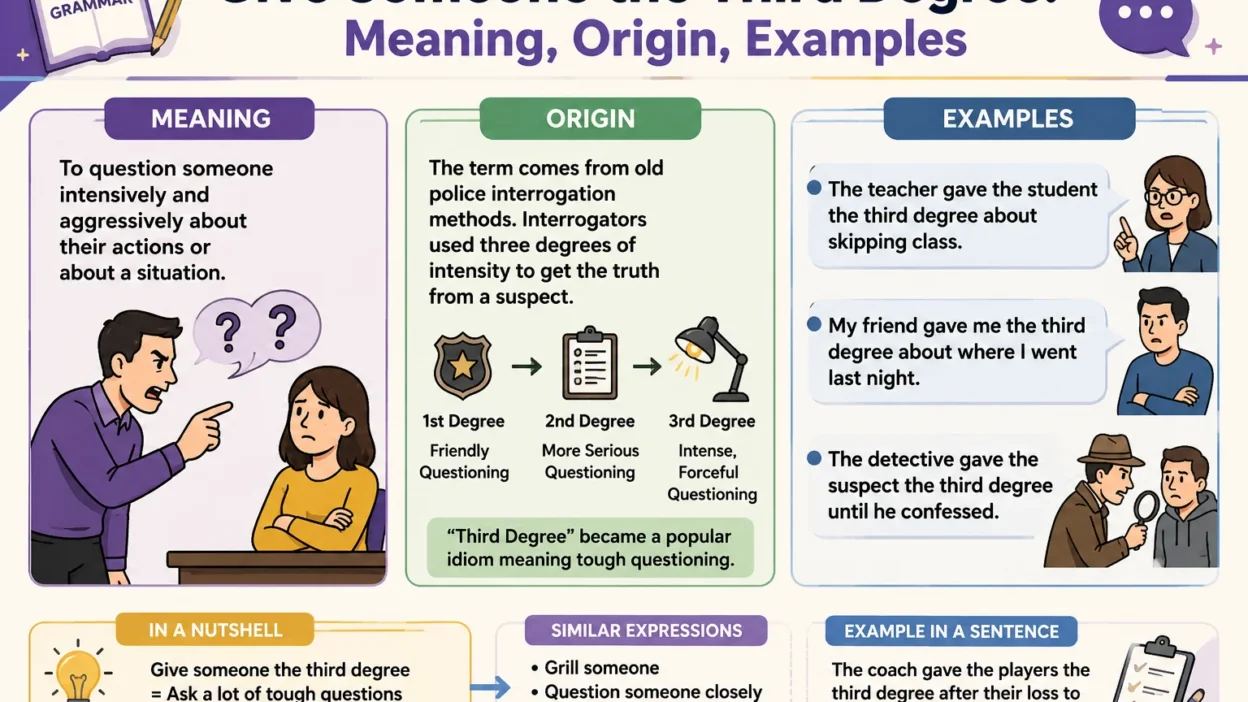
Give Someone the Third Degree is an idiom that describes intense questioning during a conversation, helping listeners understand the speaker’s real meaning.The expression is a common phrase in everyday conversation and figurative language that describes a serious action. It means to question someone, question intensely, or question harshly to find out exactly what happened. The meaning depends on the context, communication, and the situation, not on temperature, angles, or actual degrees.
From my own experience, my mo once gave me the third degree after I arrived home late, asking a lot of questions, many questions, and detailed questions about where I had been, what I was doing, and the full story. That simple family moment became the best example of how the term works in real life.Although many people connect the idiom with a police interrogation, a police setting, or formal interrogations, it also applies to ordinary everyday situations.
An interrogation may follow a thorough and thoroughly planned process to uncover important information, seek a confession, or get to the bottom of an issue. This type of questioning can feel persistent, tough, and exhausting, making someone feel as if they are undergoing great pressure. Over time, the phrase has remained popular because its deep meaning, explanation, and similar use in daily talking make it easy to understand. It is often used to explain that someone is asking too much instead of simply requesting an answer.
Simple Definition of Give Someone the Third Degree
At its core, the idiom refers to:
- intense questioning
- repeated follow-up questions
- pressure to explain yourself
- a feeling that someone is not satisfied with your answers
It is not the same as a normal conversation. When two people chat, questions flow naturally. When someone gets the third degree, the questioning feels more like an interrogation than a friendly talk.
Here is a quick comparison:
| Situation | Example | Tone |
| Normal questions | “How was your day?” | Friendly |
| Curious questioning | “Where did you go after work?” | Neutral |
| The third degree | “Where were you? Who were you with? Why didn’t you call?” | Pressuring |
That contrast is important. The idiom is not about asking one question. It is about piling on question after question until the other person feels boxed in.
Where “Give Someone the Third Degree” Came From
The origin of the phrase is connected to the idea of an interrogation. The exact history is debated, but the expression is strongly linked to police questioning and the pressure of being examined under suspicion.
The word degree in the idiom does not refer to temperature, school grades, or rank in a normal sense. It suggests a level or stage of severity. So the “third degree” implies a more intense level of questioning.
Over time, the phrase moved from the world of police and formal questioning into everyday speech. Today, people use it in everyday life when someone asks too many questions, especially in a way that feels aggressive or intrusive.
Early References and Historical Development
The phrase became common in American English in the late 19th and early 20th centuries. It likely grew out of a culture where police interrogation and public suspicion were common topics in newspapers, fiction, and everyday talk.
A few useful points about its development:
- The phrase is most strongly associated with American English.
- It likely gained popularity through crime stories and police-related language.
- The idiom shifted from a literal feeling of harsh questioning into a broader figurative expression.
The phrase survived because it is vivid. You can almost hear the pressure in it. It sounds sharp. It sounds uneasy. That makes it memorable.
How Police Interrogations Shaped the Phrase
The connection to police questioning gives the idiom much of its force. Police interrogation is not casual. It involves close questioning, repeated follow-ups, and an attempt to uncover facts someone may not want to reveal.
That background gives the idiom a built-in sense of pressure.
For example:
- A detective might press a suspect for details.
- A manager might press an employee about a mistake.
- A parent might press a teenager about missing curfew.
In each case, the questions may differ, but the feeling is similar. The person on the receiving end senses that they are being cornered by the conversation.
That is why give someone the third degree works so well as an idiom. It captures not just questioning, but the emotional weight of questioning.
Modern Meaning and Everyday Use of Give Someone the Third Degree
Today, people use the idiom in many ordinary settings. It is not limited to police work. In fact, most uses happen in daily life.
People might say:
- “My boss gave me the third degree about the missing report.”
- “Her brother gave him the third degree when he came to pick her up.”
- “My mom gave me the third degree after I got home late.”
The phrase usually suggests one of three things:
- the questions were too many
- the questions were too personal
- the questions were too intense
Sometimes the phrase is used jokingly. Other times it shows real frustration. The tone depends on the speaker, the situation, and the relationship between the people involved.
When People Use the Idiom in Daily Conversation
People often use give someone the third degree in situations like these:
- when a parent questions a child about behavior
- when a partner asks too many personal questions
- when a friend keeps demanding details
- when a manager wants an explanation for a problem
- when security staff or police ask close questions
It is especially common when the questioning feels relentless. One question leads to another, then another, and the person answering starts to feel trapped.
How to Use Give Someone the Third Degree Correctly
Use “give someone the third degree” when you want to describe questioning a person intensely or repeatedly to get information. The expression is commonly used in informal English and often suggests that the questioning feels uncomfortable or excessive. It works well in everyday conversations, stories, and writing when someone is being pressed for answers rather than simply asked a few questions.
How to Use “Give Someone the Third Degree” Correctly
Use the idiom “give someone the third degree” when you want to describe a situation where a person is asked many intense or persistent questions. It usually implies that the questioning feels more like an interrogation than a casual conversation. This expression works best in informal conversations, storytelling, and everyday writing, especially when the speaker wants to emphasize pressure or suspicion. Avoid using it for ordinary, friendly questions because the idiom specifically suggests close, repeated, and often uncomfortable questioning.
Common sentence patterns
- They gave me the third degree.
- My parents always give me the third degree.
- He gave her the third degree about the money.
- Don’t give me the third degree.
- The interviewer gave the candidate the third degree.
The structure is straightforward. The idiom works like a fixed phrase, so people generally do not change the wording too much.
Formal vs. Informal Usage
This idiom is informal. It fits casual conversation, storytelling, dialogue, and everyday speech. It is usually not the best choice for formal business writing, academic papers, or legal documents.
Here is a simple guide:
| Context | Good choice? | Why |
| Friendly conversation | Yes | Natural and vivid |
| Storytelling | Yes | Adds realism |
| Workplace email | Sometimes | Only if the tone is casual |
| Academic writing | No | Too informal |
| Legal writing | No | Not precise enough |
In formal writing, a clearer phrase may work better:
- questioned closely
- pressed for details
- interrogated
- asked repeated questions
Those expressions are more direct and less idiomatic.
When You Should Avoid the Idiom
Avoid it when:
- the situation is too serious
- the audience may not understand idioms well
- the tone needs to stay professional
- the speaker is describing actual police procedure
If you want clarity, use plain language. Idioms are powerful, but they are not always the best tool.
Real-Life Examples of Give Someone the Third Degree
You might hear this idiom in many everyday situations where someone faces a flood of questions. For example, a parent may give their teenager the third degree after they miss curfew, a manager might question an employee closely about a costly mistake, or friends may jokingly give someone the third degree about a new relationship. In each case, the phrase describes persistent, detailed questioning that goes beyond ordinary conversation.
Family conversations
“Dad gave me the third degree when I got home after midnight.”
This suggests the parent asked many questions and wanted a full explanation.
Workplace situations
“My manager gave me the third degree after the client complained.”
This shows close questioning at work, often with a serious or stressed tone.
Friendships and relationships
“My sister gave my boyfriend the third degree the first time she met him.”
This often sounds humorous, but it also shows suspicion or protective behavior.
School and college examples
“The teacher gave the student the third degree about the missing assignment.”
This use shows intense questioning in an educational setting.
Social life and everyday situations
“The receptionist gave him the third degree about why he needed access to the building.”
This sounds like strict questioning in a practical setting.
Is Give Someone the Third Degree Positive or Negative?
Most of the time, the idiom has a negative or at least uncomfortable tone. It suggests pressure, suspicion, or annoyance.
However, it can also be used playfully. For example, a parent might say with a smile, “I gave him the third degree before I let him date my daughter.” In that case, the phrase sounds light and humorous.
Understanding the tone and context
The tone depends on:
- the relationship between the people
- the seriousness of the questions
- the speaker’s attitude
- the setting
Here is a useful guide:
| Tone | Example | Meaning |
| Friendly humor | “My aunt gave me the third degree about my love life.” | Playful teasing |
| Mild irritation | “Stop giving me the third degree.” | Annoyed |
| Serious pressure | “The police gave him the third degree.” | Strong questioning |
| Protective concern | “Her dad gave me the third degree.” | Cautious but not always rude |
So the idiom is not always harsh. It can shift depending on the scene.
When it can sound offensive
The phrase can sound rude if:
- the questions are personal
- the person feels attacked
- the speaker sounds resentful
- the questioning is too aggressive
That is why tone matters. What sounds like a joke to one person may sound like criticism to another.
Common Mistakes People Make with This Idiom
A common mistake is using “give someone the third degree” for ordinary or friendly questions. The idiom should only describe intense, repeated questioning that feels like an interrogation. Another error is taking the phrase literally instead of recognizing it as a figurative expression, or using it in formal writing, where a more direct phrase is often a better choice.
Confusing it with literal police procedure
People sometimes think the idiom literally refers to a police ranking or official process. It does not. It is figurative language, not a formal legal term.
Using it for ordinary questions
If someone asks one or two casual questions, that is not the third degree. The idiom fits repeated, pressing, and uncomfortable questioning.
Wrong: “She gave me the third degree” when she only asked, “How was your day?”
Better: “She asked me a few questions.”
Overusing the phrase
Because the idiom is vivid, some writers use it too often. That weakens it. Use it when the pressure is real and the image fits.
Mixing it up with similar phrases
The third degree is not exactly the same as:
- grilling someone
- cross-examining someone
- putting someone on the spot
Those phrases overlap, but they are not identical.
Similar Idioms and Expressions
English has several idioms that express the idea of asking someone many questions or putting them under pressure. Common alternatives include “grill someone,” “cross-examine someone,” “put someone on the spot,” and “pepper someone with questions.” While each expression has its own nuance, they all describe situations where someone is closely questioned or challenged during a conversation.
Grill someone
This is one of the closest alternatives. It means to question someone hard and quickly.
Example: “The reporters grilled the politician about the scandal.”
It feels direct and strong.
Cross-examine someone
This comes from legal language. It means to question someone carefully, often to challenge their story.
Example: “The lawyer cross-examined the witness.”
It sounds more formal than give someone the third degree.
Put someone on the spot
This means to make someone answer suddenly or awkwardly.
Example: “The teacher put him on the spot with a surprise question.”
It is less intense than the third degree, but it can still feel uncomfortable.
Pepper someone with questions
This image suggests a burst of questions one after another.
Example: “The interviewer peppered her with questions about her experience.”
This is close in meaning, but often less hostile.
Give someone a hard time
This is broader. It can mean to bother, criticize, or pressure someone.
Example: “My boss gave me a hard time about being late.”
It may involve questioning, but it is not always about questions alone.
Opposite Expressions and Softer Alternatives
The opposite of “give someone the third degree” involves showing patience, trust, and understanding instead of asking relentless questions. Expressions such as “give someone the benefit of the doubt,” “let it go,” “leave someone alone,” and “mind your own business” suggest stepping back rather than pressing for answers. These alternatives create a more relaxed and respectful tone in everyday conversations.
Give someone the benefit of the doubt
This means to assume someone is telling the truth or acting honestly until proven otherwise.
Example: “Instead of giving him the third degree, give him the benefit of the doubt.”
Let it go
This means to stop pressing an issue.
Example: “She wanted answers, but he told her to let it go.”
Leave someone alone
This means to stop bothering the person.
Example: “He was tired, so I left him alone.”
Mind your own business
This is sharper and more defensive. It tells someone not to interfere.
Example: “She snapped, ‘Mind your own business.’”
That is not the same as the third degree, but it often appears in similar tense situations.
Synonyms and Related Words for Give Someone the Third Degree
If you want to vary your writing, these options can help:
- interrogate
- question closely
- press for details
- grill
- cross-examine
- badger
- hound
- probe
- quiz
- needle
Each word carries a slightly different tone.
| Word or phrase | Tone | Best use |
| Interrogate | Serious | Formal, police, legal |
| Grill | Strong but common | Casual speech |
| Badger | Annoying | Repeated pressure |
| Probe | Careful | Sensitive subjects |
| Quiz | Mild | Quick questioning |
Using the right word makes your writing sharper.
Give Someone the Third Degree in Literature, Film, and TV
Writers and screenwriters love this kind of phrase because it creates tension fast. You do not need a long explanation. The idiom itself gives the scene energy.
A detective asking a suspect questions. A parent pressing a teenager. A friend demanding the truth. These are all classic scenes because they naturally create conflict.
How writers use the idiom
They use it to show:
- suspicion
- stress
- pressure
- conflict
- drama
A line like “He gave her the third degree” tells the reader a lot in a few words. That makes the phrase useful in fiction and dialogue.
Why it works so well on screen
The idiom sounds active. It suggests movement and force. That fits scenes where characters are under pressure. In film and television, quick exchanges matter. This phrase helps deliver that feeling immediately.
Psychological Impact of Receiving the Third Degree
Being given the third degree can leave a person feeling stressed, anxious, or defensive, especially when the questions seem never-ending. Constant, intense questioning may create feelings of pressure, embarrassment, or frustration, making it harder to respond calmly. Over time, this kind of interaction can even affect trust and communication, particularly in close relationships or workplace settings.
The stress of intense questioning
When someone gets the third degree, they may feel:
- nervous
- defensive
- trapped
- embarrassed
- angry
- tired
That happens because the body responds to pressure. The mind shifts into self-protection mode. People may speak less clearly, forget details, or become irritated.
Social and relational implications
Intense questioning can damage trust if it happens too often. If a person feels constantly examined, they may stop sharing openly.
That is especially true in:
- romantic relationships
- parent-child relationships
- work relationships
- friendships
A little concern can be healthy. Too much pressure can backfire.
A useful quote to remember
“Questions can open doors, but too many can also close them.”
That simple idea captures the balance. Curiosity helps relationships. Pressure can strain them.
Case Studies of Give Someone the Third Degree in Real Life
Imagine a teenager arriving home well past curfew. Instead of asking one simple question, their parents ask where they were, who they were with, and why they didn’t answer their phone. In another example, a manager questions an employee in detail after an important deadline is missed. Both situations illustrate how giving someone the third degree involves persistent, detailed questioning that makes the other person feel pressured to explain every detail.
Case study one: A parent and a teen
A teenager comes home later than expected. The parent asks where they were, who they were with, why they did not answer texts, and whether anything happened.
This is a classic example of giving someone the third degree. The parent may be worried, but the teen experiences the questioning as intense and restrictive.
Case study two: A manager and an employee
A report is missing a key number. The manager asks the employee how it happened, when they noticed the mistake, whether anyone else checked it, and why it was not caught sooner.
That is not just a normal check-in. It becomes a pressure-filled conversation. The employee may feel put on the defensive.
Case study three: Two friends
One friend starts dating someone new. The other asks how long they have known each other, where they met, whether the relationship is serious, and whether they trust this person.
This can be affectionate or annoying depending on the tone. If it goes too far, the listener may say, “Stop giving me the third degree.”
Common Questions About Give Someone the Third Degree
Many people wonder whether “give someone the third degree” always refers to police questioning, but today it is most often used figuratively in everyday conversations. Others ask if the idiom is rude or offensive, and the answer depends on the tone and context. Understanding these common questions helps you use the expression accurately and naturally in both speech and writing.
Is this idiom American?
Yes, it is strongly associated with American English.
Does it always mean police questioning?
No. That is part of its background, but modern use is much broader.
Is it rude?
Not always. It can be playful, but it often carries a negative edge.
Can I use it in writing?
Yes, in informal writing, dialogue, storytelling, and articles about idioms. It is less suitable for formal reports.
What is the main idea behind the phrase?
The main idea is intense, repeated questioning that feels like pressure.
Why the Idiom Still Matters Today
The phrase has lasted because human behavior has not changed much. People still question each other closely when they want answers, confirmation, or control.
That is why the idiom remains useful. It describes a familiar social moment. Almost everyone has experienced it in some form.
It also works well because the image is clear. You hear the phrase and immediately understand the feeling behind it. That makes it practical, memorable, and easy to use in speech.
In modern life, it can show up in:
- family arguments
- workplace reviews
- relationship conversations
- police dramas
- internet discussions
- everyday storytelling
Language that stays alive usually does so for a reason. This one has staying power because it is vivid, flexible, and easy to understand.
Quick Summary Table: Give Someone the Third Degree
| Feature | Details |
| Meaning | To question someone intensely |
| Tone | Often negative or pressuring |
| Register | Informal |
| Origin | Linked to interrogation and police questioning |
| Common use | Everyday speech, dialogue, storytelling |
| Similar phrases | Grill someone, cross-examine someone, pepper someone with questions |
Best Ways to Use the Idiom Naturally
Here are some simple tips:
- Use it when questioning feels intense.
- Keep the tone natural and conversational.
- Avoid using it for light or casual questions.
- Use it in dialogue when you want realism.
- Pair it with context so readers understand the pressure.
Examples:
- “My mom gave me the third degree for my grades.”
- “The detective gave the suspect the third degree.”
- “My brother gave my new roommate the third degree.”
Those sentences feel natural because they match the emotional weight of the phrase.
Here’s a conclusion and five SEO-friendly FAQs in simple English.
Conclusion
The idiom “Give Someone the Third Degree” is a useful expression that describes asking someone many detailed or intense questions. Although it originally referred to serious interrogation, today it is commonly used in everyday conversations, often with a light or humorous tone. Learning its meaning, origin, and correct usage helps you understand English more naturally and communicate with greater confidence in both casual and formal situations.
FAQs
Q1. What does “Give Someone the Third Degree” mean?
“Give Someone the Third Degree” means to ask someone a lot of detailed, serious, or persistent questions, usually to discover the truth or get more information.
Q2. Where did the idiom “Give Someone the Third Degree” come from?
The idiom is believed to have come from early police interrogation practices, where suspects were questioned very intensely. Over time, it became a common figurative expression in everyday English.
Q3. Is “Give Someone the Third Degree” used in everyday English?
Yes. Native English speakers often use this idiom in daily conversations when someone asks too many questions, even in family, school, or workplace situations.
Q4. Is “Give Someone the Third Degree” always negative?
Not always. It can describe serious questioning, but it is also used humorously when friends, parents, or coworkers ask many questions about a situation.
Q5. How can I use “Give Someone the Third Degree” in a sentence?
You can say, “My parents gave me the third degree when I got home late,” or “The reporter gave the athlete the third degree after the match.” In both examples, the idiom means asking many detailed questions.