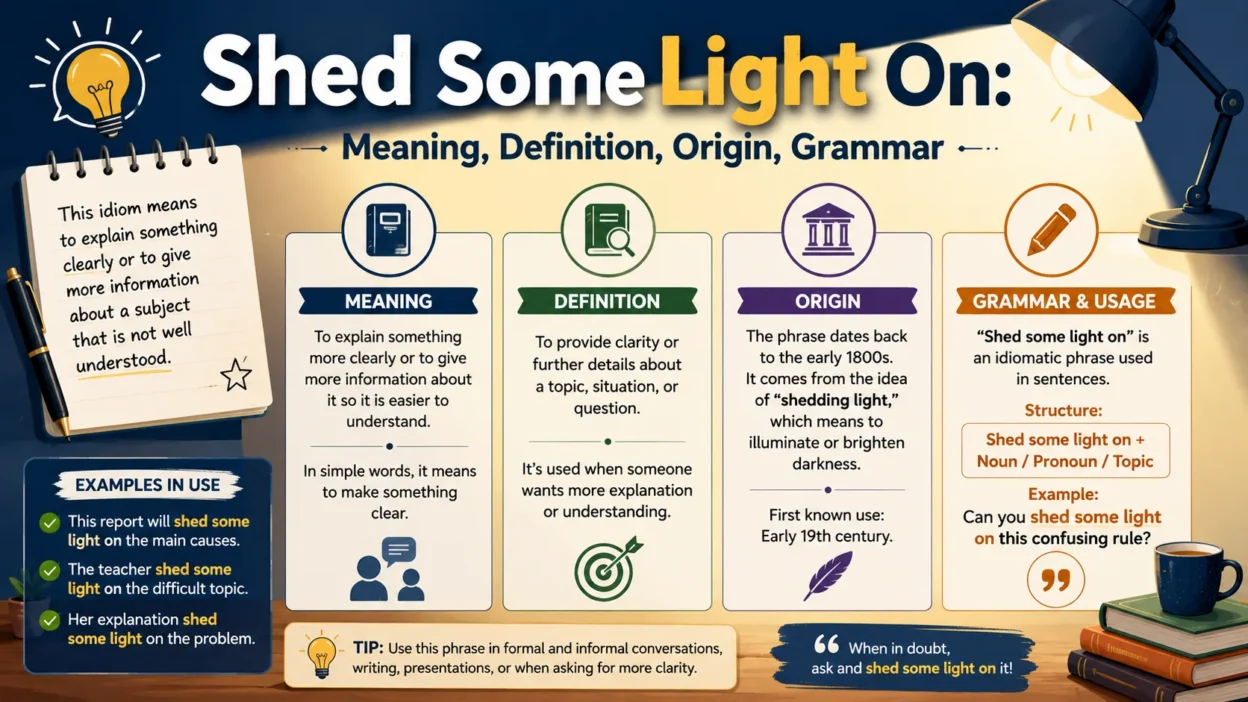
Shed Some Light On helps make unclear or complex ideas easier to understand by adding useful information, explanation, and clarification. Like turning on a flashlight in a dark room, the phrase can illuminate, elucidate, or explain something that seems difficult or confusing. In everyday conversations, classrooms, teaching, and learning sessions, it can reduce confusion, enhance understanding, and help people express themselves clearly. A writer or editor may use this catchy phrase when discussing real-life situations, while readers can use it to grasp dense theories, tricky problems, and an abstract idea. Its natural, graceful way of making explanations feel less rigid and more accessible gives the expression a useful place in communication.
The idiom shed some light on means to provide information, an explanation, or clarification about a situation, unanswered question, research finding, workplace issue, or investigation. Its familiar metaphor connects light with knowledge and darkness with uncertainty. When someone is in the dark, they lack enough information, but new information can shed light on a subject and improve your understanding. For example, a teacher might ask a student to explain an answer in more detail, or a colleague may be asked to clarify a problem. The same expression can describe asking for help with a computer that isn’t working. At first glance, its connection with brightness and lamps seems obvious, yet its roots reach back to times long ago, and it still has a crucial role in communication today.
The expression works in formal and informal settings and offers useful ways to move from uncertainty to knowledge. Examples, tables, decision frameworks, comparison methods, guides, tips, expert insight, practical tools, and real-world examples can help information be understood correctly while adding meaningful details. Someone using vocabulary thoughtfully can think better, apply concepts, and remember lessons while exploring a subject or describing something such as breaking a machine or shining a light on confusing situations. The expression has become a staple because it provides strong, effective ways of guiding others through information. Growing knowledge, revealing information, and reshaping understanding can create deeper insights, while the simple phrase can make a topic less confusing. Its phrase meaning, usage, and synonyms remain useful for anyone who wants to enhance understanding without making an explanation unnecessarily complicated.
What Does “Shed Some Light On” Mean?
“Shed some light on” means to provide information, insight, or an explanation that makes something easier to understand.
The phrase is especially useful when a person doesn’t know the whole story or when the available information doesn’t fully explain a situation.
Consider this example:
The witness shed some light on the accident.
The witness gave information that helped people understand the accident.
The sentence doesn’t necessarily mean that the witness explained every detail. It simply tells us that the witness’s information made the situation clearer.
You can use the expression for many kinds of subjects:
- A confusing situation
- An unanswered question
- A difficult decision
- A historical event
- A scientific discovery
- A workplace problem
- A financial issue
- An investigation
- A personal disagreement
- A technical problem
For example:
The new report shed some light on the company’s declining sales.
Her explanation shed some light on the misunderstanding.
The documents shed some light on what happened during the negotiations.
The study shed some light on why the results differed.
In each example, something provides information that improves understanding.
Breaking Down the Meaning
The phrase contains four important parts:
| Word | Grammatical role | Meaning in the expression |
| Shed | Verb | Give off, provide, or cast |
| Some | Determiner | An unspecified amount |
| Light | Noun | Understanding or information |
| On | Preposition | Introduces the subject being clarified |
The word shed has several meanings in English. A tree sheds leaves. A person can shed tears. A lamp can shed light.
In “shed some light on,” the verb carries the idea of providing or casting something.
The word light has its ordinary physical meaning in literal sentences. However, it represents knowledge, clarity, understanding, or information in the idiom.
That metaphor is the heart of the expression.
Does “Shed Some Light On” Mean “Solve”?
Not quite.
This distinction is important because providing information isn’t always the same as solving a problem.
Compare these two sentences:
The interview shed some light on the disagreement.
The interview solved the disagreement.
The first sentence says the interview helped people understand the disagreement. The second says the disagreement itself was resolved.
Likewise:
The evidence shed some light on the mystery.
doesn’t necessarily mean:
The evidence solved the mystery.
The evidence might reveal one important clue while leaving several questions unanswered.
That partial sense often makes “shed some light on” particularly useful. It lets you acknowledge meaningful progress without exaggerating what the evidence actually proves.
Is “Shed Some Light On” an Idiom?
Yes. “Shed some light on” is a figurative idiom.
Its figurative meaning comes from the literal experience of using light to make something visible.
For example:
The lamp shed light on the table.
This is literal. The lamp physically illuminated the table.
Now consider:
The report shed light on the problem.
This is figurative. The report didn’t produce physical light. Instead, its information made the problem easier to understand.
The distinction becomes even clearer when you place the two meanings side by side.
| Literal use | Figurative use |
| The candle shed light on the desk. | The evidence shed light on the case. |
| The window shed light onto the floor. | The study shed light on the issue. |
| The lantern shed light on the path. | The interview shed light on what happened. |
English frequently uses physical experiences to describe abstract ideas. Light and darkness are especially common metaphors for knowledge and uncertainty.
You can see the point, look into a problem, bring something to light, or shed light on an issue.
These expressions all connect understanding with vision.
The Origins of “Shed Some Light On” and Its Evolution
The history of “shed light on” is closely connected to the literal meaning of illumination.
The physical concept is straightforward. Something that produces light makes objects visible. When an object is hidden by darkness, adding light allows people to see it.
Over time, English extended this physical idea into the abstract world of knowledge.
The metaphor works naturally:
Darkness → something is difficult to see
Light → something becomes visible
Uncertainty → something is difficult to understand
Information → something becomes understandable
That connection helped light become a powerful metaphor for knowledge and truth.
The figurative expression “shed light on” eventually developed into a standard way to describe information that clarifies an issue.
The expression also has close relatives, including:
- shed light on
- shed some light on
- shed new light on
- shed further light on
- cast light on
- throw light on
These expressions share essentially the same central image: light makes something easier to see or understand.
“Shed Light On” vs. “Shed Some Light On”
The two versions have nearly the same meaning.
The report shed light on the issue.
The report shed some light on the issue.
Both indicate that the report provided useful information.
However, some can create a slightly more limited sense. It can suggest that the information helps but doesn’t explain everything.
For example:
The new evidence shed some light on the mystery.
This wording leaves room for unanswered questions.
By comparison:
The new evidence shed new light on the mystery.
The word new emphasizes that the evidence has introduced a fresh perspective or previously unavailable information.
How “Shed Some Light On” Is Used in Modern English
The phrase remains useful because it expresses something that simpler verbs don’t always capture perfectly.
You could say explain, clarify, reveal, or identify. Each word carries a slightly different meaning.
Shed some light on is useful when information contributes to understanding without necessarily providing a complete explanation.
It appears naturally in:
- Everyday conversations
- Workplace discussions
- News writing
- Academic research
- Scientific writing
- Historical analysis
- Investigative reporting
- Business reports
- Technical discussions
- Interviews
For example, a manager might say:
Could you shed some light on the recent changes?
A researcher might write:
These findings shed new light on the development of language.
A journalist might report:
The documents shed some light on the company’s internal discussions.
A friend might ask:
Can you shed some light on what happened last night?
The context changes, but the central meaning remains the same.
Variations of “Shed Some Light On”
English speakers often modify the phrase by changing the word before light.
Shed Light On
The evidence shed light on the case.
This is the broadest form.
Shed Some Light On
The evidence shed some light on the case.
This can suggest useful but possibly incomplete clarification.
Shed More Light On
The second report shed more light on the issue.
This indicates that more information has become available.
Shed New Light On
The discovery shed new light on the historical event.
This emphasizes a new perspective or previously unknown information.
Shed Further Light On
The additional documents shed further light on the negotiations.
This suggests that the new information builds on what was already known.
Shed Additional Light On
The interviews shed additional light on the employees’ concerns.
This has a slightly formal feel and emphasizes extra information.
These variations aren’t interchangeable in every situation. Choosing the right modifier lets you communicate exactly how the new information changes the reader’s understanding.
Common Sentence Patterns With “Shed Some Light On”
The most common grammatical structure is:
Subject + shed/sheds + some light + on + topic
For example:
The report shed some light on the problem.
The structure contains:
- The report — subject
- shed — verb
- some light — object
- on the problem — prepositional phrase
The phrase works with many different subjects:
The investigation shed some light on the incident.
The witness shed some light on the timeline.
The research shed some light on the causes.
The documents shed some light on the decision.
The interview shed some light on what happened.
The subject doesn’t have to be a person. A report, study, discovery, document, piece of evidence, or conversation can all shed light on something.
Breaking Down the Grammar
The verb shed is unusual because it doesn’t change in the simple past.
The basic forms are:
- Present: shed
- Third-person singular present: sheds
- Past: shed
- Past participle: shed
- -ing form: shedding
Look at these examples:
The report sheds some light on the issue.
The report shed some light on the issue.
The report has shed some light on the issue.
The report will shed some light on the issue.
The report may shed some light on the issue.
Notice that shedded is not the correct past form.
Subject-Verb Agreement
The verb changes to sheds when the subject is third-person singular in the present tense.
Correct:
The report sheds light on the issue.
Correct:
The reports shed light on the issue.
Incorrect:
The report shed light on the issue yesterday?
The last example can actually be correct if you’re using the simple past. Context determines the tense.
The important point is that shed remains unchanged in the past:
Yesterday, the report shed light on the issue.
Constructing Sentences With “Shed Some Light On”
Creating a sentence with the expression is easy when you follow its basic structure.
Start with the source of information:
The witness
Add the verb:
The witness shed
Add the idiomatic phrase:
The witness shed some light
Then identify what became clearer:
The witness shed some light on the incident.
You can make the sentence more specific:
The witness’s second interview shed some light on why the security system failed that evening.
The sentence is longer, but the grammatical structure hasn’t changed.
“Shed Some Light On” vs. “Shed Some Light Onto”
This is a common point of confusion.
When you’re using the figurative idiom, the standard preposition is on.
The evidence shed some light on the case.
The report shed some light on the problem.
The study shed some light on the question.
Using about is also not the normal idiomatic construction:
❌ The report shed some light about the issue.
Use:
The report shed some light on the issue.
What About “Onto”?
Onto can work in literal descriptions involving physical light.
For example:
The skylight shed light onto the floor.
Here, light physically falls onto a surface.
But when the expression means to provide information or clarify an issue, use shed light on.
The evidence shed light on the investigation.
That’s the standard idiomatic form.
“Shed Some Light On” vs. Similar Expressions
Several words and phrases can communicate a similar idea. However, they don’t all make the same claim.
| Expression | Main meaning | Example |
| Shed some light on | Provide useful information or insight | The report shed some light on the problem. |
| Clarify | Make something easier to understand | The manager clarified the policy. |
| Explain | Make an idea or situation understandable | She explained the situation. |
| Clear up | Remove confusion | The conversation cleared up the misunderstanding. |
| Reveal | Make hidden information known | The documents revealed the truth. |
| Uncover | Discover something hidden | Investigators uncovered new evidence. |
| Illuminate | Make something clearer or easier to understand | The research illuminates the issue. |
| Provide insight into | Offer deeper understanding | The study provides insight into the problem. |
The differences matter.
Suppose a researcher finds three major causes of a decline.
You could write:
The research shed some light on the decline.
That’s broad.
Or:
The research identified three major causes of the decline.
That’s much more specific.
If the research genuinely identifies three causes, the second sentence is stronger.
Good writing chooses precision over decoration.
“Shed Some Light On” in Everyday Conversation
The phrase works naturally when you’re asking another person for clarification.
Imagine that your friend knows why a party was canceled, but you don’t.
You might say:
Can you shed some light on what happened?
That sounds natural and reasonably polite.
You could also say:
Do you know what happened?
That’s simpler and more direct.
The idiomatic version places more emphasis on understanding the situation.
Everyday Examples
Can you shed some light on why Sarah left early?
His explanation shed some light on the misunderstanding.
Does anyone know what happened, or can someone shed some light on it?
The message finally shed some light on her sudden decision.
The conversation shed some light on why they stopped working together.
The phrase can also appear in casual dialogue:
Mia: “Why did the store close so early?”
Daniel: “I heard there was a problem with the power.”
Mia: “That sheds some light on it.”
Here, the phrase means that the information helps explain the situation.
“Shed Some Light On” in the Workplace
The workplace provides plenty of situations where people need clarification.
A manager may want to understand a sudden cost increase. A colleague may need information about a project delay. A team may need an explanation for changing priorities.
For example:
Could you shed some light on the reason for the schedule change?
The question is essentially asking:
Can you explain why the schedule changed?
However, the idiomatic wording can sound less blunt.
Compare:
Why did you change the schedule?
with:
Could you shed some light on why the schedule changed?
The second version frames the request around clarification rather than accusation.
Other workplace examples include:
The updated figures shed some light on the decline in sales.
The audit shed some light on several unusual transactions.
Could you shed some light on the changes to the budget?
The customer feedback shed some light on the reason for the complaints.
“Shed Some Light On” in Academic and Research Writing
The phrase also works well when discussing research.
Research doesn’t always deliver a complete answer. Instead, a study may uncover patterns, provide evidence, challenge assumptions, or suggest possible explanations.
That’s exactly where shed light on becomes useful.
For example:
The study sheds new light on how children develop language skills.
This doesn’t necessarily mean the study explains every part of language development. It means the findings improve our understanding of the subject.
Another example:
The research shed some light on why participants responded differently to the treatment.
The research offered an explanation or useful evidence.
You can also write:
The findings may shed further light on the relationship between sleep and memory.
The phrase works particularly well when you want to avoid making a stronger claim than the evidence supports.
“Shed Some Light On” in Journalism
News and investigative writing often deals with incomplete information.
A journalist may have access to new documents, testimony, recordings, photographs, or data. These materials can help readers understand what happened.
For example:
New documents shed some light on the company’s internal decision-making.
This wording is careful.
It doesn’t say the documents prove everything. It says the documents provide useful information.
Another example:
The witness testimony shed some light on the events leading up to the accident.
Again, the testimony contributes to understanding.
This is an important feature of the idiom: it can communicate meaningful information without claiming complete certainty.
“Shed Some Light On” in Science and Technical Writing
Scientific and technical subjects often involve complicated systems.
A new experiment might help researchers understand why a material behaves differently under certain conditions.
The experiment shed some light on how the material responds to extreme temperatures.
A software investigation could reveal why an application keeps crashing:
The diagnostic report shed some light on the source of the error.
A historical analysis might provide new evidence:
The newly discovered records shed new light on the period.
In all these examples, the expression means to increase understanding through information or evidence.
Practical Examples of “Shed Some Light On”
Examples About Problems
- The report shed some light on the cause of the problem.
- The investigation shed some light on what went wrong.
- The new evidence may shed some light on the issue.
- The technical analysis shed some light on the system failure.
Examples About People
- Her explanation shed some light on her decision.
- The interview shed some light on his unusual behavior.
- His comments shed some light on the disagreement.
Examples About Research
- The study shed new light on language development.
- The experiment shed some light on the cause of the reaction.
- The findings shed further light on the relationship between the variables.
Examples About History
- The letters shed some light on the author’s private life.
- The newly discovered records shed new light on the historical event.
- The diary sheds some light on everyday life during that period.
Examples About Business
- The financial statements shed some light on the company’s declining profits.
- The customer survey shed some light on the drop in demand.
- The audit shed further light on the unusual expenses.
Asking for an Explanation
Alex: “I heard the project was delayed again.”
Jordan: “Yes. The supplier had another problem.”
Alex: “Could you shed some light on what happened?”
Here, Alex wants more details.
Discussing New Evidence
Reporter: “Do these documents explain the decision?”
Analyst: “They don’t explain everything, but they shed some light on why the company changed its strategy.”
The analyst makes a careful distinction. The documents provide insight but not a complete explanation.
Discussing Research
Student: “Did your experiment explain the unusual result?”
Researcher: “Not completely. It shed some light on what might have caused it.”
This is a particularly natural use because research often produces partial understanding.
Mistake: Using “Shedded”
One of the easiest errors is treating shed like a regular verb.
Incorrect:
❌ The report shedded some light on the problem.
Correct:
The report shed some light on the problem.
The simple past remains shed.
Mistake: Using “About” Instead of “On”
Incorrect:
❌ The evidence shed some light about the case.
Correct:
The evidence shed some light on the case.
The standard idiomatic construction is shed light on something.
Mistake: Assuming It Means “Solve”
Incorrect interpretation:
The evidence shed some light on the mystery, so the mystery was solved.
The first part doesn’t guarantee the second.
Better understanding:
The evidence shed some light on the mystery, although several questions remained unanswered.
That sentence captures the idiom’s meaning much more accurately.
Mistake: Confusing It With “Bring to Light”
These phrases overlap, but they focus on different ideas.
Shed light on means to help make something understandable.
Bring to light means revealing something that was hidden or previously unknown.
Compare:
The study shed light on the causes of the disease.
The study improved understanding.
The investigation brought hidden financial records to light.
The investigation revealed information that had previously been hidden.
Mistake: Using It When a Precise Verb Is Better
Consider this sentence:
The report shed some light on three causes of the decline.
If the report actually identifies those causes clearly, you could write:
The report identified three causes of the decline.
The second sentence is more informative.
Use the idiom when insight itself is the point. Use a precise verb when you can state exactly what happened.
“Shed Some Light On” vs. “Shed Light On”
The difference between the two forms is subtle.
The evidence shed light on the case.
This makes a broad statement that the evidence helped explain the case.
The evidence shed some light on the case.
The addition of some can make the statement sound more limited or cautious.
That doesn’t mean the evidence was unimportant. It simply avoids suggesting that the evidence explained everything.
“Shed More Light On”
The second investigation shed more light on the problem.
This suggests that an earlier investigation already provided some information and the second one added more.
“Shed New Light On”
The discovery shed new light on the historical event.
The emphasis is on a new perspective or previously unavailable information.
“Shed Further Light On”
The additional evidence shed further light on the case.
This means that the new evidence added to what was already known.
“Shed Additional Light On”
The latest report shed additional light on the company’s financial difficulties.
This is similar to shed further light on and often sounds suitable in formal writing.
“Shed Some Light On” vs. “Cast Some Light On”
Cast light on is a close relative of shed light on.
For example:
The report shed some light on the issue.
and:
The report cast some light on the issue.
Both communicate the idea that the report helped explain something.
The main difference is often stylistic rather than semantic.
Shed light on sounds especially natural in everyday American English.
Cast light on can have a somewhat more formal or literary tone.
You can also encounter throw light on, which carries the same basic meaning.
These three expressions share the same metaphor:
Light → knowledge
Darkness → uncertainty
Literary and Figurative Expressions Related to “Shed Some Light On”
The idea of light representing knowledge appears in many English expressions.
Bring Something to Light
Bringing something to light means to reveal information that was previously hidden or unknown.
The investigation brought several accounting irregularities to light.
The emphasis is on discovery or revelation.
Come to Light
When something comes to light, it becomes known.
New evidence came to light during the investigation.
The expression doesn’t necessarily say who discovered the information.
See the Light
Seeing the light can mean to understand something or recognize what someone is trying to explain.
After reviewing the evidence, he finally saw the light.
It can also have religious or other specialized meanings depending on context, so the surrounding sentence matters.
In Light Of
In light of means considering particular information or circumstances.
In light of the new evidence, the committee changed its recommendation.
This expression is common in professional and formal writing.
Light at the End of the Tunnel
This phrase describes hope after a difficult or challenging period.
After months of delays, the team finally saw light at the end of the tunnel.
It isn’t a direct synonym for shed light on. It belongs to the same broader family of light-based metaphors.
How to Use “Shed Some Light On” in Better Writing
The expression can make writing natural and expressive, but it shouldn’t replace precise language unnecessarily.
The key question is simple:
Does the subject provide insight, or does it actually establish a specific fact?
If it provides insight, shed light on may be ideal.
The interviews shed some light on the employees’ concerns.
If the interviews identified three specific concerns, however, you might write:
The interviews identified three major concerns among employees.
The second sentence gives the reader more concrete information.
Use “Shed Some Light On” When:
- Information makes a confusing subject clearer.
- The explanation is incomplete.
- Evidence provides useful context.
- A discovery improves understanding.
- You want to avoid overstating what the evidence proves.
- The exact result is difficult to summarize with one precise verb.
Use a More Specific Verb When:
- A study identifies a particular cause.
- An investigation uncovers hidden information.
- A report confirms a fact.
- Someone directly explains something.
- Evidence demonstrates a specific result.
For example:
The audit shed some light on the financial problem.
is useful when the audit provides general insight.
But:
The audit identified $50,000 in unexplained expenses.
is better when that is the actual finding.
Clarity beats cleverness.
An idiom should make your writing more natural, not less precise.
Case Study: Why “Shed Some Light On” Can Be More Accurate Than “Prove”
Imagine researchers conduct a study about workplace productivity.
They discover that employees working irregular schedules report more difficulty maintaining consistent routines. The findings suggest that scheduling may influence productivity.
A careless summary might say:
The study proved that irregular schedules cause low productivity.
That statement could be too strong if the research only establishes an association.
A more careful sentence would be:
The study shed some light on the relationship between irregular schedules and workplace productivity.
This version accurately describes what the study contributes.
The study provides insight. It doesn’t necessarily establish a complete cause-and-effect relationship.
This is one reason shed some light on is useful in research, journalism, and analytical writing. It allows writers to communicate meaningful findings without claiming more certainty than the evidence supports.
Quick Comparison of Related Expressions
| Phrase | What it emphasizes | Example |
| Shed some light on | Increased understanding | The interview shed some light on the dispute. |
| Clarify | Removing confusion | The manager clarified the new policy. |
| Explain | Giving an explanation | She explained the process. |
| Reveal | Making hidden information known | The documents revealed the truth. |
| Uncover | Discovering something hidden | Investigators uncovered new evidence. |
| Bring to light | Exposing previously hidden information | The audit brought the errors to light. |
| Illuminate | Making something intellectually clearer | The research illuminates the issue. |
| Clear up | Resolving confusion | The meeting cleared up the misunderstanding. |
The expressions overlap, but each one has its own emphasis.
Conclusion
Shed Some Light On is a simple and useful English idiom for making unclear information easier to understand. It can describe explaining a problem, providing missing details, or helping someone move from uncertainty to knowledge. Because it works naturally in both formal and informal communication, you can use it in conversations, writing, teaching, and everyday situations.
FAQs
Q1. What does “shed some light on” mean?
It means to provide information or an explanation that makes something easier to understand.
Q2. Is “shed some light on” an idiom?
Yes. It’s an idiom that uses light as a metaphor for knowledge and understanding.
Q3. How do you use “shed some light on” in a sentence?
You can say, “Could you shed some light on this problem?” when asking someone to explain or clarify something.
Q4. Is “shed some light on” formal or informal?
It works in both formal and informal contexts, including conversations, workplace communication, academic writing, and everyday English.
Q5. What are synonyms for “shed some light on”?
Common alternatives include clarify, explain, elucidate, illuminate, provide information, and make something clearer.