Choosing between parents’ or parent’s may seem difficult at first, but one small apostrophe can change the meaning of an entire sentence, so learning the rule early makes your writing much clearer. I still remember paused moments when I was wondering which form to write in a school paper or email. In English and English grammar, this grammar rule is about ownership, not only spelling. A singular noun uses the singular possessive form, while a plural noun uses the plural possessive form. Knowing the difference, choosing the correct form, following correct usage, and avoiding common mistakes will improve everyday writing, a business document, or a social media post.
Many people second guess themselves because the confusion comes from a tiny punctuation mark instead of difficult grammar questions. A good guide written in plain language with simple explanations, real-life examples, and useful examples makes it easier to learn, pick, and use the right forms with clarity. It explains possessive grammar, punctuation, punctuation rules, usage, every rule and rules, proper placement, similar forms, different meanings, and why these forms exist. Never miss this important detail, because one small mark can affect the sentence’s meaning, even when the rest of your professional writing looks clear and professional.
This section compares parent and parents, explains what each version refers to, and provides answers to common grammar questions through FAQs, frequently asked questions, question, search, search query, and search term examples. Whether you complete school forms, prepare a paper, edit a document, publish a post, or improve your writing skills for readers in English-speaking countries and other countries, these real-life situations make the topic easier to understand. From my experience, this method removes fluff, offers good advice, helps every writer, covers different meanings, multiple situations, useful talks, practical tricks, tiny details, and makes the rule much easier to remember.
Quick Answer: Parent’s vs Parents’ vs Parents
Let’s get straight to it.
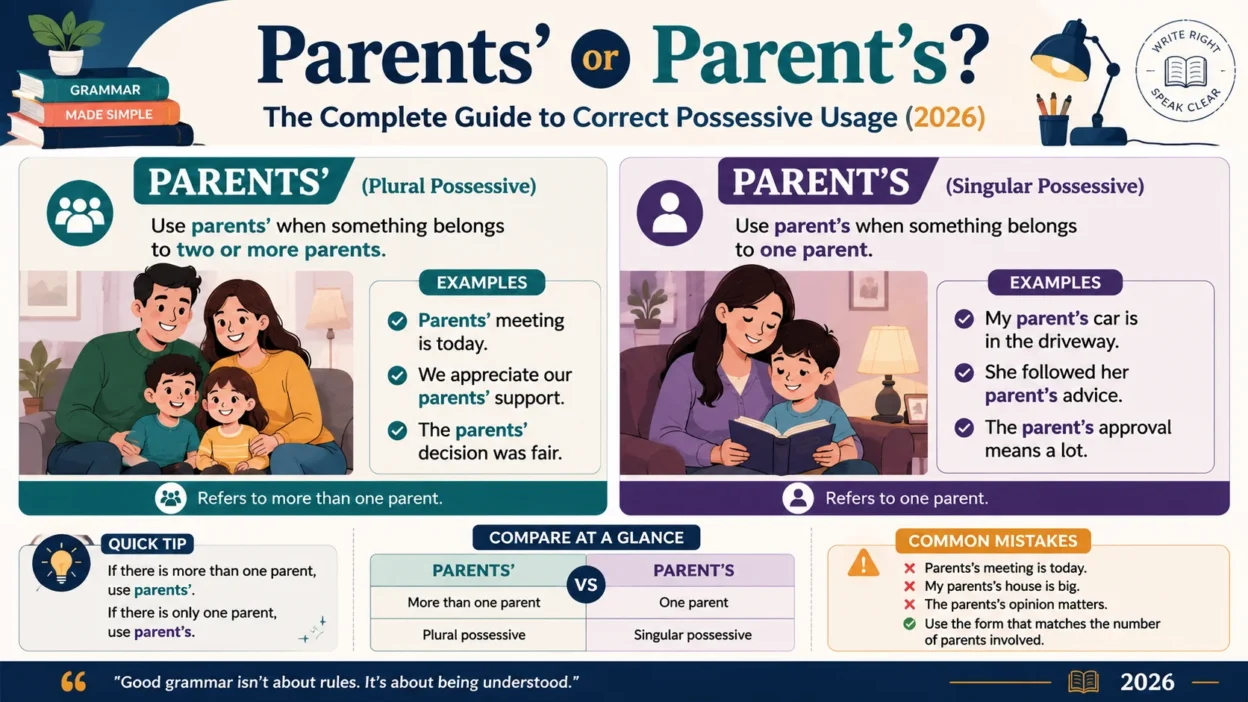
- Parent’s → one parent owns something
- Parents’ → multiple parents own something
- Parents → plural only, no ownership
Quick Examples
- The parent’s phone rang. → One parent
- The parents’ car is outside. → More than one parent
- Parents are waiting. → No ownership
If you remember one thing, remember this: check ownership first, then count how many people are involved.
What Each Form Actually Means (No Confusion Left)
Understanding meaning removes 90% of mistakes. Once you know what each form represents, the apostrophe becomes logical instead of confusing.
Parent’s (Singular Possessive)
This form shows that one parent owns something.
Examples:
- The parent’s signature is required.
- A parent’s responsibility doesn’t end after school.
Here’s a simple mental shortcut:
If you can replace it with “of one parent,” use parent’s.
Parents’ (Plural Possessive)
This shows ownership by more than one parent.
Examples:
- The parents’ meeting starts at 9 AM.
- The parents’ concerns were addressed.
Quick check:
If you mean “of multiple parents,” then use parents’.
Parents (Plural Noun Only)
No ownership here. Just more than one parent.
Examples:
- Parents are waiting outside.
- Many parents attended the event.
No apostrophe needed. Ever.
The Apostrophe Rule That Controls Everything
The rules behind parent’s or parents’ aren’t random. They follow a simple pattern used across English.
Core Rules
- Add ’s to singular nouns → parent’s
- Add ’ after plural nouns ending in “s” → parents’
Comparison Table
| Form | Type | Meaning | Example Sentence |
| Parent’s | Singular possessive | One parent owns something | The parent’s car is new |
| Parents’ | Plural possessive | Multiple parents own | The parents’ decision was final |
| Parents | Plural noun | No ownership | Parents are waiting |
Why This Rule Exists
English developed this system to show ownership clearly in writing. Without apostrophes, sentences would become ambiguous.
Compare:
- parents meeting → unclear
- parents’ meeting → meeting for parents
That apostrophe acts like a signal. It tells your reader exactly what you mean.
Why People Get This Wrong (Real Reasons)
Even experienced writers mess this up. Not because the rule is hard, but because real-life writing is fast and messy.
Common Causes of Confusion
- They sound identical when spoken
- People mix up plural vs possessive
- Apostrophes are often overused or misplaced
- Autocorrect introduces errors
- Writing quickly leads to skipped checks
A Simple Truth
Most mistakes happen because writers don’t pause to ask: Who owns this?
Ask that one question, and you’ll avoid most errors.
Real-Life Examples That Make It Stick
Let’s move from theory to actual usage.
Workplace Example
- The parent’s contact details are missing. → One parent
- The parents’ contact list was updated. → Multiple parents
School Example
- The parents’ meeting is tomorrow.
- A parent’s concern was raised during class.
Home Example
- We visited my parents’ house.
- My parent’s room is upstairs.
Mini Case Study
A school sent an email:
“Parent’s meeting scheduled for Friday.”
Parents got confused. Was it a one-on-one meeting or a group event?
Correct version:
“Parents’ meeting scheduled for Friday.”
One small change. Big clarity.
Parents’ Meeting vs Parent’s Meeting (School Context)
This is one of the most searched questions online.
Correct Usage
- Parents’ meeting → meeting for all parents ✔
- Parent’s meeting → meeting with one parent (rare)
Why Schools Use “Parents’ Meeting”
Because the meeting involves multiple parents. It’s a collective event.
Quick Rule
If more than one parent is invited, always use:
👉 Parents’ meeting
Parents’ Name vs Parent’s Name (Forms and Documents)
Forms often confuse people.
When to Use Each
- Parent’s Name → one guardian required
- Parents’ Names → both guardians required
Common Mistakes
- Writing parents name ❌
- Using parent’s names incorrectly ❌
Best Practice
Always read the form carefully:
- Singular field → use parent’s
- Multiple field → use parents’
Parents’ House vs Parent’s House (Ownership Made Clear)
Ownership becomes very important here.
Examples
- We stayed at my parent’s house. → One parent owns it
- We stayed at my parents’ house. → Both parents own it
What If Ownership Is Unclear?
Use context:
- If both parents live there → parents’ house
- If referring to one parent → parent’s house
Quick Decision Table
| Situation | Correct Form |
| One parent owns property | Parent’s house |
| Both parents own it | Parents’ house |
Parent’s Evening or Parents’ Evening?
This is a classic British school phrase, but the rule applies everywhere.
Correct Version
👉 Parents’ Evening
Why?
Because the event is for multiple parents, not just one.
Wrong Version
- Parent’s evening ❌ (suggests only one parent)
Simple Logic
If the event involves many people, use the plural possessive.
Plural vs Possessive Nouns (The Bigger Picture)
Understanding this concept helps beyond just parent’s or parents’.
Key Difference
- Plural → more than one
- Possessive → ownership
Examples Beyond “Parent”
| Word | Plural | Singular Possessive | Plural Possessive |
| Teacher | Teachers | Teacher’s | Teachers’ |
| Student | Students | Student’s | Students’ |
| Child | Children | Child’s | Children’s |
Important Note
Some plurals don’t end in “s”:
- children’s toys ✔
- men’s room ✔
Most Common Mistakes (And How to Fix Them Fast)
Let’s break down real errors you’ll see every day.
Mistake List
- Using apostrophes for plurals → parent’s ❌
- Mixing singular and plural ownership
- Forgetting the apostrophe entirely
- Writing based on sound instead of meaning
Correction Checklist
Before writing:
- Ask: Who owns this?
- Count: One or more?
- Apply the rule
Quick Fix Examples
- Parents meeting → Parents’ meeting
- Parent house → Parent’s house
A Simple Trick to Never Get It Wrong Again
Here’s a trick that works instantly.
Replace the Phrase
- “of one parent” → parent’s
- “of multiple parents” → parents’
Example
- The decision of the parents → parents’ decision
- The decision of the parent → parent’s decision
Why This Works
It removes guessing. You rely on meaning, not memory.
Why Apostrophe Placement Actually Matters
This isn’t just grammar nitpicking. It affects real communication.
Impact Areas
- Professional emails
- School documents
- Legal forms
- Academic writing
Example of Miscommunication
- Parents meeting canceled → unclear
- Parents’ meeting canceled → clear
Credibility Factor
Small errors signal carelessness. Correct usage builds trust.
“Good writing is clear thinking made visible.”
Quick Practice Section (Test Yourself)
Try these.
Fill in the blanks
- The ______ meeting starts at 10.
- The ______ signature is required.
- We visited my ______ house.
Answers
- Parents’ meeting
- Parent’s signature
- Parents’ house
Conclusion
Choosing between parent’s and parents’ becomes much easier once you know who owns something. If one parent owns it, use parent’s. If two or more parents own it together, use parents’. Paying attention to the apostrophe may seem like a small detail, but it makes your writing clearer, more accurate, and more professional. With a little practice, you’ll be able to use both forms confidently in everyday English.
FAQs
Q1.Is parent’s or parents’ correct?
Both are correct, but they have different meanings. Use parent’s when something belongs to one parent and parents’ when it belongs to two or more parents.
Q2.How do I remember the difference between parent’s and parents’?
A simple trick is to count the owners. One parent takes parent’s, while more than one parent takes parents’.
Q3.Why is the apostrophe placed differently?
The apostrophe shows possession. For a singular noun, it comes before the s in parent’s. For a regular plural noun ending in s, it comes after the s in parents’.
Q4.Can I use parent’s and parents’ in formal writing?
Yes. Both forms are grammatically correct and are commonly used in school papers, business documents, emails, and professional writing when they match the intended meaning.
Q5.What is the most common mistake people make?
The most common mistake is using parent’s when referring to multiple parents or using parents’ when referring to only one parent. Identifying the number of owners before adding the apostrophe helps prevent this error.