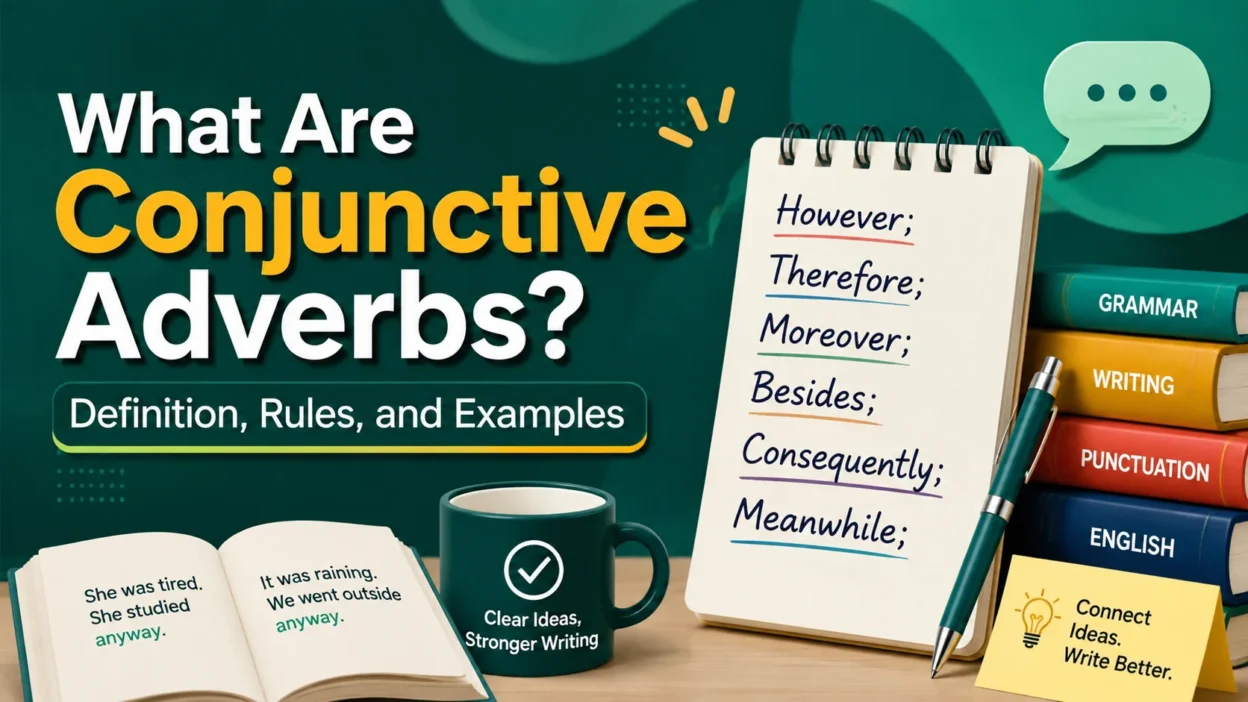
What Are Conjunctive Adverbs? They’re words that act as connectors between sentences, ideas, and thoughts. They show a clear relationship between points in your writing. For example, however shows contrast, while therefore shows cause and effect. Other adverbs can express addition, sequence, similarity, or an alternative, helping readers understand your message more easily.
Their function, grammar, punctuation, and rules differ from coordinating conjunctions. A semicolon can separate independent sentences, while a comma can follow a conjunctive adverb. Using these transitions correctly makes your writing more connected and precise and helps explain cause, effect, and contrast clearly.
With regular practice, these words can improve your writing skills. Conjunctive adverbs help readers move smoothly from one point to another in an essay, report, email, or everyday sentence. Choosing and placing each transition correctly makes your writing clearer and more natural.
Quick Answer: What Are Conjunctive Adverbs?
Conjunctive adverbs are words that connect ideas by showing a logical relationship between them. They can express contrast, cause and effect, addition, time, sequence, similarity, or an alternative.
Common conjunctive adverbs include:
- however
- therefore
- moreover
- furthermore
- nevertheless
- nonetheless
- consequently
- meanwhile
- otherwise
- thus
- similarly
- likewise
- instead
- subsequently
- finally
For example:
The weather was terrible; however, the game continued.
Here, however, shows a contrast between the bad weather and the continuation of the game.
Another example:
The road was closed; therefore, we took another route.
This sentence, therefore, shows a cause-and-effect relationship.
When a conjunctive adverb appears between two independent clauses, the usual structure is:
Independent clause; conjunctive adverb, independent clause.
That’s one of the most important patterns to remember.
What Is a Conjunctive Adverb?
A conjunctive adverb is an adverb that helps explain the relationship between ideas. It can connect thoughts within a sentence or create a logical bridge between sentences.
Think of these words as signposts. A road sign doesn’t create the road. It simply tells you where you’re going. In much the same way, a conjunctive adverb doesn’t create the ideas in your writing. Instead, it tells your reader how those ideas fit together.
Consider these examples:
The apartment was small; however, it had a beautiful view.
The apartment was expensive; therefore, we decided to keep looking.
The apartment was affordable; moreover, it was close to work.
The basic sentence structure stays similar, but each conjunctive adverb changes the relationship.
- However = contrast
- Therefore = result
- Moreover = additional information
That’s the real strength of conjunctive adverbs. They make the logic between ideas visible.
Conjunctive Adverbs and Ordinary Adverbs
Not every adverb connects ideas.
An ordinary adverb can describe how, when, where, or to what degree something happens:
She spoke quietly.
The word quietly describes how she spoke.
Now consider:
She missed the bus; therefore, she arrived late.
The word therefore doesn’t describe how she arrived. It shows the relationship between two complete thoughts.
That’s an important distinction.
Ordinary adverbs often modify parts of a sentence. Conjunctive adverbs often help readers understand the relationship between ideas.
How Do Conjunctive Adverbs Work in a Sentence?
Conjunctive adverbs can appear in different positions. Their placement affects punctuation and sometimes the emphasis of the sentence.
Conjunctive Adverbs Between Two Independent Clauses
This is one of the most important uses to understand.
An independent clause contains a subject and a verb and expresses a complete thought.
For example:
The store was crowded.
This can stand alone.
So can:
We found a table.
When you combine these ideas with a conjunctive adverb, you can write:
The store was crowded; however, we found a table.
The sentence contains two independent clauses:
- The store was crowded
- We found a table
The conjunctive adverb however tells the reader that the second idea contrasts with the first.
The standard pattern is:
Independent clause + semicolon + conjunctive adverb + comma + independent clause
For example:
The test was difficult; nevertheless, most students passed.
The company increased prices; therefore, some customers left.
The first plan failed; instead, the team developed a new strategy.
This structure is worth learning because it prevents one of the most common punctuation mistakes involving conjunctive adverbs.
Conjunctive Adverbs at the Beginning of a Sentence
A conjunctive adverb can begin a sentence when it connects that sentence to an earlier idea.
For example:
The weather became worse. However, the hikers continued.
Or:
The evidence was incomplete. Therefore, the researchers continued their investigation.
When a conjunctive adverb begins an introductory element, a comma commonly follows it.
This structure works particularly well when you want to separate two thoughts clearly.
It also helps prevent sentences from becoming overly crowded with semicolons.
Conjunctive Adverbs in the Middle of a Sentence
Conjunctive adverbs can also interrupt an independent clause.
For example:
The proposal, however, needs more work.
The manager, therefore, rejected the request.
Here, the conjunctive adverb acts as an interruption. The surrounding commas help show that the word isn’t essential to the basic grammatical structure.
Remove however from the first sentence:
The proposal needs more work.
The sentence remains complete.
That provides a useful clue about how the word functions.
Common Types of Conjunctive Adverbs
Conjunctive adverbs become much easier to understand when you organize them according to the relationship they express.
Conjunctive Adverbs That Show Contrast
These words tell readers that the next idea differs from or conflicts with the previous one:
- however
- nevertheless
- nonetheless
- still
- instead
- otherwise
- conversely
Examples:
The instructions looked complicated; however, the process was simple.
The road was dangerous; nevertheless, the rescue team continued.
The first solution was expensive; instead, we chose a cheaper option.
However, it is one of the most common choices. Nevertheless and nonetheless often add a stronger sense of “despite that.”
Conjunctive Adverbs That Show Cause and Effect
These words signal a result or consequence:
- therefore
- thus
- consequently
- accordingly
- hence
Examples:
The roads were flooded; therefore, the school closed.
The machine overheated; consequently, production stopped.
The instructions were unclear; thus, several users made mistakes.
These conjunctive adverbs are especially useful in analytical writing because they make logical relationships obvious.
Conjunctive Adverbs That Add Information
These words introduce another related point:
- moreover
- furthermore
- also
- besides
- likewise
Examples:
The phone is affordable; moreover, it has an excellent camera.
The course is practical; furthermore, it offers flexible assignments.
The hotel is centrally located; likewise, the second property is close to major attractions.
Moreover and furthermore often sound more formal than also.
Conjunctive Adverbs That Show Time or Sequence
These words help readers understand when something happens or where it falls in a sequence:
- meanwhile
- then
- subsequently
- thereafter
- finally
Examples:
The chef prepared the meal; meanwhile, the guests waited outside.
The company changed its policy; subsequently, complaints decreased.
The researchers reviewed the evidence; finally, they published their findings.
These words are especially useful when you’re explaining a process or telling a story.
Conjunctive Adverbs That Show Similarity
Some conjunctive adverbs indicate that two ideas resemble each other:
- similarly
- likewise
For example:
The first method reduced costs; similarly, the second improved efficiency.
The northern branch increased sales; likewise, the southern branch performed well.
These words help readers recognize a parallel between two situations.
Conjunctive Adverbs List With Meanings and Examples
The following table gives you a practical reference.
| Conjunctive Adverb | Relationship | Meaning | Example |
| however | Contrast | in contrast | The task was difficult; however, she finished it. |
| therefore | Result | for that reason | The road was closed; therefore, we took another route. |
| moreover | Addition | in addition | The plan is affordable; moreover, it’s easy to follow. |
| furthermore | Addition | additionally | The design looks good; furthermore, it’s durable. |
| nevertheless | Contrast | despite that | The evidence was limited; nevertheless, the claim gained attention. |
| consequently | Result | as a result | He missed the deadline; consequently, the launch was delayed. |
| meanwhile | Time | at the same time | Sara studied; meanwhile, her brother worked. |
| otherwise | Alternative | if not | Leave now; otherwise, you’ll miss the train. |
| thus | Result | as a result | The sample was contaminated; thus, the test was repeated. |
| similarly | Similarity | in a similar way | The first model saves energy; similarly, the newer model reduces waste. |
| likewise | Similarity | in the same way | The first method worked; likewise, the second produced strong results. |
| instead | Alternative/contrast | in place of that | We didn’t drive; instead, we took the train. |
| subsequently | Sequence | afterward | The company changed its policy; subsequently, sales increased. |
| indeed | Emphasis | in fact | The problem is serious; indeed, it affects many users. |
| finally | Sequence | at last | The team reviewed the evidence; finally, it reached a decision. |
The table also reveals an important point: conjunctive adverbs don’t all perform the same job. Choosing the right one requires understanding the relationship between your ideas.
Absolutely — here’s the conclusion and FAQs with the key terms bolded.
Conclusion
Conjunctive adverbs make writing clearer by connecting ideas and showing relationships between sentences. Words such as however, therefore, moreover, and nevertheless can express contrast, cause and effect, addition, and other logical connections. Once you understand their meaning and punctuation rules, you can use them confidently to make your writing smoother, clearer, and more precise.
FAQs
Q1.What are conjunctive adverbs?
Conjunctive adverbs are words that connect ideas between independent clauses or sentences. They show relationships such as contrast, cause and effect, addition, or sequence.
Q2.What are some common conjunctive adverbs?
Common examples include however, therefore, moreover, nevertheless, consequently, furthermore, meanwhile, and otherwise.
Q3.Do conjunctive adverbs need commas?
A conjunctive adverb placed between two independent clauses usually follows a semicolon and is followed by a comma. For example: “The task was difficult; however, we finished it.”
Q4.Are conjunctive adverbs the same as conjunctions?
No. Conjunctive adverbs can connect related ideas, but they don’t function exactly like coordinating conjunctions such as and, but, or, and so.
Q5.How do conjunctive adverbs improve writing?
They make relationships between ideas easier to understand. They can also create smoother transitions and make your writing more connected and precise.