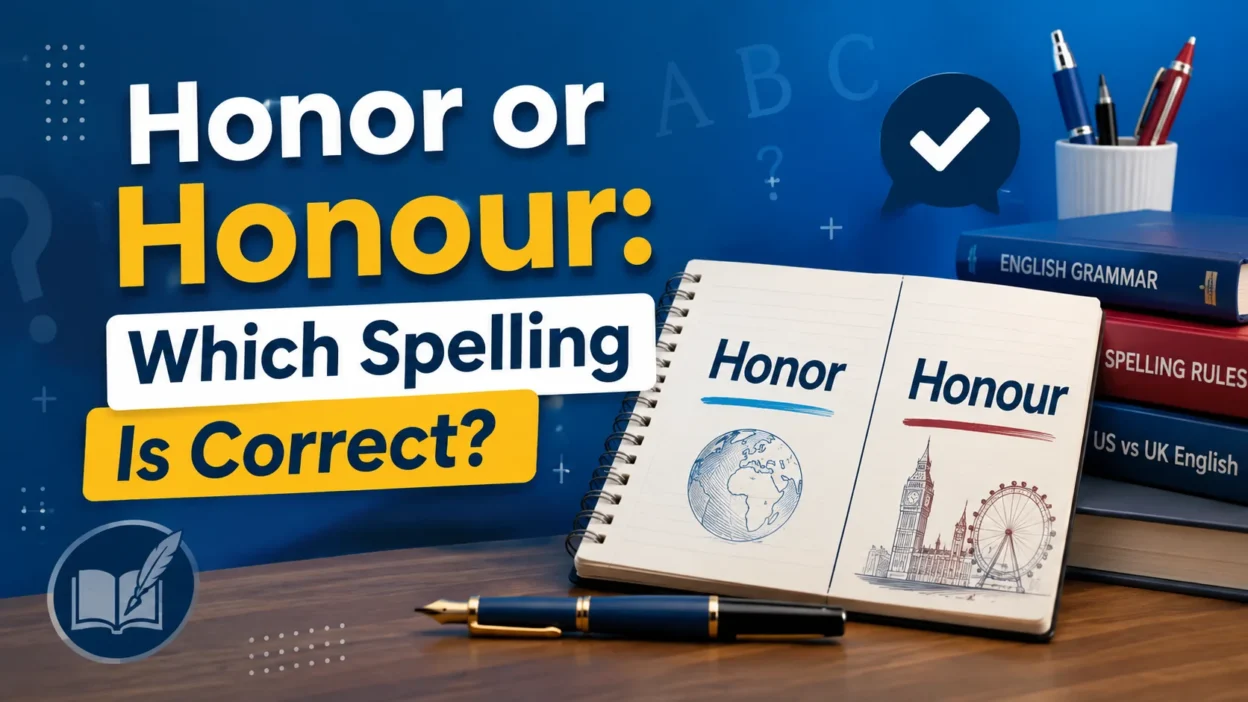
The English language has many spelling differences, and Honor’ or ‘Honour is a clear example. Both words have identical meanings, but American English uses honor, while British English uses honour. The American form drops the u, while the British form keeps it. Both are correct spelling choices in their own version of English, with the same meaning, usage, respect, and esteem. Similar differences appear in colour and colour, showing how language can vary across regions.
Your audience helps determine which variant to use. An American audience generally expects American spelling, while a British audience expects British spelling. This regional variation reflects language history, geography, education, cultural influence, and historical development. These factors have shaped English writing, English usage, and regional spelling conventions over centuries.
The same regional pattern appears in honored and honoured, honoring and honouring, and honorable and honourable. These forms represent the same word despite their noticeable differences. The distinction comes from established conventions, not different basic meanings. Understanding these spelling patterns helps English speakers choose the right regional standard for their audience.
Quick Answer: Honor or Honour?
Honor is the standard American English spelling, while honour is the standard British English spelling.
Both forms can mean respect, high regard, moral integrity, recognition, distinction, or the fulfillment of a promise or obligation. The pronunciation and meaning are generally the same. The spelling changes depending on the English variety.
| Feature | American English | British English |
| Main spelling | honor | honour |
| Past tense | honored | honoured |
| -ing form | honoring | honouring |
| Adjective | honorable | honourable |
| Opposite | dishonor | dishonour |
| Meaning | Same | Same |
| Main difference | Regional spelling | Regional spelling |
Easy rule: Choose honor for American English and honour for British English.
For example:
- American English: It was an honor to meet you.
- British English: It was an honour to meet you.
Neither sentence is wrong. Each follows a different spelling convention.
What Does Honor or Honour Mean?
The word honor/honour has several connected meanings. At its heart, it describes respect, esteem, integrity, recognition, or a strong sense of duty.
As a noun, it can describe the respect someone receives because of their character, actions, achievements, or position.
For example:
- The firefighter received an honor for his bravery.
- The soldier was treated with great honour.
- It was an honor to represent the school.
- She defended her family’s honour.
The word can also describe a distinction or award given to someone as recognition for achievement.
Consider this sentence:
The university gave her an honor for her outstanding research.
Here, honor means a distinction or recognition.
However, the word can also refer to personal integrity:
He refused to break his promise because he considered it a matter of honor.
In this context, honor refers to a person’s principles and sense of right and wrong.
Honor or Honour as a Noun
The noun honor/honour commonly appears in several situations.
Respect:
The community showed honor to the retiring teacher.
Recognition:
She received an honor for her contribution to science.
Integrity:
He kept his word because his honor mattered to him.
Privilege:
It was an honor to speak at the ceremony.
Distinction:
The athlete received several honors during his career.
These meanings overlap, but the surrounding sentence usually makes the intended sense clear.
Honor or Honour as a Verb
Honor/honour also works as a verb. It can mean to respect someone, recognize an achievement, or fulfill an agreement, promise, or obligation.
For example:
- The school honored the teacher for her dedication.
- The organization honoured the volunteers.
- The store agreed to honor the original price.
- The company promised to honour the agreement.
That last meaning deserves attention. When you honor an agreement, you follow through on what you promised.
So, honor isn’t always about ceremonies or awards. Sometimes it simply means doing what you said you’d do.
Honor or Honour in American and British English
The central distinction between honor and honour comes down to regional English standards.
American English generally uses the shorter -or spelling. British English generally retains the -our spelling.
That gives you a simple pattern:
American English: honor
British English: honour
The difference extends to several related forms as well.
When to Use “Honor” in American English
Use honor when you’re writing according to standard American English conventions.
Common American forms include:
- honor
- honored
- honoring
- honorable
- dishonor
- dishonored
- dishonorable
For example:
It was an honor to receive the award.
The city honored the firefighter for his bravery.
She made an honorable decision.
American English uses the same spelling pattern in several other words:
- color
- favor
- labor
- neighbor
- rumor
This makes the spelling of honor easier to remember. If you’re writing for an American audience, the -or form is generally the one you want.
When to Use “Honour” in British English
British English generally uses honour.
Its related forms include:
- honour
- honoured
- honouring
- honourable
- dishonour
- dishonoured
- dishonourable
For example:
It was an honour to receive the award.
The organization honoured her years of service.
He acted in an honourable manner.
British English uses this same -our pattern in words such as:
- colour
- favour
- labour
- neighbour
- rumour
The spelling may look longer, but the meaning doesn’t change.
Other English Varieties That Use “Honour”
The honour spelling isn’t restricted to England.
Several English varieties influenced by British spelling traditions commonly use honour, including Australian and New Zealand English. Canadian English also commonly retains honour, although Canadian spelling has its own blend of British and American conventions.
This is useful if you’re writing for an international audience. Geography can provide a strong clue, but it isn’t always enough to determine a publication’s exact style.
For professional or academic work, check the style guide or editorial standard being followed.
The safest approach is simple:
- Writing for a U.S. audience → use honor
- Writing for a British audience → use honour
- Writing for an international audience → choose one consistent style
- Following a specific publication’s style guide → follow its rules
Why Does American English Use “Honor” Instead of “Honour”?
The difference between honor and honour has historical roots.
English spelling absorbed considerable influence from French after the Norman Conquest. Words associated with French and Latin often developed spellings containing -our in English.
Over time, different English-speaking regions developed their own spelling preferences.
In the United States, Noah Webster played a major role in establishing American spelling conventions. His dictionaries favored some shorter and more standardized spellings. That helped strengthen forms such as honor, color, favor, and labor in American English.
British English generally retained the -our spellings.
This wasn’t a sudden switch where everyone woke up one morning and removed the letter u. Language rarely works that neatly. Spelling conventions evolve gradually through dictionaries, schools, publishers, government documents, and everyday usage.
The Honor/Honour Pattern Compared With Other Words
The same distinction appears in many familiar words.
| American English | British English |
| honor | honour |
| color | colour |
| favor | favour |
| labor | labour |
| neighbor | neighbour |
| rumor | rumour |
| behavior | behaviour |
| humor | humour |
This pattern makes honor vs. honour part of a much larger difference between American and British spelling.
However, don’t treat the pattern as an absolute rule. English contains plenty of historical exceptions and words that developed differently.
Language is a patchwork quilt, not a perfectly engineered machine.
Honor or Honour: Related Words and Spelling Patterns
The main spelling difference becomes more noticeable when you use derivatives.
| American English | British English |
| honor | honour |
| honored | honoured |
| honoring | honouring |
| honorable | honourable |
| dishonor | dishonour |
| dishonored | dishonoured |
| dishonorable | dishonourable |
| honorary | honorary |
Notice the final row.
Honor changes to honour, but honorary generally remains honorary in both varieties.
That distinction matters because writers sometimes assume that every related word must follow exactly the same spelling transformation.
It doesn’t.
For instance:
- American: honor
- British: honour
- American: honored
- British: honoured
- American: honorable
- British: honourable
- Both: honorary
Learning the common forms individually prevents awkward spelling mistakes.
Honor or Honour in Real Sentences
Seeing the two forms side by side makes the difference clearer.
| American English | British English |
| It was an honor to meet the author. | It was an honour to meet the author. |
| The city honored the veteran. | The city honoured the veteran. |
| She received a great honor. | She received a great honour. |
| He acted in an honorable way. | He acted in an honourable way. |
| The company honored the agreement. | The company honoured the agreement. |
| The event was held in honor of her. | The event was held in honour of her. |
The meaning remains stable throughout the examples.
Only the spelling follows a different regional convention.
A Practical Case Study
Imagine an American newspaper publishes this sentence:
The mayor said it was an honor to recognize the volunteers.
That spelling fits American English.
Now imagine a British newspaper reporting the same event:
The mayor said it was an honour to recognize the volunteers.
The second version isn’t a correction of the first. It’s simply a British spelling choice.
Now consider a writer who uses honor throughout an American article but suddenly writes:
The volunteers were honoured at the ceremony.
That inconsistency is more noticeable. If the article follows American English, honored would normally be the consistent form.
The lesson is straightforward: regional consistency matters more than choosing one spelling as universally correct.
Common Phrases With Honor or Honour
The word appears in many familiar expressions. These phrases follow the same regional spelling difference.
In Honor of or In Honour of
In honor of is the American form.
In honour of the British form.
The phrase means to show respect for, remember, or celebrate someone or something.
Examples:
- The scholarship was created in honor of her mother.
- The memorial was built in honour of the fallen soldiers.
The phrase appears frequently in announcements, ceremonies, memorials, awards, and celebrations.
On My Honor or On My Honour
This phrase refers to a person’s integrity or promise.
American English:
I swear on my honor that I’m telling the truth.
British English:
I swear on my honour that I’m telling the truth.
It carries a serious tone because the speaker connects the statement to personal reputation.
Honor System or Honour System
An honor system is a system that depends on people behaving honestly without constant supervision.
For example:
The exam operates under an honor system.
A British publication may write:
The exam operates under an honour system.
The concept remains the same.
Do Someone the Honor or Do Someone the Honour
This expression has a formal, sometimes ceremonial tone.
American English:
Would you do me the honor of joining us?
British English:
Would you do me the honour of joining us?
The expression often appears in invitations, formal requests, and traditional social language.
Conclusion
Honor and honour have the same basic meaning, but they belong to different English spelling standards. Honor is preferred in American English, while honour is standard in British English. The same difference appears in honored/honoured, honoring/honouring, and honorable/honourable. When choosing between them, focus on your audience and regional English. The key isn’t deciding which spelling is better. It’s using the correct form consistently.
FAQs
Q1.Is honor American or British English?
Honor is the standard spelling in American English. British English generally uses honour.
Q2.Is honour the correct British spelling?
Yes. Honour is the standard British English spelling. It also appears in several other English varieties influenced by British spelling conventions.
Q3.Do honor and honour mean the same thing?
Yes. Honor and honour have the same basic meaning. Both can refer to respect, esteem, recognition, integrity, or a sense of duty.
Q4.Should I use honor or honour in writing?
Choose honor when writing in American English and honour when following British English. Always consider your audience and regional spelling standards.
Q5.Is it honored or honoured?
Honored is the American spelling, while honoured is the British spelling. Both forms have the same meaning.