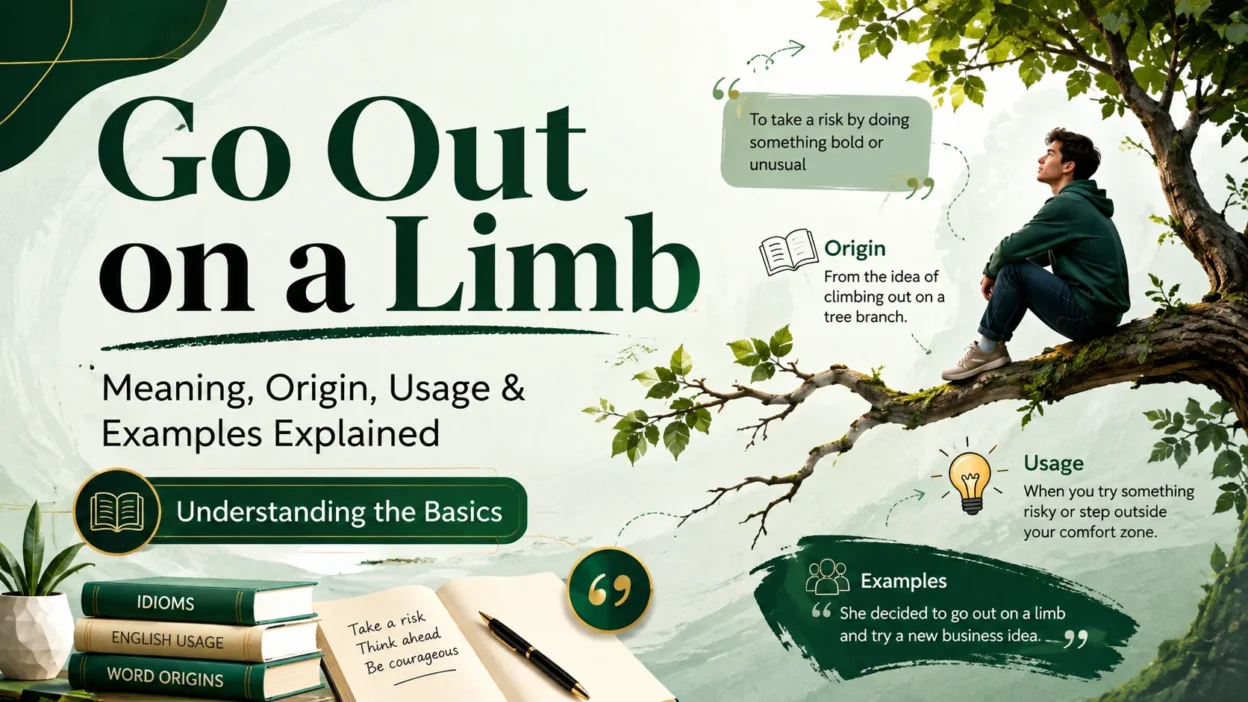
Go Out on a Limb means taking a risk when you make a bold choice without knowing the final result or whether your prediction will prove right. In English, this idiom works as a useful phrase or expression when someone makes a choice, shares an idea, or takes a position without complete proof. During conversations, you might communicate an opinion or prediction that could turn out wrong. You may still show courage by taking a risk, being willing to accept the result, and making a bold statement. For example, a manager may make a bold statement about a project even when others disagree, supporting an idea that might fail.
The phrase also describes how someone stands behind another person. If a coworker presents an unusual proposal and you support it despite criticism, you may go out on a limb for them. That kind of support can make everyday communication feel more natural because it shows trust instead of simple agreement. If you defended a colleague, you might later learn that your judgement was wrong, but that doesn’t erase the courage behind your decision. In everyday situations, this idiom often describes someone who is willing to take a risk despite uncertainty.
The same idea applies to opinions, predictions, and decisions. You might communicate that a prediction will come true, even though the final result could prove you wrong. You could also support a friend’s plan when there’s no guarantee of success. This is why go out on a limb remains a flexible phrase: it captures the moment when someone chooses courage over safety, accepts a risk, and makes a bold statement while supporting an idea.
Quick Answer: What Does “Go Out on a Limb” Mean?
“Go out on a limb” means to take a risk by saying, doing, or supporting something when the outcome is uncertain.
People use this idiom when someone makes a bold prediction, shares an unusual opinion, or supports a person or idea without guaranteed success.
Examples:
- “I’ll go out on a limb and say this team will win the championship.”
- “She went out on a limb to recommend a new strategy at work.”
- “He went out on a limb by defending his colleague during the meeting.”
The phrase does not always mean a dangerous risk. Sometimes it simply means someone is willing to be brave, different, or confident.
Go Out on a Limb Meaning in Different Contexts
The meaning of go out on a limb changes slightly depending on the situation. However, the central idea remains the same: someone accepts uncertainty.
The idiom usually involves three elements:
| Element | Meaning |
| Risk | The person accepts possible failure or criticism |
| Confidence | The person believes their choice may succeed |
| Uncertainty | The result is not guaranteed |
Taking a Risk or Making a Bold Prediction
One of the most common uses of go out on a limb involves making a prediction.
When someone predicts an outcome before there is enough evidence, they are taking a chance. If the prediction becomes correct, they appear confident. If it fails, they accept responsibility.
For example:
“I’m going out on a limb and predicting that this technology will change the industry.”
The speaker understands that the prediction might be wrong, but they are willing to express it.
This usage appears frequently in:
- Sports predictions
- Market forecasts
- Political discussions
- Business planning
- Scientific opinions
A financial analyst predicting a company’s future growth is going out on a limb. A coach predicting a young player’s success is also taking a similar risk.
Supporting Someone or Something
The phrase also describes situations where someone supports another person despite uncertainty.
Imagine an employee recommending a new team member for a leadership role. The employee believes in that person’s ability, but success is not guaranteed.
Example:
“My manager went out on a limb and gave me the opportunity to lead the project.”
Here, the manager accepted a professional risk by trusting someone.
This meaning often carries a positive feeling because it shows:
- Loyalty
- Trust
- Courage
- Leadership
Going out on a limb for someone can create strong relationships because it shows confidence when others hesitate.
Going Beyond the Safe or Expected Choice
Sometimes people use this idiom when someone chooses an unusual path.
A person may leave a comfortable career to start a business. An artist may create a completely different style. A company may introduce an innovative product.
These choices involve uncertainty, but they can also create major opportunities.
A safe choice protects you from failure. A bold choice can create unexpected success.
Where Does “Go Out on a Limb” Come From?
The expression has a clear connection to the physical image of climbing a tree.
When someone walks onto a tree branch away from the trunk, the branch becomes less stable. The person becomes more exposed and vulnerable.
That simple picture created the metaphor behind the idiom.
The Literal Meaning of Going Out on a Tree Limb
A tree trunk provides strength and support. A limb or branch becomes weaker as you move farther away from the center.
Someone standing on a far branch faces more risk because:
- The branch may break.
- Balance becomes harder.
- Returning to safety becomes more difficult.
English often creates expressions by turning physical experiences into ideas.
For example:
- Breaking the ice comes from physically breaking ice.
- Hitting the nail on the head comes from accurate hammering.
- Going out on a limb comes from moving into a risky position.
How the Literal Image Became Figurative
Over time, English speakers began using the phrase to describe social and intellectual risks rather than physical danger.
Instead of literally standing on a branch, someone was “out on a limb” because their opinion, decision, or action placed them in a vulnerable position.
The phrase became especially common in American English during the late 19th and early 20th centuries.
Today, people rarely think about an actual tree branch when using it. They understand it as a metaphor for uncertainty and courage.
How to Use “Go Out on a Limb” in a Sentence
Using this idiom correctly is simple once you understand its structure.
Sentence Patterns With “Go Out on a Limb”
Common patterns include:
Go out on a limb + to + verb
Example:
- “She went out on a limb to defend the new policy.”
Go out on a limb + and + make a statement
Example:
- “I’ll go out on a limb and say this is the best movie of the year.”
Go out on a limb + for someone
Example:
- “My teacher went out on a limb for me when I needed support.”
The verb changes depending on the tense:
| Tense | Example |
| Present | I go out on a limb |
| Past | I went out on a limb |
| Continuous | I am going out on a limb |
| Future | I will go out on a limb |
Examples of “Go Out on a Limb”
| Situation | Example Sentence | Meaning |
| Work | “I’ll go out on a limb and suggest a different approach.” | Offering a risky idea |
| Friendship | “She went out on a limb to help her friend.” | Providing strong support |
| Sports | “The commentator went out on a limb with his prediction.” | Making a bold guess |
| Business | “The company went out on a limb by launching a unique product.” | Taking an unusual risk |
Go Out on a Limb in Professional and Everyday English
The idiom works well in both casual and professional conversations.
However, the setting matters. In formal documents, a direct phrase like “take a calculated risk” may sound more appropriate.
Using the Idiom at Work
Professionals often use go out on a limb when discussing:
- New ideas
- Business strategies
- Predictions
- Recommendations
- Leadership decisions
Example:
“I’m going out on a limb, but I believe this campaign will increase sales.”
This sentence shows confidence while admitting uncertainty.
Good leaders often need to go out on a limb because innovation requires decisions without perfect information.
Using the Idiom in Casual Conversation
In everyday speech, the phrase sounds natural and friendly.
Examples:
- “I’ll go out on a limb and guess you love coffee.”
- “I’m going out on a limb here, but I think you’ll enjoy this book.”
It can even add humor because the speaker acknowledges that their guess may not be perfect.
Go Out on a Limb vs Similar Expressions
Several English expressions share similar meanings, but each has a slightly different tone.
| Expression | Meaning | Difference |
| Go out on a limb | Take a risk or make a bold statement | Often involves opinions or support |
| Take a risk | Accept possible failure | More general |
| Take a chance | Try something uncertain | Usually more casual |
| Stick your neck out | Put yourself in a vulnerable position | Often involves personal exposure |
| Leap of faith | Act without complete proof | Focuses on trust |
Go Out on a Limb vs Take a Risk
“Take a risk” is broader.
Example:
- Buying a new car can be a risk.
- Predicting a company’s future success means you may be going out on a limb.
The idiom often involves communication, judgment, or personal commitment.
Go Out on a Limb vs Stick Your Neck Out
These phrases are very similar.
“Stick your neck out” often emphasizes personal danger or criticism.
Example:
“She stuck her neck out to report the problem.”
“Go out on a limb” often feels slightly more thoughtful or analytical.
Common Mistakes With “Go Out on a Limb”
Common mistakes include using “go out on a limb” for minor choices, misunderstanding its figurative meaning, or using it in overly formal writing.
Using It for Every Small Decision
Not every choice qualifies as going out on a limb.
Choosing a restaurant is usually not a major risk. However, recommending a restaurant to a large group with different preferences might be a small example.
The phrase works best when some uncertainty exists.
Confusing It With Physical Language
Although the phrase comes from a tree image, modern speakers usually use it figuratively.
Most people are not talking about actual climbing.
Using It in Highly Formal Writing
The phrase works well in:
- Blogs
- Conversations
- Interviews
- Articles
However, formal reports may require clearer wording.
Instead of:
“The company went out on a limb.”
A formal report might say:
“The company accepted a significant strategic risk.”
Go Out on a Limb Synonyms and Alternatives
Depending on the situation, you can replace the phrase with:
- Take a risk
- Take a chance
- Make a bold prediction
- Stick your neck out
- Take a bold position
- Put yourself on the line
- Make a daring choice
Each alternative has a slightly different feeling.
For example, putting yourself on the line suggests personal consequences, while making a bold prediction focuses on expressing an opinion.
Sure — here’s the same section with the key terms and important phrases bolded for emphasis.
Conclusion
Conjunctive adverbs are useful words that help you connect ideas and show the relationship between sentences. Words such as however, therefore, moreover, consequently, meanwhile, otherwise, and nevertheless can make your writing clearer and more logical.The key is to use the correct punctuation. When a conjunctive adverb connects two independent clauses, use a semicolon before it and a comma after it. For example: The task was difficult; however, she completed it on time. With regular practice, you’ll be able to use these words naturally in essays, emails, conversations, and professional writing.
FAQs
Q1.What is a conjunctive adverb?
A conjunctive adverb is a word or phrase that connects ideas and shows the relationship between them. It can express contrast, cause and effect, addition, time, or another logical connection. Examples include however, therefore, furthermore, consequently, and meanwhile.
Q2.What are some common conjunctive adverbs?
Common conjunctive adverbs include however, therefore, moreover, furthermore, nevertheless, consequently, otherwise, meanwhile, instead, similarly, and thus. Each one helps communicate a specific relationship between ideas.
Q3.How do you punctuate a conjunctive adverb?
When a conjunctive adverb connects two independent clauses, place a semicolon before it and a comma after it.
Q4.Can a conjunctive adverb start a sentence?
Yes. A conjunctive adverb can begin a sentence when you want to connect it with the previous idea.
Q5.What is the difference between a conjunctive adverb and a conjunction?
A conjunction directly joins words, phrases, or clauses, while a conjunctive adverb explains the logical relationship between ideas. For example, but is a coordinating conjunction, whereas however is a conjunctive adverb.