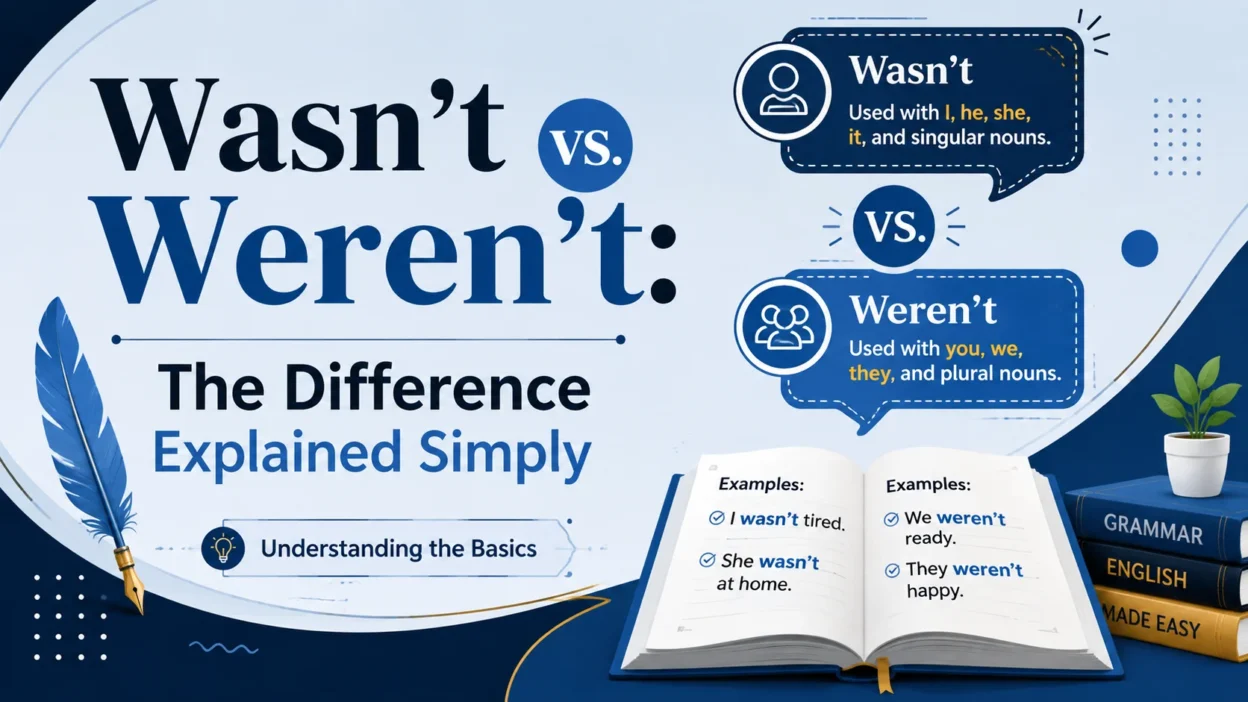
Wasn’t vs. Weren’t often confuses writers because both forms make past statements negative, yet each follows a different grammar rule in English. Wasn’t means was not, while weren’t means were not. The basic rule is straightforward: use wasn’t with a singular subject such as he or she, and use weren’t with plural subjects such as they. The pronoun you is different because you weren’t working for one person or several people. In everyday conversation and everyday language, mastering this difference helps strengthen your English grammar, English writing, and English speaking skills.
The simple rule has an important exception when a sentence expresses a hypothetical or contrary-to-fact idea. He wasn’t happy. If he weren’t happy, we’d leave. The first describes an actual past-tense state, while the second presents an imagined situation. This grammatical mood explains why we can’t appear with a singular subject. The same pattern appears in You weren’t there and They weren’t ready, as well as sentences about being busy, going to the office, or deciding whether to join someone. Choosing between the forms requires attention to meaning and context, rather than relying only on whether a subject is singular or plural.
For English writing and English speaking, this understanding turns the apparent battle between wasn’t and weren’t into less of a conundrum. To handle the question, consider whether you’re describing a real situation or an imagined one. These common mistakes and common errors can affect your grammar skills, writing skills, and speaking skills, especially when you speak or write quickly. The first sentence might report what happened yesterday, while the second describes what could happen under different conditions. One small change can alter the meaning of an entire sentence, which makes this distinction worth understanding if you want to use wasn’t vs. weren’t naturally.
Quick Answer: Wasn’t vs. Weren’t
Use wasn’t as the negative form of was with singular subjects in ordinary past-tense statements.
Use weren’t as the negative form of were with plural subjects and with you. However, we can’t also follow a singular subject in hypothetical, unreal, or contrary-to-fact situations.
Quick rule: Ordinary past fact → match the subject. Hypothetical or contrary-to-fact situations → weren’t correct with a singular subject.
| Subject or situation | Correct form | Example |
| I | wasn’t | I wasn’t ready. |
| He | wasn’t | He wasn’t home. |
| She | wasn’t | She wasn’t interested. |
| It | wasn’t | It wasn’t broken. |
| You | weren’t | You weren’t late. |
| We | weren’t | We weren’t prepared. |
| They | weren’t | They weren’t available. |
| Singular hypothetical subject | weren’t | If I weren’t busy, I’d help. |
So, “wasn’t” and “weren’t” aren’t interchangeable. Subject agreement handles most cases, while the subjunctive mood explains the important exception.
What’s the Difference Between “Wasn’t” and “Weren’t”?
Wasn’t is the contraction of was not.
Weren’t is the contraction of were not.
Both forms make a past-tense statement negative, but they normally pair with different subjects.
For example:
- I wasn’t tired.
- She wasn’t available.
- The store wasn’t open.
- We weren’t tired.
- They weren’t available.
- The stores weren’t open.
The difference becomes more subtle when you introduce hypothetical conditions.
Consider:
- She wasn’t at home.
- If she weren’t at home, where would she be?
The first sentence describes or questions a past fact. The second sentence considers an imagined condition.
That distinction is the heart of wasn’t vs. weren’t.
Wasn’t vs. Weren’t: The Basic Grammar Rule
In standard English, was and were are past forms of the verb be. Their negative contractions follow the same basic subject pattern.
Singular Subjects Usually Take “Wasn’t”
Use wasn’t with singular subjects in ordinary past-tense statements.
Common singular subjects include:
- I
- he
- she
- it
- singular nouns
- singular noun phrases
Examples:
- I wasn’t hungry.
- He wasn’t at school.
- She wasn’t feeling well.
- It wasn’t expensive.
- The meeting wasn’t productive.
- My brother wasn’t interested.
Here, the sentence describes a situation connected to the past. Nothing hypothetical requires the special ware form.
Plural Subjects Usually Take “Weren’t”
Use weren’t with plural subjects in ordinary past-tense sentences.
Examples include:
- We weren’t ready.
- They weren’t at the restaurant.
- The children weren’t asleep.
- My parents weren’t surprised.
- The employees weren’t satisfied.
A simple test helps: identify who or what the sentence describes, then determine whether that subject is singular or plural.
The students weren’t prepared.
Students is plural, so weren’t fit.
The student wasn’t prepared.
Student is singular, so wasn’t fit.
“You” Takes “Weren’t”
One important detail often catches learners off guard: you take were, whether you refer to one person or several people.
Correct:
- You weren’t late. — one person
- You weren’t late. — several people
Incorrect in standard English:
- You wasn’t late.
English once had more complicated distinctions between singular and plural forms of you. Modern standard English doesn’t use it with you.
Quick Comparison Table
| Subject | Ordinary negative past form | Example |
| I | wasn’t | I wasn’t worried. |
| He | wasn’t | He wasn’t available. |
| She | wasn’t | She wasn’t angry. |
| It | wasn’t | It wasn’t necessary. |
| Singular noun | wasn’t | The dog wasn’t hungry. |
| You | weren’t | You weren’t wrong. |
| We | weren’t | We weren’t prepared. |
| They | weren’t | They weren’t invited. |
| Plural noun | weren’t | The dogs weren’t hungry. |
When “Weren’t” Is Correct With a Singular Subject
Here’s the rule that trips up even experienced writers:
A singular subject can correctly take “weren’t” in certain hypothetical or contrary-to-fact constructions.
For example:
- If I weren’t so busy, I’d help you.
- If she weren’t tired, she’d come with us.
- If he weren’t your brother, you might react differently.
- If it weren’t for your advice, I’d be lost.
At first glance, these sentences seem to violate subject-verb agreement. They don’t.
The reason is subjunctive mood.
The Subjunctive Mood Explained Simply
The subjunctive mood helps English express situations that aren’t presented as ordinary facts. These situations can include:
- Hypothetical conditions
- Unreal situations
- Contrary-to-fact circumstances
- Wishes
- Certain recommendations or demands
With the verb be, traditional English grammar uses were in many hypothetical constructions, even when the subject is singular.
That’s why you can say:
If I weren’t so busy, I’d go.
You wouldn’t normally say I weren’t when describing an ordinary past fact. But the sentence isn’t an ordinary past statement. It describes an imagined condition.
“If I Weren’t…” vs. “If I Wasn’t…”
This distinction deserves special attention because both forms can occur in modern English, depending on meaning and context.
If I weren’t available, we’d need another person.
This strongly suggests a hypothetical or contrary-to-fact situation.
If I wasn’t available yesterday, I apologize for missing your call.
This refers to a possible past reality. The speaker doesn’t necessarily know whether they were available.
The difference is subtle but meaningful.
| Sentence | Main idea |
| If I weren’t busy, I’d come. | Hypothetical or contrary-to-fact |
| If I wasn’t at home, I would have been at work. | Possible past fact |
| If she weren’t sick, she’d be here. | Hypothetical condition |
| If she wasn’t at the meeting, who was? | Question about a past possibility |
In careful formal writing, weren’t remains the clearest traditional choice for many unreal or contrary-to-fact conditions.
“I Weren’t” and Other Singular Subjunctive Forms
The subjunctive pattern isn’t limited to I.
You can also see:
- If he weren’t here, we’d have a problem.
- If she weren’t my friend, I might be offended.
- If it weren’t raining, we’d go outside.
- If the machine weren’t broken, we could use it.
Notice the pattern. The subjects are singular, yet weren’t appear because the statements describe hypothetical conditions.
Wasn’t vs. Weren’t in Hypothetical and Unreal Conditions
A useful way to understand wasn’t vs. weren’t is to ask whether the sentence presents something as a fact or an imagined condition.
Situations That Are Contrary to Fact
Use weren’t in many traditional subjunctive constructions involving situations contrary to reality.
For example:
If I weren’t afraid of heights, I’d go skydiving.
The speaker is presenting fear as an existing condition. The sentence imagines what would happen if that condition were different.
Another example:
If he weren’t already married, he might consider the offer.
The sentence imagines a different reality.
Situations That May Have Been True in the Past
When you’re talking about something that might actually have happened, wasn’t can not be appropriate.
For example:
If Sarah wasn’t at work, she probably went home.
The speaker is considering a real possibility. Sarah may or may not have been at work.
That’s different from:
If Sarah weren’t at work, she’d be here.
The second sentence creates a hypothetical condition.
How the Meaning Changes
Changing wasn’t to weren’t isn’t merely a cosmetic grammar adjustment.
Compare:
- If he wasn’t there, he missed the announcement.
- If he weren’t there, we’d need someone else to lead.
The first sentence looks backward toward a possible past fact. The second imagines a different situation.
Context does the heavy lifting.
Wasn’t vs. Weren’t in Questions
Both forms appear naturally in questions.
Questions About Past Facts
Use wasn’t with ordinary singular subjects.
Examples:
- Wasn’t he at the meeting?
- Wasn’t she your manager?
- Wasn’t the store open yesterday?
Use weren’t with plural subjects and you:
- Weren’t they invited?
- Weren’t we supposed to leave earlier?
- Weren’t you at the party?
Questions About Hypothetical Situations
The subjunctive weren’t can also appear in hypothetical questions:
- What if she weren’t available?
- What would happen if he weren’t here?
- Would you leave if I weren’t around?
Again, the singular subject doesn’t automatically demand wasn’t. The sentence’s meaning matters.
Wasn’t and Weren’t in Negative Statements
The contractions wasn’t and weren’t extremely common in everyday English.
“Wasn’t” as “Was Not”
Examples:
- The answer wasn’t obvious.
- I wasn’t expecting that.
- She wasn’t responsible for the mistake.
The full form was not can add emphasis:
- She was not responsible for the mistake.
“Weren’t” as “Were Not”
Examples:
- They weren’t ready.
- We weren’t expecting visitors.
- You weren’t supposed to open it.
The full form can likewise create emphasis:
- They were not ready.
In ordinary conversation, contractions generally sound more natural. Formal writing doesn’t prohibit them, though style requirements can vary by publication or institution.
Common “Wasn’t vs. Weren’t” Mistakes
The most common “wasn’t vs. weren’t” mistakes involve subject-verb agreement, confusing ordinary past facts with hypothetical situations, and misusing the subjunctive “weren’t.”
Using “Wasn’t” With Plural Subjects
Incorrect:
They wasn’t interested.
Correct:
They weren’t interested.
The subjects they required were in standard English.
Using “Weren’t” With Singular Subjects in Ordinary Statements
Incorrect:
She wasn’t at home.
Correct:
She wasn’t at home.
This is a straightforward subject-verb agreement error.
Assuming Every Singular Subject Requires “Wasn’t”
This mistake goes in the opposite direction.
Consider:
If she weren’t busy, she’d join us.
Here, weren’t is correct because the sentence expresses a hypothetical condition.
Confusing Hypothetical Meaning With Past Facts
Compare these:
- If he wasn’t there, he wouldn’t hear the announcement.
- If he weren’t there, we’d have to find another manager.
The first focuses on a possible past reality. The second presents an imagined condition.
Overcorrecting Every “Wasn’t” to “Weren’t”
Some writers learn about the subjunctive and then start using weren’t everywhere.
That’s just another mistake.
You shouldn’t write:
She weren’t at the store yesterday.
The correct sentence is:
She wasn’t at the store yesterday.
The subjunctive exception doesn’t erase normal subject-verb agreement.
Here’s a concise conclusion followed by five useful FAQs that reinforce the key “wasn’t vs. weren’t” rules.
Conclusion
Understanding wasn’t vs. weren’t becomes much easier when you focus on the subject and the meaning of the sentence. Use wasn’t with singular subjects in ordinary past statements, while weren’t works with plural subjects and you. However, remember the important exception: we can’t follow a singular subject in hypothetical or contrary-to-fact situations. Once you recognise whether you’re describing a real past event or an imagined condition, choosing the correct form becomes far more natural.
FAQs
Q1.Is “wasn’t” singular or plural?
Wasn’t is normally used with singular subjects in ordinary past-tense statements, such as He wasn’t ready or She wasn’t home.
Q2.Is “weren’t” singular or plural?
Weren’t normally goes with plural subjects and you. It can also follow singular subjects in hypothetical or contrary-to-fact constructions.
Q3.Is “you wasn’t” correct?
No. In standard English, you don’t use whether you refer to one person or several people.
Q4.Should you say “if I wasn’t” or “if I weren’t”?
Both can occur, depending on meaning. If I weren’t is traditionally preferred for hypothetical or contrary-to-fact situations, while if I wasn’t can refer to a possible past fact.
Q5.Is “if she weren’t” grammatically correct?
Yes. If she weren’t is correct when the sentence expresses a hypothetical or contrary-to-fact condition, such as If she weren’t busy, she’d come with us.