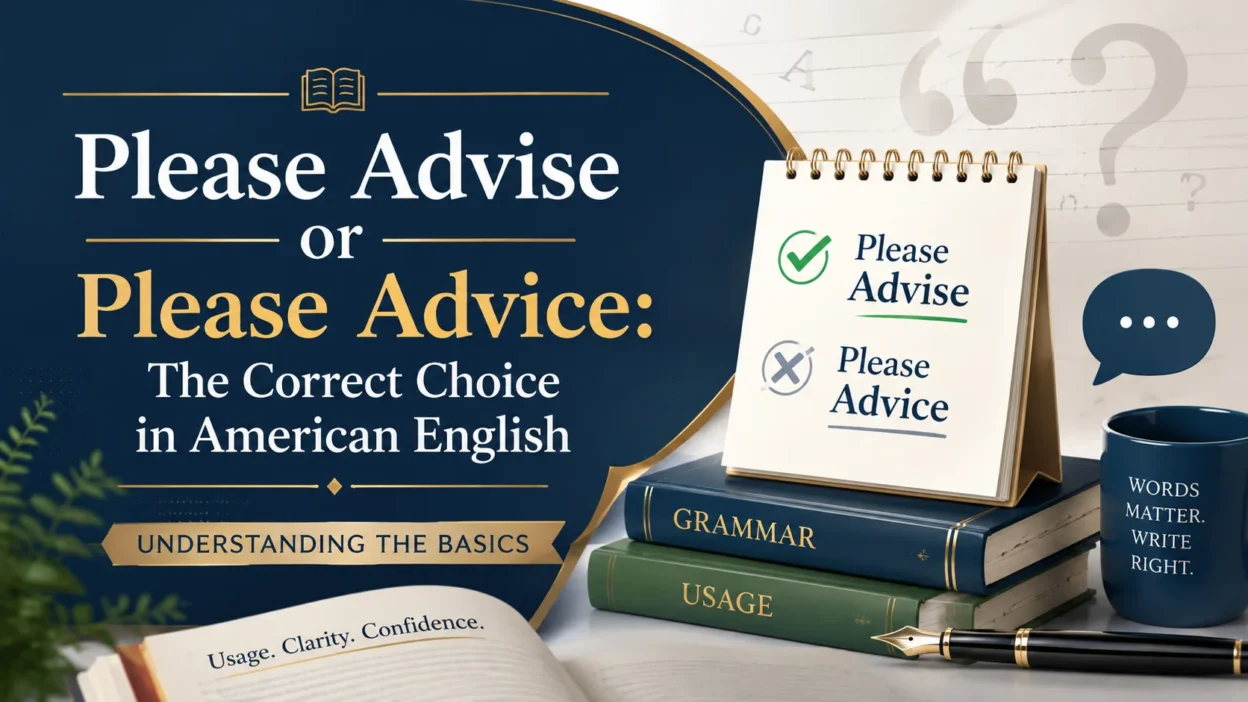
Please Advise or Please Advice can confuse writers when they need a clear, professional phrase for an email request. The two words look similar, but they have different grammatical jobs. Advise is a verb used when you ask someone to provide information or guidance, while advice is a noun for the guidance itself. Once you understand this difference, the correct choice becomes much easier.
In professional communication, please advise when you want someone to respond, explain something, or provide useful information. For example, “Please advise whether the meeting time has changed” uses advice correctly because it functions as a verb. By contrast, “Please provide some advice” uses advice as a noun. Although both forms relate to guidance, their roles aren’t interchangeable.
This distinction also helps your message sound clear and polished instead of leaving the reader puzzled. You can ask someone to advise you about a problem, but you can ask someone for advice about the same issue. Once this grammar point becomes familiar, you can communicate your request with greater confidence and avoid a common English grammar mistake.
Quick Answer: “Please Advise” or “Please Advice”?
“Please advise” is correct. “Please advice” is incorrect when you want to ask someone for guidance, information, or a response.
The reason is simple:
| Word | Part of speech | Meaning | Example |
| Advise | Verb | To give guidance or recommend something | Please advise me on the next step. |
| Advice | Noun | Guidance or a recommendation | Your advice was useful. |
In “Please advise,” the word advise acts as a verb. The sentence essentially means “Please give me your guidance” or “Please let me know what I should do.”
By contrast, advice names the guidance itself. You can give advice, receive advice, or ask for advice, but you don’t normally use advice as the verb in standard American English.
So if you’re ending an email with a request for a response, choose “Please advise.”
“Advise” or “Advice”: The Core Difference
The spelling difference is tiny, but the grammatical difference is fundamental.
Advise as a Verb
Advice is a verb. It describes the action of giving guidance, making a recommendation, or informing someone about what they should consider.
For example:
- The manager advised the team to review the contract.
- The doctor advised him to rest.
- Could you advise me about the application process?
- Please advise us of any changes.
Notice that advice describes something a person does. That’s the easiest way to recognize it.
If you can replace the word with recommend, inform, or counsel, you’re probably looking for advice.
Advice as a Noun
Advice is a noun. It refers to the guidance, recommendation, or opinion someone gives.
Consider these examples:
- She gave me valuable advice.
- I need your advice before making a decision.
- His advice helped us avoid costly mistakes.
- Thank you for your advice.
Here, advice isn’t an action. It’s the thing being given or received.
A useful mental shortcut is:
You advise someone. You give someone advice.
That distinction solves most advice vs. advice problems immediately.
Pronunciation: The Key Sound Difference
Pronunciation provides another useful clue.
Advise ends with a /z/ sound, while advice ends with an /s/ sound.
- advise → /ədˈvaɪz/
- advice → /ədˈvaɪs/
Both words contain the long “i” sound, as in eye. The final consonant changes.
This distinction can help when you’re speaking, although context usually makes the meaning clear. In writing, however, you need to choose the correct spelling.
What Does “Please Advise” Mean?
Please advise is a concise request for information, guidance, clarification, or a decision.
Depending on the context, it can mean:
- Please tell me what to do.
- Please give me your recommendation.
- Please provide the requested information.
- Please let me know your decision.
- Please clarify the situation.
For example:
The shipment hasn’t arrived yet. Please advise on how we should proceed.
Here, the writer isn’t asking for a physical object called “advice.” The writer wants the recipient to take action by providing guidance. That’s why the verb advise fits.
Is “Please Advise” Grammatically Correct?
Yes. “Please advise” is grammatically correct in American English.
The structure is straightforward:
Please + base-form verb
You see the same structure in expressions such as:
- Please respond.
- Please confirm.
- Please explain.
- Please review.
- Please advise.
Because advise is a verb, it fits naturally after please.
When “Please Advise” Works Naturally
Use please advise when you need someone to provide guidance or information.
For example:
Please advise whether the meeting will proceed as scheduled.
Or:
Please advise me if additional documents are required.
In both cases, you’re requesting an action from the reader.
What “Please Advise” Implies in Professional Communication
In business writing, please advise often signals that the writer needs the recipient to make the next move.
It can request:
- A decision
- Clarification
- Instructions
- Confirmation
- An update
- A recommendation
- Additional information
However, context determines its precise meaning.
When “Please Advise” Can Sound Too Formal or Abrupt
Although grammatically correct, please advise can sound somewhat formal. In some emails, it may also feel curt because the phrase is so compact.
For a warmer tone, you might write:
- Please let me know what you recommend.
- Could you let me know how you’d like to proceed?
- Could you please clarify this for me?
- I’d appreciate your guidance on this.
- Please let me know your thoughts.
The choice depends on your relationship with the reader and the situation.
“Please Advice” or “Please Advise”: Why One Is Wrong
“Please advice” is incorrect when “advice” is intended to mean give guidance.
The problem isn’t pronunciation. It’s grammar.
Advice is a noun, while advice is a verb. After please, English normally uses the base form of a verb when making a polite request.
Compare:
- Please advise. ✓
- Please respond. ✓
- Please confirm. ✓
- Please give me some advice. ✗
The last example doesn’t work because advice can’t perform the verb’s job in standard American English.
Why “Advice” Doesn’t Work as the Verb
Imagine saying:
Please advise me about the problem.
The intended meaning is clear, but the word choice is wrong. The correct sentence is:
Please advise me about the problem.
The noun version would be:
Please give me some advice about the problem.
That comparison reveals the difference beautifully:
advise = action
advice = guidance
How to Use “Advise” Correctly
Advise has several common uses beyond the phrase please advise.
“Advise” for Giving Guidance
Use advice when someone gives another person a recommendation.
The consultant advised us to reduce unnecessary expenses.
The consultant performed the action of giving guidance.
“Advise” for Recommending an Action
You can also use advice when someone recommends a particular course of action.
The technician advised replacing the damaged cable.
Here, the verb connects the person giving guidance with the recommended action.
“Advise” in Professional and Workplace Writing
Professional communication frequently uses advice because workplaces often involve requests for decisions, updates, and instructions.
Examples include:
Please advise whether the revised schedule works for your team.
Please advise us of any changes to the order.
Could you advise me on the correct procedure?
The phrase advise of is especially common in formal communication. In this construction, it means inform or notify.
“Advise” in Questions and Requests
You can use advise naturally in direct questions:
Could you advise me on the best option?
Can you advise us about the required documents?
The word remains a verb in each sentence.
How to Use “Advice” Correctly
Advice refers to the guidance itself.
You don’t perform “advice.” You give, offer, receive, or seek it.
“Advice” as an Uncountable Noun
In standard American English, advice is generally an uncountable noun.
That means you normally don’t say:
I received three pieces of advice.
Instead, use:
I received three pieces of advice.
Or:
She gave me some advice.
This point trips up many English learners because similar words can take a plural form.
Common Phrases With Advice
Several expressions appear frequently in natural English:
- give advice
- offer advice
- ask for advice
- seek advice
- take advice
- follow advice
- receive advice
- some advice
- a piece of advice
- valuable advice
- professional advice
- practical advice
For example:
I asked my supervisor for advice before responding.
How to Use “Some Advice” and “A Piece of Advice”
Because advice is uncountable, some advice works naturally:
Could you give me some advice?
When you want to refer to one individual recommendation, use a piece of advice:
Here’s a piece of advice that may save you time.
You can also say two pieces of advice, several pieces of advice, or a few pieces of advice.
Why “Advices” Is Usually Incorrect
In ordinary American English, advice is not the standard plural of advice.
Use:
- some advice
- a piece of advice
- two pieces of advice
- several pieces of advice
The distinction is worth remembering because advice behaves differently from countable nouns such as suggestion or recommendation.
“Advise” or “Advice” in Real Sentences
Seeing the words side by side makes the difference much easier to remember.
| Advise | Advice |
| Please advise me on the next step. | Please give me your advice. |
| She advised him to wait. | Her advice was sensible. |
| The lawyer advised us to review the terms. | We followed the lawyer’s advice. |
| Could you advise me? | Could you give me some advice? |
| Please advise us of any changes. | Thank you for your advice. |
Examples With Advise
Here are several natural examples:
Please advise when you’re available.
The accountant advised us to keep detailed records.
Could you advise me about the application?
The customer service representative advised her to contact the billing department.
Examples With Advice
Now compare those sentences with noun-based examples:
I appreciate your advice.
His advice helped me make a better decision.
She asked for advice about the interview.
We followed the consultant’s advice.
Side-by-Side Examples That Show the Difference
A particularly useful pattern is to pair the words in related sentences:
The manager advised me to wait.
The manager gave me good advice.
The meaning remains closely connected. The grammar changes.
That’s the key.
Common Mistakes With “Advise” and “Advice”
Even experienced writers occasionally confuse these words because their spelling and pronunciation are so similar.
Using “Advice” as a Verb
Incorrect:
Please advise me about the issue.
Correct:
Please advise me about the issue.
Using “Advise” as a Noun
Incorrect:
Thank you for your advice.
Correct:
Thank you for your advice.
Writing “Advices” Instead of “Advice”
Incorrect:
She gave me some useful advice.
Correct:
She gave me several useful pieces of advice.
Confusing Spelling Because of Similar Pronunciation
The final sounds offer a useful distinction:
advise → /z/
advice → /s/
The words aren’t interchangeable simply because they sound similar.
Absolutely — here’s the same section with the key terms and important phrases bolded.
Conclusion
Understanding the difference between “Wasn’t” and “Weren’t” becomes much easier when you focus on the subject and the type of sentence. Use “wasn’t” with singular subjects such as I, he, she, and it in most ordinary past-tense statements. Use “weren’t” with you, we, and they, as well as in certain hypothetical or unreal situations, such as “If I weren’t so busy, I’d help.”The key is to pay attention to whether you’re describing a real past situation or an imagined one. Once you recognise that difference, choosing between “wasn’t” and “weren’t” feels far more natural. With regular practice, you’ll be able to use both forms confidently in everyday conversations and formal writing.
FAQs
Q1. Is “wasn’t” grammatically correct?
Yes. “Wasn’t” is the contraction of “was not” and is grammatically correct when used with the appropriate subject, such as I, he, she, or it.
Q2. Is “weren’t” grammatically correct?
Yes. “Weren’t” is the contraction of “were not.” It normally works with you, we, and they. It can also appear with singular subjects in hypothetical or unreal statements, such as “If I weren’t tired, I would go.”
Q3. Should I say “I wasn’t” or “I weren’t”?
In ordinary past-tense statements, say “I wasn’t.” For example: “I wasn’t at work yesterday.” However, “I weren’t” can occur in certain hypothetical constructions, especially after “if,” as in “If I weren’t busy, I’d join you.”
Q4. What is the difference between “wasn’t” and “weren’t”?
“Wasn’t” means “was not,” while “weren’t” means “were not.” The choice usually depends on the subject and whether the sentence describes a real past situation or an unreal or hypothetical condition.
Q5. What is an easy way to remember “wasn’t” vs. “weren’t”?
Remember the basic pattern: I/he/she/it → wasn’t and you/we/they → weren’t. Then remember one important exception: hypothetical or unreal situations can use “were” with singular subjects, as in “If I weren’t here, what would you do?”