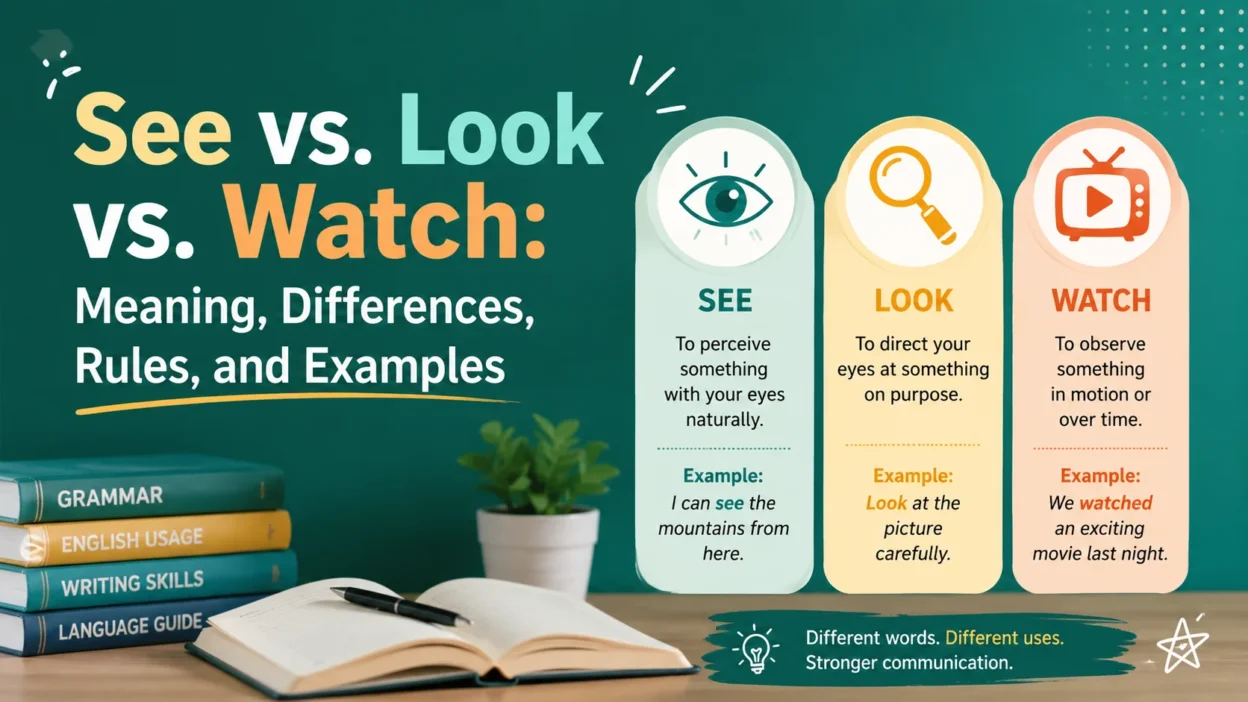
See” vs. “Look” vs. “Watch becomes easier when you understand how your eyes, attention, and focus work together. See usually means noticing something naturally without deliberately trying to find it. You might see a bird outside while walking down the street, notice a dog near a ball, or become aware of an object in your view. This makes see a more passive action, where something enters your sight without a clear intention. In English, this meaning helps you remember a simple pattern: you see something because it becomes visible to you.
Look requires more deliberate attention. You direct your eyes or gaze toward something because you have a specific purpose. You might look at a dog, look toward a bird, or look at an object to gain information. Watch goes further by adding duration and sustained observation. When you watch something, you keep your focus on it for a period, especially when it is moving or changing. You can watch a movie from start to finish, watch an event unfold, or watch a dog as it runs after a ball. Watching often means following something over time, rather than simply noticing it.
The main differences become clear when you compare their visual functions. See focuses on noticing and becoming aware; look focuses on intentionally directing your sight; and watch focuses on observing something across time. These subtle distinctions can improve your English skills and help you choose the right verb when describing sight, observation, focus, and attention. A useful mental picture is simple: see means something reaches your eyes, look means you aim your eyes at it, and watch means you stay with it as it moves or changes. This distinction explains why each verb fits different situations in everyday English.
See vs. Look vs. Watch: Quick Answer
The easiest way to understand see vs. look vs. watch is to focus on what you’re doing with your attention.
- See means to perceive something with your eyes, often without deliberately trying to do so.
- Look means to direct your eyes toward something intentionally.
- Watch means to look at something carefully for a period of time, especially when it moves, changes, or develops.
Here’s the basic pattern:
| Verb | Main meaning | Intention | Duration | Example |
| See | Perceive visually | Often unintentional | Usually brief | I saw a bird. |
| Look | Direct your eyes | Intentional | Usually brief | Look at that bird. |
| Watch | Observe closely | Intentional | Usually longer | I watched the bird fly away. |
A useful memory trick is:
See it. Look at it. Watch it happen.
That isn’t an absolute rule for every sentence, but it’s an excellent starting point.
What Does “See” Mean?
“See” means to perceive or notice something with your eyes, often without deliberately trying to look at it.
“See” as Visual Perception
See generally describes the ability to perceive something through your eyes. You don’t necessarily have to make a conscious decision to see it.
For example:
- I saw a car outside.
- She saw someone standing near the door.
- We saw the mountains from the highway.
- Did you see that bird?
In these examples, the subject notices something visually. The action doesn’t necessarily require deliberate concentration.
Imagine sitting beside a window. A red truck passes outside. You notice it without trying. You see the truck.
That’s the central idea behind see.
“See” for Something You Notice
See often works when something simply enters your visual field or catches your awareness.
Consider these two sentences:
- I saw a man in the hallway.
- I looked at the man in the hallway.
The first sentence tells us that the man became part of the speaker’s visual awareness. The second suggests deliberate attention. The speaker intentionally directed their eyes toward him.
That small distinction can change the feel of a sentence.
“See” Has Meanings Beyond Vision
The verb see isn’t limited to physical sight. English uses it for several abstract ideas.
You can see something in the sense of understanding it:
- I see what you mean.
- Now I see why you’re upset.
- I see your point.
It can also refer to meeting or visiting someone:
- I’m going to see my doctor tomorrow.
- She went to see her parents.
It can describe experiencing something:
- We went to see a Broadway show.
- Have you seen that movie?
So, context matters. See can describe physical perception, understanding, meetings, experiences, and more.
Common Expressions With “See”
Some everyday expressions include:
- See you later
- See for yourself
- See what I mean
- See how it works
- See what happens
- See someone about something
- See the difference
These expressions show why you shouldn’t treat see as nothing more than a synonym for look.
What Does “Look” Mean?
“Look” means to deliberately direct your eyes or attention toward someone or something.
“Look” Means Directing Your Eyes
Unlike ordinary seeing, look usually involves a deliberate action. You decide where to direct your eyes.
For example:
- Look at this picture.
- Look over there.
- She looked out the window.
- He looked toward the entrance.
If someone says, “Look!”, they’re asking you to direct your attention toward something.
That’s why the word often appears in commands.
Look where you’re going.
Look at this!
Look over there.
The speaker isn’t merely asking whether you can see something. They’re asking you to focus your eyes on it.
Why “Look” Usually Takes “At”
When look has a direct visual object, English commonly uses look at.
Correct examples include:
- Look at the picture.
- Look at me.
- Look at that building.
- She looked at the clock.
A common mistake is to remove at:
- ❌ Look the picture.
- ✅ Look at the picture.
However, look doesn’t always need at. Different structures create different meanings.
For example:
- Look outside.
- Look around.
- Look up.
- Look down.
- Look for your keys.
- Look after the children.
- Look into the problem.
The word that follows look can therefore change the meaning considerably.
“Look” Can Describe Appearance
Another important use appears when look describes how someone or something appears.
For example:
- You look tired.
- She looks happy.
- That soup looks delicious.
- He looks nervous.
- The house looks beautiful.
Here, look isn’t simply telling someone to direct their eyes somewhere. It describes an apparent condition or quality.
Compare:
- Look at John.
- John looks tired.
The first sentence tells you where to direct your eyes. The second describes John’s apparent condition.
Common Expressions With “Look”
You’ll encounter look in many combinations:
- look at — direct your eyes toward something
- look for — try to find something
- look after — take care of someone or something
- look into — investigate something
- look like — resemble something
- look out — be careful
- look around — examine the surrounding area
- look through — examine the contents of something
These combinations are worth learning as complete phrases because the preposition often changes the meaning.
What Does “Watch” Mean?
“Watch” means to look at, observe, or pay attention to something carefully, often for a period of time.
“Watch” Means Focused Observation
Watch usually means looking at something carefully and continuously. The object often moves, changes, or develops while you’re observing it.
For example:
- We watched the football game.
- She watched the children play.
- They watched the sunset.
- I watched the dog chase the ball.
- He watched the movie last night.
Unlike simple seeing, watching normally requires deliberate attention.
Why “Watch” Often Implies Duration
Duration is one of the clearest differences between see, look, and watch.
You might see a plane in the sky for a moment. You might look at the plane to identify it. You could then watch the plane take off.
Notice how the verbs create a progression:
See → notice
Look → focus
Watch → observe over time
The distinction becomes especially obvious with activities.
- I saw the players.
- I looked at the players.
- I watched the players practice.
The final sentence suggests sustained observation of an activity.
Common Things You “Watch”
English commonly uses watch for:
- Movies
- Television shows
- Sports
- Performances
- Children
- Animals
- People
- Games
- Events
- Moving objects
- Changes or developments
For example:
- We watched a documentary.
- She watched the basketball game.
- He watched the baby sleep.
- They watched the storm approach.
The activity doesn’t have to be fast-moving. What matters is the idea of continued observation.
See vs. Look vs. Watch: The Key Differences
See means noticing something, look means directing your eyes toward something, and watch means observing something carefully over time.
Difference in Intention
The biggest distinction involves intention.
See often happens without deliberate effort.
I saw a deer while driving.
You weren’t necessarily trying to find a deer.
Look usually involves a conscious decision.
I looked at the deer through the window.
You intentionally directed your eyes toward it.
Watch adds sustained attention.
I watched the deer walk through the field.
You observed its activity over a period of time.
Difference in Duration
The three verbs can also differ in how long the visual attention lasts.
| Verb | Typical visual experience |
| See | A moment of perception |
| Look | A deliberate glance or focused view |
| Watch | Continued observation |
However, duration isn’t an unbreakable grammatical rule. You can look at something for ten minutes, and you can see something for several seconds. Context determines the exact meaning.
Difference in Movement
Watch often works especially well with movement or change.
You can:
- watch a bird fly
- watch a child play
- watch a game
- watch a movie
- watch the rain fall
- watch a building being constructed
The subject observes something as it unfolds.
That’s one reason watch feels natural with sports, films, performances, and events.
Difference in Attention
A helpful way to picture the three verbs is as levels of deliberate attention:
See → Look → Watch
That doesn’t mean one verb is always more intense than another. Instead, the sequence illustrates a common pattern:
- Something enters your visual awareness.
- You intentionally direct your eyes toward it.
- You continue observing it.
This simple framework explains a large number of everyday examples.
See vs. Look vs. Watch Examples in Everyday English
Everyday examples show that “see” is noticing something, “look” is directing your eyes toward it, and “watch” is observing it for a while.
At Home
Imagine someone walks into your living room.
- I saw a spider on the wall.
- Look at that spider!
- I watched the spider crawl across the wall.
Each sentence gives a different perspective.
The first focuses on noticing. The second focuses on directing attention. The third focuses on continued observation.
At Work or School
Consider a presentation:
- I saw your email about the presentation.
- Look at this chart.
- We watched the presentation yesterday.
Again, the verbs aren’t interchangeable.
You see an email because you notice or receive it. You look at a chart because you focus on it. You watch a presentation because you observe it as it unfolds.
While Traveling
Imagine standing at a scenic viewpoint:
- I saw the mountains from the road.
- Look at that mountain!
- We watched the sun set behind the mountains.
This example neatly captures the three-way distinction.
Case Study: “See Him,” “Look at Him,” or “Watch Him?”
Consider these three sentences:
“I Saw Him.”
This usually means I noticed or encountered him visually.
I saw him at the grocery store yesterday.
The sentence doesn’t tell us that you deliberately observed him for a long time.
“I Looked at Him.”
This means you directed your eyes toward him.
When he called my name, I looked at him.
The visual action is intentional, but it doesn’t necessarily continue.
“I Watched Him.”
This suggests sustained observation.
I watched him play basketball for an hour.
Now the focus isn’t simply on seeing the person. You’re observing what he does.
This three-sentence comparison reveals an important point: context determines which verb sounds natural.
Here’s a concise conclusion and 5 FAQs for See vs. Look vs. Watch:
Conclusion
Understanding see, look, and watch becomes easier when you focus on intention, attention, and duration. You see something naturally with your eyes, look at something when you intentionally direct your eyes toward it, and watch something when you pay attention to it over a period of time. Once you understand these small differences, you can choose the right verb more naturally in everyday English.
FAQs
Q1.What is the main difference between see, look, and watch?
See means noticing something with your eyes, look means directing your eyes toward something, and watch means observing something carefully for a period of time.
Q2.Is “look” intentional?
Yes. Look usually involves a deliberate action. For example, “Look at that beautiful view” tells someone to direct their eyes toward the view.
Q3.When should I use “watch”?
Use a watch when you observe something for some time, especially when it involves movement or change, such as a movie, game, person, or animal.
Q4.Can I say “see a movie” and “watch a movie”?
Yes, but watching a movie is more natural when you mean the activity of viewing the movie. Seeing a movie can also mean going to experience or view a movie, especially at a heater.
Q5.How can I remember the difference?
Think of them as three levels of visual attention: see = notice, look = direct your eyes, and watch = observe over time.