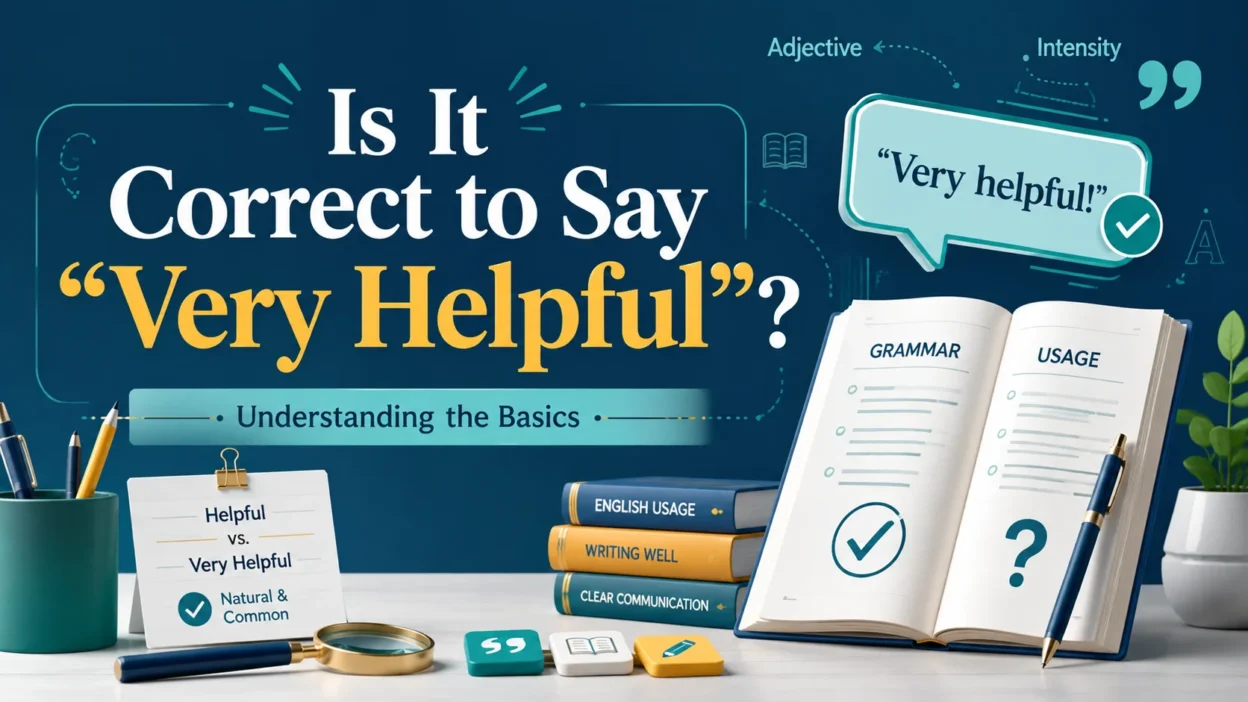
“Very Helpful” adds clear emphasis when you describe advice, support, or guidance that makes a task easier and gives useful practical value. In the English language, this phrase combines the adverb very with the adjective helpful to strengthen the idea of help and assistance. In everyday language, the expression can communicate usefulness, benefit, and a clear meaning without complicated wording. When a colleague’s advice saves time or solves a problem, calling it very helpful can also express gratitude. The wording highlights practical value while showing that something was genuinely beneficial or useful.
Good vocabulary and grammar help you choose the best wording for different situations. Although useful, beneficial, and very helpful share similar meaning, they aren’t always interchangeable. Useful often points to a clear purpose, while beneficial usually suggests a positive effect. Formal and informal settings can also influence your choice of phrase and wording. In professional writing, a polished expression may fit better, whereas casual conversation often favours simple language. Understanding the context helps you select an expression that sounds natural rather than forced.
Your vocabulary also affects tone, especially when you repeat the same expression too often. Instead of using very helpful in every situation, choose useful for something that serves a clear purpose, or beneficial when it offers an advantage. This approach keeps your writing more precise and natural. From everyday wording to professional writing, thoughtful phrase selection can make a small difference in how your message feels. The right expression should match the situation, whether you’re showing gratitude, describing assistance, or pointing out genuine usefulness.
Quick Answer: Is “Very Helpful” Correct?
Yes, “very helpful” is correct English.
The grammatical structure is:
very + adjective
In this phrase:
- Very is an adverb that acts as an intensifier.
- Helpful is an adjective.
- Very helpful means extremely or highly helpful.
For example:
Your explanation was very helpful.
Here, very increases the degree of helpful. The sentence says that the explanation provided a substantial amount of assistance.
You can also say:
- That guide was very helpful.
- She gave me some very helpful advice.
- The instructions were very helpful.
- Your feedback has been very helpful to me.
- This article provides very helpful information.
So, there’s no grammatical problem with the expression. The more interesting question is whether “very helpful” is the most precise phrase for your particular situation.
Understanding the Phrase “Very Helpful”
To understand why “very helpful” works, it helps to examine its two parts separately.
What Does “Helpful” Mean?
Helpful is an adjective that describes something or someone that provides assistance, makes a situation easier, or contributes to a useful result.
For example:
- A teacher can be helpful by explaining a difficult concept.
- A map can be helpful when you’re navigating an unfamiliar city.
- Advice can be helpful when you’re making a decision.
- A tool can be helpful when it saves time or effort.
The word doesn’t necessarily mean something that completely solves a problem. Something can be helpful simply because it improves a situation or makes a task easier.
What Does “Very” Add?
It works as an intensifier. It increases the degree of an adjective.
Compare these sentences:
- The instructions were helpful.
- The instructions were very helpful.
The first sentence gives positive feedback. The second emphasizes that the instructions provided a particularly high level of assistance.
Think of very as turning up a volume dial. It doesn’t change the basic meaning of helpful. Instead, it increases its intensity.
Helpful → Very helpful
That distinction matters because very helpful doesn’t mean something different from helpful. It means something more strongly helpful.
How “Very” Modifies “Helpful” in English Grammar
“Very” intensifies the adjective “helpful,” showing that something provides a high degree of assistance or usefulness.
What Part of Speech Is “Very”?
Very is an adverb. More specifically, it commonly works as an intensifying adverb or degree modifier.
It can modify adjectives and adverbs:
- very helpful
- very important
- very useful
- very clear
- very quickly
- very carefully
The general pattern is:
very + adjective
Examples:
| Adverb | Adjective | Complete phrase |
| Very | helpful | very helpful |
| Very | useful | very useful |
| Very | clear | very clear |
| Very | effective | very effective |
| Very | important | very important |
What Part of Speech Is “Helpful”?
Helpful is an adjective because it describes a noun or subject.
Consider:
The employee was helpful.
The adjective helpful describes the employee.
Now add very:
The employee was very helpful.
The word very modifies helpful, not employee.
That’s the grammatical relationship that makes the phrase work.
Why Is “Very Helpful” Grammatically Correct?
English commonly places an adverb before an adjective to express degree.
For example:
The explanation was very clear.
The instructions were very useful.
The presentation was very informative.
The customer service was very professional.
The same structure applies to very helpful. There’s nothing unusual about it.
How to Use “Very Helpful” in a Sentence
You can use it very helpful in several common sentence structures.
“Very Helpful” After a Linking Verb
One of the most common patterns places the phrase after a linking verb.
For example:
Your advice was very helpful.
Here, it links the subject of your advice with the adjective phrase very helpful.
Other examples include:
- The tutorial was very helpful.
- Her explanation seemed very helpful.
- The feedback became very helpful during the revision process.
- The information proved very helpful.
The structure is generally:
Subject + linking verb + very helpful
“Very Helpful” Before a Noun
You can also place very helpful directly before a noun.
For example:
She gave me a very helpful suggestion.
Here, very helpful description.
More examples include:
- He shared a very helpful resource.
- We received some very helpful feedback.
- I found a very helpful guide online.
- The teacher offered a very helpful explanation.
The structure is:
a/an + very helpful + noun
Notice that very doesn’t require a hyphen with helpful.
“Very Helpful” in Professional Writing
The phrase works perfectly well in professional communication.
For example:
Thank you for your feedback. It was very helpful.
That sounds polite and natural.
However, professional writing sometimes benefits from greater specificity. Instead of saying:
Your feedback was very helpful.
You could write:
Your feedback was very helpful because it clarified which sections needed revision.
The second sentence carries more information. It tells the reader why the feedback mattered.
Examples of “Very Helpful” in Different Contexts
Context changes how the phrase sounds and what it communicates.
Everyday Conversation
You might say:
- Thanks for showing me how to use this. That was very helpful.
- Your directions were very helpful.
- That tip was very helpful when I was cooking.
These examples sound natural and conversational.
Work and Professional Communication
In the workplace, you could write:
- Your suggestions were very helpful during the planning process.
- The training session was very helpful.
- Thank you for providing such a very helpful overview.
The phrase can communicate appreciation without sounding excessively formal.
Customer Reviews
A customer might say:
The support team was very helpful when I had trouble placing my order.
The phrase works because the customer describes actual assistance.
Academic and Educational Contexts
A student might write:
The professor’s explanation was very helpful because it clarified the difference between the two theories.
A study resource could also be described as:
The practice questions were very helpful for preparing for the exam.
In academic writing, however, precise descriptions often beat broad praise.
Is “Very Helpful” Too Informal or Vague?
No. “Very helpful” isn’t inherently informal.
You can use it in professional and formal situations. Still, it can sometimes sound general or imprecise.
Consider:
The report was very helpful.
That tells the reader the report provided value. But it doesn’t reveal what made it valuable.
Now compare:
The report provided the data needed to identify the main cost increases.
The second sentence is more informative because it identifies the specific benefit.
This distinction is important:
Grammatical correctness ≠ maximum precision.
A phrase can be completely correct while still being less informative than another option.
Alternatives to “Very Helpful”
Sometimes very helpful is exactly right. Other times, a more specific adjective will make your sentence sharper.
Stronger and More Precise Synonyms for “Very Helpful”
Depending on context, you can use:
- Highly useful
- Extremely helpful
- Valuable
- Beneficial
- Effective
- Practical
- Informative
- Supportive
- Instrumental
- Invaluable
Each carries a slightly different shade of meaning.
When to Use “Highly Useful”
Use highly when you want to emphasize practical value.
The spreadsheet is highly useful for tracking monthly expenses.
This works especially well in professional, technical, and instructional contexts.
When “Invaluable” Is Better
Invaluable means extremely valuable or useful.
For example:
Her experience was invaluable during the project.
It expresses stronger praise than ordinary, very helpful.
Interestingly, invaluable doesn’t mean “worth nothing.” It means something is so valuable that its importance is difficult to measure.
When “Informative” Is More Precise
Use informative when something primarily provides knowledge or useful facts.
The presentation was very informative.
That’s different from:
The presentation was very helpful.
The first focuses on information. The second focuses on assistance or usefulness.
When “Practical” Is More Precise
Use practical when advice, information, or instructions can be applied directly.
The workshop offered practical advice for improving customer service.
That’s more specific than simply saying the workshop was very helpful.
“Very Helpful” vs. “Extremely Helpful” vs. “Highly Helpful”
These phrases look similar, but they don’t sound equally natural in every context.
| Expression | Meaning | Tone | Commonness |
| Very helpful | Highly helpful | Natural and neutral | Very common |
| Extremely helpful | Helpful to a very high degree | Stronger emphasis | Common |
| Highly helpful | Highly beneficial or supportive | More formal/less conversational | Less common |
| Invaluable | Extremely valuable | Strong praise | Common in formal contexts |
| Very useful | Highly practical or useful | Neutral | Very common |
Very helpful is generally the safest everyday choice.
Extremely helpful adds more intensity.
Highly helpful is grammatically possible, but native speakers often prefer very helpful, extremely helpful, or a more specific adjective.
For example:
Your advice was extremely helpful.
sounds more natural to many readers than:
Your advice was highly helpful.
Bilkul yaar — simple, natural, aur properly polished version ye raha:
Conclusion
Very Helpful is a simple and natural phrase that shows something provides strong assistance, support, or practical value. You can use it in both formal and informal English when talking about advice, feedback, guidance, or useful support. Although useful and beneficial have similar meanings, very helpful often sounds warmer and more direct.
FAQs
Q1. What does “Very Helpful” mean?
Very Helpful means something gives you a lot of help, support, or assistance and makes a task easier.
Q2. Is “Very Helpful” grammatically correct?
Yes, Very Helpful is grammatically correct. Very is an adverb that strengthens the adjective helpful.
Q3. What are other words for “Very Helpful”?
You can use useful, beneficial, valuable, supportive, or practical, depending on the context.
Q4. Can you use “Very Helpful” in professional writing?
Yes, Very Helpful works well in professional writing. You can use it to describe useful advice, feedback, instructions, or assistance.
Q5. Is “Very Helpful” formal or informal?
Very Helpful works in both formal and informal situations. The surrounding words and context determine how formal the sentence sounds.