Waive vs. Wave often confuses writers because both words sound identical, yet their meanings are entirely different in everyday English. The difference becomes obvious when you focus on the context, meaning, and correct usage instead of only the spelling or sound. Although these words are pronounced exactly the same in spoken English, they serve completely different purposes. I have seen students, writers, professionals, native speakers, and ordinary people make this common mistake by using them interchangeably. A single letter can change the intended meaning, reduce your credibility, and create problems in business email, essays, contracts, legal documents, formal agreements, and other professional settings. This article acts as a practical guide to clarify the distinction, explain the definition, improve your word usage, and provide clear examples in plain language. Once you read it and remember the simple memory tricks, you are far less likely to repeat the error.
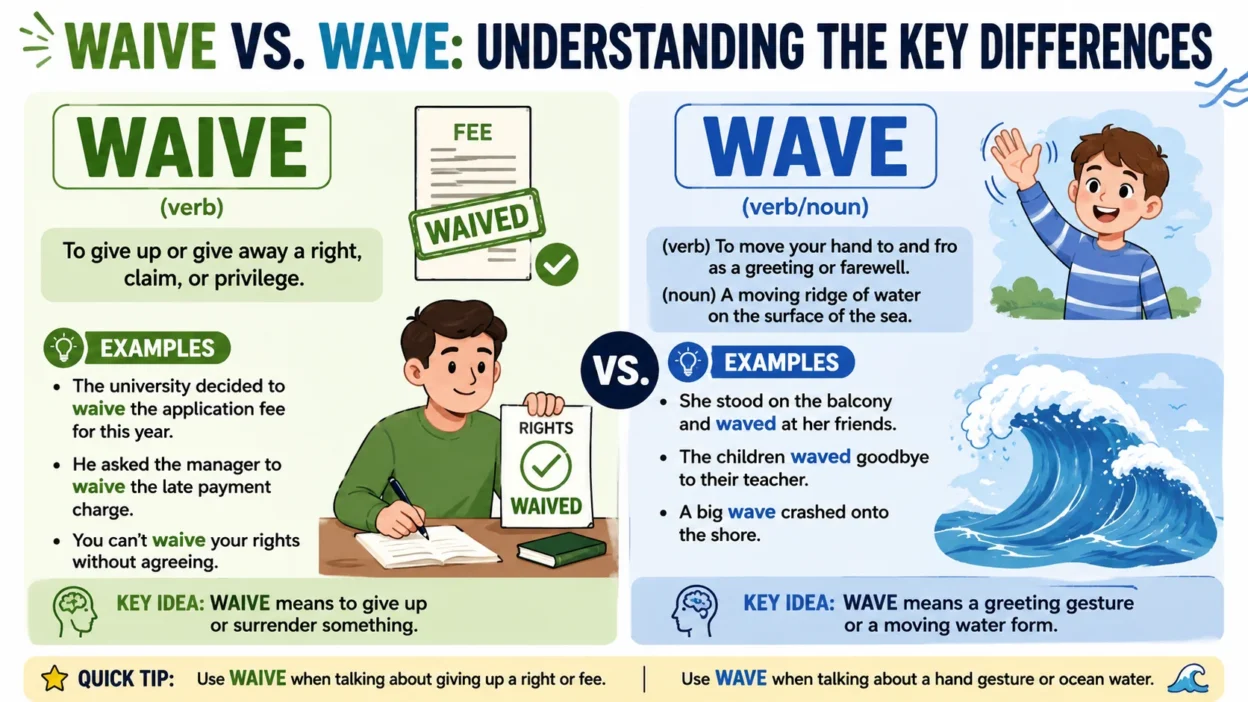
To waive means to give up, forgo, or voluntarily surrender a right, claim, or privilege. For example, someone may waive rights, waive claim, or waive legal representation before deciding to represent yourself in a legal matter. A fee may also be waived depending on the process, choice, or specific use. By contrast, wave refers to moving your hand or another object back and forth in a motion or gesture. You might wave hand, wave object, or wave at a friend across the street to say hello, send greetings, make a greeting gesture, signal someone, or get attention. The word can also refer to ocean swells, a repeating pattern, or a type of movement. Keeping this simple difference in mind makes your communication much clearer.
My own learning process taught me that slowing down before choosing a word prevents confusion. Instead of making a quick guess, I now check the contexts, meanings, and whether the situation involves a legal right, a legal claim, legal representation, or simply a friendly greeting. I still imagine the moment I typed one word but meant another while writing, because that small error could have caused unnecessary damage. While waiting on a corner before a trip, I watched family, cousins, and distant relatives at gatherings wave from across the road, and that simple glance helped the lesson stay in my memory. Since then, I have used one easy test: if the situation belongs to law, think waive; if it belongs to movement, think wave. That simple habit breaks down the topic into a real-world idea, strengthens your English vocabulary, improves writing, and helps you notice the difference almost everywhere, whether you are helping a client, talking about money, or seeing everyday lives unfold through ordinary actions.
Quick Comparison Table
| Feature | Waive | Wave |
| Main meaning | To give up, excuse, or surrender a right or requirement | To move the hand, signal, or describe a motion |
| Common context | Legal, business, academic, formal writing | Everyday speech, physical motion, signals, nature, science |
| Part of speech | Verb | Verb and noun |
| Typical example | Waive the fee | Wave goodbye |
| Easy memory tip | Think of giving up something | Think of hand movement or motion |
Why People Confuse Waive and Wave
People often confuse waive and wave because they sound exactly the same but have completely different meanings. Since they are homophones, many writers accidentally choose the wrong spelling, especially when typing quickly or relying on pronunciation alone. Waive means to give up or voluntarily forgo a right, requirement, or fee, while wave refers to a hand gesture or a moving swell of water. Understanding the difference in meaning makes it much easier to use the correct word in context.
Waive vs. Wave: Why They Sound So Similar
Waive and wave are homophones, which means they sound alike but have different meanings and spellings. That alone explains a lot of the confusion. When you hear the word in conversation, your brain has to guess from context. In writing, though, you need the exact spelling.
That is where the trouble starts.
Someone might say, “They waived the fee,” and another person hears it as “waved.” Both sound nearly identical. But only one spelling fits the meaning. A fee can be waived. A fee cannot be waved unless someone is literally moving it through the air, which makes no sense.
Similar Sound, Very Different Job
The words do not just differ in spelling. They do completely different jobs in a sentence.
- Wave often describes a visible action, like moving your hand or a flag.
- Waive often appears in formal settings, especially where someone is giving up a right, benefit, or obligation.
That difference matters in business emails, contracts, school forms, customer service messages, and legal documents. A small error can make writing look careless. In some settings, it can also create real confusion.
Why Spell Check Does Not Always Save You
Spell check usually catches typos, but it does not always catch the wrong word if it is spelled correctly. That means a sentence like “Please wave the fee” may slip through because wave is a real word. The software sees no spelling error, even though the meaning is wrong.
That is why context matters more than autocorrect. If you want clean writing, you need to ask one simple question:
Am I describing motion, or am I describing the removal of a rule, fee, or right?
If it is motion, use wave.
If it is removal or surrender, use waive.
What Does Wave Mean?
A wave is a disturbance or movement that transfers energy from one place to another without permanently moving the medium itself. Waves can travel through a material, such as water or air, or through empty space, as light waves do. Depending on the context, the word wave can also describe a hand gesture used to greet someone or the curved shape formed by moving water.
Wave vs. Wave: The Word “Wave” in Everyday Use
The word wave has several common meanings, and most of them relate to movement. It can describe what your hand does when you greet someone. It can also describe the shape of water, sound, light, or even a sudden rise in feeling or activity.
Because wave is so flexible, it shows up in both casual speech and technical writing.
Wave as a Verb
As a verb, wave usually means to move something back and forth or from side to side. The most familiar use is a hand gesture.
Common verb meanings of wave
- To move your hand as a greeting or signal
- To move an object from side to side
- To swing or flutter in the air
- To rise and fall in a flowing motion
- To signal or direct attention
Examples
- She waved at her friend across the street.
- He waved the flag to start the race.
- The child waved her arms excitedly.
- Tall grass waved in the wind.
- The crowd waved their phones in the air during the concert.
In each case, the word points to movement. That is the key idea.
Wave as a Noun
As a noun, wave refers to a moving form or pattern. This could be a water wave, a sound wave, or a larger symbolic wave like a wave of emotion.
Common noun meanings of wave
- A moving ridge of water
- A pattern in sound, light, or energy
- A sudden rise or increase in something
- A signal made with the hand
- A flowing pattern of hair
Examples
- The boat rocked on a large wave.
- Radio signals travel as waves.
- A wave of relief swept through the room.
- She has natural waves in her hair.
- The team gave a final wave to the audience.
Common Phrases Using Wave
The word wave appears in a lot of everyday expressions. These are the ones writers use most often.
- Wave hello
A friendly greeting. - Wave goodbye
A gesture of farewell. - Wave someone over
To motion for someone to come closer. - Make waves
To create trouble or attract attention, often by challenging the norm. - Ride the wave
To take advantage of momentum, success, or a trend. - Heat wave
A period of unusually hot weather. - Wave of change
A large shift in behavior, opinion, or events. - Wave off
Often it means to dismiss something, signal “go ahead,” or brush something aside.
Notice how most of these phrases involve movement, motion, flow, or signal. That is the thread connecting them.
A Simple Quote to Keep in Mind
If the sentence is about motion, greeting, or a pattern, wave is usually the word you need.
That is not a grammar rule by itself, but it is a strong mental shortcut.
Why Wave Has So Many Uses
The word wave works well because English loves borrowing one word for several related ideas. A real wave moves. A hand can mimic that motion. A crowd can move like a wave. A feeling can spread like a wave. Even a hairstyle can keep the idea of flowing movement.
That is why the word feels so natural in so many places. It keeps the same core idea even when the setting changes.
Real-World Examples of Wave
Here are a few more examples that show how flexible the word is:
- She waved from the window.
- The ocean wave hit the shore.
- A wave of applause filled the hall.
- The doctor studied brain waves.
- He has a wave of anxiety before presentations.
Even though these sentences look different, they all carry the idea of motion or spread.
Why Understanding Wave Matters Before You Learn Waive
Before you move on to waive, it helps to fully understand wave because it appears in more everyday conversations. It is the word most people learn first, and it often becomes the wrong one people default to when they mean waive.
For example, many writers accidentally type:
- “Please wave the late fee.”
- “He waved his right to appeal.”
- “The school waved the requirement.”
Each of those sentences should use waive, not wave.
Once you see the pattern, the mistake becomes easy to spot. The issue is not pronunciation. The issue is meaning.
Wave in Practical Writing
In practical writing, wave is commonly used as both a noun and a verb. As a verb, it means to move your hand to greet someone, say goodbye, or attract attention. It can also describe something moving back and forth, such as a flag waving in the wind. In everyday communication, the word is often used in emails, stories, instructions, and conversations to describe simple gestures or movements.
Wave vs. Wave in Casual Writing
In casual writing, wave usually show up in simple, visible actions.
- Wave to a friend
- Wave at the camera
- Wave a hand
- Wave goodbye
- Wave the flag
These are easy because they match what you can physically see.
Wave vs. Wave in Descriptive Writing
In descriptive writing, wave help create motion and atmosphere.
- The curtains waved in the breeze.
- A wave of laughter spread across the room.
- The city felt a wave of energy after the win.
In these cases, the word adds rhythm. It helps the reader picture movement without needing a long explanation.
Wave and the Bigger Picture
One reason wave is such a useful word is that it connects to motion in nature, technology, and human behavior.
A few examples:
- Water waves move across the sea.
- Sound waves carry voices and music.
- Light waves help explain how we see.
- Brain waves appear in science and medicine.
- Social waves describe broad changes in trends or opinion.
That range makes wave one of those words you see everywhere. It is common enough that people rarely stop to think about it. That is exactly why it gets mixed up with waive in writing.
A Quick Memory Trick for Wave
Here is an easy way to lock it in:
Wave = movement.
If you can picture something moving, flowing, fluttering, rising, or signaling, wave is probably right.
Try this mental shortcut:
- Wave has an “a” like arm.
- You often wave your arm.
It is not a perfect rule, but it gives your brain a quick anchor.
Mini Review Before Moving On
At this point, the difference should feel clearer:
- Wave is about motion, greeting, signals, or patterns.
- Waive is about giving up something, especially in formal or legal settings.
That is the foundation. In the next section, the word waive gets the same close look so you can use both words with confidence.
Waive vs. Wave: One-Sentence Summary
You wave when you move or signal, and you waive when you give up a right, rule, fee, or requirement.
What Does “Waive” Mean?
The word waive means to voluntarily give up, surrender, or choose not to enforce a right, claim, rule, privilege, or requirement. Unlike wave, which involves physical movement, waive is about making a deliberate decision to forgo something that you are legally or officially entitled to.
People often encounter this word in contracts, legal documents, financial agreements, insurance policies, schools, healthcare, and government paperwork. Although it appears formal, the idea behind it is simple: someone chooses not to insist on a rule or benefit.
For example:
- The university waived the application fee.
- The customer waived the cancellation charge.
- She waived her right to appeal the decision.
- The airline waived change fees because of severe weather.
In each sentence, nobody is physically moving anything. Instead, a person or organization is choosing not to enforce a fee, right, or requirement.
Quick Tip: If you can replace the word with “give up,” “forgo,” “relinquish,” or “decline to enforce,” then waive is almost always the correct choice.
Waive as a Verb
Unlike wave, waive functions almost exclusively as a verb.
It describes an intentional action where someone decides not to exercise a legal right, collect money, enforce a rule, or require a condition.
Common meanings include:
- Giving up a legal right
- Removing a fee
- Forgoing a requirement
- Relinquishing a claim
- Declining enforcement of a rule
- Excusing someone from an obligation
For example:
| Sentence | Meaning |
| The bank waived the annual fee. | The bank chose not to charge the fee. |
| The judge waived the filing requirement. | The requirement was removed. |
| The employee waived overtime pay. | The employee voluntarily gave it up. |
| The company waived the penalty. | The company decided not to collect it. |
Notice that every example involves a choice, not a physical action.
The Core Idea Behind “Waive”
The easiest way to understand waive is to think about giving something up voluntarily.
You cannot accidentally waive something.
Instead, someone intentionally decides not to use or enforce it.
For example:
- A landlord may waive a late fee.
- A school may waive an entrance requirement.
- A company may waive shipping charges.
- A patient may waive confidentiality in limited situations.
- A customer may waive the right to return a product.
Every example involves an intentional decision.
Where “Waive” Is Commonly Used
Although waive appears in everyday conversations, it is especially common in professional settings.
Let’s look at the industries where you’ll encounter it most often.
Legal Documents
Legal writing frequently uses waive because contracts often describe rights and obligations.
Examples include:
- Waive the right to sue
- Waive the right to arbitration
- Waive legal claims
- Waive notice
- Waive objections
For example:
The tenant agreed to waive the right to terminate the lease early.
Another example:
The plaintiff waived any future claims related to the settlement.
In legal language, every word matters. Using wave instead of waive would completely change the meaning.
Contracts
Businesses regularly include waiver clauses in agreements.
Common examples include:
- Waiver of liability
- Waiver of claims
- Waiver of notice
- Waiver of damages
- Waiver of contractual rights
Example:
By signing this agreement, both parties waive certain legal claims.
This sentence means both parties voluntarily surrender specific rights.
Banking and Finance
Banks often waive fees to attract customers or reward loyalty.
Common examples include:
- Waive monthly maintenance fees
- Waive overdraft charges
- Waive transfer fees
- Waive annual credit card fees
- Waive foreign transaction fees
Example:
The bank waived the annual account fee after the customer maintained the minimum balance.
Another example:
The lender waived the processing fee during the promotional period.
Insurance
Insurance companies frequently waive requirements under special circumstances.
Examples include:
- Waive deductibles
- Waive waiting periods
- Waive premiums
- Waive documentation requirements
Example:
The insurer waived the deductible because the damage resulted from a declared natural disaster.
Healthcare
Medical providers often use waive when discussing paperwork, payments, or legal permissions.
Examples include:
- Waive copayments
- Waive authorization
- Waive informed consent in limited emergency situations
- Waive administrative fees
Example:
The hospital waived the administrative fee for qualifying patients.
Education
Schools and universities regularly waive requirements for eligible students.
Examples include:
- Waive application fees
- Waive entrance exams
- Waive prerequisite courses
- Waive tuition charges
- Waive enrollment deposits
Example:
The university waived the application fee for veterans.
Another example:
The department waived the language requirement after reviewing previous coursework.
Government Services
Government agencies sometimes waive penalties or filing requirements.
Examples include:
- Waive passport fees
- Waive filing deadlines
- Waive penalties
- Waive taxes
- Waive documentation
Example:
The agency waived late penalties after the system outage.
Human Resources
HR departments also use waive in employment documents.
Examples include:
- Waive benefits
- Waive participation
- Waive notice periods
- Waive relocation reimbursement
- Waive probation requirements
Example:
The employee waived participation in the retirement plan.
Common Phrases Using Waive
Learning fixed expressions helps you recognize correct usage much faster.
Here are the phrases you’ll encounter most often.
| Common Phrase | Meaning |
| Waive a fee | Remove or cancel a charge |
| Waive a right | Voluntarily surrender a legal right |
| Waive a requirement | Remove an obligation |
| Waive a penalty | Decide not to impose punishment |
| Waive interest | Forgive interest charges |
| Waive liability | Give up the ability to hold someone legally responsible |
| Waive consent | Choose not to require permission |
| Waive the waiting period | Remove the required delay |
| Waive objections | Decide not to challenge something |
| Waive notice | Forgo formal notification |
“Waive a Fee”
This is one of the most common expressions in English.
When a company waives a fee, it decides not to charge the customer.
Examples:
- The hotel waived the resort fee.
- The college waived the application fee.
- The airline waived baggage fees after the storm.
- The bank waived the overdraft fee.
“Waive a Requirement”
Organizations sometimes decide that a particular rule does not need to apply.
Examples include:
- Experience requirement
- Testing requirement
- Training requirement
- Documentation requirement
Example:
The employer waived the experience requirement because the candidate had exceptional skills.
“Waive Liability”
This phrase appears in sports, travel, recreational activities, and legal agreements.
It means someone agrees not to hold another person or organization legally responsible under specific conditions.
Example:
Participants signed a waiver to waive certain liability claims before joining the event.
“Waive the Waiting Period”
Insurance companies sometimes remove waiting periods.
Example:
The insurer waived the six-month waiting period for existing customers.
“Waive Interest”
Banks and lenders occasionally forgive accumulated interest.
Example:
The lender agreed to waive interest for three months during the financial hardship program.
Waive vs. Wave: Side-by-Side Comparison
Although the words sound identical, they have completely different meanings.
| Feature | Waive | Wave |
| Pronunciation | /weɪv/ | /weɪv/ |
| Meaning | Give up or forgo a right, fee, or requirement | Move a hand, object, or describe a moving pattern |
| Part of Speech | Verb | Verb and noun |
| Used In | Law, business, finance, education, healthcare | Everyday conversation, science, weather, greetings |
| Common Expressions | Waive a fee, waive rights | Wave hello, ocean wave, sound wave |
| Physical Action? | No | Yes (except scientific noun uses) |
| Formality | Usually formal | Common in everyday English |
Waive vs. Wave in Real Sentences
Context makes the difference obvious.
Everyday English Examples
✅ She waved goodbye before leaving.
✅ The bank waived the monthly fee.
✅ He waved at his neighbors.
✅ The school waived the registration charge.
Business Examples
- The company waived the cancellation fee for affected customers.
- Management waived the late payment penalty.
- The CEO waved to employees during the company celebration.
- Staff members waved company flags during the parade.
Legal Examples
- The defendant waived the right to a jury trial.
- Both parties waived further legal claims.
- The attorney explained every right before the client chose to waive one.
Academic Examples
- The university waived standardized test requirements.
- The professor waved students into the classroom.
- The scholarship committee waived the application deadline because of technical issues.
Customer Service Examples
Customer support representatives frequently use waive when resolving billing issues.
For example:
- We have waived the late fee as a courtesy.
- Your replacement shipping charge has been waived.
- The processing fee will be waived after verification.
These phrases are common in emails from banks, airlines, online retailers, and subscription services.
“Waive a Fee” or “Wave a Fee”?
The correct expression is always waive a fee.
Since waive means to remove or voluntarily give up, it fits perfectly when talking about charges, penalties, or costs.
Correct examples:
- The bank waived the annual fee.
- The university waived tuition for scholarship recipients.
- The airline waived change fees because of severe weather.
- The company waived the setup fee for new customers.
Incorrect examples:
- ❌ Wave a fee
- ❌ Wave the application fee
- ❌ Wave the penalty
Those sentences are incorrect because wave refers to movement, not removing charges.
Conclusion
Understanding Waive vs. Wave is easier once you connect each word to its purpose instead of its pronunciation. Waive is used when someone voluntarily gives up a right, claim, privilege, or fee, while wave describes a physical motion, gesture, or a pattern such as ocean waves. Although they sound exactly the same, their meanings belong to completely different situations. Keeping this simple distinction in mind will help you write with greater accuracy, avoid common mistakes, and communicate confidently in both everyday and professional writing.
FAQs
Q1.What is the difference between waive and wave?
Waive means to voluntarily give up a right, claim, privilege, or fee, while wave means to move your hand or another object back and forth as a greeting, signal, or gesture.
Q2.Is it waive a fee or wave a fee?
The correct phrase is waive a fee because it means to cancel or voluntarily give up the requirement to pay. Wave a fee is incorrect unless you are literally waving a document or paper showing the fee.
Q3.Why do people confuse waive and wave?
People confuse them because they are homophones. They have the same pronunciation in spoken English but different spellings, meanings, and usage, making them easy to mix up.
Q4.How can I remember the difference between waive and wave?
A simple trick is to connect waive with legal rights, claims, privileges, and fees. Connect wave with moving your hand, greeting someone, signalling, or ocean waves. Thinking about the context will help you choose the correct word.
Q5.Can waive and wave ever be used interchangeably?
No. Although waive and wave sound exactly the same, they have completely different meanings and uses. Using the wrong word can change the meaning of a sentence and create confusion in both casual and professional communication.