The Have You Seen vs Did You See guide helps learners understand tense, time, and context through real conversations and clearer communication. When people speak English, they often feel confused because these phrases seem similar, but each one has a different purpose. Have You Seen connects with a present moment experience, while Did You See focuses on something that happened at a specific time. Understanding this difference makes your spoken English more natural and helps you avoid common mistakes in daily communication.
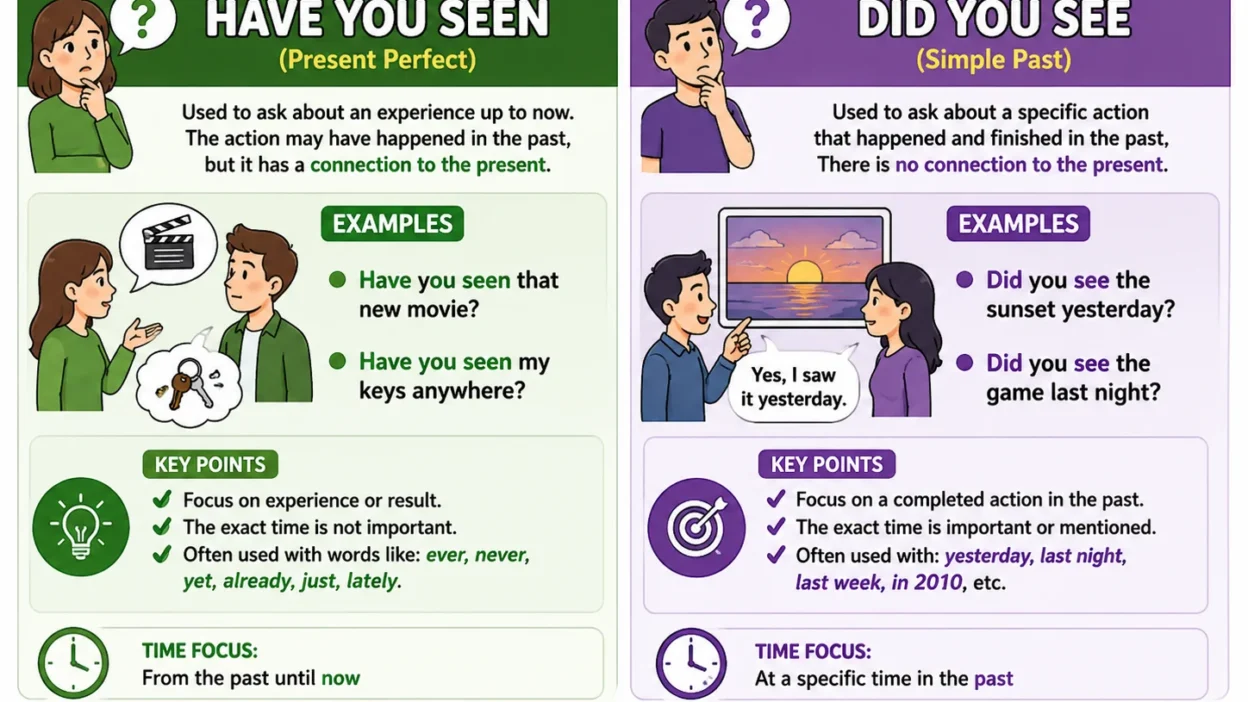
The choice between these verb phrases depends on the sentence’s meaning, usage, and the speaker’s intended time frame. Have You Seen uses the present perfect to ask about experiences connected to now, such as asking if someone has watched a movie lately. Did You See uses the simple past for completed actions, especially when the speaker has a clear past event in mind, such as a movie watched last night or an event from an evening. These grammar rules improve your understanding of question forms and make your English more accurate.
With regular practice, English learners can build stronger language fluency and develop better grammar mastery. Looking at contextual meaning, semantic meaning, and natural communication style helps you recognise why one phrase sounds correct while another does not. Through practical exercises, daily speaking practice, and careful word choice, you can improve confidence, reduce mistakes, and create smoother communication patterns in both personal and professional situations.
Have You Seen vs Did You See: Quick Answer
Let’s keep this simple and practical.
- Use “have you seen” when the action is connected to now
- Use “did you see” when the action happened at a specific past time
Quick rule you can remember instantly
- No time mentioned → Have you seen
- Specific time mentioned → Did you see
Why “Have You Seen vs Did You See” Confuses So Many Learners
This confusion isn’t random. There are real reasons behind it.
Both forms talk about the past
Your brain groups them together automatically.
Many languages don’t make this distinction
In many languages, one tense handles both meanings.
Grammar rules are often taught without context
You learn definitions, but not how people actually speak.
Native speakers don’t explain it
They use it naturally, so learners don’t hear the logic.
The Real Meaning Behind Have You Seen vs Did You See
Instead of memorizing rules, focus on how these phrases behave in real life.
What “Have You Seen” Really Means
When you use “have you seen,” you connect the past to the present.
You’re basically asking:
“Does this matter right now?”
Key features
- No specific time needed
- Focus on result or experience
- Still relevant now
Examples
- Have you seen my phone? (I need it now)
- Have you seen that movie? (experience matters)
- Have you seen John? (I’m looking for him now)
What “Did You See” Actually Means
When you use “did you see,” you’re talking about a completed moment in the past.
You’re asking:
“Did this happen at a specific time?”
Key features
- Refers to a finished action
- Often includes a time reference
- Focus on the event itself
Examples
- Did you see the match last night?
- Did you see her at the meeting?
- Did you see what happened earlier?
The Core Difference in Have You Seen vs Did You See
Let’s make this crystal clear with a table.
| Situation | Correct Form | Reason |
| No time mentioned | Have you seen | Focus on result |
| Specific time mentioned | Did you see | Focus on when |
| Still relevant now | Have you seen | Connected to present |
| Fully completed event | Did you see | Action is finished |
The Time Rule That Solves Most Mistakes
If you remember one thing, remember this.
Use “Have You Seen” with unfinished time
- today
- this week
- recently
- ever
- yet
Examples:
- Have you seen him today?
- Have you ever seen snow?
Use “Did You See” with finished time
- yesterday
- last night
- earlier
- in 2023
Examples:
- Did you see him yesterday?
- Did you see the news earlier?
The Hidden Secret in Have You Seen vs Did You See (Relevance vs Time)
Most articles stop at “time.” That’s only half the story.
The real difference is about what you care about.
Use “Have You Seen” when you care about the result
You’re focused on the present.
Have you seen my keys? (I still need them)
Use “Did You See” when you care about the event
You’re just talking about something that happened.
Did you see the accident? (describing what happened)
Side-by-Side Examples That Make It Click
| Sentence | Meaning |
| Have you seen Sarah? | Is she around now? |
| Did you see Sarah? | Did you meet her earlier? |
| Have you seen the news? | It matters now |
| Did you see the news? | Referring to a specific report |
Tricky Time Expressions in Have You Seen vs Did You See
Some words can confuse even advanced learners.
“Today,” “This Week,” “Recently”
These can use both forms depending on context.
- Morning: Have you seen him today?
- Night: Did you see him today?
Same word. Different feelings.
“Ever,” “Yet,” “Already”
These always use present perfect tense.
- Have you ever seen that place?
- Have you seen it yet?
American vs British Usage
Understanding this helps you sound more natural.
American English
- Uses simple past more often
Did you eaten yet?
British English
- Prefers present perfect
Have you eaten yet?
Best strategy
Follow grammar rules first, then adapt to your audience.
Common Mistakes in Have You Seen vs Did You See
Let’s fix the most common errors.
Wrong combination with time
❌ Have you seen him yesterday?
✔ Did you see him yesterday?
Using simple past without context
❌ Did you see that movie ever?
✔ Have you ever seen that movie?
Confusing “seen” and “saw”
- Seen → always with have/has
- Saw → used with did
✔ Have you seen it?
✔ Did you see it?
Easy Memory Trick That Actually Works
Ask yourself two quick questions.
Question one
Does it matter now?
→ Use have you seen
Question two
Do I know when it happened?
→ Use did you see
Simple shortcut
- Now matters → Have
- Time matters → Did
Real-Life Examples of Have You Seen vs Did You See
Let’s make it practical.
At Home
- Have you seen my wallet?
- Did you see my wallet on the table earlier?
At Work
- Have you seen the new report?
- Did you see the email I sent yesterday?
Entertainment
- Have you seen that Netflix show?
- Did you see the episode last night?
Tone and Meaning Differences
Even tone changes depending on what you choose.
Have you seen
- Feels immediate
- Feels relevant
- Sometimes urgent
Did you see
- Feels relaxed
- Used for storytelling
- Focuses on past events
Social Media Usage
Modern English reflects these differences clearly.
Why “Have you seen this?” is popular
- Creates urgency
- Feels current
- Works for viral content
Why “Did you see this?” feels different
- More casual
- Less immediate
Case Study: Why One Sentence Feels Wrong
Let’s break it down.
Incorrect
Have you seen him yesterday?
Problem
“Yesterday” is finished. Present perfect doesn’t work.
Correct
Did you see him yesterday?
Fast Reference Table
| Rule | Use |
| No time mentioned | Have you seen |
| Specific time mentioned | Did you see |
| Still relevant now | Have you seen |
| Finished event | Did you see |
| Ever, yet, already | Have you seen |
| Yesterday, last night | Did you see |
Mini Practice Quiz
Fill in the blanks:
- ___ you ___ this before?
- ___ you ___ the game last night?
- ___ you ___ my keys?
Answers
- Have you seen (experience)
- Did you see (specific time)
- Have you seen (still relevant)
Deep Insight: Why English Uses Two Forms
English separates:
- Past connected to now
- Past completely finished
This helps you:
- Communicate clearly
- Avoid confusion
- Sound natural
Expert Quote
“Grammar is not about rules alone. It’s about meaning in context.”
Conclusion
Understanding the difference between Have You Seen vs Did You See makes English communication clearer and more natural. Although both phrases talk about the past, they describe different situations. Have You Seen is used when you are asking about an experience connected to the present, while Did You See is used for a finished event that happened at a specific time. Once you understand the role of tense, context, and time reference, choosing the correct phrase becomes much easier.With regular practice and attention to real conversations, you can improve your spoken English, avoid common mistakes, and communicate with more confidence. Learning these small grammar differences helps you build stronger language skills and makes your English sound more accurate, natural, and expressive.
FAQs
Q1. What is the main difference between Have You Seen and Did You See?
The main difference is the connection with time. Have You Seen asks about a past experience that relates to the present, while Did You See asks about a completed action at a specific time in the past.
Q2. When should I use Have You Seen?
Use Have You Seen when you are asking whether someone has experienced something before or recently. For example: “Have you seen this movie?” means you want to know if the person has watched it at any time until now.
Q3. When should I use Did You See?
Use Did You See when you are talking about a specific past event. For example: “Did you see the match last night?” refers to a particular time that has already finished.
Q4. Can Have You Seen and Did You See be used interchangeably?
No, they cannot always be used interchangeably. Changing one phrase for the other can change the meaning because they use different tenses and focus on different contextual situations.
Q5. Why do English learners confuse Have You Seen and Did You See?
Many English learners confuse these phrases because both refer to past events. The confusion happens because the difference depends on context, timing, and whether the speaker is asking about an experience or a completed action.