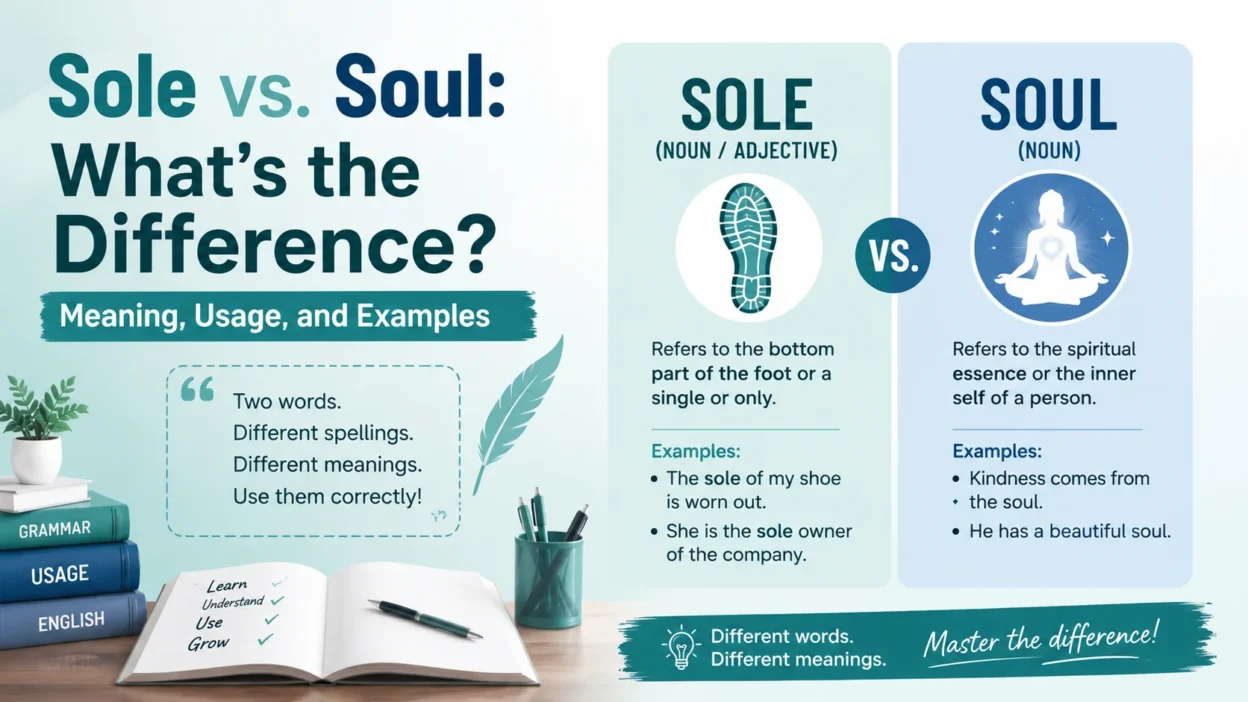
Sole vs. Soul often creates confusion because these English words sound alike, yet they have completely different meanings and spelling. Sole usually means the bottom part of a shoe or foot, but it can also describe a type of flatfish or mean only one or a single person or thing, as in sole survivor. Soul, however, refers to a person’s spiritual and inner nature, deep emotions, essential character, or inner essence and being. In writing and speaking, knowing this distinction prevents the wrong word from changing a sentence’s meaning or making it grammatically incorrect.
The difference becomes clearer when you consider context, familiar expressions, and common sentence patterns. For example, the sole of a shoe may become damaged after someone walks across rough ground, while a kind soul describes someone whose character, feelings, love, and compassion reveal a warm inner nature. A memory trick can make the distinction easier: think of sole as something underfoot, connected with the part that touches the ground, and soul as the inner part of a human being. This simple connection gives each word its own mental place and helps you remember which spelling belongs in a particular situation.
Even though the words are pronounced exactly alike, their meanings are not interchangeable. Their similar sound can be slightly misleading, so mixing them up may create confusing or even hilarious situations, especially when using them in emotional writing. To distinguish them confidently, connect sole with physical things such as a shoe, foot, flatfish, or underfoot surfaces, and connect soul with spiritual qualities, inner nature, deep emotions, and essence. With regular practice, understanding these differences, mastering the English language, and improving vocabulary correctness becomes easier. You’ll then choose the correct expression naturally instead of second-guessing yourself.
Quick Answer: Sole vs. Soul
Sole and soul are homophones. They have the same pronunciation in standard English but different spellings and meanings.
- Sole means the bottom of a foot or shoe.
- Sole can also mean only or single.
- Sole can refer to certain types of flatfish.
- Soul can mean a person’s spiritual or nonphysical essence.
- Soul can describe someone’s deepest feelings or inner character.
- Soul can refer to soul music.
The easiest way to remember them is:
Sole = shoe or only. Soul = spirit or inner self.
For example:
“The sole of my shoe is worn out.”
“That song touched my soul.”
The first sentence concerns footwear, so sole is correct. The second concerns deep emotion, so soul is correct.
Understanding Sole vs. Soul as Homophones
Sole and soul are commonly classified as homophones. A homophone is a word that sounds the same as another word but has a different spelling and meaning.
English has many homophone pairs. Some examples include:
- right / write
- sea / see
- flower / flour
- pair / pear
- brake / break
- whole / hole
- sole / soul
Homophones can create problems because pronunciation doesn’t always help you decide which spelling to write.
For example, if someone says:
“The music touched my soul.”
You hear the pronunciation, but you can’t see the spelling. When writing the sentence, you need to understand the meaning before choosing soul.
The same principle applies to sole:
“The sole of my boot is cracked.”
The word refers to footwear, so sole is the correct spelling.
Sole and Soul Have Different Meanings
Although the pronunciation is similar, the meanings are clearly different.
| Word | Part of Speech | Main Meaning | Example |
| Sole | Noun | Bottom of a foot or shoe | The sole of my shoe is worn. |
| Sole | Adjective | Only or single | She was the sole owner. |
| Sole | Noun | A type of flatfish | We ordered grilled sole. |
| Soul | Noun | Spiritual or inner essence | He believes the soul survives death. |
| Soul | Noun | Deep emotional nature | The song touched her soul. |
| Soul | Noun | A music genre | He listens to soul music. |
The important point is that sole has several meanings, while soul generally centers on the ideas of spirit, inner nature, emotional depth, and music.
Sole Meaning and Definition
Sole has several established meanings in English. It can be used as both a noun and an adjective.
As a noun, it commonly describes the bottom of a foot or shoe. It can also refer to certain flatfish.
As an adjective, sole means only, single, or exclusive.
Understanding these meanings helps you recognize sole quickly in different types of writing.
Sole as the Bottom of a Shoe or Foot
The most common physical meaning of sole refers to the bottom surface of a foot or shoe.
The sole of the foot is the underside of the foot that faces the ground. The sole of a shoe is the bottom part of the footwear.
Examples include:
- The sole of my shoe has started to wear out.
- The sole of his boot was covered in mud.
- She injured the sole of her foot while walking barefoot.
- These shoes have thick rubber soles.
- The repair shop replaced the worn sole.
- The soles of my feet hurt after the long walk.
You’ll often recognize this meaning from nearby words such as shoe, foot, boot, sandal, rubber, leather, walking, and wear.
Common expressions include:
- sole of the foot
- sole of the shoe
- rubber sole
- leather sole
- shoe sole
- thick sole
- thin sole
If the sentence refers to something underneath your foot or footwear, sole is almost certainly the word you need.
Sole Meaning “Only” or “Single”
Another very common meaning of sole is only or single.
Here, sole works as an adjective.
For example:
She was the sole owner of the company.
This means:
She was the only owner of the company.
The two sentences have essentially the same meaning.
You’ll often see this use of sole in professional, legal, academic, and formal writing.
Common expressions include:
- sole purpose
- sole reason
- sole owner
- sole responsibility
- sole survivor
- sole provider
- sole source
- sole decision-maker
Examples:
- The sole purpose of the meeting was to review the contract.
- He became the sole owner of the property.
- Her sole responsibility was managing the department.
- She was the sole survivor of the crash.
- The company became the sole provider of the service.
- The sole reason for the delay was bad weather.
In each sentence, sole means that there is only one.
Sole as a Type of Fish
Sole also has a noun meaning connected with seafood.
A sole is a type of flatfish. The term is used for several related fish and is particularly familiar in culinary contexts.
You may encounter it on restaurant menus or in recipes.
Examples:
- The chef prepared grilled sole with lemon.
- Fresh sole was available at the seafood market.
- The recipe calls for two sole fillets.
- We ordered baked sole for dinner.
This meaning is less common in everyday conversations than the meanings related to footwear and being the only one.
Still, it’s useful to recognize because you may see sole in food writing, menus, cookbooks, or discussions about seafood.
Soul Meaning and Definition
Soul is a noun that commonly refers to the spiritual, emotional, or inner part of a person.
The exact meaning depends on context.
In religious and philosophical writing, soul can refer to a spiritual aspect of human existence. In everyday language, it can describe someone’s deepest feelings, character, or emotional nature.
It can also describe the essential quality of a place, piece of art, tradition, or community.
Soul as Spiritual Essence
One of the oldest and most familiar meanings of soul relates to spirituality.
Different religious and philosophical traditions have different beliefs about the soul. Because of those differences, the word doesn’t have one universal theological definition.
In general English, however, soul can refer to a person’s spiritual or nonphysical essence.
Examples:
- The book explores the relationship between the body and the soul.
- The character believes that the soul continues after death.
- The philosopher questioned the nature of the human soul.
- The poem reflects on the connection between the soul and the body.
This use is common in religious, philosophical, literary, and reflective writing.
Soul as Deep Feelings or Inner Character
Soul can also describe someone’s deepest feelings, character, or inner nature.
This meaning is often figurative.
For example:
She poured her soul into the painting.
This doesn’t mean she literally placed a physical soul inside the painting. It means she put her deepest emotions, creativity, passion, and personal energy into her work.
More examples include:
- He spoke from his soul.
- The writer poured her soul into the novel.
- The song came straight from his soul.
- She opened her soul to her closest friend.
- The artist’s work reveals something of her soul.
In these sentences, soul represents the deepest part of a person’s emotional or personal identity.
Soul as the Essential Character of Something
The word soul can also describe the quality that gives something its unique character or identity.
This use doesn’t require a person.
You might describe a city, neighborhood, restaurant, tradition, business, or artwork as having soul.
Examples:
- The old neighborhood has a special soul.
- The music gave the movie its soul.
- Local traditions are part of the town’s soul.
- The restaurant has the soul of a family kitchen.
- The handmade furniture gives the room its soul.
Here, soul means something close to spirit, character, identity, or emotional essence.
Soul as a Music Genre
Soul also has an important musical meaning.
Soul music is a genre that developed in the United States during the mid-20th century. It grew from African American musical traditions and drew strongly from gospel music and rhythm and blues.
The word soul in this context refers to the genre rather than a person’s spiritual essence.
Common terms include:
- soul music
- soul singer
- soul artist
- soul song
- classic soul
- soul sound
Examples:
- She listens to soul music while cooking.
- The singer has a powerful soul voice.
- The playlist includes classic soul songs.
- He enjoys soul, funk, and rhythm and blues.
This is another reason context matters when you see the word soul.
Conclusion
Understanding sole vs. soul becomes easier once you connect each word with its core meaning. Sole relates to the bottom of a foot or shoe, a type of flatfish, or only one person or thing. Soul refers to a person’s inner nature, spiritual side, feelings, emotions, and essential character. Although both words sound alike, their meanings and uses are completely different. Remembering these simple distinctions can help you avoid confusion, improve your English vocabulary, and choose the correct word in both writing and speaking.
FAQs
Q1.Is sole and soul the same word?
No. Sole and soul sound alike but have different meanings. Sole can refer to the bottom of a shoe or foot, while soul relates to a person’s inner or spiritual nature.
Q2.What does sole mean?
Sole commonly means the bottom part of a shoe or foot. It can also mean only one or refer to a type of flatfish.
Q3.What does soul mean?
Soul refers to the inner, spiritual, or emotional nature of a human being. It can describe a person’s character, feelings, or deepest essence.
Q4.How can I remember the difference between sole and soul?
A simple memory trick is to associate sole with something underfoot, such as a shoe or foot. Think of soul as the inner part of a person.
Q5.Is sole or soul correct in a sentence?
Both can be correct, depending on the meaning and context. Use sole for meanings connected with a foot, shoe, fish, or something that is the only one. Use soul for a person’s inner, spiritual, or emotional nature.