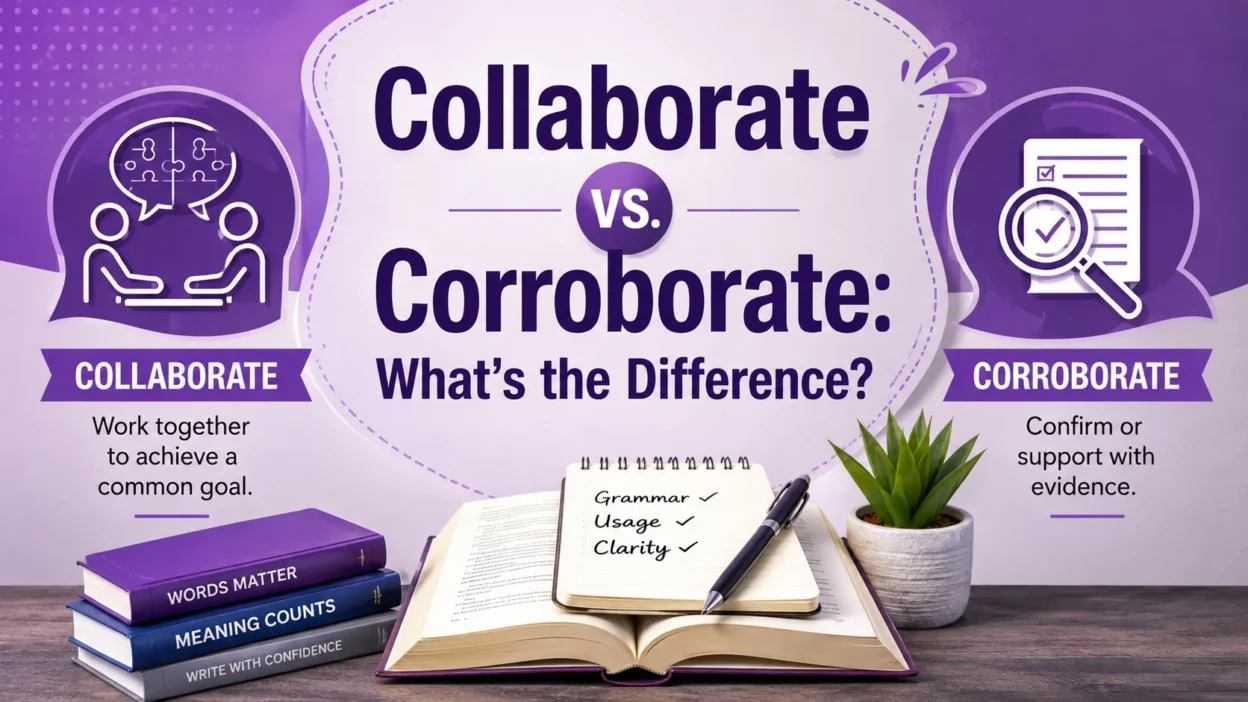
Collaborate vs. Corroborate explains the difference between two commonly confused words that many English learners, learners, and even native speakers often mix up. These words look alike, have similar similar spelling, and a close pronunciation, yet their pronunciation difference, meaning, mean, and different meanings are not the same. Choosing the correct word instead of the incorrect word depends on the context, contextual meaning, word choice, and proper usage. Strong English, language, English vocabulary, vocabulary, English grammar, and grammar help you communicate clearly in conversation, conversations, everyday conversations, everyday English, business communication, business writing, academic writing, legal writing, and legal documents. From experience, taking a second to understand the sentence meaning before you use a word can clarify your message, clear up mistakes, clear the fog, and prevent confusion.
Collaborate means working together through teamwork, cooperation, and collaboration, where a team, partner, or others join forces on a project or task to reach a common goal. Successful task completion depends on people working together to achieve results by achieving shared objectives. In contrast, corroborate means giving support to a story, idea, statement, or theory by providing evidence, information, proof, or backing up claims. Confirmation, corroboration, validate, validation, verify, and verifying help make claims more believable and trustworthy, allowing people to trust every finding. This simple explanation with practical examples makes the difference much easier to understand.
The easiest way to remember Collaborate vs. Corroborate is that people collaborate, while evidence corroborates. Keeping that simple point in mind will improve your writing, strengthen your communication, help you avoid confusing words and wrong use, and make every sentence more accurate. With the correct use in the right context, your message gets your point across more clearly, and your confidence in language learning continues to grow forever.
Quick Answer: Collaborate vs. Corroborate
The difference is simple:
- Collaborate means to work together with one or more people to achieve a common goal.
- Corroborate means to confirm, support, or strengthen a claim, statement, or piece of evidence with additional proof.
For example:
- The marketing team collaborated to launch a successful campaign.
- Security camera footage corroborated the witness’s testimony.
Think of it this way: people collaborate, while evidence corroborates.
What Does Collaborate Mean?
Collaborate means to work together with one or more people to achieve a shared goal, complete a project, or solve a problem. It involves combining knowledge, skills, and ideas to produce better results than one person could achieve alone. You can collaborate in business, education, research, healthcare, technology, and creative fields whenever teamwork and cooperation are essential.
Collaborate Definition
The verb collaborate means to work jointly with others to complete a task, solve a problem, or achieve a shared objective. It involves cooperation, communication, and combining different skills or ideas to produce a better outcome than one person could achieve alone.
Collaboration happens every day. Businesses rely on it to complete projects. Scientists use it to make discoveries. Musicians create albums together. Students collaborate on presentations, and software developers build applications as teams.
At its core, collaboration is about sharing responsibility and contributing toward the same goal.
“Alone we can do so little; together we can do so much.” — Helen Keller
When to Use Collaborate
Use collaborate whenever two or more people actively work together.
Common situations include:
- Team projects
- Business partnerships
- School assignments
- Research studies
- Creative writing
- Software development
- Product design
- Community initiatives
If cooperation is involved, collaborate is usually the correct choice.
Common Situations Where People Collaborate
People collaborate whenever they combine their skills, ideas, or resources to achieve a shared goal. You’ll commonly see collaboration in workplaces, schools, businesses, research projects, creative industries, healthcare, and community initiatives, where teamwork leads to better decisions, greater innovation, and more successful outcomes.
Workplace Projects
Modern businesses encourage employees from different departments to collaborate. A marketing specialist, graphic designer, and copywriter may all work together on the same advertising campaign.
Example:
The design and sales departments collaborated to improve the company’s product launch.
Business Partnerships
Companies often collaborate with other organizations to expand into new markets or create innovative products.
Examples include:
- Technology companies partnering with universities
- Clothing brands working with famous athletes
- Restaurants collaborating with local farmers
School Assignments
Teachers frequently assign group projects because collaboration teaches communication, leadership, and problem-solving skills.
Example:
Four students collaborated on their science presentation and earned the highest grade in the class.
Research Teams
Scientific breakthroughs rarely happen in isolation. Researchers from different countries often collaborate by sharing data, equipment, and expertise.
Creative Work
Artists, filmmakers, musicians, authors, and game developers collaborate to produce creative works that require multiple talents.
Collaborate Synonyms
Depending on the context, these words have similar meanings:
| Synonym | Best Used For |
| Cooperate | Working together generally |
| Partner | Business relationships |
| Team up | Informal collaboration |
| Join forces | Combined effort |
| Work together | Everyday conversations |
| Coordinate | Organizing tasks |
| Unite | Shared purpose |
| Contribute | Individual participation |
Each synonym has subtle differences, but all involve some level of teamwork.
Collaborate in a Sentence
Here are practical examples:
- The engineers collaborated to design a safer bridge.
- Our company collaborated with local charities during the fundraising event.
- Several universities collaborated on climate research.
- The author collaborated with an illustrator to publish a children’s book.
- Doctors from different hospitals collaborated to study the rare disease.
- The marketing team collaborated on a new advertising strategy.
- Two musicians collaborated on a chart-topping single.
- Students collaborated to solve the challenging math problem.
- Scientists collaborated across three continents.
- We collaborated closely throughout the six-month project.
What Does Corroborate Mean?
Corroborate means to confirm, strengthen, or support a statement, claim, or piece of evidence with additional proof. Unlike collaborate, which involves people working together, corroborate focuses on verifying information by using independent evidence that points to the same conclusion.
Corroborate Definition
The verb corroborate means to confirm or support a statement, claim, theory, or testimony with additional evidence.
Instead of involving teamwork, corroboration focuses on verification. It strengthens information by showing that independent evidence points to the same conclusion.
Imagine someone claims it rained yesterday. If weather records show rainfall at the same time, those records corroborate the claim.
When to Use Corroborate
Use corroborate whenever evidence confirms another piece of information.
You’ll often see this word in:
- Court cases
- Criminal investigations
- Journalism
- Academic research
- Historical studies
- Medical research
- Scientific publications
Where Corroborate Is Commonly Used
You’ll most often see corroborate in situations where facts, evidence, or testimony need independent support to prove that something is true.
Legal Cases
Courts often require corroborating evidence before accepting testimony.
Examples include:
- DNA evidence
- Security camera footage
- Phone records
- Financial documents
- Eyewitness accounts
A witness’s story becomes much stronger when physical evidence corroborates it.
Journalism
Responsible journalists rarely publish a story based on one anonymous source.
Instead, they corroborate information through:
- Public records
- Official documents
- Interviews
- Independent witnesses
- Expert opinions
This process helps ensure accuracy and credibility.
Academic Research
Researchers corroborate findings by comparing results with previous studies or conducting additional experiments.
If multiple independent studies reach the same conclusion, confidence in the findings increases.
Scientific Studies
Scientific discoveries become more reliable when repeated experiments corroborate earlier results.
Replication is one of the foundations of modern science.
Police Investigations
Investigators collect different types of evidence to corroborate witness statements.
For example:
- GPS records
- Fingerprints
- DNA samples
- Surveillance footage
- Phone location data
Each piece of evidence helps build a stronger case.
Historical Research
Historians compare letters, government records, newspapers, and artifacts to corroborate historical events.
Using multiple independent sources reduces the chance of relying on inaccurate information.
Corroborate Synonyms
Common alternatives include:
| Synonym | Meaning |
| Confirm | Verify accuracy |
| Verify | Check correctness |
| Support | Strengthen a claim |
| Validate | Prove legitimacy |
| Substantiate | Back with evidence |
| Authenticate | Prove genuine |
| Reinforce | Add supporting evidence |
| Prove | Establish truth |
While these words overlap, corroborate specifically emphasizes independent supporting evidence.
Corroborate in a Sentence
Here are practical examples:
- Medical records corroborated the patient’s account.
- DNA evidence corroborated the suspect’s confession.
- Two witnesses corroborated her version of events.
- Satellite images corroborated the environmental report.
- Financial statements corroborated the company’s earnings.
- Security footage corroborated the employee’s explanation.
- Multiple experiments corroborated the original findings.
- The documents corroborated the historian’s theory.
- Police recovered evidence that corroborated the witness statement.
- Independent experts corroborated the research conclusions.
Collaborate vs. Corroborate: Side-by-Side Comparison
| Feature | Collaborate | Corroborate |
| Meaning | Work together | Confirm with evidence |
| Purpose | Achieve a shared goal | Verify information |
| Involves | People or organizations | Facts, evidence, testimony, research |
| Common Fields | Business, education, technology, arts | Law, journalism, science, history |
| Focus | Teamwork | Verification |
| Typical Keywords | Team, partnership, cooperation | Evidence, proof, confirmation |
| Example | The team collaborated on the project. | The evidence corroborated the witness’s testimony. |
Conclusion
Understanding Collaborate vs. Corroborate becomes much easier once you remember what each word does. Collaborate is about people working together toward a common goal, while corroborate is about supporting a statement, theory, or claim with evidence or proof. Although the words have similar spelling and a similar pronunciation, their meaning is completely different. Using the correct word in the right context makes your writing clearer, more professional, and easier for others to understand.
FAQs
Q1.What is the difference between Collaborate and Corroborate?
Collaborate means to work together with others on a project or task, while corroborate means to confirm, verify, or support a statement with evidence, information, or proof.
Q2.Can Collaborate and Corroborate be used interchangeably?
No. Collaborate refers to teamwork, cooperation, and collaboration, while corroborate refers to confirmation, corroboration, validation, and verification of facts or claims.
Q3.How can I remember Collaborate vs. Corroborate?
Remember this simple rule: people collaborate, but evidence corroborates. If you’re talking about working together, use Collaborate. If you’re talking about supporting a story, idea, or claim with proof, use Corroborate.
Q4.Where is the word Corroborate commonly used?
Corroborate is commonly used in legal writing, academic writing, business writing, journalism, scientific research, police investigations, and court cases where evidence is needed to support or verify a statement.
Q5.Why do people confuse Collaborate and Corroborate?
Many English learners and even native speakers confuse these commonly confused words because they look alike, have similar spelling, and a similar pronunciation. Learning their different meanings and paying attention to the context helps you choose the correct word every time.a