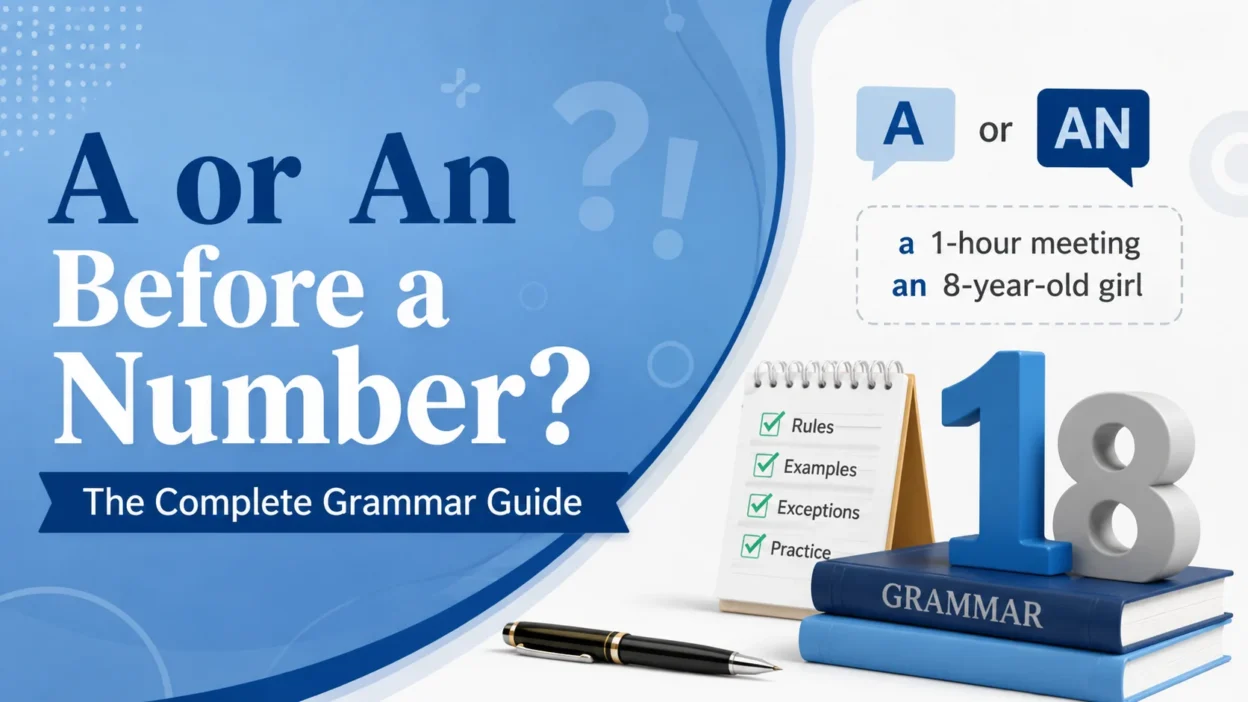
“A” or “An” Before a Number? is a common question that many English learners ask when they want to use articles correctly. The answer depends on pronunciation, sound, and specific grammar rules rather than simple spelling. In English, a and an are indefinite articles used before a singular noun or non-specific noun. The article choice depends on the first sound of the following word or following number. For example, we say an eight because eight begins with a vowel sound, while a hundred begins with a consonant sound. This rule may look small, but it plays an important role in clear and natural English.
When you look closely at English grammar, you will notice that spoken language often matters more than written form. The first spoken sound decides whether you should use a or an, not only the first letter you see. Numbers such as eight, eleven, and eighteen begin with a vowel sound, so they usually need an. However, numbers that start with a consonant sound, such as one hundred, use a. Understanding this pronunciation rule helps remove confusion and improves your correct usage in everyday communication.
In everyday English writing, including emails, essays, reports, and simple sentences, choosing the right article makes your writing sound more professional and natural. When you say out loud the number before writing, you can easily identify the correct sound and avoid common mistakes. This simple habit strengthens your English skills, improves English learning, and helps you understand how the English language connects pronunciation with grammar. Even experienced writers can hesitate with these small details, but learning the rule makes article selection much easier.
Quick Answer: A or An Before a Number
Use a before a number that begins with a consonant sound.
Use an before a number that begins with a vowel sound.
The written digit does not decide the article. The spoken sound does.
Examples:
- a one-time fee
- a 100-page report
- a 1,000-word essay
- an 8-hour shift
- an 11-year-old student
- an 80-mile drive
A fast way to check is simple: say the number out loud. If the first sound feels like a vowel, use an. If it feels like a consonant, use a.
Why Pronunciation Matters More Than Spelling
Many people look at the first digit and choose the article from that. That is where the confusion starts.
English does not care only about spelling here. It cares about the sound. This is the same reason we say:
- an hour
- a house
Both words begin with the letter h, but they do not begin with the same sound. The same logic works with numbers.
For example:
- a 100-dollar bill
- an 8-year-old child
The first number sounds like one hundred. The second sounds like eight. That first spoken sound decides the article.
Simple rule: Choose a or an based on the first sound, not the first digit.
Understanding Indefinite Articles in English
A and an are indefinite articles that refer to a singular, non-specific noun, and choosing the correct one depends on the first spoken sound of the following word or number rather than its spelling.
The Basics of “A” and “An”
A and an are indefinite articles. They point to one thing without being specific.
Examples:
- a book
- an apple
- a student
- an engineer
When a number comes before a noun, the same rule still applies. The article must sound natural when spoken.
Examples:
- a 100-meter race
- an 18-year-old athlete
- a one-hour meeting
- an 11-inch screen
Why English Uses Articles This Way
The rule exists to make speech flow better. English avoids awkward sound clashes.
Say this out loud:
- an eight-hour trip
It feels rough because a ends and eight begins with a vowel sound.
Now say:
- an eight-hour trip
That flows much more easily. English prefers the smoother version.
When to Use “A” Before a Number
Use a when the number begins with a consonant sound.
The most common case is numbers that begin with one.
Why “One” Takes “A”
Although one starts with the letter o, it is pronounced with a w sound: won.
That is why we say:
- a one-time offer
- a one-bedroom apartment
- a one-year warranty
- a one-hour break
We do not say:
- an one-time offer
- an one-bedroom apartment
The sound controls the article.
Common Examples With “A”
- a 100-page book
- a 1,000-word article
- a 180-degree turn
- a one-person team
- a one-way street
- a one-night stay
A Small Pattern to Notice
Numbers starting with 1 often use a because many of them sound like one.
Examples:
- a 100-mile journey
- a 1,500-seat stadium
- a 1,000-person crowd
The first sound is still the w sound in one, so a stays correct.
When to Use “An” Before a Number
Use an when the number begins with a vowel sound.
Numbers That Usually Take “An”
These numbers are the most common ones:
- eight
- eleven
- eighteen
- eighty
- eight hundred
Examples:
- an 8-hour shift
- an 8-year-old boy
- an 11-page handout
- an 18-month lease
- an 80-year-old house
- an 800-seat theater
Why These Numbers Take “An”
Even though the digits look different, the spoken form begins with a vowel sound.
- eight starts with a vowel sound
- eleven starts with a vowel sound
- eighteen starts with a vowel sound
- eighty starts with a vowel sound
That first sound is what matters.
More Sentence Examples
- She works an 8-hour shift every Friday.
- He gave an 11-minute speech at the event.
- They rented an 18-seater van for the trip.
- The museum owns an 80-year-old painting.
- We moved into an 800-square-foot apartment.
These all sound natural because the article matches the opening sound.
A Helpful Number Table
| Number | Spoken Form | First Sound | Correct Article | Example |
| 1 | one | consonant sound | a | a one-time payment |
| 8 | eight | vowel sound | an | an 8-hour delay |
| 11 | eleven | vowel sound | an | an 11-inch laptop |
| 18 | eighteen | vowel sound | an | an 18-year-old driver |
| 80 | eighty | vowel sound | an | an 80-page report |
| 100 | one hundred | consonant sound | a | a 100-page report |
| 180 | one eighty | consonant sound | a | a 180-degree turn |
| 800 | eight hundred | vowel sound | an | an 800-seat hall |
This table solves a lot of confusion at a glance.
Special Cases That Confuse Writers
Some numbers can seem confusing because their written form doesn’t always match their spoken sound, but the correct choice between a and an always depends on pronunciation rather than the digit or spelling.
Numbers Written in Digits vs. Words
Sometimes the numeral looks simple, but the spoken form changes the article.
For example:
- a 1-hour meeting
- an 8-minute wait
- a 100-meter sprint
- an 11-year-old child
The article follows the spoken version, not the written symbol.
Time, Age, Money, and Measurements
This rule appears in many common situations.
Age
- an 8-year-old student
- a one-year-old puppy
- an 18-year-old voter
- an 80-year-old author
Time
- an 11-hour flight
- an 8-minute delay
- a one-hour class
- an 18-hour journey
Money
- a $100 bill
- an $80 ticket
- a $1,000 prize
- an $18 meal
Measurements
- a 100-meter race
- an 8-foot ladder
- an 11-inch screen
- a one-mile walk
Regional Pronunciation Can Matter
In rare cases, the article can change if the number is pronounced differently.
For example, some people may say a large number one way and others may say it another way. In those cases, the spoken version still decides the article. That is why pronunciation is always the safest guide.
Common Mistakes People Make
People often make the same few errors with a or an before a number.
Mistake: Using the Digit Instead of the Sound
Wrong:
- an 100-page book
Correct:
- a 100-page book
Why? Because 100 is spoken as one hundred.
Mistake: Ignoring “One”
Wrong:
- an one-time offer
Correct:
- a one-time offer
Why? Because one starts with a w sound.
Mistake: Copying the Pattern Blindly
Wrong:
- a 8-hour shift
Correct:
- an 8-hour shift
Why? Because eight begins with a vowel sound.
Mistake: Trusting Spelling Alone
English spelling can be deceptive. Letters do not always match sound. That is why you should always say the number aloud.
Conclusion
Choosing “A” or “An” Before a Number? becomes simple once you understand that English follows pronunciation rather than spelling. The first spoken sound of the number decides whether you should use a or an. Numbers like eight, eleven, and eighteen begin with a vowel sound, so they take an, while numbers like one hundred begin with a consonant sound, so they take a. By practising this rule in everyday writing, you can improve your grammar, avoid common mistakes, and make your English sound more natural.
FAQs
Q1.Why do we use “an” before some numbers?
We use an before numbers that begin with a vowel sound when spoken. For example, eight, eleven, and eighteen start with vowel sounds, so we say an 8-hour shift and an 18-year-old student.
Q2.Why is it “a 100-page book” instead of “an 100-page book”?
We say a 100-page book because 100 is pronounced as one hundred. The word one begins with a consonant sound (w), so it requires a.
Q3.Should I choose “a” or “an” based on the first digit?
No. The first digit does not decide the article. You should choose a or an based on the first sound of the number when you say it aloud.
Q4.Is “an 11-year-old child” correct English?
Yes, an 11-year-old child is correct because eleven begins with a vowel sound. The article matches the pronunciation, not the written number.
Q5.Does the same rule apply when numbers are written as words?
Yes. Whether you write the number as a digit or a word, the rule stays the same. For example, you can write an eight-page report or an 8-page report because both begin with the same vowel sound.