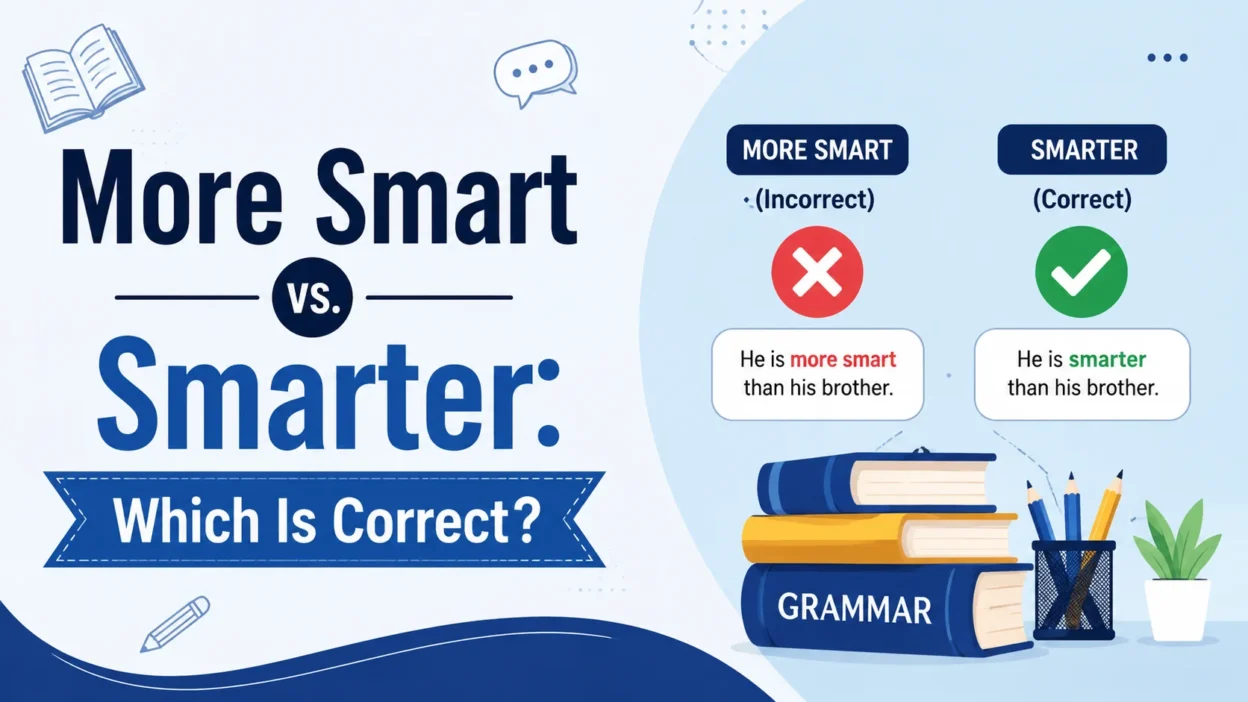
In everyday English, More Smart vs Smarter becomes easier when you understand which choice sounds natural in a direct comparison. When you compare one person, thing, idea, or choice with another, smarter is usually the better form. It sounds natural in everyday conversations and clear in most types of writing.
For example, you might say one student is smarter, one solution is smarter, or one plan is smarter. When comparing two people, smarter usually sounds much smoother than more smart. The phrase more smart can appear in certain contexts, but it isn’t the usual choice for a direct comparison. “Maria is smarter than John” follows the normal grammar pattern.
You can use the same structure for objects, plans, or a phone with better features. From a practical writing perspective, choosing smarter keeps your sentence clear, natural, and easy to understand. Understanding this difference helps you avoid a common grammar mistake when forming a comparative sentence. Once you recognise smarter as the standard form, choosing between more smart and smarter becomes much easier.
More Smart vs. Smarter: The Quick Answer
Smarter is generally the correct and more natural comparative form of smart.
The basic pattern looks like this:
- Smart — base form
- Smarter — comparative form
- Smartest — superlative form
Here are a few examples:
- Jake is smart.
- Jake is smarter than his brother.
- Jake is the smartest student in his class.
The word smarter works when you’re comparing two people or things.
For example:
This laptop is smarter than my old one.
She made a smarter decision this time.
You need a smarter way to solve this problem.
In each sentence, smarter tells the reader that one person, object, decision, or method has a greater degree of a quality than another.
Understanding the Comparative Form of “Smart”
The adjective smart has several meanings. Its most familiar meaning relates to intelligence or good judgment.
You might describe someone as smart because they learn quickly, solve problems well, or make sensible decisions.
For example:
David is a smart student who understands difficult ideas quickly.
However, smart doesn’t always mean intelligent. Depending on context, it can describe someone who looks polished, behaves sensibly, or uses an effective approach.
Consider these examples:
- She is a smart student.
- That was a smart decision.
- He looks smart in that suit.
- This is a smart solution to the problem.
When you want to compare these qualities, smarter usually does the job.
She is smarter than her classmates.
That was a smarter decision.
He looks smarter in a formal suit.
This is a smarter solution.
The ending -er creates the comparative form.
smart → smarter
That pattern is common with short adjectives in English.
Why “Smarter” Is Usually the Better Choice
English often forms comparisons in two main ways. Short adjectives commonly take -er, while longer adjectives often use more.
For example:
| Base adjective | Comparative |
| fast | faster |
| tall | taller |
| bright | brighter |
| small | smaller |
| smart | smarter |
| careful | more careful |
| useful | more useful |
| intelligent | more intelligent |
Because smart is a short, one-syllable adjective, smarter fits the standard comparative pattern.
Think of it like adding a small gear to a machine. The word doesn’t need an extra helper because -er already performs the comparison.
So these sentences sound natural:
- My brother is smarter than me.
- This is a smarter choice.
- She found a smarter solution.
- That student is smarter than he appears.
In ordinary English, smarter is the form to reach for first.
Is “More Smart” Ever Correct?
This point deserves some nuance.
“More smart” isn’t necessarily impossible in every conceivable sentence. English sometimes allows speakers to use more + adjectives for emphasis, contrast, stylistic reasons, or special interpretations.
However, grammatical possibility doesn’t always equal natural usage.
Imagine two roads leading to the same destination. One road is smooth and familiar. The other works too, but it feels unusual. In normal English, smarter is the smooth road.
For example:
She is smarter than her sister.
This sounds natural and direct.
By comparison:
She is more smart than her sister.
The second sentence may be understandable, but it sounds less idiomatic in standard modern English.
That’s why writers and speakers generally choose smarter.
A useful rule
When you’re simply comparing the quality expressed by smart, use:
smart → smarter
Don’t automatically insert more just because you’re forming a comparison.
Smart, Smarter, and Smartest: Comparative and Superlative Forms
Adjectives can appear in three degrees of comparison.
Positive Form: Smart
The positive form simply describes something.
Emma is smart.
There’s no comparison here.
Comparative Form: Smarter
The comparative form compares two people or things.
Emma is smarter than Liam.
The word then often appears after a comparative adjective when the second item is named.
Superlative Form: Smartest
The superlative form describes the highest degree within a group.
Emma is the smartest student in the class.
The pattern is:
smart → smarter → smartest
This is one of the easiest adjective patterns to remember.
When to Use “More” With Adjectives
The word more isn’t wrong in comparative grammar. In fact, English uses it constantly.
The key is knowing which adjectives typically need it.
Short adjectives often take -er:
- fast → faster
- strong → stronger
- cold → colder
- bright → brighter
- smart → smarter
Longer adjectives often use more:
- careful → more careful
- useful → more useful
- expensive → more expensive
- difficult → more difficult
- intelligent → more intelligent
For example:
This method is more effective than the old one.
It would sound unnatural to force an -er ending onto a long adjective.
The important lesson is that more and -er aren’t interchangeable tools. English chooses between them according to the adjective and established usage patterns.
Smart vs. Intelligent: Are They Interchangeable?
Smart and intelligent overlap in meaning, but they aren’t always identical.
Smart is common in everyday conversation. It can sound relaxed and natural.
She’s a smart kid.
Intelligent often sounds more formal or precise.
She’s an intelligent researcher.
Their comparative forms also differ:
- smart → smarter
- intelligent → more intelligent
For example:
James is smarter than his brother.
James is more intelligent than his brother.
Both sentences can communicate a similar basic idea.
However, smart can carry meanings beyond raw intelligence. Someone can make a smart choice without being compared in academic ability.
For example:
Buying the cheaper car was a smart decision.
Here, smart means sensible, practical, or wise.
You could also say:
Buying the cheaper car was a smarter decision.
The comparative smarter shows that one decision was better or more sensible than another.
Common Mistakes With “More Smart” and “Smarter”
Several mistakes appear repeatedly when people form comparisons.
Using “More Smart” as the Default
The biggest issue is choosing more smart when you simply need the comparative form of smart.
Prefer:
She is smarter than her brother.
Rather than:
She is more smart than her brother.
Confusing “Smarter” With “More Intelligent”
Both words can describe mental ability, but they belong to different adjective patterns.
Correct:
He is smarter than his friend.
Correct:
He is more intelligent than his friend.
Don’t transfer the comparative structure of intelligent to smart.
Using “Smartest” for Two Things
The comparative generally handles a comparison between two items.
Of the two plans, Plan A is smarter.
The superlative usually applies when you’re selecting the highest degree from a group.
Plan A is the smartest of the five options.
This distinction keeps your comparisons precise.
“Smarter Than” in Real Sentences
One of the most useful structures is:
smarter than
Here are some natural examples:
- My new phone is smarter than my old phone.
- She is smarter than she looks.
- This strategy is smarter than the previous approach.
- He’s smarter than his competitors expected.
- Taking the train was smarter than driving.
Notice that smarter doesn’t always describe intelligence.
It can describe:
- a decision
- a strategy
- a solution
- a purchase
- a method
- a choice
- a design
- a technology
For instance:
Saving money before making a major purchase is a smarter approach.
Here, smarter means more sensible or effective.
“More Smart” vs. “Smarter” in Different Contexts
“More Smart” vs. “Smarter” depends on the context, but “smarter” is usually the natural choice for comparisons.
Talking About People
When discussing intelligence, smarter is the natural comparative.
Ava is smarter than her older brother.
This doesn’t necessarily mean Ava knows everything. It simply compares their perceived intelligence or ability.
Talking About Technology
Modern English frequently uses smart to describe technology.
You might hear:
- smart phone
- smart device
- smart home
- smart system
- smart technology
When comparing such systems, smarter remains natural.
This smart thermostat is smarter than the older model.
Here, the word can refer to greater automation, responsiveness, or capability rather than human intelligence.
Talking About Decisions
This is another common use.
Taking the earlier flight was a smarter choice.
The person isn’t saying the flight has a higher IQ. Instead, the choice produced a better practical outcome.
Talking About Appearance
Smart can also mean neat, polished, or well-dressed.
For example:
He looks smart in that jacket.
A comparative form can describe a stronger impression:
He looks smarter in a tailored jacket.
The exact meaning depends on context.
Examples of “More Smart” vs. “Smarter”
| Sentence | Naturalness | Explanation |
| She is smarter than me. | Natural | Standard comparative form. |
| He made a smarter choice. | Natural | Compare the quality of two choices. |
| This system is smarter than the old one. | Natural | Compares technological capability. |
| She is more intelligent than me. | Natural | “Intelligent” normally uses “more.” |
| She is more smart than me. | Less natural | Usually replace it with “smarter.” |
| He is the smartest student here. | Natural | Superlative form. |
| This is the smarter of the two options. | Natural | Comparative used for two choices. |
The table reveals the central pattern: smarter is the normal comparative form of smart.
How to Remember the Correct Form
Here’s a simple memory trick:
Smart is short, so give it -er: smart → smarter.
Then remember the three forms as a small sequence:
Smart → Smarter → Smartest
You can also compare it with another short adjective:
Fast → Faster → Fastest
The structure works in much the same way.
When the adjective becomes longer, more often enters the picture:
Intelligent → More intelligent → Most intelligent
This distinction helps you avoid a common comparative mistake.
Here’s a concise conclusion and five useful FAQs for “More Smart vs. Smarter.”
Conclusion
Choosing between smarter and smarter is simple once you understand the basic grammar rule. Smarter is the standard comparative form of smart and usually sounds more natural when comparing two people, things, ideas, or choices. While more smart may appear in certain contexts, smarter remains the clearer choice for everyday English and most practical writing.
FAQs
Q1.Is “smarter” correct English?
Yes. Smarter is the standard comparative form of smart and works naturally when comparing two people or things.
Q2.Is “more smart” grammatically correct?
More smart can appear in some contexts, but it isn’t usually the preferred form for a direct comparison. Smarter normally sounds more natural.
Q3.Should I say “more smart” or “smarter”?
In most situations, choose smarter. For example, “Maria is smarter than John” is natural and grammatically standard.
Q4.What is the comparative form of “smart”?
The comparative form is smarter. The basic pattern is smart → smarter → smartest.
Q5.Can “smarter” describe things besides people?
Yes. You can describe a smarter plan, smarter solution, smarter choice, smarter phone, or smarter approach. In these cases, it can mean more effective, practical, or useful.