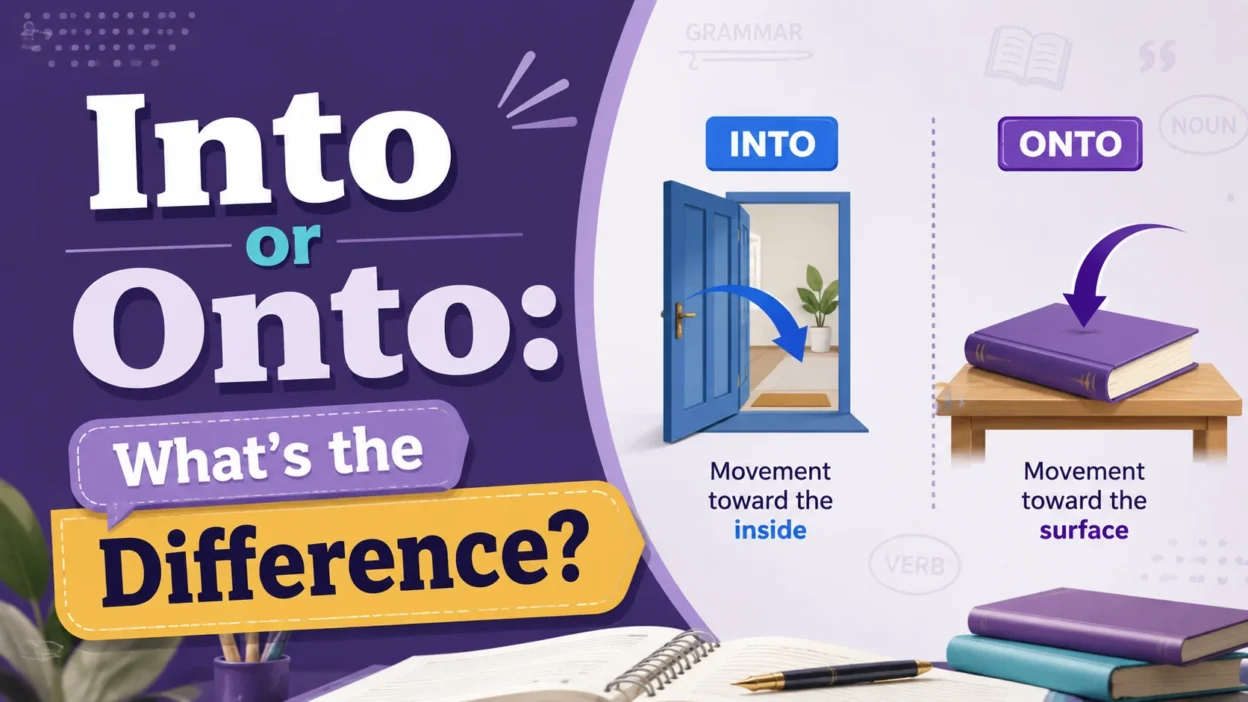
Into’ or ‘Onto can confuse English learners because these prepositions are small words, yet they can change the meaning of a sentence. The difference becomes easier when you focus on movement and destination. Into usually describes physical movement from the outside to the inside of a place, such as when someone walks into a room or enters a space. Onto shows movement toward a surface or higher position, such as when someone climbs onto a roof. This simple pattern gives you a clear picture and makes these words easier to use than simply memorising long definitions.
These prepositions can also describe actions, changes, and movement in less literal situations. You might move into a new state, direct an action towards something, or move onto a new stage or position. A crossroads or signpost can help you imagine movement toward an inside destination, while atop clearly suggests being on a surface. The more you connect the word with the destination, the easier its usage becomes. This approach can strengthen your understanding and help you choose the right preposition without stopping to think through complicated grammar rules.
In everyday English, paying attention to these small words can prevent confusion, especially when you’re writing quickly. The difference between into and onto can appear in simple physical examples, but it can also involve transition, thoughts, and a change of place. For example, moving into a new situation suggests entering a different state, while moving onto a new stage suggests reaching another position or phase. From my experience, picturing the movement first and checking the destination second makes this grammar point much more natural and helps you use both prepositions correctly.
Quick Answer: Into or Onto?
The basic rule is straightforward:
- Into usually means movement from outside to inside.
- Onto usually means movement to a surface or position.
- In to contains two separate words that perform separate grammatical jobs.
- On to also contains two separate words that perform separate grammatical jobs.
Compare these sentences:
She walked into the room.
She moved from outside the room to its interior.
She walked onto the stage.
She moved toward the stage and ended up on its surface.
| Form | Basic meaning | Example |
| into | Movement inside | He walked into the store. |
| onto | Movement to a surface or position | He stepped onto the platform. |
| in to | Two separate words | She came in to help. |
| on to | Two separate words | Let’s move on to the next topic. |
A simple memory trick works in many situations:
Into = inside.
Onto = on a surface.
However, context still matters. English has plenty of expressions where the meaning depends on the verb and the relationship between the words.
Into or Onto: Understanding the Basic Difference
The central distinction between into or onto comes down to the final position of the person or object.
When something crosses a boundary and ends up inside, into generally fits.
When something moves toward a surface and ends up on it, onto generally fits.
Imagine two simple pictures.
In the first, a ball rolls through the opening of a box. The ball goes into the box.
In the second, the same ball rolls across the floor and lands onto a platform.
The movement itself isn’t enough to choose the word. The destination matters.
What Does “Into” Mean?
Into is a preposition that commonly expresses movement toward the inside of something.
It can describe movement into:
- A room
- A building
- A house
- A box
- A bag
- A container
- A vehicle
- An enclosed area
For example:
- She walked into the kitchen.
- He ran into the house.
- The dog jumped into the car.
- Put the clothes into the suitcase.
- Pour the milk into the cup.
In each sentence, something moves toward an interior space.
However, into has broader meanings too. It can describe a transformation:
The company turned the idea into a successful product.
It can also describe contact or collision:
The cyclist crashed into the barrier.
So into doesn’t always mean physically entering something. Its wider meaning involves movement toward a new state, position, relationship, or point of contact.
What Does “Onto” Mean?
Onto commonly describes movement toward and ending on a surface or position.
Examples include:
- The cat jumped onto the table.
- She stepped onto the stage.
- He climbed onto the roof.
- The child crawled onto the bed.
- The book fell onto the floor.
The surface doesn’t have to be completely flat. A roof, platform, branch, stage, or deck can all work with onto.
The key idea is that the object or person reaches a position on something rather than entering its interior.
Into or Onto: A Quick Comparison
| Feature | Into | Onto |
| Main idea | Movement inside | Movement to a surface or position |
| Common destination | Room, building, box, container | Table, stage, roof, platform |
| Typical relationship | Outside → inside | Off/away → on a surface |
| Transformation use | Common | Less common |
| Collision use | Common | Usually different |
| Example | She walked into the room. | She stepped onto the stage. |
The easiest way to remember the difference is to picture the endpoint.
Inside? Think into.
On a surface? Think onto.
Into or Onto for Physical Movement
Physical movement provides the clearest examples of this grammar rule.
Suppose someone stands outside a house. When that person crosses the doorway, they walk into the house.
Now imagine that person climbs onto the porch. They move onto the porch.
The starting point can change, but the destination tells you which preposition makes sense.
Using “Into” With Rooms and Buildings
Use into when movement takes someone or something inside a room, building, or enclosed space.
Examples:
- She walked into the bedroom.
- He ran into the office.
- The children rushed into the classroom.
- We went into the restaurant.
- The dog wandered into the garage.
Notice the difference between in and into:
She is in the room.
This describes location.
She walked into the room.
This describes movement toward that location.
That distinction is important. It tells you where something is. Into commonly tells you where something moves.
Using “Into” With Containers
Containers make the rule even easier.
Use when something moves from outside a container to its inside.
Examples:
- Put the coins into the jar.
- Pour the water into the bottle.
- Drop the letter into the mailbox.
- Place the clothes into the drawer.
- Throw the ball into the basket.
The object crosses the boundary of the container. That’s the central idea behind into.
Using “Onto” With Tables, Floors, and Platforms
Use onto when something moves toward a surface.
Examples:
- Put the keys onto the table.
- The child climbed onto the chair.
- The dog jumped onto the couch.
- She stepped onto the floor.
- He moved onto the platform.
The object doesn’t enter the table or platform. It reaches a position on it.
Using “Onto” With Stages and Elevated Areas
A surface doesn’t have to be a traditional flat object.
You can say:
- The actor walked onto the stage.
- She climbed onto the roof.
- The child stepped onto the deck.
- The bird landed onto the branch.
- He climbed onto the balcony.
In these examples, onto describes a change in position.
Into or Onto With Cars, Buses, Trains, and Other Vehicles
Vehicles create some interesting examples because English treats different types of transportation differently.
You generally get into a car, taxi, truck, or van.
Examples:
- She got into the car.
- He climbed into the taxi.
- They got into the truck.
These vehicles are commonly understood as enclosed spaces that you enter.
However, you normally get onto a bus, train, plane, or ship.
Examples:
- She got onto the bus.
- He stepped onto the train.
- They climbed onto the plane.
- The passengers got onto the ship.
This isn’t simply a matter of whether you physically enter a vehicle. Conventional English usage also shapes the choice.
A useful practical rule is to learn these common combinations as natural expressions:
| Expression | Common usage |
| Get into the car | Correct |
| Get into the taxi | Correct |
| Get onto the bus | Correct |
| Get onto the train | Correct |
| Get onto the plane | Correct |
| Get onto the ship | Correct |
There are exceptions and differences in regional usage, but these forms are standard in everyday American English.
Into or Onto for Transformation and Change
The word into has an important figurative use. It can describe a transformation from one thing, condition, or form into another.
This meaning appears frequently in business, education, science, storytelling, and everyday conversation.
Using “Into” for Transformation
Consider these examples:
- The artist turned the sketch into a painting.
- The company turned the idea into a product.
- The caterpillar changed into a butterfly.
- The small project grew into a major business.
- The discussion turned into an argument.
Nothing necessarily moves through physical space in these sentences.
Instead, into marks the result of a change.
You can think of it as:
Original state → into → new state
For example:
idea → into → product
sketch → into → painting
discussion → into → argument
This is one reason the word into is more flexible than the basic “inside” rule might suggest.
Using “Into” for Contact and Collision
Into also appears with verbs that describe physical impact.
Common combinations include:
- crash into
- bump into
- run into
- slam into
- walk into
- drive into
For example:
The car crashed into the wall.
The car doesn’t enter the wall. Instead, its movement ends in contact with the wall.
Another example has a figurative meaning:
I ran into my old teacher at the grocery store.
Here, I ran into means encountered unexpectedly.
The same preposition can therefore appear in different situations. The verb and context determine the exact meaning.
Into or Onto: Understanding “Into” vs. “In To”
The question isn’t always simply into or onto. Sometimes the real choice is into or in to.
These forms look and sound similar, but they have different grammatical structures.
When to Use “Into”
Use into as one word when it functions as a preposition.
Examples:
- She walked into the store.
- He put the keys into his pocket.
- The dog ran into the yard.
- They poured the water into the glass.
- She turned the idea into a plan.
In these examples, into connects the action to its destination or result.
When to Use “In To”
Use it when in and to have separate jobs.
For example:
She came in to help.
Here, came in the form of the movement phrase while to help explain the purpose.
Another example:
He logged in to check his email.
Here, logged in is the phrasal verb. The phrase to check his email explains the purpose.
The distinction becomes clearer when you look at the sentence structure rather than the sound.
Into or In To: Compare the Meaning
| Sentence | Correct form | Reason |
| She walked into the room. | into | Movement inside |
| He poured water into the glass. | into | Movement into a container |
| She came in to help. | in to | “Came in” + infinitive “to help” |
| He logged in to check his messages. | in to | “Logged in” + purpose phrase |
| They went into the building. | into | Movement inside |
A useful test is to examine whether it naturally belongs to the verb before to.
If it does, it may be the correct choice.
Conclusion
Understanding into and onto becomes easier when you focus on movement and destination. Use into when something moves from outside to inside, and use onto when something moves toward or reaches a surface or position. Simple examples such as walking into a room or stepping onto a stage can make the distinction clear. Once you learn to picture the direction of movement, you’ll find it much easier to choose the right preposition in everyday English.
FAQs
Q1.Is “into” used for movement?
Yes. Into commonly describes movement from outside to inside. For example, “She walked into the house” shows movement from outside the house to its interior.
Q2.Is “onto” used for surfaces?
Yes. Onto generally describes movement toward or onto a surface. For example, “The cat jumped onto the table” shows movement to the table’s surface.
Q3.What is the easiest way to remember “into” and “onto”?
Think about the destination. If something moves inside, use into. If something moves to a surface or position, use onto.
Q4.Can “into” describe something other than physical movement?
Yes. Into can describe changes, transitions, or entering a new state. For example, someone can move into a new stage of life or get into a difficult situation.
Q5.Can “onto” describe a change or new position?
Yes. Onto can indicate movement toward a new position, stage, or subject. For example, “Let’s move onto the next topic” shows a transition to something new.