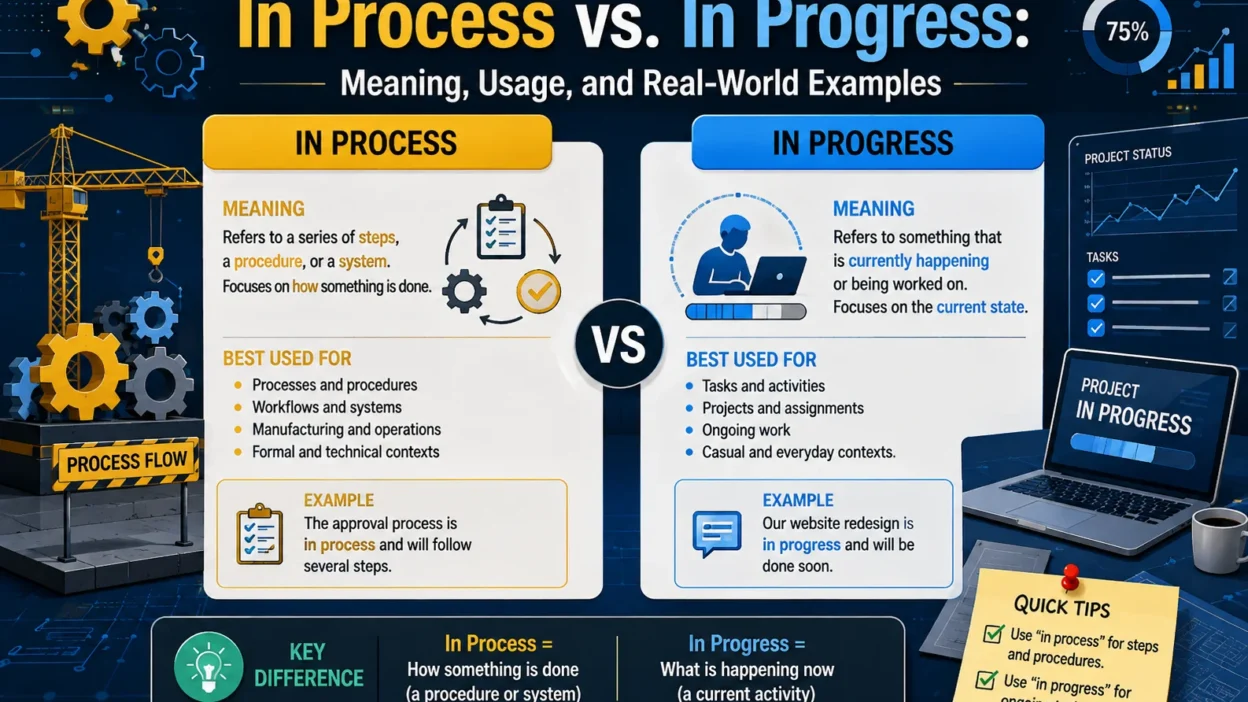
When comparing In Process” vs “In Progress, the difference matters because each phrase can shape your writing and communication differently. In professional writing, workplace writing, academic writing, emails, and project updates, context helps you choose the right expression. In progress usually describes an activity, task, project, or event that remains unfinished and is still happening, while in process can describe something moving through a process or several stages. This distinction gives the reader greater clarity and makes the message easier to understand without confusion about the meaning.
The distinction becomes even more useful in technical and industry communication, particularly in manufacturing. A manufacturing process may include in-process inspection and in-process testing, while a project can remain in progress until completion. In an academic setting, academic work or research may be in progress, whereas a specific procedure may be in process. Paying attention to grammar, usage, and terminology helps you use these expressions correctly. It also helps you communicate clearly, avoid common mistakes, and produce more credible writing.
A simple guide can make the distinction easier to remember. Think of progress as movement toward completion, while process points to stages or procedures. This memory trick becomes useful when you’re polishing emails, reports, or project updates. The examples are straightforward: a task or event can be in progress, while manufacturing testing may be in-process. Understanding the language behind these terms gives your writing a sharper edge, whether you’re preparing academic documents, professional material, or everyday communication.
Quick Answer: In Process vs. In Progress
In progress is generally the better choice when you mean that something is happening, continuing, or not yet finished.
In process can also mean that something is underway, but it tends to appear in more specific procedural or technical contexts. In many everyday sentences, in progress, underway, or being processed sounds more natural.
| Expression | Meaning | Common use | Example |
| In progress | Something is happening or continuing | Projects, activities, events, repairs | “The repairs are in progress.” |
| In process | Something is underway or moving through a process | Procedural or specialized contexts | “The preparations are in process.” |
| In-process | Related to something within a process | Manufacturing and technical writing | “The product requires in-process testing.” |
| Being processed | Something is currently being handled | Applications, orders, payments | “Your application is being processed.” |
| In the process of | Someone is currently carrying out an action | Everyday and professional writing | “We’re in the process of reviewing it.” |
The simplest rule is this: if you mean that something is happening, “in progress” will usually be the clearest choice.
What Does “In Progress” Mean?
“In progress” means that something has started and is still happening, continuing, or moving toward completion.
The Meaning of In Progress
In progress describes something that has begun and continues toward completion. It focuses on an ongoing activity, event, task, or development.
Think about a construction project. Before work begins, construction hasn’t started. Once workers begin, construction is in progress. When the project finishes, it is no longer in progress.
The same idea applies to a meeting, investigation, repair, research project, or discussion.
For example:
- “The meeting is in progress.”
- “The investigation is in progress.”
- “Repairs are in progress.”
- “The new website is in progress.”
- “Construction is in progress.”
- “The research is still in progress.”
In each sentence, the reader understands that something is actively happening or developing.
Why In Progress Is So Common
The word progress naturally suggests movement toward an outcome. Something begins at one point and moves toward another.
That makes in progress particularly useful when you want to communicate three ideas at once:
- The activity has started.
- The activity hasn’t finished.
- The activity is moving toward completion.
For instance, “The project is in progress” immediately tells you that the project isn’t merely planned. Someone has already started working on it.
What Does “In Process” Mean?
“In process” means that something is underway or moving through a particular process, procedure, or series of steps.
The Meaning of In Process
In process can mean that something is underway or being carried through a process. However, it doesn’t have the same broad everyday range as in progress.
This distinction matters because writers sometimes assume that the two expressions are perfect synonyms.
They aren’t.
For example, “The renovation is in progress” sounds natural because renovation is an ongoing activity. “The renovation is in process” can be understood, but many readers would find in progress more natural.
The phrase in process becomes more useful when the process itself matters.
For example:
- “The preparations are in process.”
- “The transition is in process.”
- “The changes are already in process.”
Even in these examples, alternatives such as underway, ongoing, or in progress may sound more natural depending on the sentence.
Why Context Matters With In Process
English often gives you several expressions for a similar idea. The best choice depends on the exact relationship between the subject and the action.
Compare these sentences:
- “The project is in progress.”
- “The application is being processed.”
- “The application is under review.”
- “The transition is underway.”
All four describe something unfinished. Yet each sentence gives the reader a slightly different picture.
That’s why good word choice isn’t just about finding a synonym. It’s about identifying the specific action or state you want to describe.
In Process vs. In Progress: The Main Difference
The clearest distinction comes down to emphasis.
In progress emphasizes an ongoing activity.
In process emphasizes something being within or undergoing a process.
Consider a road construction project.
You’d naturally say:
“Road construction is in progress.”
That sentence focuses on the activity itself.
Now consider a manufacturing plant checking products while workers make them. You might see:
“The products undergo in-process inspection.”
Here, in-process identifies a specific stage within manufacturing.
The two expressions aren’t simply interchangeable versions of the same phrase.
| Situation | Best choice |
| A meeting has started | in progress |
| Construction is happening | in progress |
| A project is unfinished | in progress |
| Repairs are underway | in progress |
| A payment is being handled | being processed |
| An application is being examined | under review |
| A manufacturing check happens during production | in-process inspection |
| Someone is currently doing something | in the process of |
When to Use “In Progress”
Use “in progress” when something has started and is still happening, continuing, or moving toward completion.
Use In Progress for Projects
Projects are one of the most common situations in progress.
Examples include:
- “The software update is in progress.”
- “The building renovation is in progress.”
- “The marketing campaign is in progress.”
- “The website redesign is in progress.”
- “The research project is in progress.”
The phrase works because each activity has a clear beginning and expected completion.
Use In Progress for Events
You can also use in progress for events that are happening at the moment.
For example:
- “The game is in progress.”
- “The meeting is in progress.”
- “The examination is in progress.”
- “The ceremony is in progress.”
- “The discussion is in progress.”
A notice might simply say “Meeting in progress.” That’s short, familiar, and immediately understandable.
Use In Progress for Investigations and Discussions
Investigations, negotiations, and discussions often take time. In progress makes their temporary and unfinished nature clear.
For example:
“The investigation is still in progress.”
The word still strengthens the idea that the investigation began earlier and hasn’t ended yet.
Similarly:
“Contract negotiations remain in progress.”
The sentence tells readers that the parties haven’t reached a final agreement.
When to Use “In Process”
Use “in process” when you want to emphasize that something is moving through a specific process or procedure.
Use In Process When the Process Itself Matters
In process can work when you specifically want to describe something as moving through a process.
For example:
“The preparations were already in process.”
The focus falls on the preparations as part of an unfolding procedure.
However, don’t assume that this makes the process the best option in every situation. In progress or underway may still sound more natural.
Use In-Process in Technical Writing
The hyphenated form in-process has an important role in specialized language.
You’ll find expressions such as:
- in-process inspection
- in-process testing
- in-process control
- in-process inventory
- in-process measurement
Manufacturing provides some of the clearest examples.
An in-process inspection happens during production. It checks an item before the entire manufacturing process has finished.
That’s different from saying:
“The inspection is in progress.”
The first describes what kind of inspection it is. The second describes the current state of the inspection.
That grammatical difference is easy to miss.
In Process vs. In-Process: What’s the Difference?
The hyphen matters because in-process can function as a compound adjective.
Consider:
“The inspection is in progress.”
Here, in progress describes the state of the inspection.
Now consider:
“The factory performs in-process inspections.”
Here, in-process modifies the noun inspections.
The meaning changes slightly because the grammatical job changes.
Examples of In-Process
- in-process inspection
- in-process testing
- in-process control
- in-process analysis
- in-process materials
These terms commonly appear in technical, industrial, and manufacturing environments.
Don’t automatically add a hyphen whenever you see the words in process. Use the form that fits the grammatical structure and established terminology.
In Progress vs. Being Processed
This comparison causes another common problem.
Suppose you submitted an application.
You might see:
“Your application is in progress.”
This tells you that the application process is ongoing.
You might also see:
“Your application is being processed.”
This gives you more specific information. It says the application is currently being handled by a person, department, or system.
For customer-facing communication, being processed often sounds more precise.
The same distinction applies to:
- payments
- refunds
- orders
- applications
- requests
- documents
- claims
For example:
“Your refund is being processed.”
That’s more direct than:
“Your refund is in process.”
The second sentence may be understandable, but the first tells the reader exactly what is happening.
Conclusion
Understanding in process vs. in progress becomes easier when you focus on context and meaning. Use in progress for an activity, task, project, event, or other work that has started but isn’t finished. Use in process when the focus is on a particular process, procedure, or set of stages. In technical and manufacturing writing, in-process also appears in terms such as in-process inspection and in-process testing. Choosing the right phrase makes your writing clearer, more natural, and more professional.
FAQs
Q2. What is the difference between “in process” and “in progress”?
In progress usually means something is happening or continuing, while in process focuses more on something moving through a particular process or procedure.
Q2. Is “in process” correct English?
Yes, in process is correct in certain contexts. However, in progress is usually more natural when describing an ongoing activity or unfinished project.
Q3. Should I say “the project is in process” or “the project is in progress”?
You should generally say “the project is in progress.” This clearly shows that the project has started but hasn’t finished.
Q4. What does “in-process” mean?
In-process is commonly used as a compound adjective in technical and manufacturing contexts, such as in-process inspection or in-process testing.
Q5. Can “in progress” and “in process” be used interchangeably?
Not always. Although their meanings can overlap, in progress is broader and more common for ongoing activities, while in process has a more specific procedural meaning.