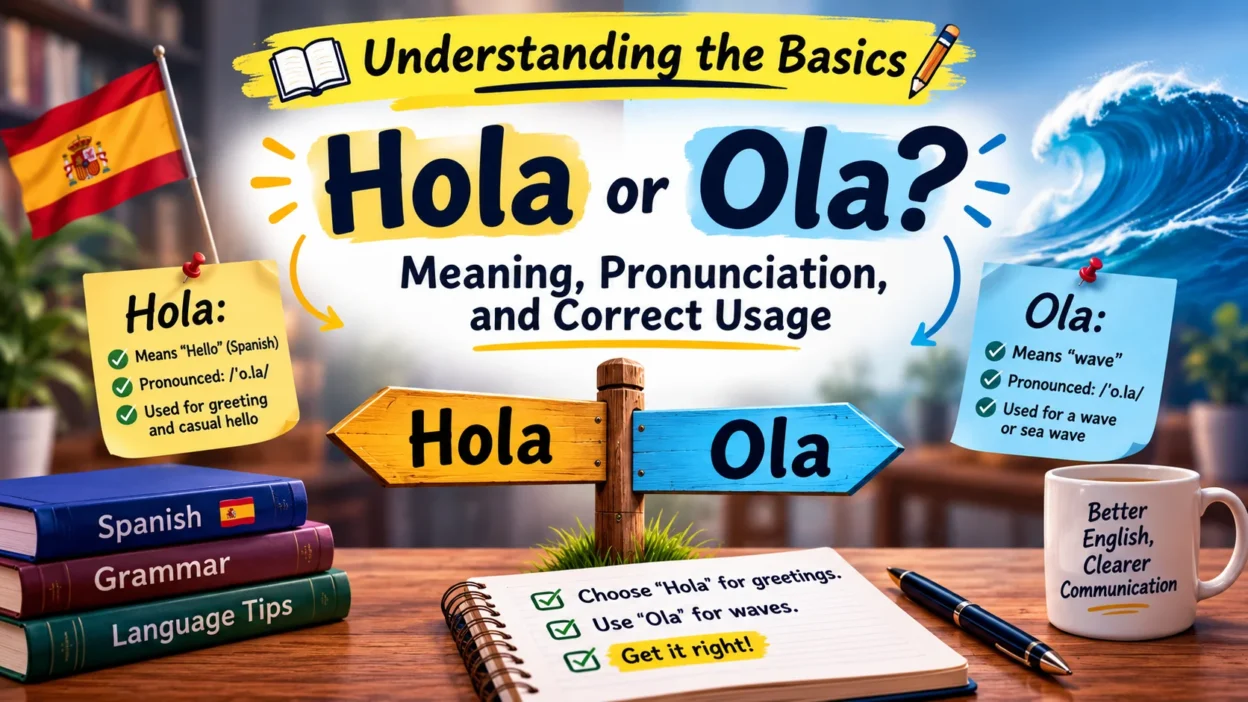
When you first come across the Spanish words Hola and Ola, the difference can seem confusing because they have almost the same pronunciation but completely different meanings. Hola or Ola can sound identical because the h in hola is silent in standard Spanish. However, the two words aren’t interchangeable. Hola means “hello” and is used as a friendly greeting, while ola means “wave” and usually refers to a wave of water. For Spanish learners, this is a useful example of how spelling, sound, and meaning can work differently within the same language.
In Spanish, hola is one of the most common words you’ll use when greeting another person. You can use it when meeting a friend, starting a conversation, or simply saying hello to someone. Ola, on the other hand, is a noun that describes a wave, such as a wave in the ocean or a large wave reaching the shore. For example, “Hola, ¿Como Estes?” means “Hello, how are you?” while “La ola es grande” means “The wave is big.” Although both words share the same basic sound, their context immediately helps listeners understand which meaning is intended.
For Spanish learners, the easiest way to remember the difference is to connect each spelling with its meaning. Think of Hola as the word you use when you meet someone, and remember Ola by connecting it with the ocean, water, or a wave. This small memory trick can prevent common language mistakes, especially when you’re learning Spanish through listening and conversation. When you hear either word, the surrounding sentence usually provides enough context to identify it. When you write, however, choosing the correct spelling is essential because hola and ola represent two entirely different ideas.
Quick Answer: Hola or Ola
The difference is simple once you see it clearly.
| Word | Meaning | Part of Speech | Pronunciation | Example |
| hola | hello, hi | Interjection | OH-lah | ¡Hola, Ana! |
| ola | wave | Noun | OH-lah | La ola es grande. |
The easiest rule to remember
Hola = hello.
Ola = wave.
For example:
- ¡Hola! ¿Cómo estás? = Hello! How are you?
- La ola es enorme. = The waves are enormous.
So, when you’re greeting someone, use hola with the h. When you’re talking about water, use ola without it.
The pronunciation may fool your ear, but the spelling won’t.
What Does “Hola” Mean in Spanish?
Hola is one of the most common and recognizable Spanish greetings. It generally translates into English as “hello” or “hi.”
You can use it when meeting someone, starting a conversation, answering a greeting, or addressing a group. It’s flexible and doesn’t depend on a specific time of day.
Here are some natural examples:
- ¡Hola! — Hello!
- Hola, María. — Hi, María.
- Hola, ¿cómo estás? — Hello, how are you?
- ¡Hola a todos! — Hello, everyone!
- Hola, mucho gusto. — Hello, nice to meet you.
Because hola functions as a greeting rather than an object or action, it’s generally treated as an interjection.
That distinction becomes useful when comparing it with ola, which is a noun.
Is “Hola” Formal or Informal?
Hola works in both casual and many polite settings.
Its tone depends heavily on the situation and the words that come after it. Saying Hola to a friend feels casual. Saying Hola, señor García can still sound perfectly respectful.
Spanish also has greetings that are more clearly tied to time and register:
- Buenos días — Good morning
- Buenas tardes — Good afternoon
- Buenas noches — Good evening or good night
So, hola isn’t automatically informal or inappropriate in professional settings. It simply has a broad, flexible use.
For example:
Hola, profesora.
This can be perfectly natural in a respectful conversation.
For a more formal tone, you might instead say:
Buenos días, profesora.
The difference lies in the overall register rather than in hola itself.
Can “Hola” Mean Both “Hi” and “Hello”?
Yes.
English has both hi and hello, but Spanish commonly uses hola for either one.
For example:
- ¡Hola! → Hi!
- Hola, ¿qué tal? → Hello, how’s it going?
- Hola, señor López. → Hello, Mr. López.
The translation can change depending on context, but the Spanish word stays the same.
What Does “Ola” Mean in Spanish?
Ola means “wave.”
In its most common sense, it refers to a wave of water. You’ll see the word in conversations about oceans, beaches, surfing, storms, boats, and swimming.
Here are several examples:
- La ola es grande. — The waves are big.
- Vi una ola enorme. — I saw a huge wave.
- Las olas están fuertes. — The waves are strong.
- Una ola golpeó el barco. — A wave hit the boat.
- El surfista espera una buena ola. — The surfer is waiting for a good wave.
The plural form is olas.
This is where the spelling difference becomes important. Ola isn’t a shortened or casual form of hola. It’s a completely separate Spanish word.
Can “Ola” Ever Mean “Hello”?
In standard Spanish, no.
If you want to write “hello,” the correct spelling is hola.
Writing ola may still allow someone to understand what you intended, especially in a casual text. However, the word itself means wave, not hello.
That’s an important distinction for anyone learning Spanish.
A spelling mistake can remain invisible in speech because the two words sound alike. On the page, though, the error is obvious.
Hola or Ola: The Exact Difference
The difference between hola and ola comes down to meaning, spelling, and grammatical function.
| Feature | Hola | Ola |
| Meaning | Hello / hi | Wave |
| Word type | Interjection | Noun |
| Pronunciation | OH-lah | OH-lah |
| Initial H | Written and silent | Not present |
| Plural | Not normally pluralized | olas |
| Typical setting | Greetings | Water and waves |
| Example | Hola, Juan. | La ola es alta. |
Notice what’s missing from this comparison: a pronunciation difference.
There really isn’t one in ordinary speech.
That’s what makes these words such a classic example of Spanish homophones.
Why Do Hola and Ola Sound the Same?
The answer is the Spanish h.
In standard Spanish, the standalone letter h is silent. It doesn’t produce the English /h/ sound found in words such as house or happy.
So:
hola → OH-lah
and
ola → OH-lah
The pronunciation matches while the spelling and meaning differ.
This is perfectly normal in language. English has many examples where words sound alike but have different spellings and meanings. Spanish does too.
Why Does the H Matter If You Can’t Hear It?
Because written language carries information that speech sometimes can’t.
Imagine hearing someone say:
“OH-lah.”
Without context, you might not know whether they mean a greeting or a wave.
Now put the same words on a page:
Hola
Ola
The ambiguity disappears.
That silent h acts like a signpost. You don’t pronounce it, but it tells you which word you’re looking at.
How to Pronounce “Hola” Correctly
The simplest pronunciation guide for hola is:
OH-lah
The word has two syllables:
ho-la
However, don’t pronounce the h the way you would in English.
Avoid saying:
HO-lah
Instead, begin with the vowel:
OH-lah
The stress falls on the first syllable, so the word sounds closer to:
HO-la
without an audible h.
How to Pronounce “Ola”
Ola is also pronounced approximately:
OH-lah
That’s why hola and ola qualify as homophones.
Your ears alone may not solve the puzzle. You need context.
Common Pronunciation Mistakes
English speakers often carry English pronunciation habits into Spanish. That’s where trouble begins.
Common mistakes include:
- Pronouncing the h in hola
- Saying HO-lah with a strong initial /h/
- Stressing the second syllable too heavily
- Overcomplicating the Spanish vowel sounds
- Assuming hola and ola must sound different because they are spelled differently
A simple approach works best:
Pronounce hola as OH-lah and memorize the spelling separately.
Why Is the H Silent in “Hola”?
The silent h in hola isn’t an isolated oddity. It’s part of a broader Spanish pronunciation pattern.
Consider these words:
- hablar — to speak
- hacer — to do or make
- hombre — man
- hora — hour
- hotel — hotel
- hospital — hospital
In ordinary Spanish pronunciation, the h in these words doesn’t produce an independent /h/ sound.
For beginners, this can feel strange because English teaches you to associate the letter h with a sound. Spanish doesn’t work that way.
Is the H Always Silent in Spanish?
The ordinary standalone h is silent in Spanish.
However, that doesn’t mean the letter never participates in a sound combination. For instance, ch is a separate consonant combination. You shouldn’t treat its h as an independently pronounced /h/.
This distinction matters because learners sometimes assume every appearance of the letter has exactly the same behavior.
The safest rule for hola is simple:
The h is silent.
Where Did “Hola” Come From?
The history of hola is more complicated than its modern meaning suggests.
Historical Spanish has used forms associated with greeting and getting someone’s attention. Linguists have proposed different explanations for the word’s development, including expressive origins and possible connections with older European greeting forms.
Because the etymology has been debated, it’s better to avoid overly neat claims such as “hola definitely came from one specific word.”
Language history rarely follows a perfectly straight road.
Words can change pronunciation, spelling, meaning, and social use over centuries. A modern Spanish speaker doesn’t need to know every stage of that evolution to use hola correctly, but the history helps explain why the spelling may seem unusual to an English speaker.
The Historical Development of the Silent H
Spanish evolved from forms of Latin and other linguistic influences over many centuries.
During that development, some sounds disappeared while older spelling traditions remained. In some cases, letters stayed in written forms even after speakers stopped pronouncing them.
That’s part of the reason Spanish contains words where the written h seems to do nothing when spoken.
Hola is a classic example.
The letter matters in writing even though it contributes no audible consonant.
Hola Across Spanish-Speaking Countries
One reassuring fact for Spanish learners is that hola has broad international reach.
You can use it throughout the Spanish-speaking world as a normal greeting. Regional varieties of Spanish differ greatly in accent, vocabulary, slang, and conversational habits, yet hola retains its basic meaning.
| Region | Common role of hola | Example |
| Spain | Everyday greeting | Hola, ¿qué tal? |
| Mexico | Everyday greeting | Hola, ¿cómo estás? |
| Argentina | Everyday greeting | Hola, ¿cómo andás? |
| Colombia | Everyday greeting | Hola, ¿cómo estás? |
| Chile | Everyday greeting | Hola, ¿cómo estás? |
| Peru | Everyday greeting | Hola, ¿cómo estás? |
The surrounding phrases may change. The greeting itself remains familiar.
Regional Greeting Differences
Spanish-speaking countries have their own conversational habits.
For example, you’ll encounter different ways of asking how someone is doing:
- ¿Cómo estás?
- ¿Qué tal?
- ¿Cómo andás?
- ¿Cómo va?
- ¿Qué haces? in context
These differences shouldn’t lead you to think hola changes meaning by country.
It doesn’t.
Instead, the expressions surrounding it reflect regional speech patterns and social preferences.
Hola and Other Spanish Greetings
Learning hola alongside a few other basic greetings gives you more flexibility.
| Spanish greeting | Typical English meaning | Common use |
| Hola | Hello / hi | General greeting |
| Buenos días | Good morning | Morning |
| Buenas tardes | Good afternoon | Afternoon |
| Buenas noches | Good evening / good night | Evening or night |
| ¿Qué tal? | How’s it going? | Casual conversation |
| ¿Cómo estás? | How are you? | Asking someone’s well-being |
A natural conversation might sound like:
Hola, ¿qué tal?
That tiny combination already sounds more conversational than simply memorizing hola in isolation.
Conclusion
Understanding Hola or Ola becomes much easier once you connect each word with its meaning and use. Hola means “hello” and works as a common Spanish greeting, while ola means “wave” and refers to moving water. Because the h in hola is silent, the two words can sound the same, which may confuse new Spanish learners. However, their spelling, context, and meaning clearly separate them. Remembering Hola = hello and Ola = wave is a simple way to avoid mistakes in both speaking and writing.
FAQs
Q1. Is Hola the Spanish word for hello?
Yes. Hola is the standard Spanish word for “hello.” It’s one of the most common greetings in Spanish and can be used in both casual and everyday conversations.
Q2. What does Ola mean in Spanish?
Ola means “wave” in Spanish. It usually refers to a wave of water, such as an ocean wave. For example, “La ola es grande” means “The wave is big.”
Q3. Do Hola and Ola sound the same?
Yes, in standard Spanish, hola and ola are pronounced the same because the h in hola is silent. Their different meanings become clear from the context.
Q4. Can I use Ola to say hello in Spanish?
No. You should use hola when you want to say “hello.” Ola has a completely different meaning and refers to a wave.
Q5. How can I remember the difference between Hola and Ola?
A simple memory trick is Hola = hello and Ola = wave. Associate hola with greeting someone and ola with the ocean or water. This makes the spelling and meaning easier to remember.