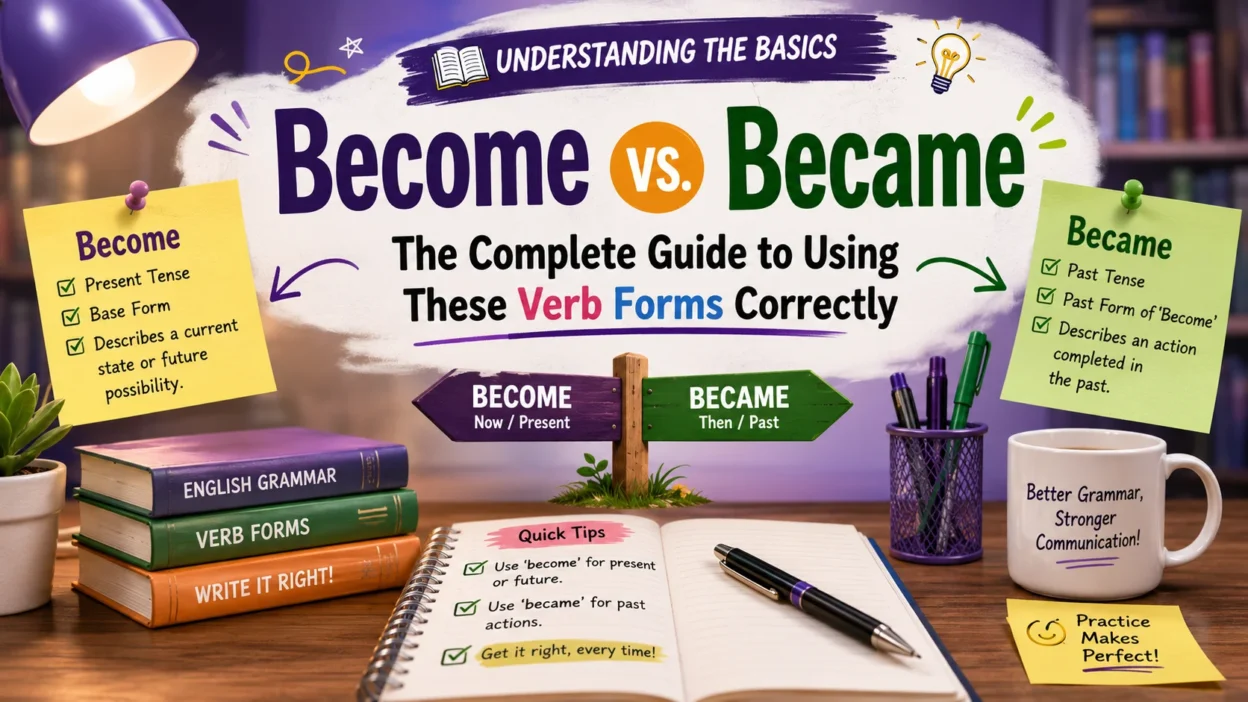
Become vs Became shows how English grammar changes when the time of a change shifts from the present to a completed past event. In English, become and became describe a change, but their forms show different times. Become is commonly used for the present, future, or after certain helping verbs, while became normally describes a completed past tense change. The difference becomes easier to understand when you focus on the meaning and sentence structure. For example, “She became a teacher” describes a complete change in the past, while “She has become a teacher” connects that change with the present.
A useful grammar guide is to check the words around before choosing the correct form. You may see become after helping verbs such as “will,” “has,” “have,” or “would,” depending on the sentence structure. By contrast, became can stand alone when you describe a simple past event. In everyday conversation, short examples can make this distinction much easier to remember. Ask yourself when the change happened. If it happened as a completed event in the past tense, became is usually the right choice. If the sentence refers to another time frame or uses a helping verb, become may fit better.
For clarity, think of become and became as two forms of the same verb that point to different time frames. This simple guide can help you avoid a common grammar mistake. “He became famous” tells us that the change happened in the past, while “He has become famous” emphasises the result connected to the present. Once you understand the meaning, choosing between them becomes much more natural. Whether you’re writing a sentence or speaking in conversation, checking the time of the change will usually lead you to the correct form.
Quick Answer: Become vs. Became
Become is the base form of the verb and also works as its past participle. Became is the simple past form.
The basic pattern is:
Become → Became → Become
Here are the main forms at a glance:
| Form | Use | Example |
| Become | Base form | They become tired quickly. |
| Becomes | Simple present with he, she, or it | She becomes nervous easily. |
| Became | Simple past | She became nervous yesterday. |
| Become | Past participle | She has become nervous. |
| Becoming | Present participle | She is becoming nervous. |
The most important rule is simple:
Use “became” for the simple past. Use “become” after helping verbs such as has, have, had, will, and would.
What Does “Become” Mean?
The verb becomes means to change into a particular state, condition, role, or situation. It often describes a process of development rather than a single physical action.
For example:
- She wants to become a doctor.
- People become tired after long journeys.
- The weather can become unpredictable.
- Children become more independent as they grow.
- The problem may become serious.
Think of becoming as a bridge between two conditions. Someone might start as a student and later become a teacher. A quiet neighborhood might become busy. A simple problem might become complicated.
The verb can describe personal development, changes in circumstances, new identities, or shifts in conditions.
Become as the Base Form
Become is the basic dictionary form of the verb. You use it in several different grammatical structures.
For example:
- I become
- you become
- we become
- they become
- to become
- can become
- will become
- would become
- has become
- have become
Notice that become appears in more situations than simple present tense. That’s why it’s better to think of it as the base form rather than simply calling it the “present form.”
When to Use “Become”
You commonly use become in these situations:
- With I, you, we, and they in the simple present.
- After to in an infinitive.
- After modal verbs such as can, could, will, would, may, might, should, and must.
- After has, have, and had when forming perfect tenses.
Examples include:
- I become more confident with practice.
- They become tired after work.
- She wants to become a lawyer.
- You can become more fluent with regular practice.
- The situation will become clearer soon.
- He has become more patient.
One rule deserves special attention: modal verbs take the base form.
So you say:
- will become
- would become
- can become
- could become
- might become
You don’t say:
- will became
- would became
- can became
Examples of “Become” in the Present Tense
In the simple present, become works with I, you, we, and they.
- I become nervous before interviews.
- You become stronger through practice.
- We become more efficient with experience.
- They become excited when they travel.
With he, she, and it, however, the form changes to become.
- He becomes nervous before interviews.
- She becomes more confident every year.
- It becomes difficult after midnight.
That small -s matters.
What Does “Became” Mean?
Became is the simple past form of become. Use it when you’re describing a change that happened in the past.
For example:
- She became a teacher in 2020.
- He became interested in history at school.
- The weather became colder during the night.
- They became close friends in college.
- The company became profitable after several years.
The change belongs to the past in each sentence.
When to Use “Became”
Use became when you want to show that someone or something changed in the past.
A specific past time often makes the choice especially clear:
- She became a doctor in 2018.
- He became famous after the movie.
- The building became a museum in 2005.
- They became friends during college.
However, you don’t always need a specific date.
For example:
The situation became more complicated.
The surrounding context can already establish that you’re talking about the past.
Correct Examples of “Became”
Here are several natural examples:
- The child became quiet after lunch.
- She became interested in photography.
- He became a manager last year.
- The city became an important trade center.
- The problem became obvious after testing.
- They became good friends during their first semester.
Why “Becomed” Is Incorrect
A common mistake is adding -ed to become.
Becomes is not the standard past form.
The correct pattern is:
become → became → become
Because become is an irregular verb, you need to memorize its forms rather than apply the regular -ed rule.
Become vs. Became: The Core Grammar Difference
The biggest difference between become vs. became involves tense and grammatical structure.
Compare these sentences:
They become tired after long walks.
This describes a general or repeated situation.
They became tired after the long walk.
This describes a completed past event.
They have become tired.
This connects a previous change with their present condition.
They will become tired later.
This describes a future possibility or expectation.
They would become tired without regular breaks.
This describes a hypothetical or conditional situation.
The meaning of the verb remains connected to change, but the verb form tells the reader how that change relates to time and circumstance.
Become vs. Becomes: The Simple Present Difference
The difference between become and becomes comes down to subject-verb agreement.
When to Use “Become”
Use become with:
- I
- you
- we
- they
- plural nouns
Examples:
- I become tired after long meetings.
- You become better with practice.
- We become stronger together.
- They become frustrated easily.
- Students become more confident over time.
When to Use “Becomes”
Use becomes with:
- he
- she
- it
- singular nouns
Examples:
- He becomes nervous before tests.
- She becomes happier when she travels.
- It becomes difficult after dark.
- The process becomes easier with experience.
Compare:
- They become tired. ✓
- She becomes tired. ✓
- They become tired. ✗
- She became tired. ✗
Become vs. Becomes After Helping Verbs
Here’s where many learners get caught.
Look at these examples:
She becomes tired.
But:
She will become tired.
And:
She can become tired.
Why doesn’t becomes appear after will or can?
Because modal verbs take the base form of the following verb.
Therefore:
She will become tired. ✓
Not:
She will become tired. ✗
And not:
She will become tired. ✗
Has Become vs. Have Become
The forms has become and have become are part of the present perfect tense.
The structure is:
has/have + past participle
The past participle of become is also become.
That’s why:
- has become ✓
- have become ✓
- has became ✗
- have became ✗
When to Use “Has Become”
Use has become with he, she, it, and singular nouns.
Examples:
- She has become a successful writer.
- He has become more patient.
- The company has become more profitable.
- The neighborhood has become popular.
- The situation has become difficult.
These sentences usually connect a past change with a situation that matters now.
For example:
The city has become more expensive.
The sentence focuses on the city’s current condition, even though the change developed over time.
When to Use “Have Become”
Use have become with I, you, we, they, and plural nouns.
Examples:
- I have become more confident.
- You have become much more careful.
- We have become close friends.
- They have become successful business owners.
- The problems have become more serious.
Why “Has Became” Is Always Incorrect
The problem with has became is grammatical structure.
The word has is already helping form the present perfect. The main verb must therefore appear in its past participle form.
The correct examples are:
- She became famous. ✓
- She has become famous. ✓
- She has become famous. ✗
The same principle applies to have and had:
- They have become friends. ✓
- They have became friends. ✗
- They had become friends. ✓
- They had became friends. ✗
A useful shortcut is:
has/have/had + become
The Subtleties of “Would Become”
Would become can look confusing because it refers to a possible change rather than a simple past change.
The structure is:
would + become
For example:
She would become successful if she continued working hard.
Here, would become describes a conditional result.
Common Uses of “Would Become”
You can use would become for several purposes.
Conditional situations:
- If he accepted the job, he would become a manager.
Hypothetical situations:
- Without regular practice, the skill would become difficult to maintain.
Future viewed from the past:
- She knew the small project would become a major success.
The important grammar point remains the same: would take the base form.
Therefore:
would become ✓
would became ✗
Examples of “Would Become”
- The plan would become expensive without proper budgeting.
- She would become a strong leader with more experience.
- The problem would become worse without immediate action.
- He knew the decision would become controversial.
Other Important Forms of Become
Understanding the complete family of become vs. became much easier.
Become vs. Becoming
Becoming is the present participle of become.
You often see it in continuous structures:
- She is becoming more confident.
- They are becoming impatient.
- The weather is becoming colder.
- The situation was becoming complicated.
Compare:
She became confident.
This describes a past change.
She is becoming confident.
This describes a change that is currently developing.
Become in the Future
Use will become for future changes.
Examples:
- The city will become busier next year.
- She will become an excellent teacher.
- The process will become easier with experience.
Remember the rule:
will + become
Not:
will + became
Become After Modal Verbs
Modal verbs always use the base form.
| Modal verb | Correct example |
| can | She can become successful. |
| could | The problem could become serious. |
| may | The situation may become difficult. |
| might | Prices might become higher. |
| should | The process should become easier. |
| must | The system must become more efficient. |
| will | He will become stronger. |
| would | She would become nervous. |
Conclusion
Understanding the difference between become and became is much easier once you focus on time and verb tense. Become is the base form and works with the present tense, infinitives, and helping verbs such as have, has, will, and to. Became is the simple past form and describes a change that happened in the past. When you’re unsure, ask yourself whether the change is happening now, may happen later, or has already happened. That simple check will help you choose the right form confidently.
FAQs
Q1. What is the difference between become and became?
Become is the base or present form of the verb, while became is its simple past form. For example, “I want to become a teacher” and “She became a teacher last year.”
Q2. Is became the past tense of become?
Yes. Became is the simple past tense of become. The past participle is become, as in “She has become more confident.”
Q3. Should I use “become or became after “has” or “have”?
Use becomes after has, have, or had. For example, “He has become successful” is correct. “He has become successful” is incorrect.
Q4. Can become refer to the past?
Yes. Become can refer to a past change when it follows a helping verb. For example, “She has become a skilled writer” describes a change that happened over time.
Q5. Which is correct: “I became” or “I become”?
Both can be correct, depending on the meaning and tense. Use “I became” for a completed past change: “I became interested in grammar last year.” Use “I become” for a present or habitual situation: “I become nervous before exams.”