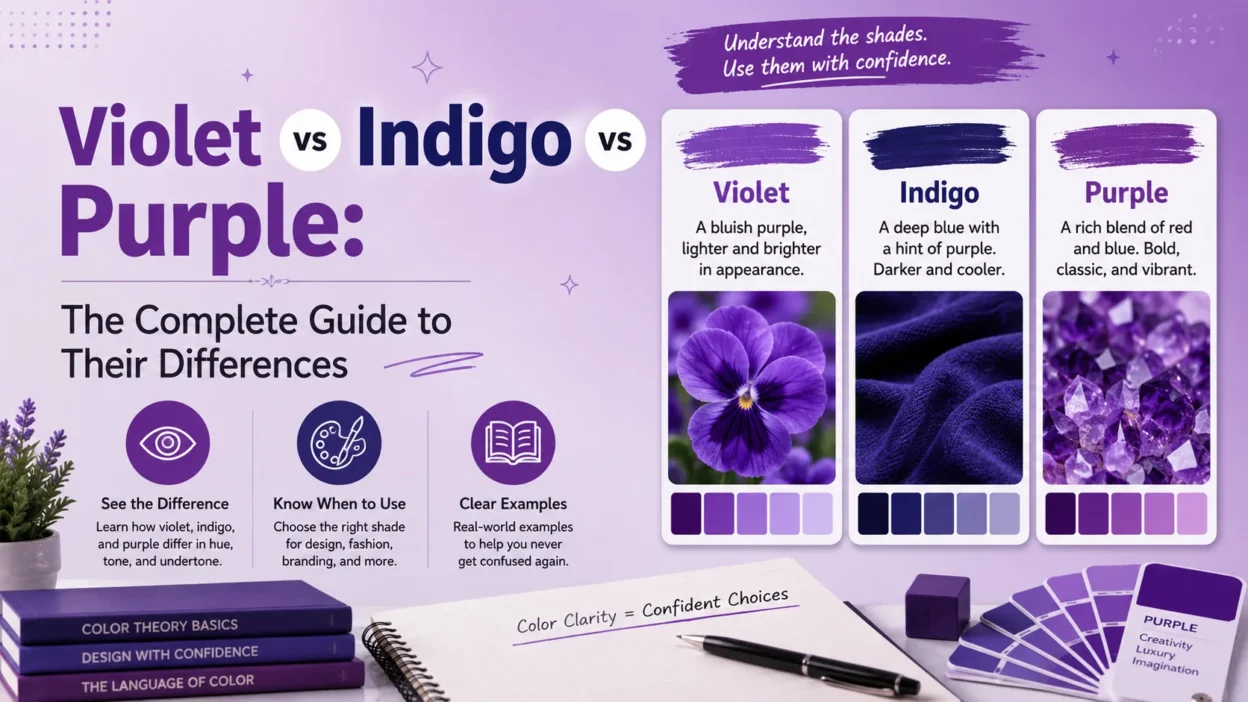
When exploring Violet vs Indigo vs Purple, colour differences become easier to understand through science, perception, natural light, pigments, and wavelengths. These shades may look similar visually, yet each has a unique identity. Violet belongs to the visible spectrum, indigo has a complex history, and purple doesn’t come from one single wavelength of visible light. That distinction helps explain why people sometimes use these colours interchangeably or leave them mislabelled.
In art, an artist or designer may mix paint to produce different shades. Mixing pigments isn’t the same as combining light on digital screens, so colours can appear differently depending on the medium. Natural light can also affect perception, making a flower or rainbow useful for noticing subtle differences. Violet sits near the blue-to-red region, while indigo occupies a debated place in traditional colour classification. Purple, by contrast, is created through combinations of wavelengths rather than one specific wavelength.
The story also reaches beyond science into culture, art, and emotion. Artists have long used symbolism and meaning to give these colours different associations. The fascinating history of indigo and its dyes adds another layer, while design, nature, and modern digital colour systems continue to shape how we see them. If you’re curious or a colour-lover, learning these differences can help you recognise each shade with greater confidence instead of letting visual similarity override scientific facts.
Quick Answer: Violet vs Indigo vs Purple
The short version is simple:
- Violet is a spectral color found near the short-wavelength end of visible light.
- Indigo is traditionally described as a deep blue-violet color between blue and violet.
- Purple is a nonspectral color that results from combinations of light rather than one specific wavelength.
| Feature | Violet | Indigo | Purple |
| Spectral color | Yes | Traditionally classified as one | No |
| Typical appearance | Blue-violet | Deep blue-violet | Blue-red mixture |
| Spectrum position | Near the short-wavelength end | Traditionally between blue and violet | No single spectrum position |
| Common association | Violet light and flowers | Dye and textiles | Royalty, art, fashion |
| Single wavelength | Yes | Not precisely defined as a unique band | No |
| Color family | Violet | Blue-violet | Broad purple family |
The biggest scientific difference is this: violet can correspond to a region of the visible spectrum, while purple doesn’t correspond to one wavelength at all.
What Is Violet?
Violet is one of the most familiar colors at the short-wavelength end of visible light.
When white light separates into its component wavelengths, violet appears near the end of the visible spectrum. It sits beyond blue in the traditional rainbow sequence.
Violet as a True Spectral Color
A spectral color is associated with a particular region of the electromagnetic spectrum.
Violet qualifies because light within a certain short-wavelength range can produce a violet visual response.
The visible spectrum doesn’t have hard borders between named colors, though. Instead, wavelengths transition continuously.
That’s why there isn’t a physical line where blue suddenly stops and violet begins.
Color names are human classifications placed on a continuous physical phenomenon.
Violet’s Position in the Visible Spectrum
The traditional rainbow sequence is:
Red → Orange → Yellow → Green → Blue → Indigo → Violet
Violet occupies the short-wavelength side of this sequence.
Visible light is commonly described as spanning roughly 380 to 700 nanometers, although the exact limits depend on the observer and measurement conditions. Violet sits toward the lower end of that range.
The shorter the wavelength becomes, the closer the light moves toward ultraviolet light, which humans generally can’t see.
Violet’s Approximate Wavelength Range
Many educational sources place violet roughly around 380–450 nanometers.
That range shouldn’t be treated as an absolute law. Human color perception doesn’t use rigid wavelength boundaries.
For example, one observer might classify a particular wavelength as violet while another sees it as blue-violet.
The spectrum remains continuous regardless of the label.
Spectral Violet vs Violet Objects
Here’s an important distinction.
A beam of nearly single-wavelength violet light isn’t the same physical thing as a violet flower.
A flower doesn’t normally produce its color by emitting one precise violet wavelength. Instead, pigments absorb some wavelengths and reflect others. Your eyes then interpret the resulting mixture.
So when you say “that flower is violet,” you’re describing its perceived appearance rather than claiming that it reflects only violet light.
What Is Indigo?
Indigo is where the discussion gets more complicated.
It’s traditionally one of the seven colors of the rainbow, but modern discussions of color don’t always treat it as a sharply defined spectral category.
Indigo’s Place in the Traditional Spectrum
Indigo traditionally sits between blue and violet:
Blue → Indigo → Violet
The color is usually described as a dark, deep blue with a violet influence.
Compared with bright violet, indigo generally looks darker and more blue-heavy.
However, there’s no universally accepted physical boundary separating blue from indigo or indigo from violet.
Why Indigo Is a Controversial Color
The controversy isn’t about whether indigo exists as a perceived color.
It does.
The debate concerns whether indigo needs to be considered a separate spectral color.
The visible spectrum doesn’t naturally divide itself into seven perfectly balanced sections. The familiar seven-color classification is a historical way of describing the rainbow.
The wavelength range associated with indigo also lacks the same kind of universal boundary that people sometimes assume.
In other words, indigo is a useful color category, but its scientific boundaries are fuzzy.
Indigo as a Deep Blue-Violet Color
If you need a practical visual description, imagine gradually moving through this sequence:
Blue → deep blue → indigo → blue-violet → violet
The transitions are gradual rather than abrupt.
Indigo usually feels deeper and darker than violet. It also tends to retain more of a blue character.
That’s why indigo denim looks unmistakably blue even though it carries a violet undertone.
Indigo Is Also a Historic Dye
Indigo has another meaning that makes it especially interesting.
It isn’t merely the name of a color. Indigo is also a dye.
Natural indigo has been used for centuries to color textiles. Plants such as Indigofera tinctoria contain compounds that can ultimately produce the blue dye molecule indigo.
The dye became important across different parts of the world, especially in textile production.
This historical connection gives indigo a much more specific cultural identity than many ordinary color names.
What Is Purple?
Purple is the most scientifically distinct of the three.
Purple Isn’t a Single Spectral Color
There is no single wavelength of visible light that produces “pure purple” in the same way a particular wavelength can produce a spectral violet response.
That’s because purple is a nonspectral color.
A nonspectral color can result when different wavelengths stimulate your visual system together.
This is one of the most fascinating facts about purple.
How Your Brain Perceives Purple
Human color vision relies on three broad classes of cone photoreceptors.
They’re commonly called:
- S cones
- M cones
- L cones
These cones respond differently to various portions of the visible spectrum.
Your brain compares those signals and constructs the color experience you perceive.
When appropriate combinations of long- and short-wavelength light stimulate the visual system, you can perceive purple even though no single wavelength produces that exact sensation.
So purple isn’t imaginary.
It’s a legitimate color experience created by the way human vision processes light.
Purple as a Combination of Red and Blue Light
On a digital display, purple-like colors can be created by combining red and blue light.
This is called additive color mixing.
The exact result depends on the relative intensity and spectral characteristics of the red and blue components.
That’s why saying “red plus blue makes purple” works as a basic explanation but doesn’t tell the whole story.
Why Purple Includes So Many Shades
Purple isn’t one tightly defined shade.
It can include:
- Lavender
- Plum
- Mauve
- Eggplant
- Royal purple
- Amethyst
- Blue-purple
- Red-purple
These colors can look dramatically different while still belonging to the broader purple family.
That’s one reason the word “purple” can be frustratingly vague in professional color work.
Violet vs Indigo vs Purple: The Main Differences
The easiest way to understand these colors is to compare their physical and perceptual characteristics.
Spectrum Position
Violet has a clear relationship with the short-wavelength portion of the visible spectrum.
Indigo is traditionally placed between blue and violet.
Purple doesn’t have a single position on the spectrum because it’s nonspectral.
Wavelength and Light Composition
Violet can be produced by light concentrated around the appropriate short wavelengths.
Purple generally requires a combination of wavelengths.
Indigo occupies a less precise middle ground because its traditional definition doesn’t correspond to one universally agreed wavelength range.
Hue and Visual Appearance
In everyday terms:
- Violet usually looks blue-violet.
- Indigo usually looks dark blue-violet.
- Purple often has a stronger red component.
These descriptions aren’t absolute. Lighting, saturation, brightness, and surrounding colors can change how each shade appears.
Brightness and Saturation
Brightness and hue aren’t the same thing.
A dark violet can look more like indigo. A bright purple can look surprisingly close to violet.
Saturation also changes perception. A muted purple may appear grayish or dusty, while a highly saturated purple looks vivid and intense.
That’s why simply asking, “What color is this?” doesn’t always produce a reliable answer.
How to Tell Violet, Indigo, and Purple Apart
You don’t need specialized equipment to make a reasonable distinction.
Look at the Blue-to-Red Balance
Start by asking which direction the color leans.
If it looks strongly blue and deep, it may be indigo.
If it looks blue-violet without much red, it may be violet.
If it contains a noticeable red-violet character, it may be purple.
Compare the Color’s Depth
Indigo generally looks darker than bright violet.
Purple can be either light or dark.
Violet also varies in brightness, so darkness alone isn’t enough to identify the color.
Use several clues together.
Use the Rainbow as a Reference
If you’re looking at a real spectrum, remember this progression:
Blue → Indigo → Violet
Purple isn’t simply another stripe that belongs between these colors.
It exists as a perceptual category rather than a single spectral band.
Pay Attention to Lighting
Lighting can dramatically change color appearance.
A fabric that looks violet in daylight might look more purple under warm indoor lighting.
That’s because different light sources contain different mixtures of wavelengths.
The object hasn’t necessarily changed.
The illumination has.
Consider the Surrounding Colors
Your perception also depends on nearby colors.
Place violet beside yellow and it can appear more intense.
Put indigo against white and its depth becomes much more obvious.
Surround purple with red and it may appear relatively blue.
Color perception is contextual, not isolated.
Conclusion
Understanding violet vs indigo vs purple becomes much easier once you look beyond how these colours appear. Violet has a direct place in the visible spectrum and corresponds to a range of wavelengths. Indigo has a more complicated history, especially in traditional colour classification and natural dyes. Purple differs most clearly because it isn’t tied to a single wavelength of visible light. Their appearance can also change with natural light, paint,pigments, digital screens, and human perception. Once you understand these differences, you can recognise each colour more confidently in science, art, design, and everyday life.
FAQs
Q1. Is violet the same as purple?
No. Violet is a spectral colour associated with visible light, while purple is a non spectral colour that can result from combining different wavelengths of light.
Q2. Is indigo closer to violet or purple?
Indigo is generally considered closer to violet because it sits between blue and violet in traditional colour classifications. However, its exact appearance can vary by context.
Q3. Is indigo a real color in the rainbow?
Yes. Indigo is traditionally listed as one of the rainbow colours. However, the boundary between indigo and violet isn’t sharply defined in human colour perception.
Q4. Why do violet and purple look so similar?
They can look similar because both contain strong blue and red components in many visual contexts. Lighting, pigments, screens, and perception can make their differences even harder to notice.
Q5. Which color comes first: violet, indigo, or purple?
In the traditional rainbow sequence, indigo appears before violet. Purple isn’t a spectral rainbow colour, so it doesn’t have a specific position in the visible spectrum.