If you’re wondering about Hassle vs Hastle, hassle is the correct spelling, while hastle is a misspelling often caused by pronunciation or quick typing. This tiny word can create confusion, especially when you pause in doubt while choosing between different spellings. Major dictionaries recognise hassle as both a noun and a verb. In noun usage, it describes annoyance, inconvenience, difficulty, or trouble. Something difficult, inconvenient, or troublesome can be called a hassle, such as paperwork hassle, the hassle of travelling, or repeated requests. In verb usage, hassle means to bother or annoy someone, as in hassling someone or hassling you. Its function is clear whether you describe a problem or are describing a frustrating situation. Travelling, travel, paperwork, and many other everyday situations can involve a hassle.
The spelling becomes easier to remember when you separate meaning from appearance. Correct spelling, usage, history, and examples consistently support hassle, not hastle. Internet typos can cause hastle to spread, and people may mistakenly write it after seeing the error many times. A comprehensive guide can provide useful memory tricks, easy reading, and a clear sentence that shows the proper word in natural writing. Good style also matters in friendly communication, especially when you want your spelling to look polished. Tables, lists, quotes, and case studies can explain the distinction, but the practical rule remains simple: hassle is correct and hastle is incorrect. If you write the wrong form mid-sentence, you might pause and wonder whether you’re alone in making the mistake. You aren’t; common typing errors can appear fast and become familiar through repeated exposure.
It’s also useful to separate hassle, hustle, and hustler because these words aren’t normally interchangeable despite their similar appearance. They have distinct meanings. Hustle often relates to working hard, making an effort, trying to achieve goals, completing a project, or finding ways to work hard while managing your time. This can create a positive context. By contrast, hassle usually refers to difficulties, annoyances, a task, or a situation you must deal with, often in a negative context, such as returning an item. These differences have an impact on everyday life and communication because choosing the wrong word can change the intended meaning and context. I once used hussle in a social media post, thinking it was a casual spelling of hustle, but it looked unprofessional and incorrect in certain contexts. I decided to check dictionaries and real usage examples, and I learned that hustle is the correct spelling, while hussle is a common mistake linked to pronunciation and informal typing habits. After correcting it, my content looked more polished and credible, reinforcing why a good guide can help you clearly understand hustle vs hussle, the correct form, and use each word with confidence.
Quick Answer: Hassle vs. Hastle
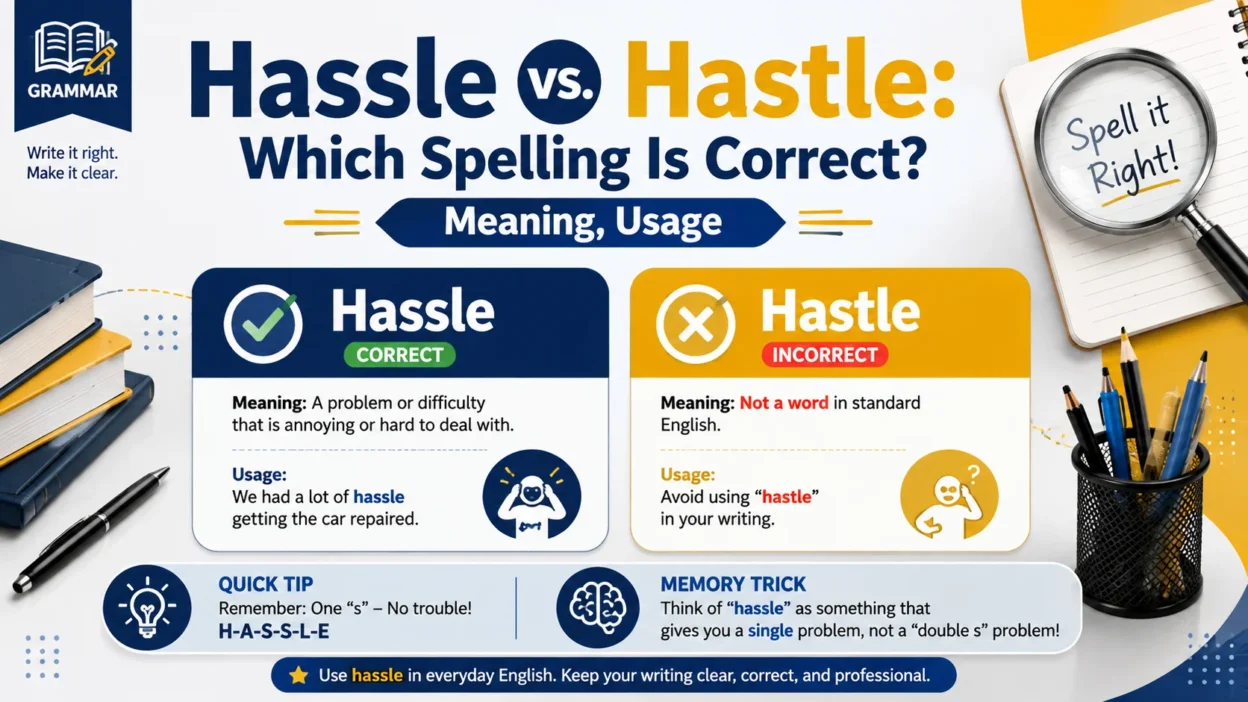
Hassle is the correct spelling. Hastle is a misspelling when you intend to use the word hassle.
| Spelling | Correct? | Meaning |
| hassle | ✅ Yes | Trouble, inconvenience, annoyance, or a difficult situation |
| hastle | ❌ No | Not the standard spelling of hassle |
For example:
- Correct: The paperwork was a real hassle.
- Correct: Don’t hassle me about it.
- Incorrect: The paperwork was a real hastle.
- Incorrect: Don’t hastle me about it.
The simplest rule is worth remembering: hassle has two s’s and no t.
What Does “Hassle” Mean?
The word hassle generally describes something that causes difficulty, inconvenience, annoyance, or trouble. The exact meaning depends on how you use it in a sentence.
Oxford classifies the noun as informal and defines it as a situation that is annoying because it involves something difficult or complicated that requires effort.
For example:
Getting a refund turned into a huge hassle.
Here, hassle doesn’t necessarily mean something disastrous. It means the process became unnecessarily difficult or annoying.
That’s an important part of the word’s character. A hassle is often a relatively ordinary problem that makes something harder than it needs to be.
You might have a hassle with:
- paperwork
- traffic
- customer service
- travel arrangements
- technical problems
- complicated forms
- changing appointments
- returning an item
- moving to a new home
In everyday American English, hassle is especially useful because it captures that frustrating feeling of thinking, Why does this have to be so complicated?
Hassle as a Noun
As a noun, hassle refers to an annoying or troublesome situation. It can be countable or uncountable, depending on how you’re using it. Oxford gives examples such as legal hassles, a lot less hassle, and the hassle of opening a new bank account.
“A Hassle”
When you use a hassle, you’re usually referring to one particular troublesome situation.
Examples:
- Getting a parking permit was a hassle.
- Returning the damaged product was a hassle.
- Moving all that furniture was a real hassle.
- Finding a reliable repair service can be a hassle.
Notice how naturally the word fits situations involving effort and inconvenience.
“The Hassle of”
The pattern of the hassle of + noun or -ing form is extremely common.
Examples:
- I don’t want the hassle of moving again.
- She avoided the hassle of waiting in line.
- He wasn’t prepared for the hassle of changing flights.
- They complained about the hassle of filling out the forms.
This structure focuses on the difficult or annoying process itself.
“Without the Hassle”
The phrase without the hassle is common in everyday and commercial English.
Examples:
- You can renew your membership without the hassle of visiting the office.
- We finished the process without any hassle.
- The new system lets customers pay online without the hassle of paperwork.
The related adjective hassle-free means free from trouble or unnecessary difficulty.
Hassle as a Verb
Hassle also works as a verb. In this form, it generally means to annoy, bother, pressure, or repeatedly trouble someone.
Oxford gives the pattern hassle somebody for something and hassle somebody to do something.
For example:
- Don’t hassle me while I’m working.
- My kids keep hassling me to buy a new game.
- The salesperson kept hassling us about the warranty.
- He was tired of being hassled by telemarketers.
The verb often suggests repetition. Someone isn’t simply asking one reasonable question. They’re repeatedly bothering or pressuring another person.
Hassle Someone
The basic structure is:
hassle + person
Example:
Stop hassling me while I’m trying to concentrate.
Hassle Someone About Something
You can also use hassle someone about something.
My manager kept hassling me about the unfinished report.
The phrase emphasizes the subject of the repeated pressure or annoyance.
Hassle Someone to Do Something
Another common pattern is:
hassle + someone + to + verb
The children kept hassling their parents to buy them a puppy.
Cambridge specifically records this pattern alongside other common uses of the verb.
Hassle: Noun vs. Verb
The spelling stays the same, but the grammatical role changes.
| Use | Meaning | Example |
| Noun | An annoying or difficult situation | The paperwork was a hassle. |
| Verb | To annoy or pressure someone | Don’t hassle me about it. |
A useful test is to look at what comes before the word.
If you see a, the, this, that, much, or a lot of, hassle is often functioning as a noun:
It was a hassle.
If someone performs the action of bothering another person, hassle is functioning as a verb:
They hassled me all morning.
Why Do People Spell “Hassle” as “Hastle”?
The incorrect spelling hastle is understandable as a spelling error, but it isn’t the standard form.
Pronunciation Can Create Confusion
Hassle is pronounced approximately HAS-uhl in American English. Oxford gives the pronunciation as /ˈhæsl/.
Because the word is short and the second syllable is weak, some writers may reconstruct its spelling incorrectly when they remember it mainly from speech.
English creates this problem constantly. Words don’t always give you enough information about their spelling simply from the way they sound.
The Missing “T” Is the Key
The biggest visual mistake is inserting t before the final syllable:
hassle → correct
hastle → incorrect
There is no t in the standard spelling.
A quick visual check can save you from the mistake:
H-A-S-S-L-E
The middle contains SS, not ST.
Typing Errors Also Matter
Fast typing can turn familiar words into strange-looking spellings. A writer who types quickly may accidentally produce hastle, especially if the word hasn’t been seen often in print.
That doesn’t make the spelling an accepted variant. It simply explains why the error can appear.
How to Pronounce “Hassle”
In American English, hassle is pronounced roughly like:
HAS-uhl
The first syllable receives the main stress. Cambridge and Oxford both provide pronunciations centered on /ˈhæsl/ or /ˈhæsəl/.
The pronunciation can sound almost like the word has a very light second vowel. However, that doesn’t introduce a t into the spelling.
Think of the word as:
hass + le
not:
hast + le
Common Expressions With “Hassle”
One of the best ways to learn hassle is to see it in natural word combinations.
“A Lot of Hassle”
This means a large amount of inconvenience or trouble.
Organizing the event created a lot of hassle.
“Not Worth the Hassle”
This expression means that something isn’t valuable enough to justify the effort or frustration.
The discount isn’t worth the hassle of driving across town.
“Avoid the Hassle”
This means to prevent unnecessary trouble.
Book online to avoid the hassle of waiting in line.
“Without the Hassle”
This describes something that happens without unnecessary difficulty.
The app lets you transfer money without the hassle of visiting a branch.
“Take the Hassle Out of”
This means to make a difficult or annoying process easier.
The new service takes the hassle out of scheduling appointments.
“Hassle-Free”
Hassle-free is a common compound adjective.
The installation process was hassle-free.
The phrase appears frequently in everyday speech and commercial writing because it immediately communicates convenience.
Hassle vs. Similar Words
Hassle overlaps with several words, but the alternatives aren’t always interchangeable.
Hassle vs. Trouble
Trouble is broader. It can refer to serious problems, danger, difficulty, or inconvenience.
Hassle usually has a more everyday and informal flavor.
Compare:
Fixing the printer was a hassle.
The damaged bridge caused serious trouble for the community.
The first sentence describes inconvenience. The second can suggest a much larger problem.
Hassle vs. Bother
Bother can mean to annoy someone or to cause inconvenience.
Don’t bother me while I’m working.
Don’t hassle me while I’m working.
Both sentences work, but hassle can suggest repeated pressure or persistent annoyance.
Hassle vs. Nuisance
A nuisance is something that causes annoyance or inconvenience.
The construction noise was a nuisance.
A hassle more often emphasizes the effort, complications, or aggravation involved.
Getting through airport security was a hassle.
Hassle vs. Harass
These words can overlap when hassle is used as a verb, but harass can carry a more serious meaning.
Hassle often describes persistent everyday annoyance:
My brother keeps hassling me for my headphones.
Harass can refer to repeated unwanted behavior that is more serious or threatening:
The employee reported being harassed at work.
Don’t automatically replace harass with hassle. Context matters.
Hassle in Everyday Life
The word fits naturally into situations where a small problem becomes disproportionately annoying.
Travel Hassle
Travel provides endless examples:
- Flight changes
- Lost luggage
- Long security lines
- Parking problems
- Hotel booking issues
- Complicated connections
For example:
The delayed flight was annoying, but finding a new hotel was the real hassle.
Shopping and Customer Service
Returns and refunds can also create hassles.
Returning the defective appliance was more of a hassle than expected.
Here, the word communicates frustration without suggesting that the situation was catastrophic.
Workplace Hassle
Office life has its share of hassles too.
Filling out three different forms for one request was unnecessary hassle.
In professional writing, however, consider your audience. Hassle is perfectly understandable, but words such as inconvenience, difficulty, or complication may sound more neutral in a formal report.
Technology Hassle
Technical problems are another natural setting.
Resetting the password shouldn’t be such a hassle.
That’s conversational and perfectly natural.
Hassle in American English
Hassle is an informal word in major learner dictionaries. Oxford labels the noun and verb informal, while Cambridge also identifies its everyday uses as informal.
That doesn’t mean the word is incorrect or unsuitable for all professional communication.
Instead, formality depends on context.
For a casual email:
Sorry for the hassle.
That sounds completely natural.
For a formal complaint:
We apologize for the inconvenience caused by the delay.
Inconvenience may be the better choice because it has a more formal tone.
The difference is about register, not correctness.
The History and Etymology of “Hassle”
The history of hassle is less straightforward than its modern meaning.
Merriam-Webster gives the first known use of the noun as 1945 and the verb as 1951. It says the word may be a blend of harass and hustle.
Oxford gives a different possibility. It traces an older dialectal use and says the origin is uncertain, with a possible connection to haggle and tussle.
That disagreement is important. Word origins aren’t always neat little stories with one proven source.
The safest conclusion is that the exact origin of modern hassle remains uncertain. Several possible influences have been proposed, but the modern noun meaning of trouble or annoyance is well established.
Etymology Online also records the American English noun from the 1940s and the verb from the early 1950s.
Hassle Word Forms
The related forms follow standard English patterns:
| Form | Example |
| hassle | Don’t hassle me. |
| hassles | She often hassles her brother. |
| hassled | I was hassled by several salespeople. |
| hassling | Stop hassling me. |
| hassle-free | We had a hassle-free experience. |
The -ing form is particularly useful to remember because it makes the double s obvious:
hassle → hassling
Merriam-Webster lists hassled and hassling as the standard verb forms.
Common Mistakes With “Hassle”
A common mistake with “hassle” is using it incorrectly as a verb or confusing its meaning with “problem,” “trouble,” or “inconvenience.”
Writing “Hastle” Instead of “Hassle”
This is the main spelling error.
Incorrect: The process was a hastle.
Correct: The process was a hassle.
Confusing “Hassle” With “Harass”
Although the meanings overlap in some contexts, they’re not identical.
Use hassle for ordinary annoyance or persistent bother. Use harass when the context calls for the stronger meaning of repeated unwanted or abusive behavior.
Confusing the Noun and Verb
Compare:
The paperwork is a hassle.
Here, hassle is a noun.
The clerk keeps hassling me.
Here, hassling is a verb.
Using “Hassle” in Every Formal Context
The word is legitimate, but tone matters.
Instead of:
The new policy created a lot of hassle for employees.
A formal report might say:
The new policy created significant administrative difficulties for employees.
The first version sounds conversational. The second sounds more formal.
Neither is inherently grammatically wrong.
How to Remember the Correct Spelling of “Hassle”
A simple memory trick works surprisingly well:
Less hassle = less stress.
Both words contain the same important ss pattern:
haSSle
If you’re unsure whether the word contains st, stop and remember:
Hassle has no T.
You can also connect it with its related forms:
- hassle
- hassles
- hassled
- hassling
- hassle-free
Once hassle becomes visually familiar, hastle starts to look like what it is: an error.
Correct and Incorrect Examples
| Incorrect | Correct |
| This is such a hastle. | This is such a hassle. |
| Don’t hastle me. | Don’t hassle me. |
| The return process was a hastle. | The return process was a hassle. |
| Stop hastling me. | Stop hassling me. |
| It wasn’t worth the hastle. | It wasn’t worth the hassle. |
More Sentence Examples With “Hassle”
This section provides practical sentence examples showing how to use “hassle” naturally in everyday and professional contexts.
Noun Examples
- Getting a visa can sometimes be a hassle.
- I don’t want the hassle of changing hotels.
- The paperwork was more hassle than it was worth.
- Online payment saves customers a lot of hassle.
- Parking downtown is always a hassle.
- We completed the entire process without any hassle.
- The repair wasn’t expensive, but arranging it was a hassle.
- Moving apartments was a bigger hassle than expected.
Verb Examples
- Please don’t hassle me while I’m studying.
- The children kept hassling their parents for permission.
- Customers shouldn’t have to be hassled about unnecessary upgrades.
- My friends hassled me about arriving late.
- Stop hassling her about the decision.
- The salesperson kept hassling us to buy the extended warranty.
A Practical Case Study: When “Hassle” Fits Best
Imagine that you order a pair of shoes online. The shoes arrive in the wrong size. You contact customer service, wait for a reply, print a return label, drive to a shipping center, and then wait several days for the replacement.
Nothing catastrophic happened. Yet the entire process required far more effort than expected.
That’s exactly where hassle works well:
Returning the shoes was a hassle.
Now imagine that the company repeatedly calls you and pressures you to purchase additional products.
In that situation, the verb works:
The salesperson kept hassling me about the upgrade.
The same word handles two related ideas: the troublesome situation as a noun and the act of repeatedly bothering someone as a verb.
Hassle vs. Hastle: Side-by-Side Comparison
| Feature | Hassle | Hastle |
| Standard English spelling | Yes | No |
| Noun | Yes | No |
| Verb | Yes | No |
| Pronunciation | /ˈhæsl/ | Not a standard pronunciation for this word |
| Meaning | Trouble, inconvenience, annoyance, or persistent bothering | — |
| Example | The paperwork is a hassle. | The paperwork is a hastle. ❌ |
| Related forms | hassled, hassling, hassles | — |
Conclusion
The difference between hassle and hastle is simple once you remember the correct spelling. Hassle is the standard English word and can work as both a noun and a verb, while hastle is a spelling mistake. If you’re writing about annoyance, difficulty, trouble, or an inconvenient situation, choose hassle. Keeping this distinction in mind can make your writing more accurate, polished, and credible.
FAQs
Q1. Is hassle or hastle correct?
Hassle is correct. Hastle is a common misspelling and isn’t the standard English spelling.
Q2. What does hassle mean?
Hassle means an annoying, difficult, or troublesome situation. It can also mean to bother or annoy someone.
Q3. Is hassle a noun or a verb?
Hassle can be both. As a noun, it means an annoyance or difficulty. As a verb, it means to bother or trouble someone.
Q4. Why do people spell hassle as hastle?
The mistake usually comes from pronunciation, quick typing, or seeing the incorrect spelling repeatedly online.
Q5. What is the difference between hassle and hustle?
Hassle refers to an annoyance, problem, or inconvenience, while hustle commonly refers to energetic activity, effort, or working hard.