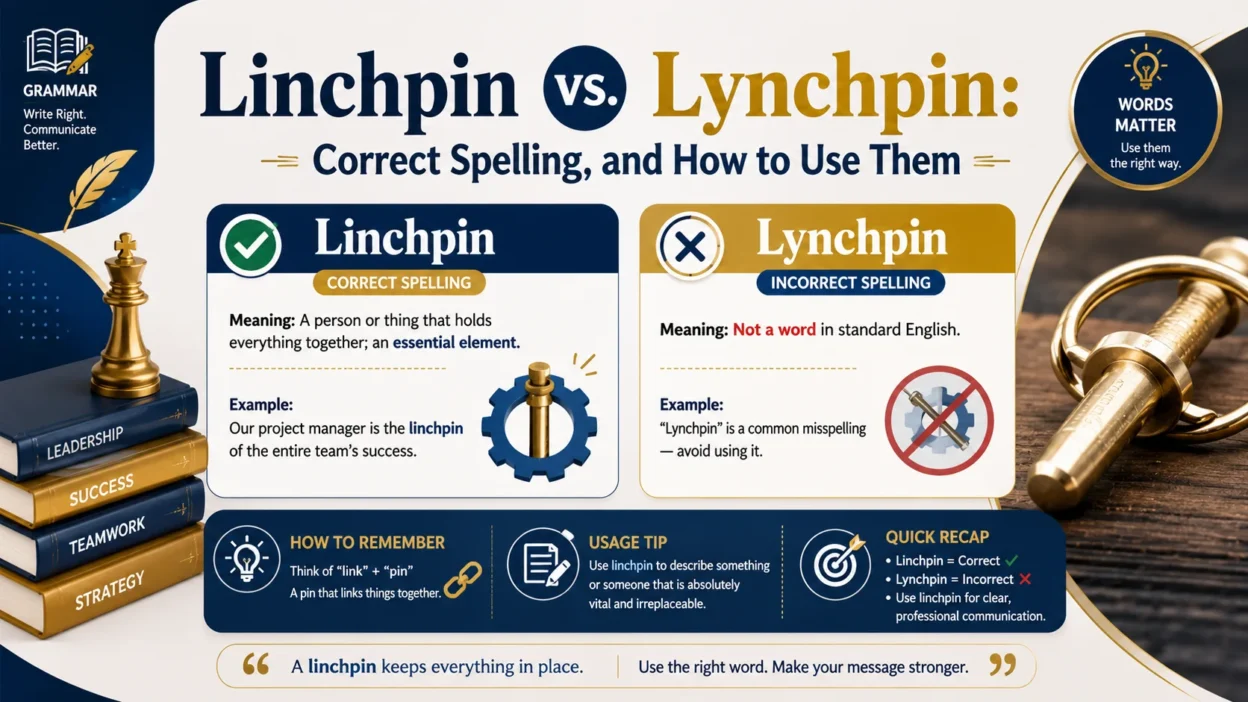
Linchpin vs. Lynchpin is a common spelling question that can make even strong writers pause when the two forms look almost identical. The pronunciation can also make the choice less obvious, but linchpin is the standard and more widely recognised form in major dictionaries. Lynchpin survives as a less common spelling variant, so knowing the difference can improve clarity when you’re writing an article, report, email, academic paper, or business document. The word has an interesting history. It originally referred to a small mechanical pin that helped keep a wheel attached to an axle. Over time, its physical meaning developed into a familiar figurative sense: something or someone who holds a larger system together. Linchpin therefore works as both a useful vocabulary word and a clear metaphor for an essential person, part, or idea.
When choosing between the two forms, linchpin remains the safer choice for formal writing and professional communication. English language learning often involves noticing small spelling details like this because seemingly interchangeable words can create confusion for writers and speakers. Understanding these language differences can shape meaning in subtle ways and strengthen communication skills, vocabulary, writing skills, and overall clarity. A strong grasp of the correct spelling also helps you refine, polish, and improve how you express ideas. The origins of the original term explain why the word carries an idea of structural importance. A mechanical pin provides dependency and stability because a missing part can cause a group of connected parts to fall apart. That mechanical origin later became a modern figurative role, and language evolution allowed the word to move naturally into modern communication, informal writing, professional contexts, and everyday explanations.
The spelling debate also shows why authority and professionalism matter when words appear in casual usage or professional metaphors. Students, experienced professionals, and marketers may encounter lynchpin in older texts or different sources, which can make the spelling variation seem more established than it actually is. However, linchpin dominates contemporary formal English and remains the preferred spelling. The difference isn’t really about meaning; it’s mainly about spelling, history, habit, and language evolution. Everyday speech can make both forms seem interchangeable, while careful writing requires you to recognise the accepted form. A team, for example, may depend on one person as its linchpin, meaning that person’s role is essential to keeping the team together. Once you understand the word origin and how the second version emerged as a variation, the choice becomes easier. This is one of those classic cases where strong writers may hesitate before typing, but a clear, fact-supported explanation can cut through the noise and show which version is acceptable.
Quick Answer: Linchpin vs. Lynchpin
Linchpin is the preferred spelling.
Lynchpin is a recognized variant spelling with the same meaning, but it is less common and usually isn’t the best choice when you’re writing from scratch.
| Spelling | Meaning | Status | Recommended? |
| Linchpin | An essential person, thing, or component | Standard form | Yes |
| Lynchpin | Same meaning as linchpin | Recognized variant | Usually no |
A useful rule is simple:
When you mean an essential person, part, or factor that helps hold something together, use “linchpin.”
That choice works well in both formal and everyday American English.
What Does “Linchpin” Mean?
Linchpin is a noun with two closely connected meanings.
The original meaning is mechanical. A linchpin is a locking pin inserted through the end of an axle or shaft to help keep a wheel or another component in place.
The modern figurative meaning is more common. A linchpin is a person or thing that is essential to the operation of a group, organization, plan, or system.
For example:
- Maria is the linchpin of the research team.
- Reliable transportation is the linchpin of the distribution network.
- The agreement became the linchpin of the new strategy.
- The goalkeeper is the linchpin of the team’s defense.
In each sentence, the word suggests more than ordinary importance.
A linchpin is something that helps keep the larger structure working.
Linchpin as a Literal Mechanical Term
The original mechanical meaning gives the modern metaphor its strength.
Imagine an old wagon with a wheel attached to an axle. A small pin passes through the end of the axle and helps prevent the wheel from coming off.
The pin may be tiny compared with the wheel or wagon. Yet its role is crucial.
That physical relationship eventually became a useful metaphor for people and things that perform a similarly important function in larger systems.
Linchpin as a Figurative Term
When you call someone the linchpin of a project, you’re saying that the project depends heavily on that person.
For example:
The project manager is the linchpin of the entire launch.
This doesn’t necessarily mean the manager has the highest position. Instead, it means the person’s work, knowledge, coordination, or decisions are central to keeping the project moving.
That’s an important difference.
Someone can be important without being a linchpin. The word carries a stronger idea of dependence and structural importance.
Understanding the Origin of “Linchpin”
The history of linchpin goes back to Middle English.
The word developed from older English forms associated with an axle pin. Historical spelling wasn’t as standardized as modern English, so the word appeared in several forms over time.
The original concept was straightforward: a small pin used to secure a wheel or similar component.
That practical meaning eventually gave English speakers a useful metaphor for something essential to a larger arrangement.
Etymology of Linchpin
The older form essentially referred to an axle pin.
That’s important because it explains why the word has nothing to do with the verb lynch.
The modern spelling lynchpin can create the impression that the word contains lynch, but that isn’t its historical source. The word developed from older terms connected with an axle and fastening pin.
The basic historical progression can be simplified like this:
Old English axle-pin term → Middle English forms → modern “linchpin”
The exact historical development contains more linguistic detail, but the central idea is clear: linchpin originated as a mechanical term.
From Mechanics to Metaphor: How “Linchpin” Became a Symbol of Importance
The figurative meaning developed naturally from the physical function.
If a small pin can keep a wheel attached to an axle, then something equally essential in another system can be called a linchpin.
The metaphor remains powerful because it communicates more than the word important.
Compare these sentences:
James is an important employee.
James is the linchpin of the operations team.
The first sentence tells you that James matters.
The second tells you that the operation depends significantly on James.
That’s the real force of the word.
Metaphorical Evolution
English often turns concrete objects into abstract ideas.
A foundation can describe a building or a principle.
A bridge can describe a physical structure or a connection between ideas.
A cornerstone can describe masonry or a fundamental principle.
Likewise, a linchpin can describe a mechanical fastening device or an essential part of a complex system.
The metaphor works because the original object has a clear structural role.
Modern Metaphorical Usage of Linchpin
Today, linchpin appears in many fields. Business writers use it for employees and strategies. Sports journalists use it for players. Technology writers use it for infrastructure. Economists use it for markets and policies.
Linchpin in Work and Leadership
A person can become a linchpin because of expertise, coordination, experience, or responsibility.
For example:
Her knowledge of the company’s legacy systems made her the linchpin of the transition project.
The sentence doesn’t say she’s the company’s most senior employee. Instead, it emphasizes her unique importance to a particular operation.
That’s a more precise use of linchpin than simply calling her a “leader.”
Linchpin in Economics
Economic writing often uses the word for a factor on which broader activity depends.
For example:
Consumer spending is a linchpin of the economy.
The term works because consumer spending affects many interconnected areas of economic activity.
Linchpin in Politics
Political writers can use linchpin for a person, agreement, institution, or policy that plays a central role.
For example:
The agreement became the linchpin of the coalition’s economic program.
The word doesn’t tell you whether the agreement is good or bad. It simply emphasizes its central role.
Linchpin in Technology
Technology systems often contain components that many other services depend on.
For example:
The authentication service is the linchpin of the company’s internal security system.
If several applications rely on that service, its importance goes beyond its individual function.
Linchpin in Sports
Sports writing frequently describes a player as a team’s linchpin.
For example:
The veteran midfielder is the linchpin of the team’s defensive structure.
The player doesn’t have to score the most goals or receive the most attention. The key idea is that their role helps hold the team’s system together.
Linchpin vs. Lynchpin: Why Does the Variant Exist?
The existence of lynchpin can be confusing because it looks like a completely separate word.
It isn’t.
Lynchpin developed as a variant spelling of linchpin. Both forms refer to the same concept.
The variant has survived in actual English usage, even though linchpin is more common.
Where “Lynchpin” Comes From
The important point is that lynchpin isn’t derived from “lynch.”
The similarity is mainly a spelling issue.
The standard historical form developed from older words associated with an axle pin. Over time, lynchpin emerged as an alternative spelling.
Because English contains many words with lynch, that spelling may look familiar to modern readers. But familiarity doesn’t make it the historical source.
Is “Lynchpin” Wrong—or Just Less Common?
This is where a simple “right versus wrong” answer becomes misleading.
Lynchpin is a recognized variant.
At the same time, linchpin is the preferred form for general writing.
So the best practical rule is:
Don’t treat “lynchpin” as meaningless, but use “linchpin” when you have a choice.
Linchpin vs. Lynchpin: Direct Comparison
| Feature | Linchpin | Lynchpin |
| Meaning | Essential person, thing, or component | Same |
| Literal meaning | Locking pin associated with an axle | Same |
| Figurative meaning | Essential element holding something together | Same |
| Pronunciation | LINCH-pin | LINCH-pin |
| Dictionary status | Main form | Recognized variant |
| Frequency | More common | Less common |
| Best choice for formal writing | Yes | Usually no |
| Related to the verb “lynch”? | No | No |
| Recommended default | Yes | No |
The difference is therefore mainly spelling preference, not meaning.
How to Choose the Correct Spelling
The correct spelling depends on the word’s meaning, pronunciation, context, and standard usage.
Use “Linchpin” When:
Choose linchpin when you’re:
- Writing an article
- Preparing a business report
- Writing academic content
- Creating website content
- Writing professional correspondence
- Describing an essential employee
- Describing a critical system
- Discussing an important strategy
- Referring to the traditional mechanical device
If you’re uncertain, linchpin is the safest choice.
Use “Lynchpin” Only When:
There are situations where you may need to preserve the alternative spelling.
For example:
- You’re quoting someone directly.
- You’re discussing spelling variants.
- You’re analyzing a historical text.
- You’re reproducing an original title.
- A proper name specifically uses that spelling.
Otherwise, there’s little reason to choose the less common variant.
Example Sentences Using “Linchpin”
The easiest way to understand linchpin is to see how it behaves in real sentences.
Workplace Examples
Sarah became the linchpin of the customer service team after learning the new software.
His technical knowledge made him the linchpin of the company’s data migration.
Business Examples
The distribution center is the linchpin of the company’s regional expansion.
The partnership became a linchpin of the firm’s growth strategy.
Technology Examples
The central database is the linchpin of the reporting system.
Reliable authentication has become a linchpin of modern digital security.
Sports Examples
The veteran defender is the linchpin of the team’s back line.
Without its defensive linchpin, the team struggled to maintain its shape.
Everyday Examples
Good communication is the linchpin of a healthy working relationship.
Careful planning was the linchpin of their successful move.
Literal Mechanical Example
The linchpin secured the wheel to the axle.
This example returns to the word’s original physical meaning.
Common Confusions and Misconceptions
Misconception 1: “Lynchpin” Looks More Logical
It may look familiar because lynch is already a common English word.
However, the spelling doesn’t reflect the historical origin of linchpin. The word is connected with older terms for an axle pin.
Misconception 2: “Lynchpin” Is a Modern Spelling
The variant isn’t simply a recent internet typo.
It has appeared in English usage for a long time and is recognized by major dictionaries as an alternative spelling.
Misconception 3: Both Are Equally Preferred
This is the part worth remembering.
Both forms are recognized, but they aren’t equally common or equally recommended.
Linchpin is the stronger default.
Misconception 4: Linchpin Always Refers to a Person
Not at all.
A linchpin can be:
- A person
- A product
- A policy
- A system
- A process
- A partnership
- A technology
- A piece of evidence
- A mechanical component
The word describes function, not category.
Linchpin vs. Key Player vs. Cornerstone vs. Keystone
Several words can describe something important, but their meanings aren’t identical.
| Term | Main idea | Example |
| Linchpin | An essential element that helps hold a system together | “She is the linchpin of the project.” |
| Key player | An important participant | “He is a key player on the team.” |
| Cornerstone | A foundational element | “Trust is the cornerstone of the partnership.” |
| Keystone | A central supporting element | “Education is a keystone of the policy.” |
The word linchpin is especially useful when you want to emphasize dependence.
Something can be a key player without being the component that keeps everything connected.
Advanced Usage of “Linchpin”
“Linchpin” has advanced uses in professional, strategic, and organizational contexts, where it describes a person, idea, or element that is essential to the success of a larger system.
“Linchpin of” vs. “Linchpin in”
The phrase linchpin of is extremely common.
She is the linchpin of the organization.
Trust is the linchpin of the relationship.
You can also use linchpin in:
The agreement became a linchpin in the negotiations.
The choice depends on the sentence, but linchpin of often sounds especially natural when identifying the larger system.
“The Linchpin” vs. “A Linchpin”
The linchpin usually points to one particularly central element.
He is the linchpin of the department.
A linchpin can identify one essential element among several.
Reliable logistics are a linchpin of successful retail operations.
The second sentence doesn’t necessarily claim that logistics are the only important factor.
Singular and Plural Forms
The singular form is:
linchpin
The plural is:
linchpins
For example:
Several linchpins support the organization’s operations.
The plural simply adds -s.
Real-World Case Studies of the Word “Linchpin”
A real-world case study shows how a linchpin person, process, or element can play a crucial role in keeping a team, project, or organization successful.
Case Study 1: The Startup Linchpin
Imagine a small software company with a team of eight people.
One engineer understands the architecture of the company’s oldest product. Several other employees depend on that knowledge when difficult problems arise.
That engineer could reasonably be called the linchpin of the technical team.
The point isn’t that the engineer does everything. Instead, the person’s specialized knowledge connects several important parts of the operation.
Case Study 2: The Supply Chain Linchpin
Now imagine a company that depends on one distribution center to move products into several markets.
The center coordinates inventory, transportation, and delivery schedules. A major disruption there could affect many other operations.
In this situation, the distribution center could be described as a linchpin of the supply chain.
Case Study 3: The Sports Team Linchpin
Consider a soccer team with a star striker who scores most of its goals.
Another player may receive less attention but organize the defense, control the midfield, and maintain the team’s shape.
That player could be called the linchpin of the team’s tactical system.
The distinction is useful:
Star describes visibility.
The key player describes importance.
Linchpin emphasizes structural dependence.
Examples of “Linchpin” in Advanced Writing
The word becomes especially useful in analytical and professional writing because it expresses a complicated relationship in a single term.
Consider:
Public trust became the linchpin of the institution’s recovery strategy.
This sentence says more than “public trust was important.” It suggests that several parts of the recovery strategy depended on it.
Another example:
Interoperability is a linchpin of modern digital infrastructure.
Again, the writer emphasizes connection and dependence rather than simple importance.
That makes linchpin a strong word when discussing complex systems.
Quick Decision Guide: Linchpin or Lynchpin?
When you need a quick answer, use these rules:
- Standard spelling: Linchpin
- Recognized variant: Lynchpin
- Best choice for formal writing: Linchpin
- Best choice for professional content: Linchpin
- Literal mechanical meaning: Linchpin
- Figurative meaning: Linchpin
- When reproducing a source’s exact spelling: Preserve the source’s form when necessary
The easiest memory trick is this:
Think “linchpin” first whenever you mean something essential that holds other parts together.
Conclusion
The difference between linchpin vs. lynchpin mainly comes down to spelling, not meaning. Linchpin is the standard, preferred, and more widely recognized form, especially in formal writing, professional documents, and academic work. Lynchpin exists as a less common spelling variant, but linchpin is the safer choice when you want clear and polished English.
FAQs
Q1. Is it linchpin or lynchpin?
Linchpin is the standard and preferred spelling. Lynchpin is a less common variant that still appears in some writing.
Q2. Do linchpin and lynchpin have the same meaning?
Yes. Both forms refer to something or someone that is essential to holding a larger system, group, or plan together.
Q3. Which spelling should I use in formal writing?
Use linchpin in formal writing, academic papers, business documents, reports, and professional communication.
Q4. Why is lynchpin sometimes used?
Lynchpin developed as a spelling variation of linchpin. Its continued use is largely connected to historical spelling variation and common usage.
Q5. What does linchpin mean figuratively?
Figuratively, a linchpin is a person, thing, or idea that is essential to the success or stability of something larger. For example, She is the linchpin of the team.