“Next Friday” vs. “This Friday” creates confusion because English time phrases depend on context, timing, and clear communication in conversations. Many people use these phrases every day without noticing that their meaning can change based on the speaker’s reference point, schedule, and situation. In my experience, a simple phrase about a meeting, event, or plan can create misunderstanding when two people understand the date differently. Learning the difference between these expressions helps avoid missed meetings, delayed plans, and unnecessary stress.
In professional and personal settings, these time markers require careful attention because people often interpret them in different ways. Some speakers use This Friday for the nearest upcoming Friday, while others may connect it with the current week. Similarly, Next Friday can mean the following Friday after the nearest one. Checking context clues, asking for clarification, and confirming the exact date can prevent miscommunication, planning errors, awkward situations, and social blunders. Clear communication allows everyone to stay organised and understand the intended meaning.
These tricky phrases show how small words can influence larger plans and schedules. A sentence like “Let’s meet next Friday” may seem simple, but it can become a confusing situation when people follow different interpretations of time sequences. Similar to a bus leaving in 10 minutes or an event immediately occurring in a series, timing depends on the reference point. Proper clarification, real-life usage, and awareness of language patterns help maintain agreement, reduce confusion, and support better daily communication.
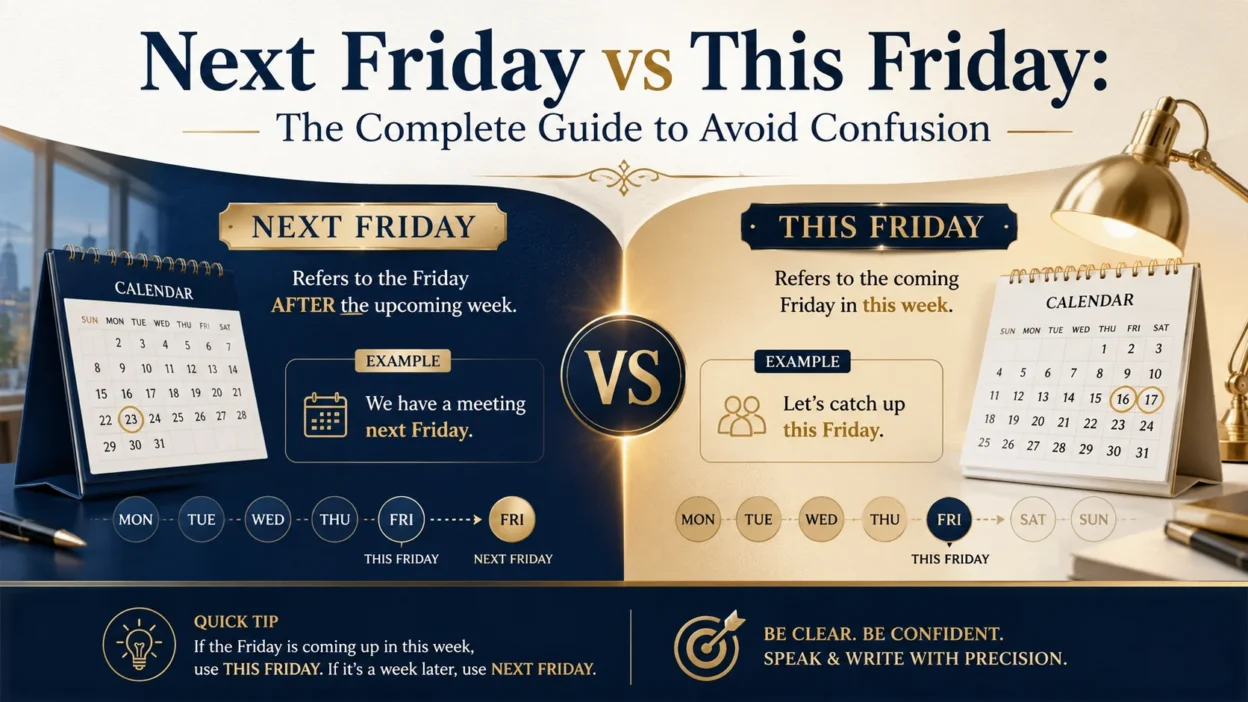
Quick Answer: Next Friday vs This Friday (At a Glance)
If you want the simplest explanation:
- This Friday = the closest upcoming Friday
- Next Friday = the Friday after this coming one
One Rule That Works Most of the Time
“This” = nearest. “Next” = after that.
But here’s the problem — not everyone follows this rule.
Why “Next Friday vs This Friday” Confuses So Many People
English doesn’t always rely on strict rules. Instead, it depends on how people think about time.
That’s where confusion begins.
Main Reasons People Get It Wrong
- No universal rule exists
- People use different mental systems
- Context often gets skipped in fast communication
- Regional habits influence meaning
Real-Life Example
Manager: “Submit it next Friday.”
Employee A: Plans for 3 days later
Employee B: Plans for 10 days later
Same sentence. Totally different interpretations.
What “This Friday” Means in Next Friday vs This Friday Context
The Most Common Meaning
In most conversations, “This Friday” means the nearest upcoming Friday.
If today is Monday, it refers to the Friday in the same week.
How Meaning Changes Based on Today
| Today | Meaning of “This Friday” |
| Monday | Same week Friday |
| Tuesday | Same week Friday |
| Wednesday | Same week Friday |
| Thursday | Same week Friday |
| Friday | Today OR next week |
| Saturday | Usually next week Friday |
| Sunday | Usually next week Friday |
👉 The closer you are to Friday, the more confusing it becomes.
Real Examples of “This Friday”
- “We’re launching this Friday.”
- “I’ll call you this Friday.”
- “The event is this Friday evening.”
These sound clear — until timing gets close.
When “This Friday” Becomes Risky
- Conversations on Friday itself
- Late Thursday planning
- Remote team communication
- Cross-time-zone discussions
Even a small delay in understanding can cause problems.
What “Next Friday” Means in Next Friday vs This Friday Usage
The Two Interpretations
This is where confusion peaks.
People interpret “Next Friday” in two ways:
- The Friday in the next calendar week
- The Friday after the upcoming one
Why People Disagree
- Some think in structured weeks
- Others think in sequence of days
Both feel logical. Neither is universal.
Real Examples of “Next Friday”
- “The meeting is next Friday.”
- “We’ll finalize this next Friday.”
- “Your deadline is next Friday.”
Each example depends on interpretation.
Next Friday vs This Friday: Side-by-Side Comparison
| Phrase | Meaning (Most Common) | Clarity Level | Risk |
| This Friday | Closest Friday | Medium | Moderate |
| Next Friday | Following Friday | Low | High |
Key Insight
👉 “Next Friday” creates more confusion than “This Friday.”
The Core Problem in Next Friday vs This Friday
Two Competing Systems
System 1 — Proximity Thinking
- “This Friday” = nearest
- “Next Friday” = after that
This is how most people speak naturally.
System 2 — Calendar Week Thinking
- “This Friday” = current week
- “Next Friday” = next week
This is common in structured environments.
Why Both Systems Still Exist
- No strict grammar rule defines them
- People learn from environment, not textbooks
- Workplaces develop their own habits
How to Identify Which System Someone Uses
Watch how they talk:
- If they say “next week” often → calendar system
- If they focus on upcoming days → proximity system
Or just ask:
“Do you mean this coming Friday or the one after?”
That single question can prevent major confusion.
High-Risk Situations in Next Friday vs This Friday
When Today Is Friday
This is the most confusing case.
- “This Friday” could mean today
- “Next Friday” could mean 7 days later
Weekend Conversations
If today is Sunday:
- “This Friday” → 5 days away
- “Next Friday” → could mean 5 OR 12 days away
The 7-Day Gap Problem
Some people think:
“Next Friday = exactly 7 days from now”
Others think:
“Next Friday = the next occurrence after this one”
Both interpretations cause mistakes.
Workweek vs Casual Thinking
- Work environments → structured
- Casual speech → flexible
That mismatch leads to confusion.
Real-World Scenarios (Next Friday vs This Friday in Action)
Workplace Deadlines
Case Study: Missed Deadline
A team received this message:
“Finish the report by next Friday.”
Result:
- Half the team planned for 3 days later
- Half planned for 10 days later
Outcome:
- Deadline missed
- Client unhappy
- Last-minute chaos
All from one unclear phrase.
Meetings and Scheduling
- Verbal agreement says “next Friday”
- Calendar invite shows a different date
Confusion spreads quickly.
Social Plans
“Party next Friday!”
One friend shows up early. Another comes a week later.
Client Communication
Ambiguity here looks unprofessional.
Clear communication builds trust. Vague timing breaks it.
Is “Next Friday” Ever the Same as “This Friday”?
Yes — but only sometimes.
If someone follows the calendar system:
- “This Friday” = current week
- “Next Friday” = next week
But if today is the weekend, both phrases may refer to the same upcoming Friday.
That overlap creates false confidence.
Better Alternatives to Avoid Next Friday vs This Friday Confusion
Use Exact Dates (Best Option)
- “Friday, March 15”
- “April 12 at 2 PM”
No confusion. Ever.
Use “This Coming Friday”
- “Let’s meet this coming Friday”
Slightly clearer, but not perfect.
Say “Friday Next Week”
- “We’ll review it Friday next week”
More precise than “Next Friday.”
Add Time Details
- “This Friday at 3 PM”
- “Next Friday morning”
Extra context improves clarity.
Practical Rules for Next Friday vs This Friday
Use these rules immediately:
- Always assume ambiguity exists
- Use exact dates for important events
- Clarify when stakes are high
- Match your audience’s style
Quick Checklist
Before sending a message:
- Could this be misunderstood?
- Is the timing critical?
- Should I include a date?
Regional Differences in Next Friday vs This Friday
United States
- Mixed usage
- Context matters most
United Kingdom
- Slight preference for structured interpretation
Australia & New Zealand
- More use of “this coming Friday”
Global English Users
- Higher confusion levels
- Clear phrasing works best
Conclusion
Understanding the difference between Next Friday and This Friday is an important part of using English time phrases correctly. Although both expressions seem simple, their meaning depends on context, timing, and the speaker’s reference point. Taking a moment to provide clarification or mention the exact date can prevent miscommunication, missed plans, and unnecessary confusion.
Whether you are arranging a meeting, planning an event, or communicating in a professional setting, using these phrases carefully helps everyone stay on the same schedule.
FAQs
Q1. What is the difference between Next Friday and This Friday?
This Friday usually refers to the nearest upcoming Friday, while Next Friday often means the Friday after that. However, the exact meaning depends on the context and how the speaker uses the phrase.
Q2. Why do people get confused about Next Friday and This Friday?
The confusion happens because different people interpret these time phrases differently. Regional habits, personal preference, and the conversation’s context can all affect the intended meaning.
Q3. How can I avoid misunderstandings when using these phrases?
The best approach is to include the exact date or confirm your meaning. For example, instead of saying Next Friday, you can say Friday, March 12 to remove any uncertainty.
Q4. Do native English speakers always agree on the meaning of Next Friday?
No. Even native English speakers sometimes interpret Next Friday differently. That is why clarification is often helpful, especially for important meetings or events.
Q5. Which phrase is better for professional communication?
In professional communication, it is best to use the exact date along with Next Friday or This Friday. This keeps your communication clear and reduces the chance of scheduling mistakes.