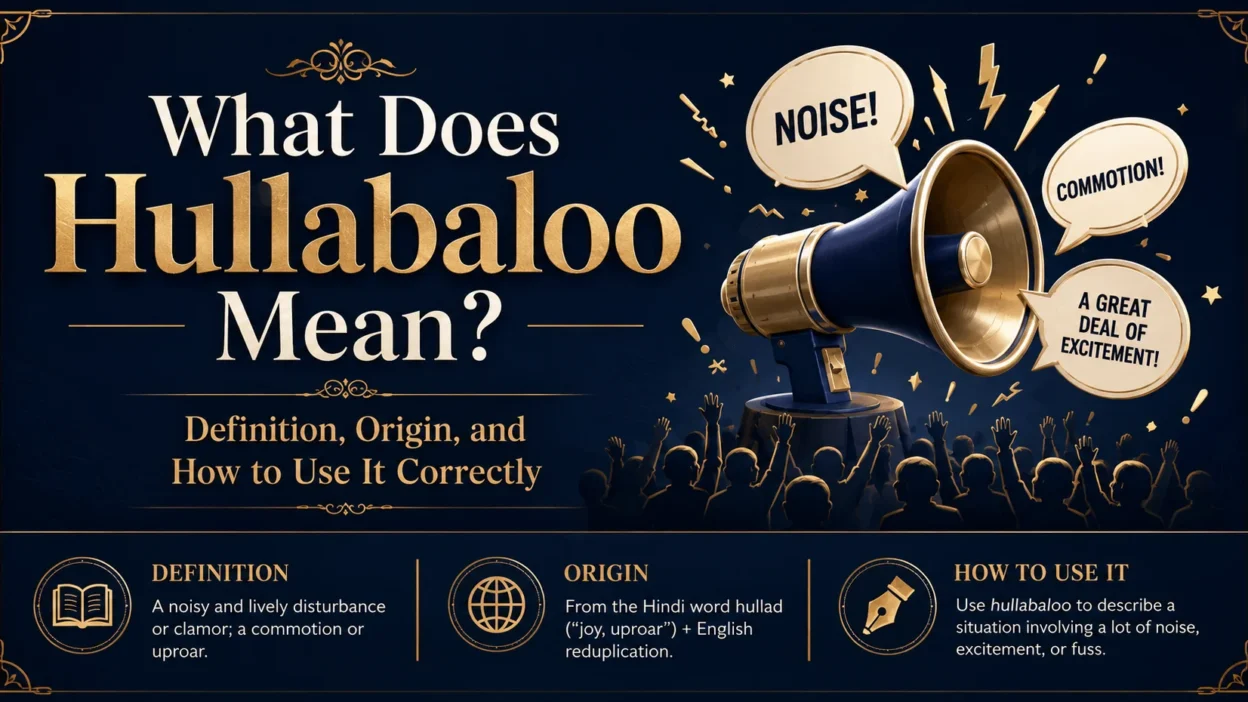
What Does Hullabaloo Mean explains a loud fuss or commotion when people create noise, excitement, and an over-the-top reaction in daily speech. The word describes an exaggerated situation where a small matter becomes a big deal and receives more attention than it may deserve.
In plain English, hullabaloo is used for a moment filled with confusion, buzz, or unnecessary activity. I have found that this English word adds personality, tone, and fun to casual conversations, headlines, and storytelling because it creates a strong image in the listener’s mind.
The definition and meaning of hullabaloo are connected with lively situations, energy, and a feeling that something is fully alive. This legitimate term can describe a clamorous scene, a noisy environment, or a sudden uproar where many voices and actions happen together. In writing, this expressive word helps share clear ideas with readers by showing emotion and movement.
The word appears in everyday speech and different forms of communication, while older versions like hullabaloo, Holloway, and halloo-balloon show its changes over many years. The OED records historical examples and explains how the term continues to prevail in modern language.
The origin of hullabaloo includes interesting sound connections and cultural references. Some explanations mention sounds like a train on tracks or a cannon, while another connection comes from Aggie, Texas A&M University, the ca neck tradition, and a football chant from 1918 known as the War Hymn.
Hullabaloo Meaning Explained in Plain English
Everyday Meaning You’ll Actually Use
Let’s strip it down.
Imagine this:
- A new phone launches and people line up overnight.
- A minor rumor spreads online and suddenly everyone’s talking about it.
- A small mistake at work turns into a dramatic office discussion.
That’s hullabaloo.
It’s not just noise. It’s unnecessary noise mixed with emotion.
You’re not describing chaos alone. You’re describing a reaction.
Think of it like turning the volume way up on something that didn’t need it.
What Hullabaloo Does Not Mean
People often misuse this word. Let’s fix that quickly.
Hullabaloo is NOT:
- Pure chaos without emotion
- A celebration (unless exaggerated)
- Always serious or negative
- Formal or professional language
Here’s a simple comparison:
| Situation | Hullabaloo? | Why |
| A crowd panicking during an emergency | No | That’s real chaos |
| Fans screaming over a celebrity sighting | Yes | Loud and exaggerated reaction |
| A quiet disagreement | No | No noise or fuss |
| Social media overreacting to a minor issue | Yes | Classic hullabaloo |
How to Pronounce Hullabaloo Correctly
You don’t want to guess this one.
Correct pronunciation:
/ˌhʌl.ə.bəˈluː/
Break it down like this:
- HUL – uh – buh – LOO
Say it out loud:
👉 “HUL-uh-buh-LOO”
Common Mispronunciations to Avoid
- “Hulla-balloo” (extra syllable)
- “Hulla-baloo” (missing rhythm)
- “Hulla-buh-lo” (incorrect stress)
The stress always lands on the last syllable: -LOO
The Origin and History of Hullabaloo
Likely Etymology
The word hullabaloo doesn’t come with a clean origin story. Linguists believe it may come from:
- Irish or Scottish expressions of shouting
- Imitations of loud, chaotic sounds
- Old slang used to describe noisy crowds
In other words, it likely started as a sound-based word, mimicking what it describes.
How the Meaning Developed Over Time
Originally, it referred to:
- Loud shouting
- Crowd noise
- Uproar
Over time, it evolved.
Now it carries an extra layer:
👉 Not just noise, but exaggerated noise
That shift matters.
It’s why today, hullabaloo often implies:
- Overreaction
- Drama
- Unnecessary excitement
Interesting Linguistic Insight
Words like hullabaloo are called expressive words.
They stick because:
- They sound playful
- They mimic real-life noise
- They’re memorable
English is full of them:
- Hocus-pocus
- Mumbo jumbo
- Razzle-dazzle
These words don’t just communicate meaning. They create a feeling.
When and How to Use “Hullabaloo” in Real Life
Casual Conversations
This is where the word shines.
Examples:
- “Why is everyone making such a hullabaloo over this?”
- “It’s just a small update. No need for all the hullabaloo.”
You use it when you want to gently call out exaggeration.
Media and Headlines
Journalists love this word.
Why?
Because it captures:
- Public reaction
- Emotional intensity
- Slight exaggeration
Example:
- “Social Media Hullabaloo Over Celebrity Tweet”
Humor and Storytelling
Hullabaloo adds personality.
It makes your sentence feel alive.
Example:
- “Grandma dropped a spoon, and suddenly there was a full family hullabaloo.”
When NOT to Use It
Avoid using hullabaloo in:
- Academic writing
- Legal documents
- Formal business reports
Why?
Because it sounds informal and slightly playful.
Real-Life Sentence Examples of Hullabaloo
Let’s make it real.
- “What’s all the hullabaloo about that movie?”
- “The announcement caused quite a hullabaloo online.”
- “There was a huge hullabaloo over a minor pricing error.”
- “Honestly, I don’t get the hullabaloo.”
- “The media created a hullabaloo out of nothing.”
- “Fans made a hullabaloo when tickets sold out.”
- “It’s just a design change, not worth the hullabaloo.”
- “There’s always some hullabaloo before elections.”
Notice something?
Every sentence carries emotion + exaggeration.
Synonyms of Hullabaloo (With Real Differences)
Common Alternatives
Here are the closest synonyms:
- Fuss
- Uproar
- Commotion
- Hype
- Outcry
- Stir
But they’re not identical.
Comparison Table
| Word | Tone | Context Use | Key Difference |
| Hullabaloo | Informal | Daily speech | Implies exaggeration |
| Uproar | Strong | News/events | More serious and intense |
| Fuss | Mild | Everyday talk | Smaller reaction |
| Hype | Modern | Marketing/media | Often intentional |
| Commotion | Neutral | General use | Focus on activity, not emotion |
| Outcry | Serious | Public reaction | Usually negative |
Which Word Should You Use?
Use this quick guide:
- Want humor? → Hullabaloo
- Want seriousness? → Uproar
- Want simplicity? → Fuss
- Talking about marketing? → Hype
Antonyms of Hullabaloo (Opposites)
Every loud reaction has a quiet opposite.
Here are the best antonyms:
- Calm
- Silence
- Order
- Peace
- Composure
Example Contrast Sentences
- “There was chaos yesterday. Today, I am completely calm.”
- “The launch caused hullabaloo. The update passed quietly.”
You can feel the contrast immediately.
Hullabaloo vs Similar Words (Common Confusion)
Hullabaloo vs Chaos
- Hullabaloo = exaggerated reaction
- Chaos = real disorder
Hullabaloo vs Drama
- Hullabaloo = noise + fuss
- Drama = emotional storytelling
Hullabaloo vs Hype
- Hullabaloo = natural reaction
- Hype = often planned excitement
Common Mistakes People Make With “Hullabaloo”
Using It in Formal Writing
Wrong:
- “The report caused a hullabaloo among stakeholders.”
Better:
- “The report caused significant concern.”
Misunderstanding Its Tone
Hullabaloo often has a light or humorous tone.
Using it in serious situations can sound inappropriate.
Overusing It
Like any expressive word, too much kills impact.
Use it sparingly.
Using It Without Context
Saying:
- “There was hullabaloo.”
Feels incomplete.
Always give context:
- Who?
- Why?
- About what?
Why “Hullabaloo” Still Exists in Modern English
This word survived for a reason.
It Sounds Fun
Say it once. You’ll remember it.
It Feels Expressive
It captures something plain words don’t.
It Fits Modern Conversation
In a world of social media reactions, exaggeration is everywhere.
Hullabaloo describes that perfectly.
It Adds Personality
Instead of saying:
- “People reacted strongly”
You say:
- “There was a hullabaloo”
Much better.
Real-World Case Study: Media Hullabaloo
Case: Product Launch Frenzy
A tech company releases a minor update.
What happens?
- Social media explodes
- Influencers debate features
- Fans argue online
- Headlines exaggerate importance
Within hours, a small update becomes a global discussion.
That’s hullabaloo.
What We Learn
- Not all noise equals importance
- Reactions often exceed reality
- Language like “hullabaloo” captures that gap
Quick Usage Cheat Sheet
| Element | Answer |
| Meaning | Loud, exaggerated fuss |
| Tone | Informal, slightly humorous |
| Best Use | Conversations, storytelling |
| Avoid | Formal writing |
| Key Idea | Overreaction |
Conclusion
Hullabaloo is a colourful and expressive English word that describes a situation filled with noise, commotion, excitement, or a big fuss. It helps speakers and writers add more personality when describing moments where people create extra attention around an event.
From casual conversations to storytelling, the word brings energy and emotion to language. Understanding What Does Hullabaloo Mean makes it easier to recognise this unique term and use it naturally when describing lively or chaotic situations.
FAQs
Q1. What does hullabaloo mean in simple English?
Hullabaloo means a lot of noise, fuss, or commotion caused by people who are excited, upset, or making a situation seem more important than it is.
Q2. Is hullabaloo a positive or negative word?
Hullabaloo can be either positive or negative depending on the context. It may describe a fun celebration with energy, or it can describe unnecessary confusion and uproar.
Q3. How do you use hullabaloo in a sentence?
You can use hullabaloo when describing a noisy or dramatic situation. For example: “There was a huge hullabaloo after the team won the game.”
Q4. Is hullabaloo a common English word?
Yes, hullabaloo is a recognised English word. It appears in writing, books, movies, and everyday conversations, although it has a playful and informal tone.
Q5. Where did the word hullabaloo come from?
The exact origin of hullabaloo is uncertain, but it has historical connections with different sounds and expressions. Older forms like hullabaloo and Holloway show how the word developed over time.