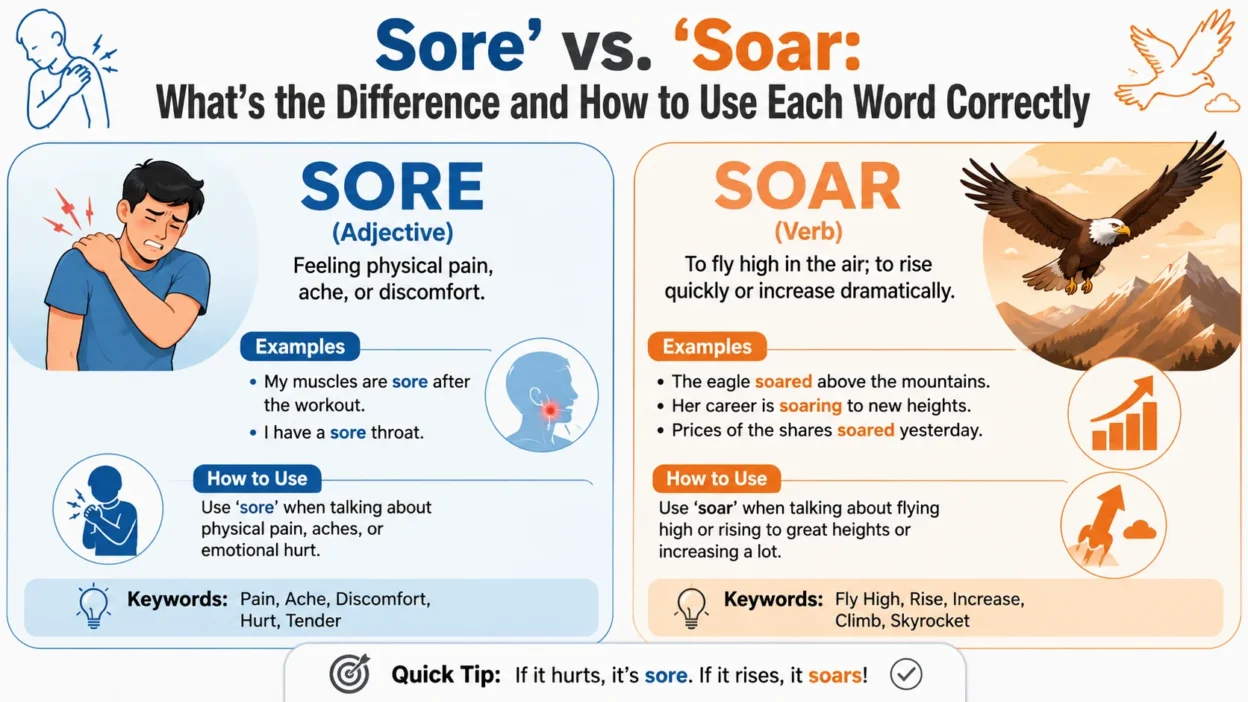
Sore’ vs. ‘Soar explains confusing homophones where words sound alike but have different meanings, spellings, and usage in English clearly! Many English learners, students, writers, and speakers struggle with these similar-sounding words because they have the same pronunciation but completely different meanings. These homophones often create confusion in writing, speaking, emails, exams, and daily communication. A strong understanding of definitions, context, and usage helps learners choose the correct word and improve their English vocabulary, grammar skills, and overall language accuracy.
The word Sore describes pain, discomfort, or a physical condition connected with the body. People may have a sore throat, sore legs, or sore muscles after running, exercise, or post-workout situations. It can also describe emotional discomfort when someone feels hurt, upset, or offended. On the other hand, Soar shows upward motion, literal flight, or metaphorical ascension. Birds can fly, cross the sky, and move upwards, while a person’s spirits can lift after achieving something important. In a business setting, companies may soar when profits increase rapidly, prices climb, or market demand grows.
Learning the difference between these words becomes easier through memory tricks, practical patterns, and real-life examples. Sore works as an adjective or sometimes a noun, while Soar is a verb connected with rising, flying, and growth. By studying sentence structure, grammar rules, pronunciation, and context clues, learners can avoid common mistakes and improve their writing skills, speaking skills, and communication skills. Regular practice, reviewing sentences, and recognising the correct meaning help students, professionals, and writers use these words confidently in real-world situations.
Sore’ vs. ‘Soar — Quick Answer You Can Remember Instantly
Here’s the simplest way to lock it in your mind:
- Sore = Pain or discomfort
- Soar = Rise or fly upward
Now look at this:
- My legs feel sore after the workout
- Prices continue to soar this year
See the difference? One stays grounded in the body. The other rises into the air.
That single idea will save you from most mistakes.
Sore’ vs. ‘Soar — Side-by-Side Comparison
Sore and Soar may look and sound similar, but they have completely different meanings and uses. Sore usually describes physical pain, tenderness, or irritation, while soar means to rise high, fly, or increase quickly. This side-by-side comparison helps clarify their definitions, differences, and correct usage in everyday English.
Meaning, Usage, and Context Table
| Feature | Sore | Soar |
| Core Meaning | Pain, irritation, discomfort | Rise, fly, increase rapidly |
| Part of Speech | Adjective / Noun | Verb |
| Common Contexts | Body, emotions, reactions | Flight, growth, increase |
| Example Sentence | My muscles are sore | Sales will soar this year |
| Memory Trigger | Body pain | Sky movement |
This table cuts through confusion quickly. When in doubt, come back here.
Why “Sore’ vs. ‘Soar” Causes So Much Confusion
People often confuse sore and soar because they sound exactly alike, making them perfect examples of English homophones. Although their pronunciation is identical, their meanings are completely different. Sore refers to pain, discomfort, or an aching body part, while soar means to fly high in the air or rise quickly. Since the difference is only visible in writing, many learners accidentally choose the wrong word without realizing it.
They Sound Identical (Homophones Explained Clearly)
“Sore” and “soar” are homophones. That means they sound the same when spoken. However, their meanings and spellings differ completely.
English is full of these traps. Think about:
- their / there / they’re
- your / you’re
- hear / here
Because pronunciation stays the same, your brain relies on context. When that context isn’t clear, mistakes slip in.
Real Mistakes People Make
Let’s look at actual confusion:
- ❌ My confidence began to sore
- ✅ My confidence began to soar
- ❌ My arms soar after lifting weights
- ✅ My arms feel sore after lifting weights
Notice something? The wrong word doesn’t just look odd. It breaks the meaning entirely.
What Does “Sore” Mean in Sore’ vs. ‘Soar?
Core Meaning of “Sore”
“Sore” refers to pain, discomfort, or irritation. This can be physical or emotional.
It often describes something sensitive or tender.
Where You Actually Use “Sore”
You’ll see “sore” in three major contexts:
Physical Pain
- sore muscles
- sore throat
- sore back
Emotional Sensitivity
- feeling sore about criticism
- a sore memory from the past
Negative Reactions
- sore loser
- sore attitude after losing
Each one connects back to discomfort. Sometimes physical. Sometimes emotional.
Idioms and Expressions with “Sore”
“Sore” appears in everyday English phrases. These aren’t optional to learn. They show up constantly.
- Sore spot → a sensitive issue
- Sore loser → someone who reacts badly to losing
- Stick out like a sore thumb → something clearly noticeable
These expressions make your English sound natural.
Real-Life Example Sentences
- I woke up with a sore neck after sleeping wrong
- He’s still sore about what happened last week
- Her muscles felt sore after running five miles
Short. Clear. Natural.
Real Case Study: Muscle Pain and “Sore”
A common real-life example of sore is the muscle pain people feel after starting a new workout or doing intense physical activity. Someone might say, “My legs are sore after yesterday’s hike,” meaning the muscles are tender and slightly painful from overuse. This temporary discomfort is a normal part of recovery and usually fades within a few days as the muscles heal and become stronger.
What Is Delayed Onset Muscle Soreness (DOMS)?
After intense exercise, your muscles often feel sore. This condition is called Delayed Onset Muscle Soreness (DOMS).
It usually starts:
- 12 to 24 hours after exercise
- Peaks around 48 hours
- Fades within a few days
Why does this happen?
Tiny tears form in muscle fibers. Your body repairs them. That repair process creates soreness.
Practical Example
Imagine this:
You hit the gym after months. The next morning, you feel fine. Then suddenly, your legs tighten up.
Walking downstairs becomes a challenge.
That’s soreness. Not a weakness. It’s actually a sign your body is adapting.
What Does “Soar” Mean in Sore’ vs. ‘Soar?
Soar means to fly or rise high in the air, or to increase quickly to a much higher level. It is commonly used for birds, airplanes, emotions, prices, and achievements. Unlike sore, which relates to pain or discomfort, soar always suggests upward movement, rapid growth, or reaching great heights. For example, “The eagle soared above the mountains,” or “Company profits soared last year.”
Core Meaning of “Soar”
“Soar” means to rise quickly or fly high in the air.
It suggests movement upward. Often fast. Sometimes dramatic.
Where You Actually Use “Soar”
“Soar” appears in three powerful contexts:
Flight
- birds soar through the sky
- eagles soaring above mountains
Rapid Increase
- prices soar
- profits soar
- temperatures soar
Emotional High
- spirits soar
- confidence soars after success
Each use involves upward movement—physical or metaphorical.
Real-Life Example Sentences
- The eagle soared above the valley
- Gas prices continue to soar globally
- Her confidence soared after winning
Notice the pattern. Everything moves upward.
Case Study: When Prices Soar
What “Prices Soar” Really Means
When we say prices “soar,” we don’t mean they increase slowly. We mean they rise sharply.
Think of a sudden spike.
Real-World Scenario
Over the past few years, many countries experienced rising fuel costs.
- Fuel prices jumped rapidly
- Food prices followed
- Rent increased in urban areas
In such situations, headlines often say:
“Fuel prices soar amid supply shortages.”
That word—soar—signals urgency and speed.
Sore’ vs. ‘Soar — Key Differences That Actually Matter
Although sore and soar sound exactly alike, they have completely different meanings and are never interchangeable. Sore describes pain, discomfort, or irritation, while soar means to fly high, rise quickly, or increase dramatically. Understanding this distinction helps you avoid common writing mistakes and ensures your sentences are both clear and accurate in everyday English.
Meaning Comparison
- Sore deals with pain or discomfort
- Soar deals with rising or increasing
Usage Differences in Sentences
- My legs are sore → correct
- My legs are soar → incorrect
- Sales will soar → correct
- Sales will sore → incorrect
Context and Tone Differences
“Sore” feels grounded and physical.
“Soar” feels dynamic and upward.
That emotional tone matters in writing.
Common Mistakes in Sore’ vs. ‘Soar (And Fast Fixes)
One of the most common mistakes is using sore when talking about flying or rising, or using soar when describing physical pain. Remember this simple trick: sore relates to pain or discomfort, while soar means to fly high or increase rapidly. If you can replace the word with hurt, choose sore; if you can replace it with rise or fly, choose soar. This quick check helps you avoid the confusion in both writing and everyday conversation.
Incorrect vs Correct Usage Table
| Incorrect Sentence | Correct Sentence | Why It’s Wrong |
| My confidence is sore | My confidence soars | Confidence rises, not hurts |
| My legs soar after running | My legs are sore after running | Legs feel pain, not rise |
| Prices are sore | Prices soar | Prices increase upward |
Patterns Behind These Errors
Most mistakes happen because:
- People write based on sound
- They don’t check context
- They rush through sentences
Fix that by pausing for one second. Ask yourself:
Is this about pain or rising?
That question solves almost everything.
Memory Tricks That Actually Help You Remember
Simple memory tricks can make it much easier to remember the correct spelling of a word. Instead of relying on repetition alone, connect the word with a pattern, phrase, or visual image that stands out in your mind. These small mental shortcuts help your brain recall the correct form more quickly.
The best memory techniques are easy to use and stick with you over time. Once you associate the word with a clear reminder, you’ll be far less likely to make the same spelling mistake again. With regular reading and writing, the correct spelling soon becomes automatic.
Simple Association Trick
- Sore = Pain
- Soar = Rise
Keep it simple. Your brain loves shortcuts.
Visual Memory Trick
Picture this:
- Someone holding their arm in pain → Sore
- A bird flying high → Soar
Images stick better than rules.
Spelling Hack
“Soar” contains “oar.” Think of motion or movement.
“Sore” stays grounded. Like a body.
Everyday Examples of Sore’ vs. ‘Soar
The difference between sore and soar becomes much easier to understand when you see them in everyday situations. You might wake up with sore muscles after a workout, while a bird or airplane can soar high across the sky. Although the words sound the same, sore describes pain or discomfort, whereas soar refers to flying, rising quickly, or increasing dramatically. Using real-life examples helps you remember which word fits naturally in different contexts.
Health and Fitness
- My muscles feel sore today
- My energy levels soared after rest
Business and Money
- Profits soared this quarter
- Investors felt sore after losses
Sports Situations
- He was a sore loser after the match
- The team’s performance soared this season
Emotions and Reactions
- She felt sore about the criticism
- His confidence soared after success
Nature and Environment
- Eagles soar across the sky
- My throat feels sore in cold weather
Mini Story Using Sore’ vs. ‘Soar Correctly
After months of training, Jake ran his first marathon. His legs felt sore, yet his spirit began to soar. Every step hurt, still he pushed forward. When he crossed the finish line, the pain remained. However, his confidence soared higher than ever before.
This contrast makes the difference unforgettable.
Practice Section: Test Your Understanding
Now it’s your turn to put what you’ve learned into practice. Try answering the following questions or completing the exercises without looking back at the explanations first. Checking your own answers is one of the best ways to build confidence and make the correct usage feel natural in everyday writing and conversation.
Fill-in-the-Blanks
- My arms feel ____ after lifting weights
- Prices continue to ____ this year
- He’s a ____ loser
Sentence Correction
- My confidence is sore
- Birds sore across the sky
Answers with Explanations
- sore → physical pain
- soar → rising
- sore → emotional reaction
- Confidence should “soar”
- Birds should “soar”
Advanced Usage in Sore’ vs. ‘Soar
As your English skills improve, understanding the more advanced uses of sore and soar becomes increasingly important. Sore can describe emotional pain or frustration, such as a sore loser or a sore subject, while soar is often used figuratively to express rapid growth, success, or strong emotions, as in profits soared or spirits soared. Recognizing these extended meanings helps you understand literature, news articles, and everyday conversations more naturally while avoiding common word choice mistakes.
Figurative Meaning of “Soar”
“Soar” goes beyond physical movement. It’s often used metaphorically.
- creativity soars
- imagination soars
- success soars
This adds emotional impact to writing.
Emotional and Idiomatic Use of “Sore”
“Sore” also moves beyond the body.
- sore feelings
- sore relationships
- a sore subject
It often signals unresolved tension.
Quick Reference Guide for Sore’ vs. ‘Soar
If you need a fast way to remember the difference, think about the context. Use sore when talking about pain, discomfort, or something emotionally hurt, such as sore muscles or a sore throat. Use soar when describing flying high, rising quickly, or increasing dramatically, such as birds soaring through the sky or profits soaring. Remember: sore = pain, while soar = rise or fly.
Use “Sore” When:
- You describe pain
- You mention discomfort
- You refer to emotional sensitivity
Use “Soar” When:
- Something rises
- Something increases rapidly
- You describe upward motion
Final Summary: Sore’ vs. ‘Soar in One Clear Rule
If it hurts, use sore.
If it rises, use soar.
That’s it. Clean. Simple. Effective.
Visual Summary (Concept)
Think of two worlds:
- Sore → Body → Pain → Grounded
- Soar → Sky → Movement → Rising
That contrast makes the difference impossible to forget.
Why Word Choice Matters More Than You Think
Here’s the reality. Small word choices shape how people see your writing.
One wrong word can:
- confuse your message
- weaken your credibility
- distract your reader
On the other hand, the right word builds trust instantly.
As the writer Mark Twain once said:
“The difference between the almost right word and the right word is the difference between lightning and a lightning bug.”
That’s exactly what’s happening in Sore’ vs. ‘Soar.
Conclusion
Understanding the difference between Sore and Soar becomes much easier when you focus on their meaning, context, and usage. Although these homophones have the same pronunciation, they represent completely different ideas. Sore is connected with pain, discomfort, and physical or emotional conditions, while Soar describes rising, flying, upward movement, and rapid growth. By practising examples, improving vocabulary skills, and paying attention to sentence structure, learners can avoid confusion and choose the correct word with confidence. Mastering these small differences helps improve writing clarity, spoken English, and overall communication accuracy.
FAQs
Q1. What is the main difference between Sore and Soar?
The main difference is their meaning and usage. Sore describes pain, discomfort, or irritation, while Soar means to rise, fly, or increase quickly. They have the same sound but different spellings and meanings.
Q2. Are Sore and Soar homophones?
Yes, Sore and Soar are homophones because they have the same pronunciation but different meanings and spellings. Many English learners confuse them because they sound identical when spoken.
Q3. How can I remember the difference between Sore and Soar?
A simple memory trick is to connect Sore with pain, such as sore muscles or a sore throat, and connect Soar with the sky, birds, flying, and rising upward.
Q4. Can Soar be used for things other than flying?
Yes, Soar can describe more than physical flight. It can refer to rapid increases, such as prices soaring, profits soaring, market demand increasing, or emotions and spirits rising quickly.
Q5. Is Sore only used for physical pain?
No, Sore can describe both physical and emotional conditions. It can refer to body pain, such as sore legs or sore muscles, and emotional feelings, such as feeling upset or offended.