Learn Conform With or Conform To with English rules, where the right preposition creates natural meaning and avoids confusion. When you write or speak, choosing the correct word can change how a sentence sounds. The pair Conform to and Conform with may appear similar, but their meanings have different contexts and specific uses. English learners, native speakers, and professional writers often study these expressions because both are grammatically correct, yet they communicate different ideas. Conform to focus on following a rule, meeting standards, or showing compliance with laws, authority, and expectations. For example, a product must conform to safety standards and required regulations. This distinction helps writers create sentences with more confidence and avoid common mistakes.
The fundamental differences between Conform to and Conform with are not arbitrary; they come from how English speakers naturally understand these prepositions and their grammatical functions. A misused phrase can alter the intended message and reduce precision language in professional communication. Conform to suggests obedience, adherence, and fitting into a system of rules, while Conform with shows agreement, consistency, and harmony between ideas, opinions, or things. A company may ensure that a building design follows safety requirements, while someone may say their opinions conform with another person’s views because they match or agree. Understanding this small difference makes writing and speaking much clearer.
A strong guide that explains these phrases can help students, writers, and learners understand what each verb means, how it works in American English and British English, and why some errors happen through first language translation. Real examples and real-world situations show where each expression fits naturally. When trying to improve your writing, watching your drafts, spotting a wrong word, and revising your sentences can help you clarify your thinking and articulate ideas. The correct choice allows you to connect, confirm, and communicate your message with better accuracy in formal writing, daily speech, and everyday language.
Quick Answer: Should You Say “Conform To” or “Conform With”?
The short answer is simple:
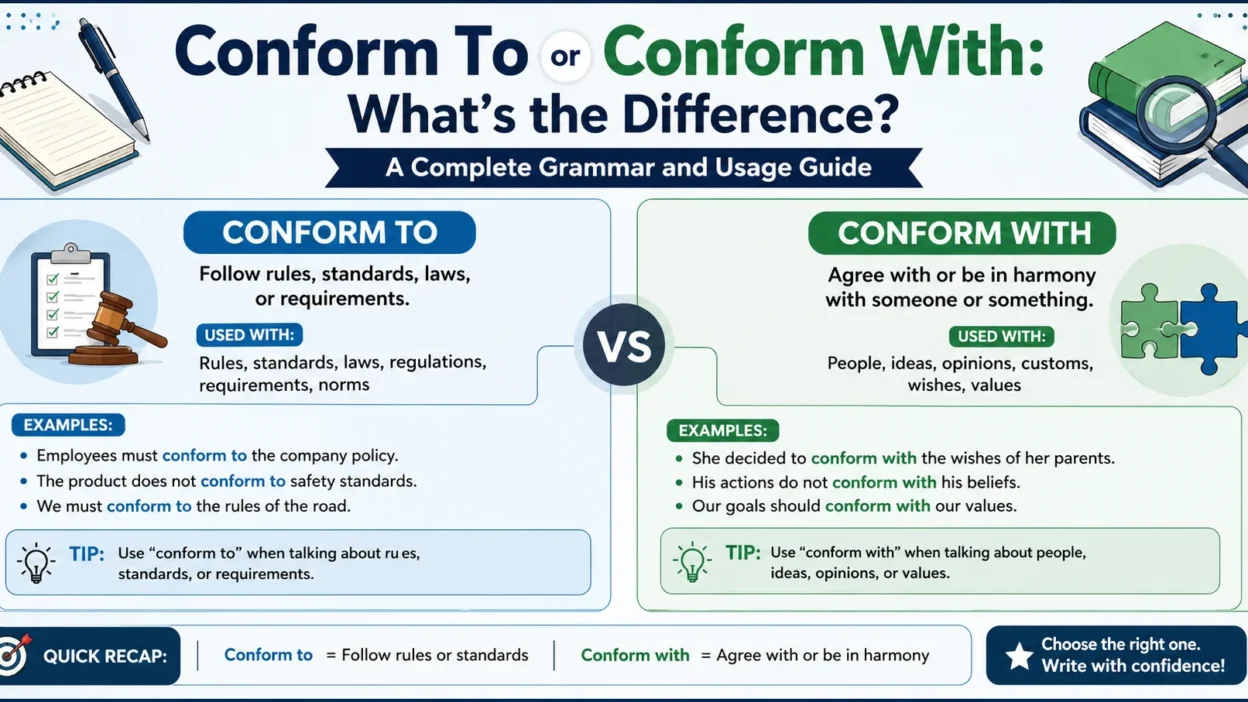
- Conform to usually means to obey, follow, or meet a rule, law, standard, requirement, or expectation.
- Conform with usually means to agree, match, or be consistent with something.
In everyday English, conform to is far more common than conform with, especially in American English. When people talk about following regulations, company policies, social norms, or technical standards, they almost always use conform to.
Meanwhile, conform with appears more frequently in formal writing, legal documents, scientific reports, and technical publications where the focus is on consistency rather than obedience.
For example:
- ✔ The building conforms to local fire regulations.
- ✔ The research findings conform with previous studies.
Although both sentences use the same verb, the relationship between the verb and the object changes because of the preposition.
The Short Rule
Remember this simple guideline:
- Conform to = Follow or comply with
- Conform with = Match or agree with
If you can replace the phrase with the following, choose conform to.
If you can replace it with match or agree with, conform with is often the better choice.
Quick Comparison Table
| Feature | Conform To | Conform With |
| Primary meaning | Follow or obey | Match or agree |
| Most common use | Rules, laws, standards | Information, evidence, findings |
| Everyday English | Very common | Less common |
| American English | Preferred | Less frequent |
| British English | Common | More common than in US English |
| Typical contexts | Regulations, requirements, expectations | Academic, legal, scientific writing |
Which Expression Is More Common?
If you search newspapers, business documents, technical manuals, and everyday conversations, you’ll notice one clear pattern:
Conform to appear much more frequently.
People naturally say:
- conform to company policy
- conform to regulations
- conform to industry standards
- conform to expectations
- conform to building codes
- conform to legal requirements
By contrast, conform with appears most often in specialized writing, including:
- research papers
- scientific journals
- engineering reports
- legal opinions
- compliance documents
That doesn’t make conform with incorrect. It simply serves a different purpose in many situations.
What Does “Conform” Mean?
The verb conform means to become the same as something else, to act according to established rules, or to match an accepted standard or pattern.
In other words, something conforms when it fits expectations instead of differing from them.
The idea of conformity appears in many areas of life, including:
- education
- business
- law
- engineering
- manufacturing
- medicine
- psychology
- fashion
- social behavior
Sometimes conformity is required for safety or legal reasons. Other times, it simply reflects social expectations.
For example:
- Employees conform to workplace policies.
- Electrical equipment conforms to safety standards.
- Students conform to classroom rules.
- Scientific observations conform with established theories.
Although every example uses the same verb, the object determines which preposition sounds most natural.
Dictionary Meaning of Conform
Major English dictionaries define conform in similar ways.
Common definitions include:
- To act according to rules or standards
- To comply with accepted practices
- To match or correspond with something
- To become similar in form or behavior
These definitions reveal why both conform to and conform with exist. The verb carries two closely related meanings:
- following something
- matching something
The preposition helps readers understand which meaning you intend.
The Origin of the Word “Conform”
The word conform comes from the Latin verb conformare, which means to shape alike or to form according to a pattern.
The Latin root combines:
- con- meaning together
- formare meaning to form or shape
The word later entered Middle English through Old French before becoming part of modern English.
Interestingly, the original meaning focused on having the same shape rather than simply obeying rules. Over time, English speakers expanded the meaning to include following customs, regulations, standards, and expectations.
That historical development explains why today’s English still uses conform in both physical and abstract contexts.
Why the Preposition Changes the Meaning
Many English verbs naturally pair with specific prepositions.
Consider these examples:
- depend on
- believe in
- belong to
- agree with
- suffer from
The verb conform behaves the same way.
Changing the preposition slightly changes the relationship between the verb and the object.
Think of it like this:
| Expression | Relationship |
| Conform to | Following something |
| Conform with | Matching something |
Although both involve similarity, they emphasize different ideas.
Imagine a factory producing bicycle helmets.
When inspectors say:
“The helmets conform to federal safety standards.”
They mean the helmets satisfy required regulations.
Now imagine a researcher writing:
“The inspection results conform with previous laboratory findings.”
The researcher isn’t discussing obedience. Instead, the new results agree with earlier evidence.
That subtle distinction explains why professional writers choose one preposition over the other.
When to Use “Conform To”
Among the two expressions, conform to is the one you’ll encounter most often.
Whenever you mean follow, obey, meet, or comply with, conform to is almost always the correct choice.
Think of it as moving toward an established rule or standard.
People, organizations, products, machines, and procedures can all conform to something.
Following Rules, Laws, and Regulations
One of the most common uses of conform to involves rules.
Whether those rules come from governments, schools, companies, or organizations, conform to express compliance.
Examples:
- Every driver must conform to traffic laws.
- Employees must conform to company policies.
- Manufacturers must conform to environmental regulations.
- Financial institutions conform to banking laws.
- Airlines conform to international aviation standards.
In each example, failing to conform could result in penalties or legal consequences.
That is why compliance professionals use this phrase so frequently.
Meeting Standards, Requirements, and Specifications
Products often need to satisfy industry standards before companies can sell them.
Manufacturers regularly describe their products using conform to.
Examples include:
- The software conforms to ISO security standards.
- The medical device conforms to international safety requirements.
- The electrical wiring conforms to national building codes.
- The equipment conforms to engineering specifications.
- The vehicle conforms to emission standards.
Notice that none of these examples suggest agreement.
Instead, they describe successfully meeting established requirements.
Following Social Norms or Expectations
Not every rule appears in a law book.
Society also develops expectations about behavior.
People frequently conform to:
- traditions
- customs
- cultural norms
- workplace expectations
- dress codes
- etiquette
Examples:
- Teenagers sometimes conform to peer pressure.
- New employees quickly conform to workplace culture.
- Guests usually conform to local customs while traveling.
- Students conform to classroom expectations.
In psychology, researchers often study social conformity, which describes how individuals adjust their behavior to fit within a group.
Classic experiments have shown that people sometimes conform even when they privately believe the group is wrong. This demonstrates how powerful social influence can be.
Common Verbs and Nouns Used with “Conform To”
Certain words commonly appear alongside conform to.
Here are some of the most frequent collocations:
| Common Collocation | Example |
| conform to regulations | The company conforms to environmental regulations. |
| conform to standards | The device conforms to safety standards. |
| conform to requirements | Applicants must conform to eligibility requirements. |
| conform to expectations | The results did not conform to expectations. |
| conform to policy | Employees conform to company policy. |
| conform to specifications | Every component conforms to design specifications. |
| conform to the law | Businesses must conform to the law. |
| conform to guidelines | Hospitals conform to national guidelines. |
Learning these collocations makes your English sound much more natural because native speakers frequently use these exact combinations.
Real-Life Sentence Examples
Here are practical examples from everyday communication.
Business
- Every supplier must conform to our quality standards.
- Contractors must conform to safety procedures before entering the site.
Education
- Students are expected to conform to the school’s code of conduct.
- The curriculum conforms to national education standards.
Healthcare
- Hospitals conform to strict hygiene regulations.
- Laboratories conform to international testing standards.
Construction
- All materials conform to local building codes.
- Engineers confirmed that the bridge conforms to federal safety requirements.
Technology
- The application conforms to modern cybersecurity standards.
- The software conforms to accessibility guidelines for users with disabilities.
One simple pattern appears throughout these examples.
Whenever someone or something follows an established rule, standard, requirement, regulation, or expectation, conform to is almost always the preferred choice.
Conclusion
Understanding the difference between Conform With or Conform To helps you make your English more accurate and natural. Although both expressions are grammatically correct, they are used in different situations. Conform to is mainly used when talking about rules, standards, laws, expectations, or requirements, while conform with is used when describing agreement, harmony, or consistency between ideas, opinions, or things. Choosing the right phrase improves your writing, speaking, and overall communication. With regular practice and attention to context, you can avoid confusion and use these expressions with greater confidence.
FAQs
Q1. What is the main difference between conform to and conform with?
The main difference is their meaning and context. Conform to means following a rule, standard, or requirement, while conform with means being in agreement or harmony with something.
Q2. Is conform to more common than conform with?
Yes, conform to is more commonly used in modern English because it often refers to following rules, regulations, and accepted standards. Conform with is less common and is usually used when discussing agreement or consistency.
Q3. Can conform to and conform with be used interchangeably?
No, they are not completely interchangeable. While both are correct expressions, replacing one with the other can change the meaning of a sentence. The correct choice depends on whether you are discussing compliance or agreement.
Q4. Which preposition should I use with rules and regulations?
Use conform to when talking about rules, laws, safety requirements, or official standards. For example, “The company must conform to safety regulations.”
Q5. When should I use conform with?
Use conform with when describing agreement or similarity between ideas, opinions, or things. For example, “His actions conform with his beliefs.”