Fiancé vs Fiancée explains a small but important difference in English that often creates confusion because both terms describe someone who is engaged and connected to a future marriage. The main distinction is based on gender, where fiancé refers to an engaged man and fiancée refers to an engaged woman. These words are used for a partner who has made a promise to marry and entered an engagement agreement before becoming a spouse. Understanding their correct meaning, usage, and spelling helps people communicate clearly when discussing relationships, weddings, and personal milestones.
The history of these terms comes from French roots, including Old French and the French verb fiancer, which is linked with ideas of trust, promise, and betrothal. Their background also connects to Latin words such as fidere and fidare, which carry the meaning of trust. As borrowed words, they became part of English vocabulary through language adaptation and developed into specific gendered nouns. The masculine form is fiancé, while the feminine form is fiancée, with the extra E showing the feminine form. These French-derived words are now common in relationship vocabulary, engagement vocabulary, and marriage terminology.
In modern communication, knowing the difference between these terms improves grammar usage, word usage, and overall communication clarity. Many writers and speakers focus on avoiding common mistakes in writing, sentences, and professional conversations. Although both words usually have identical pronunciation, the written forms have different meanings, making correct spelling important. Today, discussions about inclusive language, gender-neutral language, and social awareness also influence how people view traditional grammatical gender. Whether used in daily conversations, texting, or formal writing, choosing the correct term creates a more precise, confident, and polished expression.
What Does Fiancé Mean?
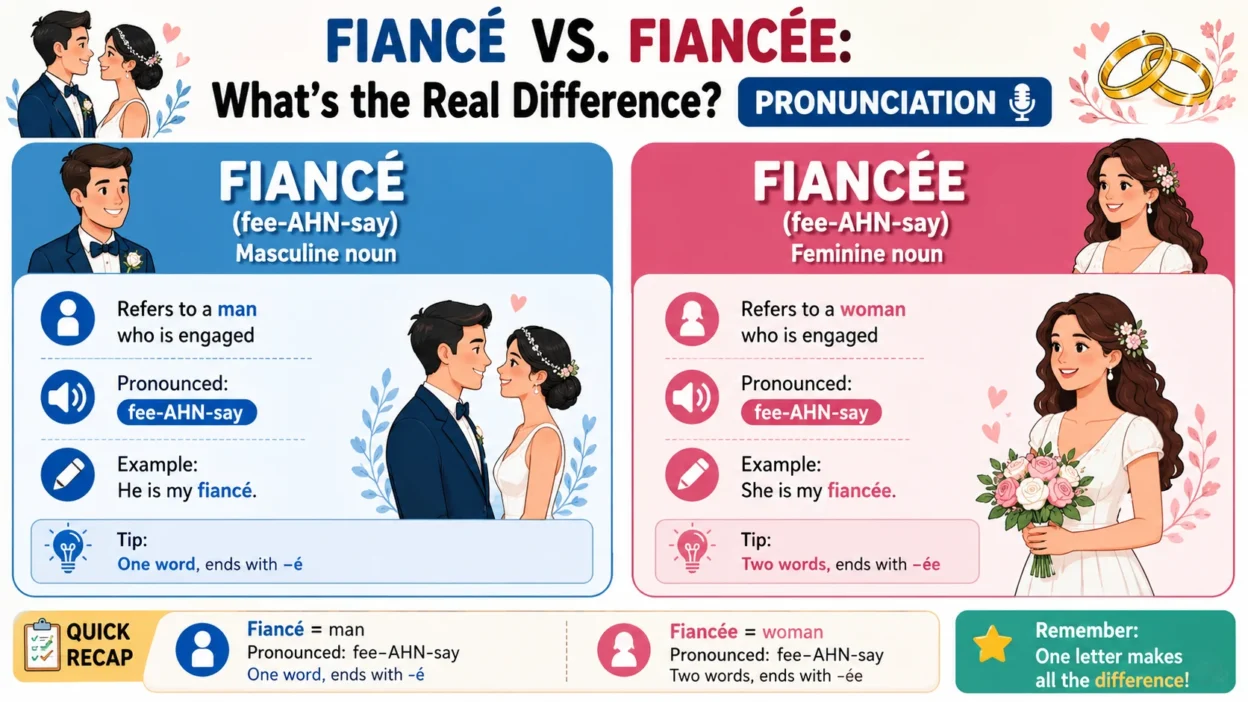
Fiancé means an engaged man. It refers to a man who is promised to someone in marriage, but the wedding has not happened yet.
The word is not about dating. It is not a general term for boyfriend. It is more specific. Once a proposal has been accepted, the man becomes the fiancé.
Common situations where fiancé appears
You will usually see fiancé in situations like these:
- Wedding announcements
- Engagement posts
- Invitations
- Personal introductions
- Formal relationship descriptions
Examples:
- My fiancé and I are getting married in June.
- She introduced her fiancé to the family last night.
- He planned a trip for his fiancé’s birthday.
A useful point: once the couple marries, the word fiancé no longer fits. After the wedding, he becomes a husband or spouse.
What Does Fiancée Mean?
Fiancée means an engaged woman. It refers to a woman who has accepted a proposal and is not yet married.
Just like fiancé, this word is tied to a very specific stage in a relationship. It is not the same as a girlfriend or partner unless the couple is engaged.
Examples:
- My fiancée is choosing the flowers for the ceremony.
- His fiancée works in healthcare.
- They are flying in early so she can meet her fiancée’s parents.
In everyday conversation, many people still use partners instead. That is especially common when someone wants a gender-neutral term or does not want to emphasize marital status too strongly.
Why Are Fiancé and Fiancée Spelled Differently?
The difference comes from French grammar.
English borrowed both words from French, and French marks gender in many nouns and adjectives. That is why the masculine and feminine forms look different.
- fiancé = masculine form
- fiancée = feminine form
This pattern is not unusual in French. English just does not use gendered spelling the same way, so the distinction stands out more.
French grammar explains everything
The roots of these words connect to the idea of being promised or betrothed. In French, the spelling changes depending on grammatical gender. English kept the original forms instead of flattening them into one spelling.
That is why the two words look so similar but still differ by one letter.
A few other borrowed words work in a similar way:
- blond / blonde
- actor / actress in older usage, though modern English increasingly prefers gender-neutral forms
- prince / princess
Not every pair follows French rules in English, but fiancé and fiancée do.
Why the Accent Mark Matters
The accent mark in fiancé and fiancée is the é, which tells you the word is French in origin. It also helps preserve the standard spelling.
In English, people sometimes drop the accent and write fiance or fiancee. That happens a lot in casual typing. Even so, the proper forms keep the accent.
The accent matters most in:
- Formal writing
- Printed wedding materials
- Edited articles
- Professional documents
- Careful personal writing
In casual messages, many people omit it because keyboards and phones make accents easier to skip. Still, if you want the cleanest and most accurate spelling, keep it.
Why people often drop the accent
There are a few practical reasons:
- English keyboards do not always make accents easy to type.
- Autocorrect sometimes removes them.
- People type quickly and do not think about French spelling rules.
- Social media and text messages tend to be less formal.
That does not mean the accent is unimportant. It just means people often get lazy with it. In polished writing, the accent shows care and accuracy.
How to Pronounce Fiancé and Fiancée
In English, fiancé and fiancée are usually pronounced the same way:
fee-ahn-SAY
The stress falls on the final syllable. That is why the word sounds elegant and slightly French to many English speakers.
A simple pronunciation guide:
- fee = first sound
- ahn = middle sound
- SAY = stressed ending
Common pronunciation mistakes
People often make these mistakes:
- Saying fee-ance
- Stressing the first syllable too much
- Pronouncing the final e separately
- Making the word sound like “fee-on-see”
The safest pronunciation is to keep the last syllable strong: say.
Here is a useful rule: if you are unsure, listen to how the word sounds in formal English speech. The pronunciation usually stays close to the French-influenced version.
Why People Constantly Confuse Fiancé vs. Fiancée
The confusion is extremely common, and the reasons are easy to understand.
They sound identical
In normal English speech, the two words sound the same. That means people hear the word but do not get a visual clue about the spelling.
English rarely uses gendered spelling today
Modern English usually prefers one term for everyone. We say teacher, doctor, friend, spouse, or partner without changing spelling for gender. So fiancé and fiancée stand out as old-style exceptions.
Phones autocorrect incorrectly
Many people type the word on a phone and let autocorrect handle it. That often leads to mistakes. Some keyboards remove the accent mark. Others replace the word with the wrong version.
That is why you can see errors in:
- Text messages
- Wedding websites
- Social captions
- Emails
- Invitation drafts
Even careful writers make this mistake because the two forms look so close.
Common Spelling Mistakes
There are several errors people make again and again.
Common incorrect forms
- fiance without the accent
- fiancee without the accent
- Using fiancé for a woman
- Using fiancée for a man
- Adding extra letters by accident
Correct examples
- My fiancé proposed in Paris.
- Her fiancée is finishing law school.
- We invited my fiancé’s parents.
- She and her fiancée are planning the reception.
Incorrect examples
- My fiancee proposed last night.
This is wrong if the person is a man. - His fiance is moving next month.
This is often understood, but the standard spelling is fiancé. - We are celebrating my fiancée birthday.
The apostrophe is missing here. It should be fiancée’s birthday.
Spelling errors with fiancé and fiancée often happen because people know the word is French but not how the accent and ending work.
When It’s Okay to Drop the Accent Mark
In very casual writing, people sometimes write fiance or fiancee without the accent. The meaning is usually still clear.
That said, there is a difference between acceptable in casual use and best in polished writing.
Acceptable situations
Dropping the accent is more common in:
- Text messages
- Social media posts
- Quick notes
- Usernames
- Platforms that do not support accents well
Keep the accent in formal writing
Use the correct accented form in:
- Wedding invitations
- Articles
- Essays
- Business writing
- Announcements
- Edited content
The accent is not decoration. It is part of the word’s standard spelling.
Fiancé vs. Fiancée in Same-Sex Relationships
This is where real-world usage gets more interesting.
The traditional French-based distinction uses gendered forms. In same-sex relationships, people may still use the word that matches the traditional gender form, or they may choose a gender-neutral term instead.
For example:
- A man engaged to another man may use fiancé.
- A woman engaged to another woman may use fiancée.
- Many people skip both and say partner.
This is not about strict grammar alone. It is also about identity, preference, and clarity.
Why some people choose “partner”
People often prefer partner because it is:
- Gender-neutral
- Modern
- Clear
- Flexible
- Useful in casual and formal settings
Example:
- My partner and I are getting married next spring.
That sentence avoids gender entirely. For many people, that is the simplest and most comfortable choice.
Fiancé vs. Fiancée vs. Other Relationship Terms
It helps to compare the main relationship words side by side.
| Term | Meaning | Common use |
| fiancé | Engaged man | Formal or traditional writing |
| fiancée | Engaged woman | Formal or traditional writing |
| partner | Romantic companion | Gender-neutral use |
| spouse | Married partner | Formal and neutral |
| husband | Married man | After marriage |
| wife | Married woman | After marriage |
When people prefer “partner”
People often choose partner when:
- They want a neutral term
- They are not focused on gender
- They are speaking casually
- They are writing in a professional or inclusive setting
- They are not legally married yet
Partner is especially useful when the audience does not need to know the gender of the engaged person.
How These Words Are Used in Wedding Announcements
Wedding announcements often use fiancé and fiancée because the words add a formal and romantic tone.
Examples:
- We are excited to announce that Emma and her fiancée will be married in October.
- James and his fiancé are planning a destination wedding.
These words often appear in:
- Save-the-date cards
- Engagement posts
- Ceremony programs
- Wedding websites
- Newspaper announcements
Why correct spelling matters in wedding materials
Wedding writing is personal. It is also public. That means a spelling mistake can feel embarrassing fast.
A mistake in a wedding invitation can create confusion, especially if the wrong gender form appears. Proofreading matters more than ever in this setting because these are keepsakes. People save them.
Social Media Usage: Rules Get Relaxed
Social media is where grammar often gets looser.
People post quickly. They type on phones. They care more about the message than the accent mark.
That is why you might see:
- fiance
- fiancee
- fiancé
- fiancée
all used in the same feed.
Still, better spelling helps. A polished post looks more thoughtful, even on a casual platform.
A practical social media tip
If the word appears in a caption, bio, wedding post, or announcement, use the correct form if possible. It gives the post a cleaner and more professional look.
Fiancé vs. Fiancée in Legal Documents
In legal or official writing, clarity matters more than style.
The words may appear in:
- Immigration forms
- Marriage records
- Affidavits
- Estate documents
- Insurance paperwork
- Relationship statements
In these situations, precise wording can matter because it reduces misunderstanding.
Why accuracy matters in legal writing
Legal documents are about definitions. If a form asks for relationship status, the language needs to be clear. Using the correct term helps avoid confusion.
That said, many official forms now use broader terms like:
- spouse
- partner
- intended spouse
- dependent
These terms are often easier to apply across different relationship types.
A Realistic Case Study: How One Wedding Invitation Went Wrong
Here is a simple example of how this mistake can happen.
A couple designs elegant wedding invitations. The groom’s name appears correctly. The bride’s name is printed with the word fiancé instead of fiancée. At a glance, most guests might not notice. But the couple does.
Now the invitation looks slightly off. It still makes sense, but the wording is wrong. The error feels small and personal at the same time. That is exactly why this mistake matters.
What this case shows
- Small spelling errors stand out in formal writing.
- A single missing letter can change meaning.
- Proofreading is worth the extra minute.
- Tools like spell check do not always catch gendered word differences.
The lesson is simple: check the word carefully before you print anything important.
Famous Engagement Quotes and the Language of Commitment
Engagement is about more than a title. It is a promise. That is why words like fiancé and fiancée carry emotional weight.
Some common ideas in engagement language include:
- commitment
- trust
- planning
- partnership
- future
- promise
A simple quote-style truth captures the idea well:
An engagement is not just a label. It is a promise with a future attached.
That is why these words show up in cards, vows, captions, and announcements. They point to the space between dating and marriage.
Easy Ways to Remember Fiancé vs. Fiancée
Memory tricks can save time and prevent mistakes.
The extra “e” rule
- fiancé = one e at the end
- fiancée = two e letters at the end
The extra e helps you remember the traditional feminine form.
Visual trick
Picture the extra e as a small addition that marks the feminine version. One word feels “lighter” by one letter. The other carries the extra ending.
French connection
Remember this: the words came from French, and French often changes word endings based on gender. That explains the spelling difference without any guesswork.
A fast mental shortcut
- Fiancé → male
- Fiancée → female
- Partner → neutral
That little pattern keeps the word choice clean in most writing.
Helpful Comparison Table
| Feature | Fiancé | Fiancée |
| Gender in traditional use | Male | Female |
| Meaning | Engaged man | Engaged woman |
| Spelling | One final e | Two final e letters |
| Pronunciation | fee-ahn-SAY | fee-ahn-SAY |
| Formal use | Yes | Yes |
| Casual use | Often simplified | Often simplified |
This table makes the difference easy to scan at a glance.
Best Usage Examples in Real Sentences
Here are some clean examples you can model.
Fiancé in sentences
- My fiancé and I are choosing a venue.
- Her fiancé sent flowers this morning.
- He introduced his fiancé to everyone at dinner.
Fiancée in sentences
- My fiancée loves planning events.
- His fiancée designed the invitation herself.
- She and her fiancée are moving in together after the wedding.
Neutral alternatives
- My partner and I are engaged.
- They are planning their wedding together.
- I’m excited to marry my partner next year.
These examples show how the words work in different tones and settings.
Conclusion
Understanding the difference between fiancé and fiancée becomes much easier once you remember the role of the extra E. A fiancé is an engaged man, while a fiancée is an engaged woman. Although both words share the same French roots and describe someone who has made a promise to marry, their gender-specific meanings make them different in English usage. Using the correct term improves communication clarity, avoids common mistakes, and helps you express relationship details with greater accuracy and confidence.
FAQs
Q1. What is the main difference between fiancé and fiancée?
The main difference is gender. Fiancé refers to an engaged man, while fiancée refers to an engaged woman. The extra E in fiancée indicates the feminine form.
Q2. Are fiancé and fiancée pronounced differently?
No, in most cases, fiancé and fiancée have identical pronunciation. The difference appears in their spelling and meaning, not usually in how they sound.
Q3. Where do the words fiancé and fiancée come from?
Both words come from French roots. They developed from the French verb fiancer, which is related to making a promise, showing trust, and entering a betrothal.
Q4. Can fiancé and fiancée be used for married people?
No. These terms describe someone who is engaged but not yet married. After marriage, the person becomes a husband, wife, or spouse.
Q5. Is fiancée still used in modern English?
Yes. Fiancée is still commonly used in modern English, especially when people want to clearly identify an engaged woman. However, some speakers prefer more gender-neutral language depending on the situation and personal preference.