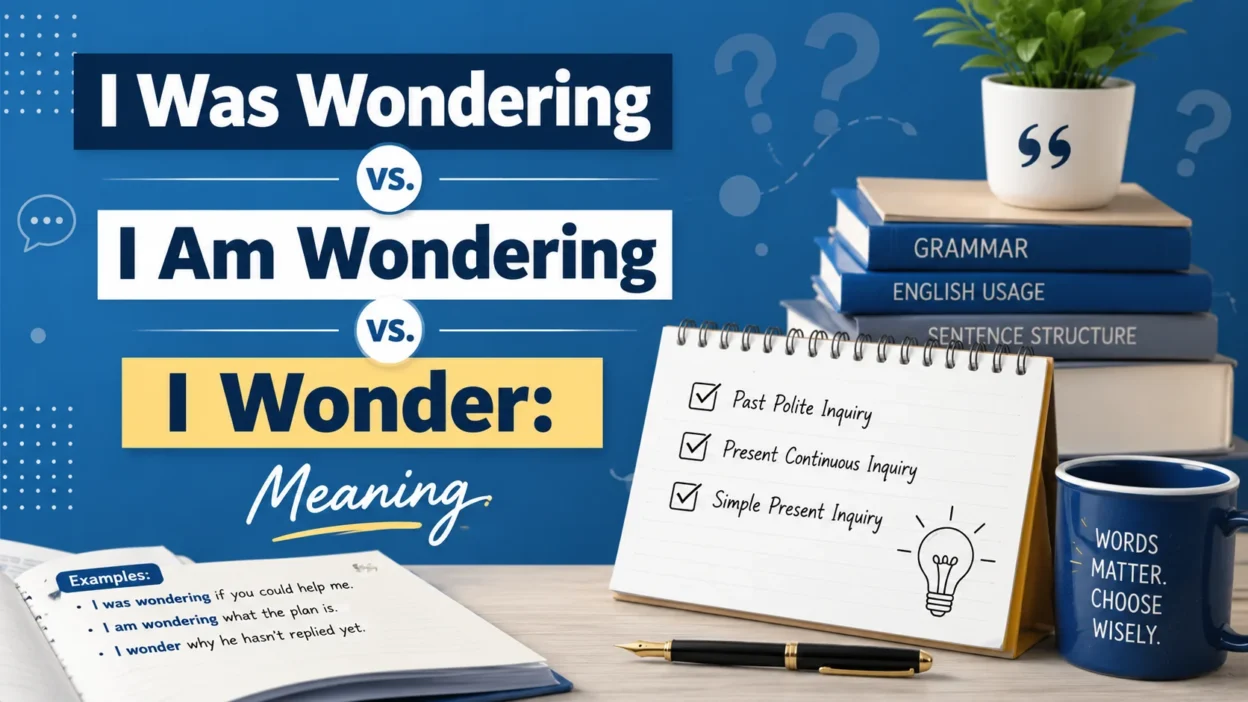
“I Was Wondering” vs. “I Am Wondering” vs. “I Wonder” helps you understand how one simple verb can create different meanings through grammar, tone, and usage in just a few words. Learning English becomes much easier when you know how each expression fits a different situation instead of treating them as the same. As I improved my own language learning, I found that noticing small changes in sentence tone made my communication sound more natural. That experience also increased my confidence in speaking, writing, and everyday conversation with native speakers. Once you understand the logic, patterns, grammar rules, grammar differences, grammar comparison, semantics, nuance, grammatical choice, and expression meaning, choosing the right phrase becomes much more natural in both professional communication and conversational English.
At its core, wonder expresses curiosity, but each expression has a unique role. I was wondering if it usually introduces a polite request, while I am wondering describes an active, immediate thought that is happening now. I wonder if I share a reflective thought or general curiosity without directly making a request. When you compare these forms, you can see that the choice of words changes the overall meaning, even though the idea stays similar. You may ask a question, request a favour, seek information, decide whether to go out for coffee or cook for dinner, or simply think, “I wonder why the sky is blue.” You could also say, “I am wondering why the sky is blue at the moment.” Both are correct, but each creates a slightly different feeling.
Instead of memorising every rule, focus on understanding, understanding differences, and seeing how each phrase introduces a different purpose. One phrase reflects a present thought, another softens a polite request, and another simply shares curiosity. This habit helps you avoid common mistakes, notice every mistake, and avoid mistakes before they become routine. Keep the core idea in mind, remember the key differences, and decide which phrase fits the situation best. Before long, you will spend less time thinking about rules and more time currently thinking, actively seeking the right answer or solution through natural thought, thoughts, thought about, pondering, present, present thoughts, past, and present and general situations, making your English more precise while making English more effective.
Quick Answer: Which Phrase Should You Use?
Here is the simplest rule:
- I was wondering = polite, indirect, and common in requests
- I am wondering = present and immediate, often used for a current thought
- I wonder = general curiosity, reflection, or speculation
The Short Rule You Can Remember
If you want to ask for something politely, I was wondering if it usually sounds best.
If you are describing a thought you have right now, I am wondering if it works well.
If you are speaking about curiosity in a general or reflective way, I wonder if it is often the most natural choice.
Side-by-Side Comparison at a Glance
| Phrase | Main Meaning | Tone | Common Use | Example |
| I was wondering | Past form used for polite requests | Soft, polite, indirect | Emails, messages, professional speech | I was wondering if you could help me. |
| I am wondering | Present thought or current curiosity | Immediate, active, thoughtful | Spoken English, ongoing reflection | I am wondering whether she got the job. |
| I wonder | General curiosity or speculation | Neutral, reflective, sometimes literary | Conversation, writing, internal thought | I wonder why he left early. |
Understanding the Verb “Wonder” in English
Before comparing the three phrases, it helps to understand the verb wonder itself.
At its core, wonder means to think about something with curiosity, uncertainty, or interest. It often carries the sense of asking yourself a question, even if no one else hears it.
For example:
- I wonder where she lives.
- He wondered whether the meeting was canceled.
- She is wondering how to solve the problem.
The verb can point to a mental process, not just a spoken question. That is why it appears in many different structures.
The Core Meaning of “Wonder”
The idea behind wonder is usually one of these:
- curiosity
- uncertainty
- speculation
- polite inquiry
- quiet reflection
It is a flexible word. That flexibility makes it useful, but it also creates confusion.
For example, wonder is not the same as asking. If you ask a direct question, you want an answer. If you wonder, you are often thinking quietly, hesitating, or approaching the question more gently.
Compare these:
- Can you send me the report?
- I was wondering if you could send me the report.
The second sentence feels softer. It does not push. It invites.
How Context Changes the Meaning
The same verb can sound different depending on the tense and sentence pattern.
- I wonder if he is home.
This sounds like a present thought. - I was wondering if he was home.
This sounds more polite and indirect. - I am wondering if he is home.
This feels immediate, as if the speaker is actively thinking about it right now.
In other words, the tense does more than mark time. It also shapes tone.
What Does “I Was Wondering” Mean?
Among the three expressions, I was wondering if it is probably the most common in polite everyday requests.
Even though it uses the past tense, it often refers to a present request or current thought. That surprises many learners at first. Still, native speakers use it constantly because it softens the message.
Why Native Speakers Prefer It for Polite Requests
Saying I was wondering makes the request feel less direct. It reduces pressure.
For example:
- I was wondering if you had time to talk.
- I was wondering whether you could help me with this.
- I was wondering if this seat was taken.
These sentences sound courteous. They do not feel harsh or demanding.
That is why you hear them in:
- customer service
- workplace emails
- classroom conversations
- formal messages
- polite introductions
The phrase acts like a cushion. It softens the edge of the request.
Common Situations Where “I Was Wondering” Sounds Natural
Use I was wondering when you want to be respectful, careful, or tactful.
It works well when you are:
- asking for help
- making a request
- checking availability
- asking for information
- approaching someone you do not know well
Examples:
- I was wondering if you could recommend a good restaurant.
- I was wondering whether the deadline changed.
- I was wondering if this file is the final version.
These sound natural because they are indirect. They give the other person room to answer comfortably.
Everyday Examples in Conversations and Emails
Here are a few real-life uses:
Conversation
I was wondering if you wanted to grab coffee later.
Email
I was wondering whether you had a chance to review my draft.
Text message
I was wondering if you’re free this evening.
Notice the pattern. The phrase often appears before if, whether, or a polite request. That structure is common for a reason: it keeps the sentence gentle.
A Helpful Way to Think About It
Think of I was wondering as a soft knock on the door. You are not kicking the door open. You are asking politely whether you may come in.
That is why this phrase often sounds better than a direct question in situations where respect matters.
Deciphering the Present Thoughts: “I Am Wondering” Explained
Now let’s move to I am wondering.
This phrase is grammatically straightforward. It uses the present continuous tense, so it points to something happening now.
That said, it does not usually carry the same polite softness as I was wondering. It sounds more immediate, more active, and sometimes a little more dramatic.
Expressing a Current Thought or Ongoing Curiosity
Use I am wondering when you are in the middle of thinking about something right now.
Examples:
- I am wondering how long this will take.
- I am wondering whether she knows the answer.
- I am wondering what the next step should be.
These sentences feel like live thought. The speaker is still processing.
That makes the phrase useful when you want to show your mind is still engaged with the question.
Situations Where It Sounds Natural
I am wondering is most natural when you are:
- thinking aloud
- describing uncertainty
- showing an active mental process
- talking about a present concern
For example:
- I am wondering if the train is delayed.
- I am wondering whether we should leave now.
- I am wondering how to fix this issue.
It can work in speech and writing, but it is not always the best choice for a polite request.
When It May Sound Slightly Less Natural
In many polite requests, I am wondering can sound a bit too direct or too formal in a strange way.
Compare:
- I was wondering if you could send the file.
- I am wondering if you could send the file.
The first one sounds smoother and more natural in most polite contexts. The second one is not wrong, but it can sound less idiomatic.
That is the key point: I am wondering if it is grammatical, but it is not always the most natural option for requests.
Common Mistake to Avoid
A lot of learners think the present tense automatically sounds better because it matches the present moment. English does not always work that way.
Sometimes the past tense is used for politeness, not time.
That is why I was wondering if it is the better choice even when the speaker means “right now.”
When “I Wonder” Is the Best Choice
The phrase I wonder is clean, simple, and very common.
It often expresses curiosity, reflection, or speculation without sounding overly polite or overly formal. It can also sound thoughtful, literary, or conversational depending on the context.
Expressing General Curiosity
Use I wonder when you are asking yourself something in a natural, direct way.
Examples:
- I wonder why she left early.
- I wonder how they solved the problem.
- I wonder what he meant by that comment.
These sentences feel open and reflective. They do not sound like formal requests. They sound like thoughts.
Using “I Wonder” for Reflection and Speculation
This phrase is especially useful when you are not asking someone else directly.
You might use it when:
- thinking to yourself
- writing a reflective sentence
- expressing curiosity about a situation
- introducing speculation
Examples:
- I wonder if he will come back.
- I wonder whether this plan will work.
- I wonder how much time we have left.
The phrase often appears in writing because it creates a thoughtful tone.
Everyday Example
Imagine you see an empty chair at a meeting.
You could say:
- I wonder if she is late.
That sounds natural. You are not pushing for an answer. You are simply expressing curiosity.
A Subtle but Important Difference
I wonder is often more internal than I was wondering.
- I wonder = present curiosity, thought in motion
- I was wondering = softened request or hesitant inquiry
The difference is small but important.
Conclusion
Choosing between “I Was Wondering,” “I Am Wondering,” and “I Wonder” becomes much easier once you understand the purpose behind each expression. Although they all come from the same verb, they create different meanings through grammar, tone, and context. “I Was Wondering” is usually the best choice for polite requests, “I Am Wondering” expresses a thought that is happening right now, and “I Wonder” shares general curiosity or reflection. By paying attention to these small differences, you can communicate more naturally, sound more confident, and make your spoken and written English clearer in everyday conversations.
FAQs
Q1.Is “I Was Wondering” grammatically correct?
Yes. “I Was Wondering” is completely grammatically correct. Native English speakers commonly use it to make polite requests or ask questions in a softer and more respectful way.
Q2.When should I use “I Am Wondering”?
Use “I Am Wondering” when you want to describe a thought or question you are actively thinking about at the present moment. It emphasises an ongoing thought rather than a polite request.
Q3.What does “I Wonder” mean?
“I Wonder” expresses curiosity, reflection, or speculation. It is often used when thinking aloud or introducing a question without expecting an immediate answer.
Q4.Which expression sounds the most polite?
Among the three expressions, “I Was Wondering” is generally the most polite. It softens requests and is widely used in professional emails, workplaces, classrooms, and everyday conversations.
Q5.Can I use these expressions interchangeably?
Not always. While “I Was Wondering,” “I Am Wondering,” and “I Wonder” all relate to curiosity, they have different tones, meanings, and purposes. Choosing the correct expression depends on whether you are making a polite request, expressing a current thought, or sharing general curiosity.