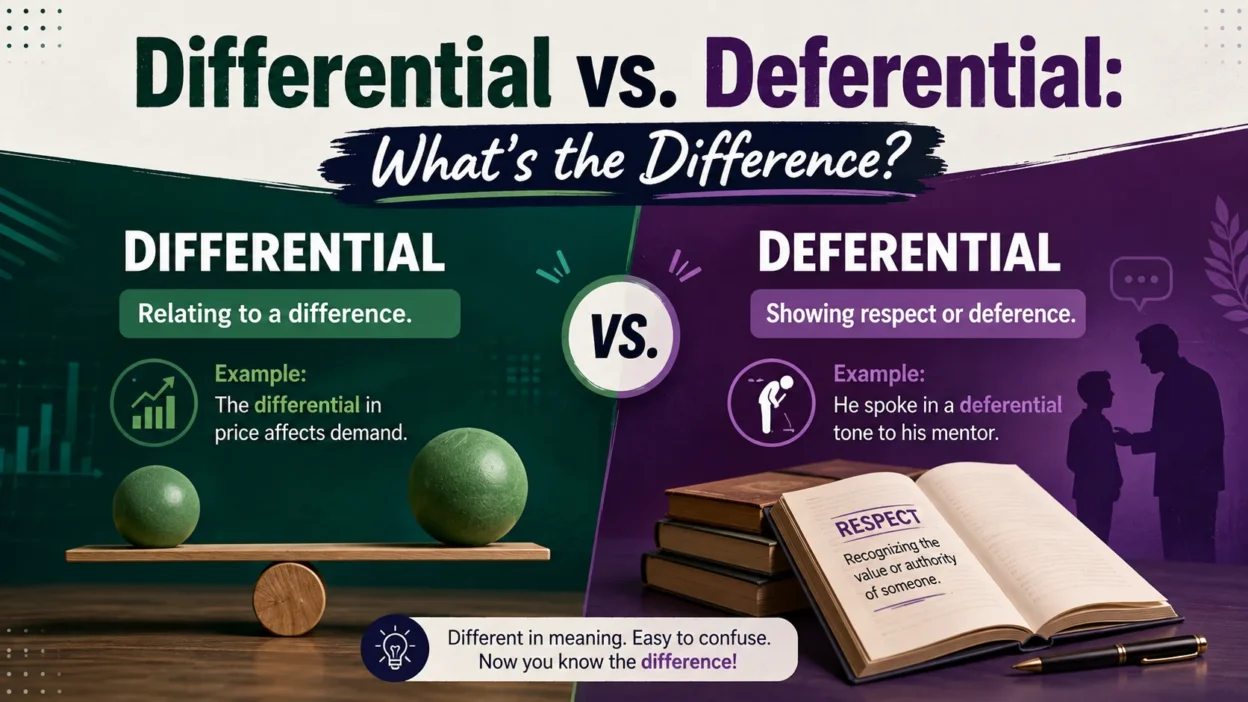
Many English learners struggle with Differential vs Deferential because they are similar words, commonly confused words, and sound alike. Although they look almost the same, their meaning and meanings are completely different. In simple English, the easiest way to understand them is by focusing on the difference in context. A quick comparison shows that Differential refers to a distinction or difference, while Deferential describes respect. Learning this simple rule improves your English vocabulary, strengthens your English grammar, and helps you make better word choice in everyday communication and writing.
One reason these confusing words create mistakes is that many people focus only on spelling instead of contextual usage. Every sentence has a purpose, and each of these words belongs in a different situation. Differential fits discussions about difference or comparison, while Deferential belongs in situations involving respect. Paying attention to the context instead of appearance helps you understand the language more naturally and improves both your grammar and vocabulary with every correct use and usage.
As your confidence grows, choosing between Differential and Deferential becomes much easier. Understanding their distinction allows you to express ideas clearly without confusing your readers. Regular practice, careful usage, and thoughtful word choice strengthen your writing skills and make your communication more accurate. Over time, these similar words become easy to recognise because you understand their meaning rather than relying only on how they look or sound.
Differential vs. Deferential at a Glance
Here’s the fastest way to separate differential from deferential.
| Word | Core meaning | Common use | Tone |
| Differential | Relating to a difference, comparison, or distinction | math, science, business, mechanics, grammar discussions | technical or analytical |
| Deferential | Showing respect, courtesy, or submission to another person’s wishes | workplace language, social behavior, formal writing | polite or respectful |
A simple rule helps:
- Differential = difference
- Deferential = deference
That one-letter shift changes the whole meaning.
A small spelling change can carry a very big meaning change.
Differential Meaning
Differential is an adjective, and sometimes a noun, that points to a difference, variation, or comparison between things.
In everyday language, it often means “not the same” or “based on differences.” In technical settings, it can get more specific.
Definition of Differential
As an adjective, differential means relating to or involving a difference between two or more things.
As a noun, it can refer to a measurable difference or a device that allows different motion between connected parts.
That means the word has both a general use and several specialized uses.
Origin and Etymology of Differential
Differential comes from the Latin root differentia, meaning “difference.” That root connects directly to the idea of distinguishing one thing from another.
The word has long carried the sense of comparison, variation, and distinction. That’s why it appears in mathematics, economics, mechanics, and everyday analysis.
Different Uses of Differential
The word differential shows up in several fields.
Mathematical use
In mathematics, a differential relates to a very small change in a variable. You’ll often see it in calculus and related subjects.
Example:
- “The differential of the function changes as the input changes.”
Scientific use
In science, differential can describe something that depends on or results from differences.
Example:
- “The experiment measured differential growth rates between the two samples.”
Economic use
In economics, a differential is often a gap between two values, rates, or prices.
Example:
- “The wage differential between the two roles was significant.”
Automotive or mechanical use
In mechanics, a differential is a part of a vehicle’s drivetrain. It lets the wheels rotate at different speeds while turning.
Example:
- “The mechanic replaced the rear differential.”
General English use
In general writing, differential usually means a difference or distinction.
Example:
- “There is a clear skill differential between the two candidates.”
Common Collocations with Differential
These word pairings are common and natural:
- wage differential
- price differential
- interest rate differential
- performance differential
- differential diagnosis
- differential equation
- differential pressure
- differential treatment
- differential advantage
- differential growth
These collocations matter because they show how the word works in real contexts. You usually hear differential where comparison or measurable difference is involved.
Differential Synonyms and Antonyms
A few useful synonyms include:
- difference
- variation
- distinction
- disparity
- gap
- contrast
Possible antonyms depend on context, but they may include:
- similarity
- sameness
- equality
- uniformity
Real-Life Examples of Differential in Sentences
Here are some clear examples:
- “The company noticed a differential in productivity between morning and evening shifts.”
- “There is a noticeable wage differential between entry-level and senior staff.”
- “The doctor used a differential diagnosis to rule out several possible causes.”
- “That truck needs a new rear differential.”
- “The study found a differential response to the treatment.”
Each sentence works because the word signals difference, not respect.
Deferential Meaning
Deferential is an adjective that means showing respect, courtesy, or submission toward another person’s status, judgment, or wishes.
If differential points to difference, deferential points to deference.
That’s the easiest way to keep them apart.
Definition of Deferential
When someone acts deferentially, they are careful, polite, and respectful. They may listen closely, avoid challenging someone openly, or give priority to another person’s opinion.
It does not mean weak. It does not mean fake. It usually means appropriately respectful.
Origin and Etymology of Deferential
Deferential comes from deference, which traces back to the Latin deferre, meaning “to yield” or “to carry down.” Over time, the word developed the idea of yielding to another person’s rank, wishes, or expertise.
That’s why deferential often appears in formal or social contexts where respect matters.
Different Uses of Deferential in Everyday English
You’ll usually see deferential in human behavior, tone, and relationship language.
Workplace use
A deferential employee may speak politely to a manager or senior colleague.
Example:
- “She gave a deferential nod and waited for the supervisor to finish speaking.”
Social use
Someone may act deferential toward elders, guests, or people they admire.
Example:
- “He was deferential to his grandparents during the family dinner.”
Formal writing
Writers often use deferential when describing respectful behavior in professional or historical settings.
Example:
- “The assistant remained deferential throughout the meeting.”
Common Collocations with Deferential
These pairings are common:
- deferential tone
- deferential attitude
- deferential manner
- deferential behavior
- deferential response
- deferential bow
- deferential gesture
- deferential treatment
- deferential language
- deferential respect
These combinations almost always involve people, etiquette, or social hierarchy.
Deferential Synonyms and Antonyms
Synonyms include:
- respectful
- polite
- courteous
- submissive
- humble
- yielding
Antonyms may include:
- rude
- disrespectful
- insolent
- defiant
- impertinent
Real-Life Examples of Deferential in Sentences
Here are some natural examples:
- “He spoke in a deferential tone to the judge.”
- “The intern was polite and deferential during the interview.”
- “She gave her teacher a deferential smile.”
- “The staff remained deferential to the client’s wishes.”
- “His deferential manner made the meeting feel formal and calm.”
Notice the pattern. Deferential describes behavior toward another person.
Differential vs. Deferential: Side-by-Side Comparison
This is where the difference becomes crystal clear.
| Feature | Differential | Deferential |
| Main idea | difference | respect |
| Part of speech | adjective, noun | adjective |
| Common fields | math, science, business, mechanics | behavior, etiquette, formal communication |
| Related noun | difference, differential | deference |
| Example use | “wage differential” | “deferential tone” |
| Easy clue | think different | think deference |
A fast memory trick:
- Differential starts with diff-, like different
- Deferential starts with defer-, like deference
That clue works because the roots point in the right direction.
Pronunciation Differences
The words also sound different enough to matter once you slow down.
- Differential is usually pronounced with four clear parts: dif-uh-REN-shul
- Deferential is usually pronounced with four parts too: def-uh-REN-shul
They sound close, but the middle vowel and root shape help distinguish them.
Typical Contexts Where Each Word Appears
Use differential when:
- you mean a measurable difference
- you discuss comparison
- you speak about technical subjects
- you mention mechanical parts
Use deferential when:
- you talk about respect
- you describe manners or behavior
- you write about hierarchy or etiquette
- you explain someone’s polite response
Why People Confuse Differential and Deferential
The confusion makes sense. The words are cousins in shape, but not in meaning.
Similar spelling
Both words are long. Both contain similar letters. Both end in -ential. That alone is enough to fool the eye.
Similar pronunciation
They sound close enough that a fast speaker might blur them. In everyday conversation, that can make mistakes easier to miss.
Different meanings despite similar appearance
This is the real trap. One word is about difference. The other is about respect. If you mix them up, the sentence may still look grammatical, but the meaning can be wrong.
Common writing mistakes
Writers sometimes use deferential when they really mean differential in technical or business writing.
Examples of wrong usage:
- Incorrect: “There was a deferential in salary between the two jobs.”
- Correct: “There was a differential in salary between the two jobs.”
And sometimes people use differential when they mean respect.
- Incorrect: “He gave a differential bow to the principal.”
- Correct: “He gave a deferential bow to the principal.”
When to Use Differential
Here’s where the differential fits best.
Academic writing
In school and university writing, differential often appears in math, science, and research.
Examples:
- differential equation
- differential analysis
- differential measurement
- differential outcome
Business and economics
Business writing often uses a differential to compare pay, prices, demand, or performance.
Examples:
- wage differential
- price differential
- tax differential
- performance differential
Engineering and automotive discussions
Mechanical and engineering contexts use differential frequently.
Examples:
- vehicle differential
- differential gear
- differential pressure
- differential speed
Everyday English examples
In normal conversation, differential can still appear when you compare two things.
Examples:
- “The quality differential was obvious.”
- “There’s a big skill differential between them.”
- “The timing differential changed the result.”
When to Use Deferential
Use deferential when the topic is people, manners, tone, or social behavior.
Workplace communication
A deferential tone can be useful in professional settings, especially when speaking to a supervisor, client, judge, teacher, or elder.
Examples:
- “She used a deferential tone in her email.”
- “The team remained deferential to the director’s decision.”
Professional and formal writing
Formal documents may use deferential when describing respectful conduct.
Examples:
- “The assistant remained deferential throughout the discussion.”
- “His deferential response prevented tension from rising.”
Literature and historical writing
Writers often use deferential to show class, rank, or old-fashioned etiquette.
Examples:
- “The servant bowed in a deferential manner.”
- “He spoke deferentially to the queen.”
Everyday conversations
Even in daily life, deferential fits when someone shows humility or respect.
Examples:
- “She was deferential to her older brother.”
- “He gave a deferential answer and let the manager speak first.”
Differential vs. Deferential in Sentences
Sometimes the best way to learn a word pair is to see them side by side.
Correct examples
- “The company offered a salary differential for night shifts.”
- “The junior lawyer remained deferential during the hearing.”
- “The mechanic checked the rear differential.”
- “The intern was deferential to the senior team.”
Incorrect examples and corrections
- Incorrect: “There is a large deferential in tuition costs.”
- Correct: “There is a large differential in tuition costs.”
- Incorrect: “He gave a differential bow to the professor.”
- Correct: “He gave a deferential bow to the professor.”
- Incorrect: “The car’s deferential needs repair.”
- Correct: “The car’s differential needs repair.”
Sentence rewrite practice
Try these:
- “The nurse used a respectful tone.” → “The nurse used a deferential tone.”
- “The gap between the two prices was large.” → “The differential between the two prices was large.”
- “He looked polite and respectful toward the judge.” → “He looked deferential toward the judge.”
Common Expressions and Phrases
Here are the most natural expressions with each word.
Phrases with Differential
- differential diagnosis
- wage differential
- price differential
- differential advantage
- differential equation
- differential pressure
- differential treatment
Phrases with Deferential
- deferential tone
- deferential manner
- deferential response
- deferential attitude
- deferential behavior
- deferential treatment
These phrases make the meaning clear without forcing the word into the wrong context.
Conclusion
Understanding Differential vs Deferential becomes much easier once you connect each word with its actual meaning instead of its similar spelling. Differential refers to a difference, distinction, or comparison, while Deferential describes showing respect, politeness, or courtesy toward someone. Although these words look and sound alike, they belong in completely different contexts. By paying attention to the sentence, practising with real examples, and remembering their core meanings, you can use both words confidently and avoid one of the most common mistakes in English writing.
FAQs
Q1.Is Differential the Same as Deferential?
No. Differential refers to a difference, comparison, or distinction, while Deferential means showing respect, politeness, or submission toward someone.
Q2.How Can I Remember the Difference Between Differential and Deferential?
Think of Differential as relating to different or difference, and Deferential as relating to deference, which means respect.
Q3.Can Differential Describe a Person’s Behavior?
Generally, no. Differential is used for differences or comparisons. If you are describing respectful behaviour, Deferential is the correct word.
Q4.Where Is the Word Differential Commonly Used?
Differential commonly appear in mathematics, science, engineering, economics, business, healthcare, and everyday discussions involving comparisons or measurable differences.
Q5.When Should I Use Deferential in a Sentence?
Use Deferential when describing someone who behaves respectfully, politely, or courteously toward another person, especially in professional, formal, or social situations.