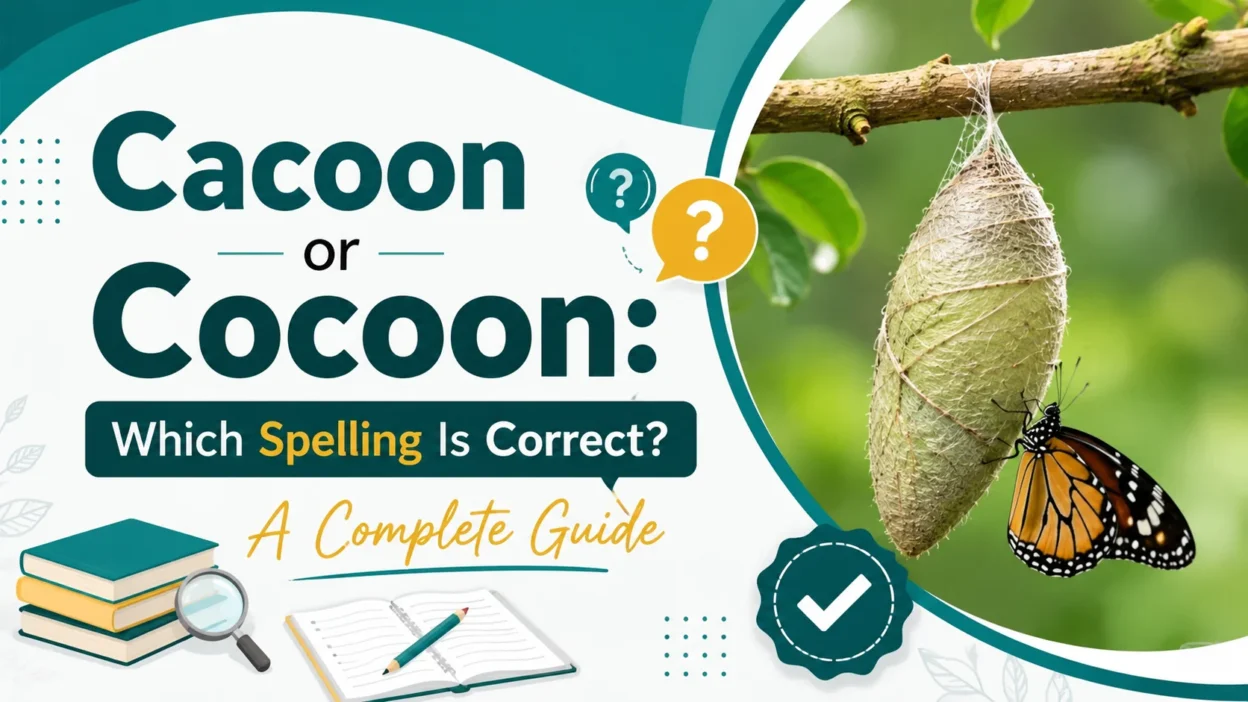
The phrase Cacoon or Cocoon creates spelling confusion because many writers compare similar sounds, but only cocoon is the correct English word. The English language contains many tricky words that create a common conundrum for English learners, native speakers, students, and readers. The similar words, similar spellings, and pronunciation differences can make people question their word choice. However, knowing the correct spelling, standard English, and correct usage improves English vocabulary, grammar, and writing accuracy.
The difference between cacoon and cocoon becomes clearer when you understand their word distinction and meaning. Many people make this spelling mistake because the brain follows familiar patterns and remembers the sound instead of the written form. The word cacoon is a misspelling, common misspelling, and spelling error, while cocoon refers to a protective covering connected with insects, nature, and transformation. This small spelling debate can create language confusion, but learning the correct word helps build confidence and prevents second-guess moments in English writing.
A clear guide with real-world examples helps you discover, explore, review, and learn the meaning, meanings, and usage of these terms. A practical guide to cocoon meaning explains its connection with a metaphor of safety, privacy, comfort, and transformation. Whether the error appears through a keyboard, autocorrect, the internet, or casual texters, improving language learning, writing, writing accuracy, accuracy, clarity, credibility, language accuracy, and search visibility creates more polished communication with stronger word choice.
Cacoon or Cocoon: Why People Mix Them Up
The confusion starts with sound. When spoken aloud, cacoon and cocoon sound almost the same. That makes the mistake easy to carry from memory to page. Add fast typing, autocorrect, and the habit of spelling by sound, and the error spreads quickly.
Another reason is visual pattern confusion. English has many doubled-letter words, and the brain often guesses spellings instead of checking them. A word like “cocoon” can feel unfamiliar at first glance, so some writers replace the middle letters with what looks more natural to them. That is how cacoon sneaks in.
There is also a simple human factor. People remember what they have seen before, even if what they saw was wrong. If a misspelling appears in social media posts, comments, or low-quality websites, it can start to feel familiar. Familiar does not mean correct, though.
The clean rule is easy: cocoon is the standard spelling in modern English. Cacoon is generally not correct when you mean the insect covering or the metaphorical idea of protection.
Cocoon: The Correct Spelling and Its Meaning
The word cocoon has two main uses in English. First, it refers to the silky protective case that some insects form during development. Second, it can describe a feeling or condition of shelter, comfort, or isolation. Both uses are common, and both are useful.
As a noun, cocoon means the covering spun by certain larvae, especially moths, before they transform into adults. That natural shell protects them from weather, predators, and damage while major change happens inside.
As a verb, to cocoon means to wrap, shield, or surround something in a protective way. You might cocoon yourself in blankets on a cold day. A parent might cocoon a baby in warmth and care. A company might cocoon a product in layers of packaging.
The word carries a feeling of enclosure, but not always in a bad way. Sometimes a cocoon suggests comfort. Sometimes it suggests withdrawal from the world. Context decides the tone.
Cocoon Definition in Plain English
In simple terms, a cocoon is a safe wrapper.
That wrapper is natural in insects and figurative in human language. The insect version is built from silk or similar material. The metaphorical version is built from ideas like privacy, security, rest, or separation from outside pressure.
Here is a quick way to think about it:
- Literal cocoon: a protective covering made by an insect
- Figurative cocoon: a protective space around a person, object, or idea
- Verb form: to surround or protect
This flexible meaning is one reason the word appears in so many contexts. A novelist might use it to describe emotional retreat. A designer might use it to describe a chair or room that feels enclosing and safe. A scientist might use it in its biological sense.
The Origin and History of Cocoon
The word cocoon entered English through French, which borrowed it from earlier forms tied to the idea of a shell or covering. Over time, the English spelling settled into the familiar form with oo in the middle.
That history helps explain why the spelling looks the way it does. English often preserves older forms even when pronunciation changes. The result can seem odd at first, but that is part of what makes English spelling so tricky.
The meaning also expanded over time. At first, the word was tied mainly to insect development. Later, writers began using it more broadly for protective enclosures and emotional shelter. Today, the word can describe anything from a silk case on a branch to a cozy blanket fort.
Cocoon in Nature
In nature, a cocoon is a survival tool. It gives a developing insect a controlled space while the body changes. That sounds simple, but the process is remarkable.
A cocoon is not just a shell. It is a highly functional structure that helps protect life during one of the most vulnerable stages in an insect’s life cycle. Inside, the insect may be undergoing dramatic physical change. Outside, the cocoon acts like a shield.
Different species use cocoons in different ways. Some make thick, tough outer layers. Others create lighter coverings. Some cocoons are spun from pure silk, while others include bits of plant matter or debris woven into the structure.
Insect Cocoon and Silkworm Cocoon
When people hear the word cocoon, they often think of moths or silkworms. That is a natural connection, because silkworm cocoons are among the most famous.
A silkworm cocoon is made from a long silk filament that the larva produces from glands near its mouth. The larva spins the filament around itself in repeated loops until it forms a protective case. Humans have used these cocoons for silk production for thousands of years.
Moth cocoons vary widely by species. Some are soft and silky. Others are more compact or layered. Their purpose stays the same: protection during transformation.
Butterflies are different. Many butterflies do not make a cocoon at all. Instead, they form a chrysalis, which is a different kind of protective stage. This distinction is one of the most common biology mix-ups tied to the word cocoon.
Cocoon Formation Process
The cocoon formation process is fascinating because it combines instinct, biology, and engineering in one tiny package.
First, the insect reaches the stage where it must transform. Then it produces silk or similar fibers through specialized glands. Next, it starts spinning around its body. The motion is repetitive and precise. Layer after layer builds up until the insect is enclosed.
Once the cocoon is complete, the insect enters a protected developmental stage. For many species, this is when the body reorganizes in preparation for adulthood. The cocoon remains intact until the transformation is finished and the insect is ready to emerge.
The process is tiny in scale, but enormous in biological importance. Without this protective stage, many insects would not survive long enough to complete metamorphosis.
Cocoon vs Chrysalis vs Pupa
A lot of confusion comes from mixing up these terms. They are related, but they do not mean the same thing.
| Term | What It Means | Commonly Associated With | Main Function |
| Cocoon | Protective covering spun by an insect | Moths, silkworms | Shields the insect during development |
| Chrysalis | Protective stage in butterfly development | Butterflies | Supports metamorphosis |
| Pupa | Developmental stage between larva and adult | Many insects | Transition stage before adulthood |
This table makes the difference easier to remember. A cocoon is a covering. A pupa is a life stage. A chrysalis is the butterfly version of a protective stage, not a silk case in the usual sense.
Cocoon in the Silk Industry
Few natural structures have had a bigger human impact than the silkworm cocoon. For centuries, people have harvested silk from cocoon filaments and turned them into cloth, thread, and luxury goods.
Silk production is tied to patience and precision. The cocoon must be handled carefully so the continuous silk thread stays intact. That thread can then be unwound and processed into fabric. This is one reason silk became such a prized material. It combines strength, softness, and shine in a way few fibers can match.
The silk industry also shaped trade routes, labor systems, fashion trends, and global commerce. In many cultures, silk was not just a fabric. It was a status symbol, a craft tradition, and a major economic resource.
Case Study: How Silk Cocoons Shaped Trade
Silk cocoons influenced trade for centuries. Merchants moved silk across long routes, connecting regions through exchange and demand. The value of silk helped support entire commercial networks.
That matters because one tiny insect product helped drive large-scale human movement, wealth, and exchange. A cocoon may look small, but its historical impact is anything but small.
Even today, silk still matters. Modern textile markets, luxury goods, and traditional craft industries continue to rely on silk production. The cocoon remains a link between nature and human industry.
Cocoon as a Metaphor
The word cocoon is powerful because people instantly understand its emotional meaning. When you hear it in everyday speech, it often suggests comfort, shelter, or withdrawal from stress.
For example, someone might say they want to cocoon at home after a long week. That does not mean they are becoming an insect. It means they want to retreat into a warm, protected space.
Writers love this metaphor because it does so much work. It can suggest healing, privacy, rest, or even self-isolation. Depending on the context, cocoon can feel soothing or slightly lonely.
Here are a few common metaphorical uses:
- Cocoon of comfort: a safe, cozy environment
- Cocoon of silence: being cut off from noise or distraction
- Cocoon oneself: to retreat into protection or privacy
- Cocooned life: a life shaped by comfort and limited exposure
These phrases work because the insect image already carries the idea of transformation. A cocoon is not the final state. It is the stage before change. That makes it a strong symbol for growth, recovery, and personal development.
Cocoon in Popular Culture and Daily Language
Cocoon appears in books, films, interior design, wellness writing, and even marketing. The word gives off a feeling of softness and security, which makes it useful in creative language.
In storytelling, a cocoon can symbolize a character’s need to hide, heal, or transform. In lifestyle writing, it can describe a peaceful home setup. In product design, it can suggest comfort, enclosure, or protection.
For example, a lounge chair may be described as cocooning if it wraps around the body. A baby carrier might be marketed as cocoon-like because it feels secure. A reading nook can be called a cocoon if it shuts out the world just enough.
That flexibility is part of the word’s appeal. It is simple, vivid, and easy to picture.
Cocoon in Technology and Design
The cocoon idea shows up surprisingly often in modern design. Engineers and designers borrow from nature all the time. That practice is often called biomimicry, which means using natural systems as inspiration for human-made solutions.
A cocoon is a great model for protection because it is light, efficient, and purpose-built. It encloses without wasting material. It shields without being huge or heavy.
Designers may use cocoon-like thinking in:
- Protective packaging
- Ergonomic seating
- Personal pods and quiet zones
- Architectural shelters
- Wearable technology cases
The basic idea is simple. Nature has already solved many protection problems, and the cocoon is one of the cleanest examples of that.
Cacoon: The Misspelling and Its Origins
Now let’s come back to the spelling problem.
Cacoon is usually a misspelling of cocoon. It appears because people hear the word and spell it by instinct. Since the middle sound is long and rounded, the brain often reaches for the wrong vowel pattern.
Sometimes people type cacoon because they have seen the mistake before. Sometimes spellcheck does not catch it quickly. Sometimes a person simply trusts memory instead of checking a dictionary.
In standard English writing, cacoon is not the correct form for the insect covering or the metaphorical word. If you are writing an essay, article, report, caption, or social post, cocoon is the spelling you want.
Is Cacoon Ever a Real Word?
This is where context matters. In most everyday English writing, no, cacoon is not the word you want. However, unusual spellings can appear in brand names, local terms, or rare names. That does not change the standard spelling of the common English word.
So the rule stays the same for general usage: cocoon is correct.
Cacoon vs Cocoon: Quick Comparison
Here is a direct comparison that makes the difference obvious.
| Feature | Cocoon | Cacoon |
| Standard English spelling | Yes | No, usually |
| Dictionary form | Yes | Usually not for the common word |
| Refers to insect covering | Yes | No |
| Used metaphorically | Yes | No |
| Safe choice in writing | Yes | No |
If you are ever unsure, go with cocoon. It is the form accepted in normal English writing.
Common Mistakes People Make With Cocoon
The spelling mistake is only one problem. People also confuse the biological meaning.
One common error is calling every insect transformation shell a cocoon. That is not accurate. Butterflies generally form chrysalises, not cocoons. Moths often make cocoons. Those details matter in science writing.
Another mistake is using cocoon too loosely in metaphor. The word works best when enclosure or protection is central to the meaning. If the sentence is really about secrecy, silence, or introversion, another word may fit better.
A third mistake is overusing the word in a way that makes writing repetitive. Because cocoon is vivid, it can be tempting to use them everywhere. Strong writing uses it where it adds real value.
How to Remember the Correct Spelling of Cocoon
Memory tricks help a lot with words like this.
One simple method is to split the word into sound chunks: co-coon. That makes the double o easier to remember. Another trick is to think of the word as having two rounded circles in the middle, just like the cozy, enclosed shape the word suggests.
Here are a few quick reminders:
- Cocoon has two o letters together.
- Cocoon begins with co, not ca.
- If it relates to protection or insect development, the answer is almost always cocoon.
- When in doubt, check a dictionary before publishing.
A lot of spelling problems disappear once the word becomes familiar. Repetition helps. Reading it in context helps even more.
Facts About Cocoons
Cocoons are small, but the facts around them are impressive.
- Cocoons help certain insects survive the most vulnerable stage of development.
- Silk cocoons played a major role in the history of textile production.
- Not all insect protective coverings are cocoons.
- Butterfly development usually involves a chrysalis, not a cocoon.
- The cocoon idea has expanded into metaphor, design, and lifestyle language.
- Cocoons show how a simple natural structure can serve both biology and human industry.
These facts are useful because they show the word from more than one angle. That depth helps readers remember both the spelling and the meaning.
Fascinating Cocoon Facts Table
| Fact | Explanation |
| Cocoons protect developing insects | They help shield the insect during metamorphosis |
| Silkworm cocoons are used for silk | Humans have harvested silk from them for centuries |
| Not every butterfly uses a cocoon | Many use a chrysalis instead |
| Cocoon also works as a verb | It can mean to wrap or protect |
| The word has metaphorical power | It often suggests comfort, privacy, or transformation |
A table like this is useful because it compresses a lot of information into a format that is easy to scan.
A Simple Example of Correct and Incorrect Usage
The difference becomes clearer in full sentences.
Incorrect: She found a cacoon hanging from the tree branch.
Correct: She found a cocoon hanging from the tree branch.
Incorrect: Butterflies form a cocoon before emerging.
More accurate: Many butterflies form a chrysalis before emerging.
Incorrect: After work, he wanted to cacoon in his room.
Correct: After work, he wanted to cocoon in his room.
Small spelling changes matter because they affect meaning and credibility. A polished sentence usually feels effortless to the reader because someone took the time to get the details right.
Why Correct Spelling Matters
Correct spelling does more than fix a typo. It builds trust.
When readers see a mistake like cacoon in a serious article, they may question the rest of the content. That does not mean one typo ruins everything, but repeated mistakes can weaken the writing fast. Clean spelling signals care. Care signals professionalism.
This matters in school, business, publishing, and search engine optimization. Search engines are not impressed by sloppy spelling, and readers are even less forgiving. If your goal is to rank well and keep attention, precision helps.
The good news is that cocoon is easy to master once you know the rules.
Conclusion
Understanding the difference between cacoon and cocoon removes common spelling confusion and improves your English writing skills. The correct spelling is always cocoon when you are referring to the protective covering created by certain insects or using the word as a metaphor for safety, comfort, and transformation. While cacoon may appear as a spelling mistake or common misspelling, it is not the accepted form in standard English.
Learning this small word distinction strengthens your vocabulary, improves writing accuracy, and helps you communicate with more clarity and confidence. By remembering the correct spelling and understanding the meaning behind cocoon, you can avoid future mistakes and make better word choices in everyday writing.
FAQs
Q1. Is the spelling correct?
No, cacoon is usually a misspelling. The correct spelling in standard English is cocoon.
Q2. What does cocoon mean?
A cocoon is a protective covering made by certain insects during development. It can also describe a feeling of safety, privacy, or comfort.
Q3. Why do people confuse cacoon and cocoon?
People often confuse these words because they have a similar sound and similar spellings. The brain may follow familiar patterns and create a spelling mistake.
Q4. Do butterflies make a cocoon?
Most butterflies do not make a true cocoon. They usually form a chrysalis, while many moths create cocoons during their transformation process.
Q5. How can I remember the correct spelling of cocoon?
You can remember cocoon by noticing the double “oo” in the middle. Think of it as co-coon to avoid writing the incorrect form cacoon.