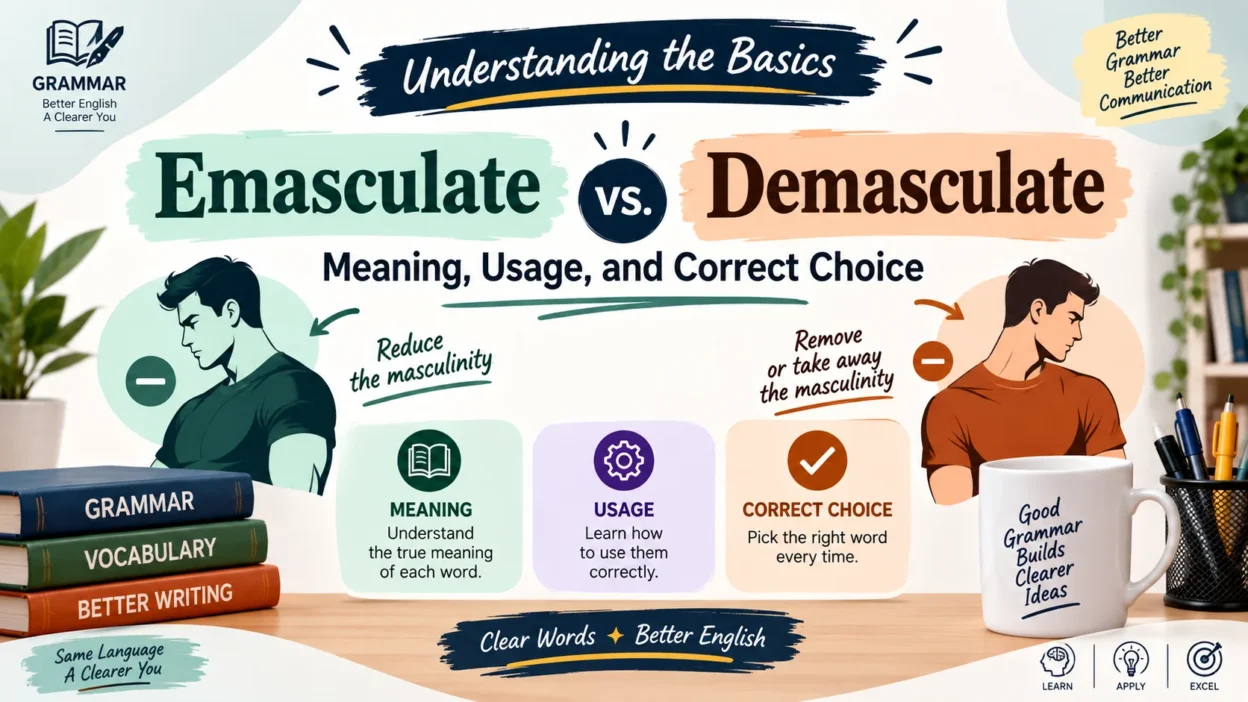
Emasculate vs. Demasculate can confuse even experienced writers because the two terms have similar forms, spelling, and a logical de- prefix that makes demasculate seem like a natural reverse of emasculate; however, standard English makes a clear distinction between them, as emasculate is an established, widely accepted, and familiar verb, while demasculate is rare, less common, and generally nonstandard in modern usage. Major dictionaries such as Oxford, Cambridge, and Merriam-Webster support the established status of emasculate, whose historical roots reach back to Latin and whose first known English use dates to 1607.
The meaning of emasculate can be literal, referring to removing or depriving someone of male genitals, masculine qualities, or vigour, or figurative, describing the weakening of power, force, authority, confidence, or effectiveness. In real examples, sentences, and everyday writing, context helps determine whether the word describes a physical act or an emotional, social, or psychological effect. Demasculate may look understandable because of its formation, but its appearance doesn’t make it an officially recognised or mainstream choice.
From my experience with English, this small difference can easily confuse native speakers when they search for a definition, compare terms, or use auto-correct tools. For academic writing, professional writing, casual conversation, online discussions, and workplace communication, the safest rule is simple: choose emasculate when you mean to strip away masculine traits, identity, power, confidence, or vigour. Careful wording, proper usage, semantic nuance, contextual awareness, and linguistic precision improve clarity, accuracy, correctness, and effective expression, while helping you avoid confusion, strengthen understanding, and maintain a professional tone.
Quick Answer: Emasculate vs. Demasculate
Emasculate is the standard and much more established choice. It can mean to deprive someone of masculine qualities or confidence, to castrate, or to weaken something’s strength or effectiveness. Oxford specifically defines it as making someone or something less powerful or effective and also describes its use for making a man feel that he has lost his male role or qualities.
Demasculate has a more transparent-looking construction. A reader can easily interpret it as “remove masculinity.” However, it isn’t the normal choice in general modern English.
| Word | Main meaning | Usage status | General recommendation |
| Emasculate | Weaken, deprive of masculine qualities, or castrate | Established English word | Use it |
| Demasculate | Remove masculinity | Uncommon/rare formation | Usually avoid |
| Weaken | Make less strong or effective | Common | Use when gender isn’t relevant |
| Undermine | Gradually weaken confidence, authority, or effectiveness | Common | Often useful as an alternative |
So, if you’re writing an email, article, essay, report, or professional document, emasculate is normally the better choice when its meaning fits.
What Does “Emasculate” Mean?
Emasculate is a formal verb with several related meanings. Its central idea is removing strength, masculine qualities, or effectiveness.
Merriam-Webster gives three major senses: depriving something of strength or vigor, depriving a male of reproductive power, and removing the male reproductive parts of a flower during artificial cross-pollination.
That range is broader than many people realize.
Emasculate Can Mean “Weaken”
In figurative English, emasculate can mean to make something less powerful or effective.
For example:
- The amendments emasculated the bill.
- Budget cuts emasculated the program.
- The revisions emasculated the committee’s authority.
- Excessive restrictions emasculated the policy.
Here, the word has nothing to do with a man’s physical body. It describes the loss of force, authority, effectiveness, or practical power.
Cambridge gives the same modern figurative sense, describing emasculate as reducing the effectiveness of something. Its examples include recommendations and institutional powers.
Emasculate Can Refer to Masculinity
The word can also describe a man who feels that his power, confidence, independence, or sense of masculine identity has been undermined.
For example:
He felt emasculated after losing control over the project he had led for years.
The sentence doesn’t necessarily mean that anyone literally removed his masculinity. It describes an emotional or social experience.
Oxford similarly gives the example of someone feeling emasculated because of another person’s dominance.
Emasculate Has a Literal Biological Meaning
The word also has a literal biological sense.
In people or animals, emasculate can mean to castrate or remove reproductive capability. In botany, it can refer to removing the male parts of a flower during controlled cross-pollination. Merriam-Webster and Cambridge both document these specialized meanings.
That means the word isn’t merely an insult or metaphor. It has technical uses as well.
The Different Uses of “Emasculate”
Understanding the context makes the word much easier to use correctly.
Personal or Social Context
When applied to a person, emasculate often relates to confidence, authority, independence, or perceived masculinity.
Example:
Being constantly corrected in front of his team made him feel emasculated.
The important idea isn’t simply embarrassment. The sentence suggests that the person’s sense of authority or masculine confidence has been damaged.
Workplace Context
You can also use emasculate when someone’s authority has been reduced.
Example:
Removing her decision-making powers effectively emasculated her role as director.
Here, emasculated means weakened or stripped of practical authority.
Political and Legal Context
This use is especially important because it proves that emasculate isn’t limited to men.
Example:
The final amendments emasculated the legislation by removing its strongest enforcement measures.
The legislation hasn’t become “less masculine.” Its effectiveness has been weakened.
Merriam-Webster even gives a legal definition involving depriving a law or judicial opinion of force or effectiveness.
Academic and Professional Writing
The word can describe recommendations, reports, institutions, policies, and arguments.
Example:
Several revisions emasculated the original proposal.
That means the revisions reduced its force or effectiveness.
Cambridge’s usage examples similarly show emasculate being applied to recommendations, policies, institutional powers, and other nonhuman subjects.
What Does “Demasculate” Mean?
Demasculate is much less common than emasculate, but the construction is understandable.
Its apparent meaning is straightforward: to remove masculinity from someone or something.
The problem isn’t that a reader cannot understand it. The problem is that English speakers generally don’t reach for demasculate when they need this idea.
That’s an important distinction.
A word can be logically constructed and understandable without being the conventional word most writers should use.
Why “Demasculate” Looks So Logical
The spelling seems to follow a familiar English pattern:
de- + masculine → demasculate
The prefix de- often suggests removal, reversal, reduction, or separation.
Consider words such as:
- deactivate
- devalue
- defrost
- deconstruct
- dehumanize
- decentralize
Because of these patterns, a writer may reasonably think:
“If emasculate means removing masculinity, why isn’t demasculate the obvious form?”
That’s a fair question.
English, however, isn’t an engineering system where every new word follows the same formula. Historical vocabulary often develops along older paths, and speakers inherit those forms rather than rebuilding them from scratch.
Why English Uses “Emasculate”
The answer becomes clearer when you look at the word’s history.
Emasculate comes from Latin emasculatus, the past participle of emasculare, from e- or ex- meaning “out” or “away” and masculus, meaning “male.” Merriam-Webster gives 1607 as the first known English use.
Oxford likewise traces the word to the early 17th century and Latin emasculat- meaning “castrated.”
So the modern spelling isn’t a newly invented way of attaching a prefix to masculate. It comes from an older Latin-derived form that English adopted.
That’s why the word doesn’t need to look exactly like a modern English construction.
A Useful Language Lesson
This is one of those cases where etymology beats visual logic.
A modern speaker sees:
de- + masculine
and expects:
demasculate
English history gives us:
emasculate
The older form won. Once a word becomes established through centuries of use, speakers don’t normally replace it simply because another construction looks more logical.
Emasculate vs. Demasculate: The Real Difference
The difference isn’t simply “one is right and one is wrong.”
It’s more useful to compare meaning, familiarity, range, and conventional usage.
| Feature | Emasculate | Demasculate |
| Established in English | Yes | Much less established |
| Commonly recognized | Yes | No |
| Can describe masculinity | Yes | Yes, in its intended sense |
| Can mean “weaken” | Yes | Not normally its established broad sense |
| Can describe laws or policies | Yes | Not normally |
| Has biological usage | Yes | Not the usual technical term |
| Appropriate for professional writing | Yes, when appropriate | Usually not |
| Best general choice | Yes | Usually no |
The biggest practical difference is conventionality.
When readers encounter emasculate, they know what the writer means. When they encounter demasculate, they may pause and wonder whether the writer has made a mistake.
In polished writing, that pause is often unnecessary friction.
Why “Demasculate” Seems Correct
The temptation comes from English word formation.
The Prefix “De-” Encourages the Mistake
English uses de- productively in many words associated with removal or reversal.
So if someone knows that masculine relates to male qualities, demasculate feels almost inevitable.
But vocabulary isn’t built entirely through modern logic.
Words have histories.
“Emasculate” Looks Less Transparent
At first glance, emasculate doesn’t clearly reveal its Latin origin to a modern English speaker.
That’s part of the confusion. Someone who hasn’t encountered the word before may assume that it should have been built from masculine in a more obvious way.
Yet its established history goes back to Latin rather than to a recent English coinage.
Familiarity Matters
Imagine two sentences:
The policy was emasculated by the amendments.
The policy was demasculated by the amendments.
The first sounds natural because emasculate has a recognized figurative meaning involving reduced force or effectiveness. Cambridge and Merriam-Webster both document this use.
The second sounds strange because demasculate isn’t the conventional verb for weakening a policy.
The difference is not just spelling. It’s established meaning and usage.
Common Mistakes With Emasculate and Demasculate
A common mistake is using demasculate when emasculate is the correct and widely accepted word for describing the loss of strength, confidence, or masculinity.
Mistake: Assuming “Demasculate” Must Be Correct
A writer may reason that de- means removal and therefore choose demasculate.
That logic makes sense internally, but English usage doesn’t work that neatly.
Better:
The experience emasculated him.
Not:
The experience demasculated him.
Mistake: Saying “Demasculate” Is Completely Impossible
This claim goes too far.
The better explanation is that demasculate is an uncommon formation, not that the sequence of letters is inherently impossible.
That distinction keeps the discussion accurate.
Mistake: Using “Emasculate” for Every Kind of Weakening
Although emasculate can mean “weaken,” it isn’t always the best word.
Compare:
The changes emasculated the law.
with:
The changes weakened the law.
The second sentence is simpler and more neutral.
If masculinity isn’t relevant to your point, weaken may be the cleaner choice.
Mistake: Treating “Emasculate” as a Synonym for “Humiliate”
The words can overlap, but they’re not identical.
Humiliate focuses on causing someone to feel ashamed or degraded.
Emasculate focuses more specifically on removing perceived masculine power, confidence, authority, or effectiveness.
That difference can matter.
Real-Life Examples of “Emasculate”
The easiest way to understand the word is to see how its meaning changes with context.
Example 1: Personal Confidence
Losing his job made him feel emasculated.
The meaning centers on his confidence and sense of masculine identity.
Example 2: Authority
The board’s decision emasculated the new director.
Here, the director’s authority has been significantly reduced.
Example 3: Legislation
The final amendment emasculated the bill.
The bill’s practical force has been weakened.
Example 4: Institutional Power
The funding cuts emasculated the agency.
The agency still exists, but it has lost much of its ability to act.
Example 5: Scientific Context
Researchers emasculated the flowers before controlled pollination.
Here, the word has a specialized botanical meaning involving removal of the male reproductive parts of a flower.
Notice how dramatically the context changes. That’s why memorizing a single definition isn’t enough.
Case Study: Why Context Changes the Meaning
Consider this sentence:
The reforms emasculated the organization.
A reader won’t normally interpret this literally. An organization doesn’t have biological sex characteristics in the ordinary sense.
Instead, emasculated means the organization has lost power, authority, or effectiveness.
Now compare:
He felt emasculated after his authority was taken away.
Here, the word describes a person’s emotional response to losing power or confidence.
The same verb connects both sentences through the idea of loss of strength or power, but the context determines exactly what has been lost.
That’s the real key to mastering this word.
Better Alternatives to “Emasculate” and “Demasculate”
Sometimes the best solution isn’t choosing between the two forms. It’s choosing a clearer word.
When You Mean “Make Less Powerful”
Use:
- weaken
- undermine
- diminish
- reduce
- limit
- cripple
- strip of authority
For example:
The amendments weakened the legislation.
This is often clearer than:
The amendments emasculated the legislation.
Both can work, but the first is more direct.
When You Mean “Damage Someone’s Confidence”
Consider:
- undermine
- discourage
- humiliate
- disempower
- make someone feel inadequate
- damage someone’s confidence
For example:
Constant criticism undermined his confidence.
That may communicate the idea more precisely than emasculated him, especially when masculinity isn’t actually part of the discussion.
When You Specifically Mean Loss of Masculine Confidence
In that case, emasculate can be exactly the right word.
He felt emasculated when he could no longer provide for his family.
The word conveys more than ordinary disappointment. It suggests that the situation affected his sense of masculine identity or role.
Is “Emasculate” Offensive?
Not inherently. However, emasculate can carry a sensitive gender-related implication when applied to a person.
The word is built around a traditional connection between masculinity and strength. As a result, calling someone emasculated can imply that being less powerful makes a man “less of a man.”
That implication isn’t always intended.
For this reason, context matters.
If the point is simply that someone lost confidence, undermined his confidence may be more neutral.
If the point is specifically that someone experienced a loss of masculine identity or power, emasculated may communicate that nuance more accurately.
Historical and Modern Usage of “Emasculate”
The word has a long history in English. Merriam-Webster records its first known English use as 1607, while its etymology leads back to Latin emasculare.
Its modern meanings have expanded beyond the literal sense.
Today, you can encounter emasculate in:
- political commentary
- legal writing
- academic prose
- journalism
- literature
- workplace discussions
- psychology-related discussions
- biology
Cambridge’s corpus examples show the word being used for policies, institutional powers, recommendations, and masculine identity.
This broad usage is one reason emasculate remains useful even though it’s a relatively formal word.
Pronunciation and Word Forms
In US English, emasculate is pronounced approximately:
ih-MASS-kyuh-late
Its principal forms are:
| Form | Example |
| emasculate | They may emasculate the proposal. |
| emasculates | The rule emasculates the agency. |
| emasculated | The reforms emasculated the institution. |
| emasculating | The experience was emasculating. |
| emasculation | The policy led to the emasculation of the agency. |
Merriam-Webster gives the US pronunciation as /i-ˈma-skyə-ˌlāt/ and lists emasculation and emasculator as related forms.
When Should You Choose “Emasculate”?
Choose emasculate when:
- You mean to remove masculine strength or qualities.
- You mean to make someone feel less masculine or powerful.
- You mean to weaken the force or effectiveness of something.
- You’re discussing a recognized biological meaning.
- You’re writing in a formal context where the word’s precise nuance is useful.
For example:
The restrictions emasculated the commission, leaving it without meaningful enforcement power.
That’s a natural figurative use.
When Should You Avoid “Demasculate”?
Avoid demasculate in ordinary professional or academic writing unless you have a specific reason to use the uncommon form.
A reader may understand it, but understanding isn’t the same thing as recognizing a conventional word.
If you want your sentence to sound natural and established, emasculate is the safer choice.
And if you simply mean “weaken,” don’t force either word into the sentence.
Use weaken.
Simple often wins.
Emasculate vs. Demasculate: Quick Decision Guide
Use this guide when you’re editing a sentence.
| What you want to say | Best word |
| Make someone feel less masculine | Emasculate |
| Remove masculine qualities | Emasculate |
| Make someone feel less powerful | Emasculate or disempower, depending on context |
| Reduce the effectiveness of a law | Emasculate or weaken |
| Reduce the authority of an institution | Emasculate or undermine |
| Make something less strong | Weaken |
| Damage someone’s confidence | Undermine |
| Cause someone shame | Humiliate |
| Remove masculinity using an uncommon formation | Demasculate, but expect it to sound unusual |
Conclusion
The difference between emasculate and demasculate becomes much easier once you focus on standard English usage. Emasculate is the established and widely accepted word, while demasculate is uncommon and generally considered nonstandard. Whether you’re discussing masculinity, power, confidence, or a figurative sense of being weakened, emasculate is the safer and more precise choice.
FAQs
Q1. Is “emasculate” the correct word?
Yes. Emasculate is the established standard English word and can be used in both literal and figurative contexts.
Q2. Is “demasculate” a real word?
Demasculate can be encountered occasionally, but it’s far less common and generally isn’t the preferred word in standard English.
Q3. What does “emasculate” mean?
Emasculate can mean to deprive someone of male reproductive organs or, figuratively, to make someone feel weaker, less powerful, or less confident.
Q4. Why do people confuse “emasculate” and “demasculate”?
The confusion comes mainly from their similar spelling and the DE- prefix in demasculate, which can make the word appear logically related to emasculate.
Q5. Should I use “emasculate” or “demasculate” in formal writing?
Use emasculate. It’s the established and broadly accepted choice for formal writing, academic writing, professional communication, and everyday English.