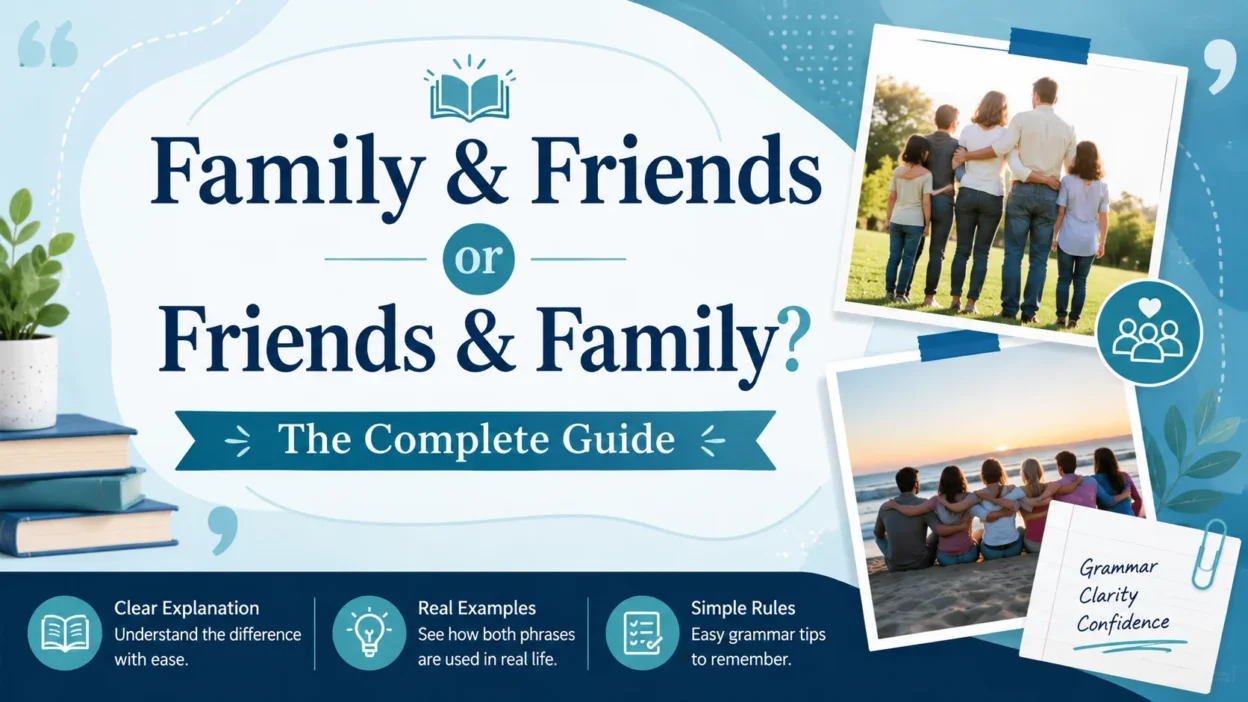
Family & Friends or Friends & Family depends on word order, context, tone, and the purpose of your English grammar choice. When choosing between these two groups of people, the order can change the emphasis and rhythm of a sentence, even though neither phrase is grammatically wrong. A natural choice works best when the audience and purpose match the writing, whether you’re preparing a polished invitation, speech, social media post, announcement, greeting, professional message, or thank-you message. The phrase, choice, and version can affect how the wording sounds, while language, distinction, and grammar help explain how each arrangement allows you to guide attention. The number 2, or two, simply represents the two sides: Family and Friends.
Choosing between Family and Friends can also reflect history, culture, patterns, and emotional weight in everyday usage. A simple phrase can be used by both groups, but thinking twice about the wording can help you make the right choice. This guide brings everything together so you know clearly and practically how the examples apply right away. The expression describes a relationship within social language, while a comparison explains the difference between Family And Friends and Friends And Family, two commonly used word orders in everyday speech and writing. Their phrases, words, and arrangement can affect natural usage, understanding, clarity, fluency, and confidence in both spoken English and written English.
In practice, Family, friends, Family & Friends, and Friends & Family are interchangeable English phrases for people closest to us, including loved ones, a chosen circle, and blood relatives. Still, word order has emotional power because placing one group before the other can signal priorities, establish the tone of a message, and shape how an audience feels before they read further. Both forms remain grammatically correct, but they can serve a different purpose depending on context, culture, and communication style. The best version fits the situation and feels intentional, rather than combined without thought. The relatives, English, phrases, order, emotional power, and signals work together as the wording sets and shapes the meaning of each word, while purpose determines what sounds most appropriate and knowing this distinction makes every expression more intentional.
Family & Friends or Friends & Family: Quick Answer
Both “Family & Friends” and “Friends & Family” are grammatically correct. English doesn’t have a rule that requires family to come before friends or vice versa.
In ordinary prose, however, “family and friends” is a very familiar expression. “Friends and family” is equally understandable and common, especially when the writer wants to place friends first.
Here’s the simplest way to choose:
| Situation | Best choice |
| Standard sentence | family and friends |
| Traditional invitation | family and friends |
| Heading or graphic | Family & Friends |
| Friends deserve first emphasis | Friends & Family |
| Casual social media post | Either |
| Formal prose | family and friends |
| Friendship-centered event | friends and family |
One important style point also matters: in normal prose, write “and” rather than “&.” Major style guides generally treat the ampersand as a special typographic symbol rather than the default replacement for and in running text.
Family & Friends or Friends & Family: Is There a Correct Order?
There isn’t a fixed grammatical hierarchy between the two nouns.
In family and friends, family and friends are coordinated nouns joined by and. In friends and family, the same grammatical relationship exists with the order reversed.
Consider these sentences:
- I invited my family and friends.
- I invited my friends and family.
Both are grammatically sound. Both tell the reader that the speaker invited relatives and friends.
The difference is mostly one of ordering and emphasis.
Think of the phrase like two people standing side by side. Whoever you mention first may receive slightly more attention. That doesn’t mean the second person matters less. It simply means the speaker chose a particular order.
Family & Friends: The More Traditional-Sounding Order
Family and friends often feels familiar because people frequently use family as the first category when discussing close personal relationships.
You’ll encounter it in:
- Thank-you messages
- Wedding speeches
- Holiday greetings
- Personal announcements
- Memorial messages
- Graduation speeches
- Community communications
- Everyday conversation
For example:
“I’d like to thank my family and friends for supporting me.”
The sentence sounds natural because the expression is deeply familiar to English speakers.
Friends & Family: A Natural Alternative
Friends and family works just as well grammatically.
For example:
“We’d love for our friends and family to join us.”
Here, friends simply comes first. The sentence doesn’t suggest that family has become less important.
Sometimes the writer wants to foreground friendship. Sometimes the phrase simply fits the rhythm of the surrounding sentence better.
Why Do People Commonly Say “Family & Friends”?
The popularity of family and friends has several practical explanations.
Family Traditionally Comes First
In many social contexts, people instinctively place family before other relationship groups.
That convention doesn’t come from an English grammar rule. Instead, it reflects a common way of organizing social relationships in speech.
When someone says:
“I spent the weekend with family and friends.”
the listener immediately understands the broad group being discussed.
The order feels familiar because you’ve probably encountered similar wording many times.
Familiar Phrases Become Easier to Process
Language isn’t built entirely from grammar rules. Speakers also rely heavily on familiar combinations of words.
Once a particular sequence becomes common, it can feel smoother simply because you’ve heard it repeatedly.
That’s why family and friends can sound almost automatic to some speakers.
The reverse isn’t wrong. It may simply feel less expected in a particular sentence.
Emotional Context Can Reinforce the Pattern
Family often appears first when people talk about major personal events.
Consider:
- “My family and friends supported me.”
- “I want to thank my family and friends.”
- “We shared the news with family and friends.”
These sentences place family first without making any explicit statement about its importance.
The wording has become a comfortable convention.
Why Do Some People Prefer “Friends & Family”?
The reverse order has its own logic.
Friends Can Become Chosen Family
Modern relationships don’t always fit neatly into traditional categories.
A close friend may have supported you through a difficult period. Another friend may have lived with you for years. Someone else may know your life better than many relatives do.
In those situations, friends and family can feel especially natural.
The phrase can acknowledge that friendship is not merely a secondary relationship category.
The Audience May Be Mostly Friends
Context can make the choice obvious.
Imagine a community organizer inviting people to a neighborhood gathering:
“We welcome all our friends and family to this year’s picnic.”
If the event was organized primarily around a friendship network, putting friends first may feel appropriate.
Likewise, a person speaking to a large group of friends might naturally say:
“Thank you to all my friends and family for being here.”
The first word can reflect the immediate audience.
Rhythm Can Influence the Choice
Say both phrases aloud:
Family and friends.
Friends and family.
They have different rhythms.
English speakers often make choices based partly on how a phrase sounds within a complete sentence. A writer may choose friends and family because it flows better with the words that follow it.
That doesn’t turn rhythm into a grammar rule. It simply shows how spoken language influences writing.
Does English Grammar Decide the Order?
No.
English grammar doesn’t require family to appear before friends.
Both phrases use coordination:
family + and + friends
friends + and + family
The conjunction and connect two equivalent noun phrases. Reversing them doesn’t violate the basic grammatical structure.
Importance Hierarchy Isn’t a Grammar Rule
You may hear the idea that speakers put the most important person or group first.
That can happen. However, it’s better understood as a stylistic tendency rather than a grammatical requirement.
For example:
“Family and friends helped me through the year.”
This may suggest that family comes first in the speaker’s mind.
But:
“Friends and family helped me through the year.”
doesn’t mean that friends are objectively more important.
The writer may simply prefer the rhythm.
Word Order Can Add Emphasis
Although the basic meaning stays the same, the first noun can receive subtle emphasis.
Compare:
“Our family and friends are invited.”
with:
“Our friends and family are invited.”
The difference is small. Still, the second sentence makes friends the first relationship category the reader encounters.
That distinction can matter when you’re deliberately shaping tone.
Family & Friends vs. Friends & Family in Different Contexts
The best choice often depends on where the phrase appears.
Personal Messages
In a personal message, either version works.
Examples:
“I’m grateful for my family and friends.”
“I’m lucky to have such wonderful friends and family.”
Both sound natural.
The first feels slightly more traditional. The second can feel more conversational depending on the surrounding wording.
Invitations
Both can work on an invitation.
For example:
Family & Friends
Please join us for an evening of celebration.
Or:
Friends & Family
Come celebrate with us this Saturday.
Here, the ampersand works especially well because the phrase functions as a display heading.
Speeches
In a speech, the full word and often sounds more natural:
“Friends and family, thank you for being here tonight.”
This is a particularly familiar opening.
You could also say:
“Family and friends, thank you for joining us.”
Neither is grammatically incorrect.
Social Media
Social media gives you considerable stylistic freedom.
You might write:
“So grateful to spend another year surrounded by family and friends.”
Or:
“Nothing beats a weekend with friends and family.”
The choice can depend entirely on the tone of the post.
Professional Communication
Professional writing requires a little more care.
A workplace announcement might say:
“Employees may invite family and friends to the event.”
That’s clear and straightforward.
If the phrase appears in a formal sentence, and is usually preferable to &.
Family & Friends vs. Friends & Family in American English
In American English, both expressions are widely understood.
Family and friends has a strongly familiar, traditional feel. You’ll often see it in personal writing and references to support networks.
Friends and family is also completely natural. It may feel more conversational in some sentences.
For American readers, neither order should cause confusion.
The important distinction is between word order and punctuation style.
The order can change:
- Family and friends
- Friends and family
The grammatical relationship remains the same.
The punctuation can also change:
- Family and friends
- Family & Friends
Those aren’t quite the same stylistic choice.
Family & Friends vs. Friends & Family in British, Canadian, Australian, and New Zealand English
The basic grammatical principle remains the same across major varieties of English.
British, Canadian, Australian, and New Zealand readers understand both family and friends and friends and family.
Regional preferences can exist in particular communities or contexts. However, it would be misleading to claim that one entire English-speaking country has a strict rule requiring one order.
In all of these varieties, context and personal preference matter.
So if you’re writing for an international English-speaking audience, either phrase is generally safe.
Family and Friends vs. Family & Friends
This distinction deserves special attention.
The words and and & perform the same basic joining function. Their stylistic roles differ.
Use “and” in Standard Prose
For ordinary sentences, spell out and:
“We invited our family and friends.”
“She thanked her family and friends.”
“The celebration brought together friends and family.”
This is the cleanest choice for articles, essays, emails, reports, and most professional writing.
Use “&” for Headings and Design
The ampersand can work beautifully in visual contexts:
Family & Friends
Friends & Family Weekend
Family & Friends Celebration
It takes up less space and creates a compact visual unit.
The symbol often fits naturally into:
- Event titles
- Posters
- Invitations
- Logos
- Graphic headings
- Social media artwork
- Business names
Style guidance from the Chicago Manual of Style and MLA also distinguishes the ampersand’s specialized uses from ordinary prose.
Common Mistakes With Family & Friends and Friends & Family
Mistake 1: Assuming Only One Order Is Correct
This is the biggest misconception.
There is no grammatical rule that makes family and friends correct while making friends and family incorrect.
Both are acceptable.
Mistake 2: Treating the Phrase as a Fixed Idiom
Although family and friends is a familiar expression, its word order isn’t permanently fixed.
English contains many conventional pairings that speakers can reverse when context calls for it.
Mistake 3: Using “&” Everywhere
The ampersand looks neat. That doesn’t mean it belongs in every sentence.
Prefer:
“We appreciate our family and friends.”
over:
“We appreciate our family & friends.”
The first version fits standard prose better.
Mistake 4: Overthinking the Emotional Hierarchy
Choosing friends and family doesn’t mean you value friends more.
Likewise, choosing family and friends doesn’t prove that family matters more.
Don’t turn a small stylistic choice into a declaration of personal priorities.
Mistake 5: Ignoring the Audience
A wedding invitation, a company announcement, and an Instagram caption don’t necessarily need identical wording.
Good writing responds to its setting.
Family & Friends vs. Friends & Family: Side-by-Side Comparison
| Feature | Family & Friends | Friends & Family |
| Grammatically correct | Yes | Yes |
| Basic meaning | Family and friends | Friends and family |
| Family emphasized first | Yes | No |
| Friends emphasized first | No | Yes |
| Conventional feel | Very familiar | Very familiar |
| Good for headings | Yes | Yes |
| Good for standard prose | Better as “family and friends” | Better as “friends and family” |
| Good for invitations | Yes | Yes |
| Good for social media | Yes | Yes |
| Formality | Depends on context | Depends on context |
| Meaning substantially changes | No | No |
How the Word Order Changes the Tone
A tiny change can produce a subtle tonal shift.
Family & Friends: Warm and Conventional
Family and friends often carry a familiar and traditional tone.
For example:
“Thank you to my family and friends for making this possible.”
The phrase works naturally in emotional and ceremonial writing.
Friends & Family: More Friendship-Centered
Friends and family can put slightly more attention on friendship.
For example:
“We’re excited to welcome friends and family to our new home.”
The phrase feels relaxed and inclusive.
The Difference Is Subtle
Don’t exaggerate the distinction.
The two phrases don’t represent two completely different meanings. They describe essentially the same broad group.
The order changes emphasis more than meaning.
Practical Examples of Family & Friends and Friends & Family
Examples show how “Family & Friends” and “Friends & Family” can be used naturally in everyday sentences and different contexts.
Example 1: Thank-You Message
Natural:
“Thank you to my family and friends for supporting me.”
Also correct:
“Thank you to my friends and family for supporting me.”
Example 2: Wedding Invitation
Heading:
Family & Friends
Sentence:
“We invite our family and friends to celebrate with us.”
The heading benefits from the compact ampersand. The sentence reads naturally with the spelled-out conjunction.
Example 3: Community Event
“Friends and family are welcome to attend the neighborhood picnic.”
Putting friends first works because the event has a broad social and community focus.
Example 4: Personal Reflection
“My family and friends have shaped who I am.”
Here, family and friends sounds especially natural because the phrase introduces a familiar pair of close relationships.
Case Study: How Order Changes Tone
Imagine someone is creating an invitation for a retirement celebration.
The organizer has two options.
Option A: Family & Friends
Family & Friends
Please join us as we celebrate John’s retirement.
This version feels traditional and familiar. It works particularly well if the event has a ceremonial or family-oriented atmosphere.
Option B: Friends & Family
Friends & Family
Please join us as we celebrate John’s retirement.
This version remains completely correct. It gives friends a little more prominence and may feel slightly more casual.
Result
Neither version is grammatically superior.
The decision comes down to tone, audience, and emphasis.
If the organizer wants the most conventional wording, Family & Friends is a safe choice.
If the celebration centers heavily on John’s social circle, Friends & Family may fit better.
That’s the practical lesson: choose the order that serves the message.
Real-World Style Tip: Don’t Confuse Grammar With Convention
One of the easiest ways to get stuck on this question is to treat every common phrase as if English grammar had permanently frozen its word order.
It hasn’t.
English speakers routinely make stylistic choices based on:
- Familiarity
- Rhythm
- Context
- Audience
- Emphasis
- Tradition
- Visual presentation
That’s why both family and friends and friends and family can coexist without one being a grammatical error.
Frequency can make one expression feel more natural to you. It doesn’t automatically make the alternative wrong.
Practical Alternatives to Family & Friends
Sometimes you don’t need either phrase.
Loved Ones
“We’re grateful to have our loved ones with us.”
This is warm and inclusive.
Family Members and Friends
“The event is open to family members and friends.”
This sounds clear and straightforward.
Friends, Family, and Loved Ones
“We invite friends, family, and loved ones to join us.”
This option broadens the group while keeping the wording explicit.
Nearest and Dearest
“We’re celebrating with our nearest and dearest.”
This has a warmer and more expressive tone. It works best in personal or informal contexts.
Which Phrase Should You Choose?
Use this quick guide:
- Want the familiar traditional expression? Choose family and friends.
- Want friends to receive first emphasis? Choose friends and family.
- Writing ordinary prose? Spell out and.
- Creating a heading or invitation design? Family & Friends or Friends & Family can work.
- Writing a formal sentence? Prefer family and friends or friends and family with the full word and.
- Writing a social media caption? Either version works.
- Unsure which sounds better? Read the complete sentence aloud and choose the version with the smoother rhythm.
Conclusion
Choosing between Family & Friends and Friends & Family usually comes down to context, tone, and personal choice rather than grammar. Both phrases are grammatically correct and clearly refer to the people who matter to you. In everyday English, either version can sound natural, whether you’re writing an invitation, greeting, speech, or social media message. When in doubt, choose the order that feels most natural for your audience and the purpose of your message.
FAQs
Q1. Is “Family & Friends” grammatically correct?
Yes. Family & Friends is grammatically correct and commonly used in invitations, announcements, greetings, and everyday writing.
Q2. Is “Friends & Family” correct?
Yes. Friends & Family is also grammatically correct. It has the same basic meaning, but the different word order may slightly change the emphasis or tone.
Q3. Which is more common, “Family & Friends” or “Friends & Family”?
Both expressions are widely used. Family & Friends is especially common when family is mentioned first, while Friends & Family is equally natural in many social and informal contexts.
Q4. Does the word order change the meaning?
Usually, no. Both phrases refer to family members and friends. However, word order can create a small difference in emphasis, depending on the context and what the writer wants to highlight.
Q5. Should I use “Family & Friends” or “Friends & Family”?
Use whichever sounds more natural for your specific context. For formal writing, consistency and clarity matter more than choosing one phrase over the other.