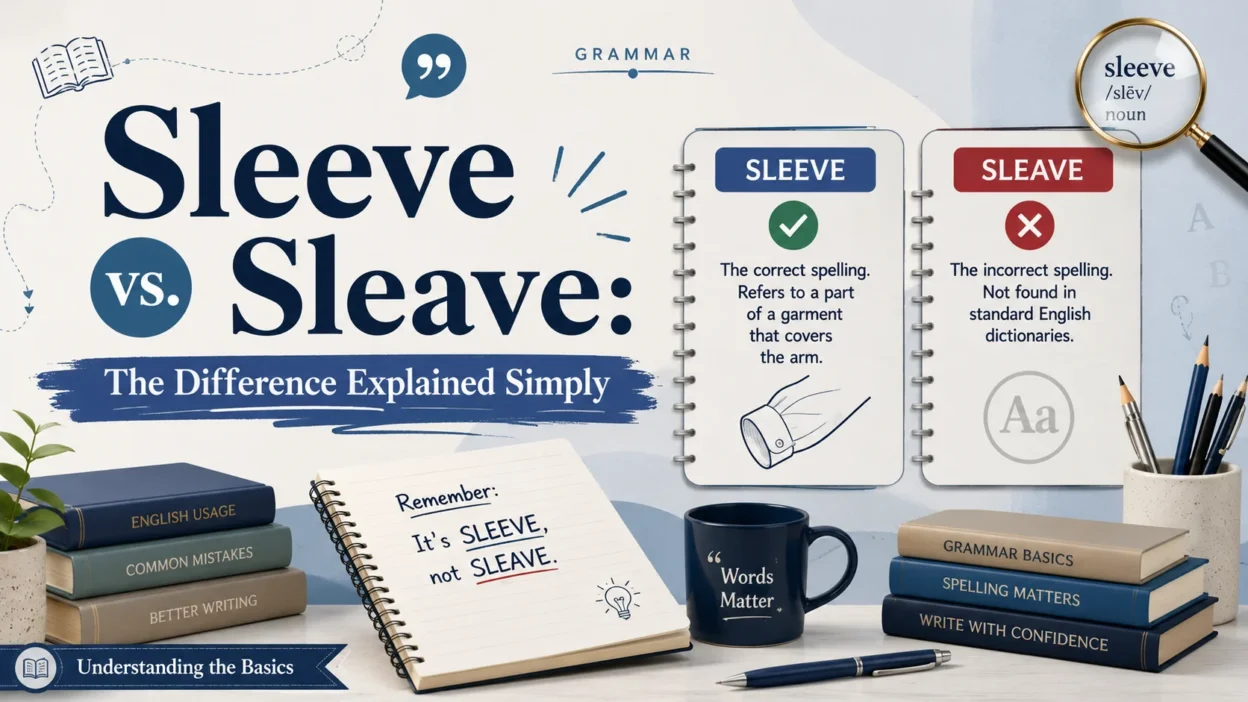
Sleeve vs Sleave can confuse you because the two words look similar, yet they have different meanings in modern English. Sleeve is the correct term for clothing, especially the part of a garment that covers the arm. You may pull down a sleeve on a shirt or adjust it when it feels too short. Sleave, however, is a rare word linked to silk, silk fibres, untwisted silk fibres, and thread in historical textile language.
The difference comes down to more than one letter. These are two words with different uses, even though their spelling looks similar. When you check an older text, sleave may seem like an incorrect spelling or typo, especially if you’ve only heard the common term sleeve. Yet its dictionary meanings show a distinct place in older English and historical vocabulary. In everyday clothing contexts, sleeve is common, while sleeve belongs mainly to specialised or old-fashioned usage.
The context therefore matters. If she says her sleeve is too long, there’s no real spelling question. If an old passage discusses silk or textile work, sleave can be a legitimate word rather than a spelling mistake. That distinction helps you avoid an awkward spelling mistake while making sense of an original historical term.
Quick Answer: Sleeve vs. Sleave
Sleeve is the standard modern word for the part of a garment that covers the arm. It can also describe a covering, casing, or tube-like component around another object.
Sleave is a rare historical word associated especially with silk thread or loosely twisted thread. It can also appear as an obsolete verb in historical sources.
So, if you’re writing about a shirt, jacket, coat, or dress, use sleeves.
If you’re reading a historical passage involving textiles, silk, or thread, sleeve may be the intended word.
Easy Memory Trick
Think of it this way:
- Sleeve = clothing or covering
- Sleave = historical textile terminology
- Shirt → sleeve
- Old textile reference → possibly sleave
A useful rule is simple: If you mean the part of a shirt that covers your arm, never write “sleave.”
What Does “Sleeve” Mean?
The noun sleeve has been part of English for centuries, and its modern uses extend beyond clothing. Its most familiar meaning describes the section of a garment designed to cover all or part of the arm.
You might wear a shirt with short sleeves, a sweater with long sleeves, or a jacket with rolled-up sleeves. These are ordinary uses that you’ll encounter constantly in modern English.
Sleeve as a Clothing Term
In clothing, a sleeve is the portion of a garment that covers the arm. Its design can vary considerably depending on the garment and fashion style.
For example:
- Long sleeve: Covers most or all of the arm.
- Short sleeve: Ends around the upper or middle arm.
- Three-quarter sleeve: Falls between the elbow and wrist.
- Bell sleeve: Flares outward toward the bottom.
- Puff sleeve: Has a fuller, gathered shape.
- Raglan sleeve: Extends in one piece toward the neckline.
- Sleeveless: Describes a garment without sleeves.
The word also appears in common clothing phrases such as shirt sleeve, coat sleeve, dress sleeve, and sleeve length.
Sleeve as a Covering or Tube
The meaning of sleeve isn’t limited to clothing.
English also uses the word for something that covers, surrounds, protects, or fits around another object. This sense develops naturally from the basic idea of a sleeve enclosing an arm.
For example, you might encounter:
- A protective sleeve for a document
- A cable sleeve used to organize or protect wires
- A sleeve bearing in mechanical contexts
- A record sleeve that holds a vinyl record
- A card sleeve that protects a playing card
The exact meaning depends on the field, but the underlying idea remains similar: a sleeve surrounds or holds something.
Common Expressions With “Sleeve”
The word sleeve also appears in several familiar idioms.
“Up your sleeve” means having a hidden plan, idea, or resource that you can use when needed.
She probably has another trick up her sleeve.
“Roll up your sleeves” literally means to push your sleeves upward. Figuratively, it means to prepare to work hard.
We have a lot to finish, so let’s roll up our sleeves.
These expressions make sleeves even more common in everyday English.
What Does “Sleave” Mean?
Now we reach the word that causes the real confusion.
Sleave is a genuine English word, but it belongs to a much narrower vocabulary. Historical dictionaries record sleeves in connection with silk thread and loosely twisted thread. It also appears in older textile contexts.
That means you shouldn’t automatically assume that every occurrence of sleave is a spelling error.
The Historical Meaning of “Sleave”
Historically, sleave could refer to silk thread that had not been tightly twisted or otherwise prepared into a finished form. The word belongs to an older vocabulary associated with textile production and thread.
This is important because older English contains many specialized terms that have largely disappeared from ordinary speech.
Modern readers might see sleave and think:
“Someone must have a misspelled sleeve.”
Not necessarily.
If the surrounding passage discusses silk, weaving, thread, spinning, or historical textile work, sleave may be exactly the word the author intended.
“Sleave” in Literature and Older English
You’re far more likely to encounter leave while reading older literature, historical documents, or specialized discussions of textiles than in a modern conversation.
One well-known literary occurrence appears in Shakespeare’s Othello, where “sleave-silk” refers to a form of silk thread.
The word therefore provides a useful reminder about historical vocabulary: a word can be perfectly legitimate without being common in modern conversation.
“Sleave” as a Verb
Historical English also records sleave as a verb. Its older uses relate to working or separating thread, particularly in textile contexts.
This verbal use is now rare or obsolete in ordinary English. You wouldn’t normally use it in a modern email, article, conversation, or workplace report.
Instead, modern writers would usually choose a clearer and more familiar verb such as separate, untwist, prepare, or work, depending on the intended meaning.
Sleeve vs. Sleeve: The Key Differences
The easiest way to understand sleeve vs. sleeve is to compare their meanings, frequency, and contexts.
| Feature | Sleeve | Sleave |
| Modern everyday use | Very common | Very rare |
| Clothing meaning | Yes | No |
| Covering or casing | Yes | No |
| Historical textile meaning | Not the primary sense | Yes |
| Silk/thread terminology | Not normally | Yes |
| Common in conversation | Yes | Rarely |
| Common in modern writing | Yes | Rare |
| Literary/historical appearance | Yes | More likely |
| Alternative spelling of the other word | No | No |
The most important point is that these aren’t interchangeable spellings.
Why Do People Confuse “Sleeve” and “Sleave”?
The confusion is easy to understand. Both words look almost identical, and the difference comes down to a single vowel.
Their Similar Spelling
The sleeve contains -ee-, while the sleeve contains -ea-.
That small visual difference can easily trip up a writer, especially when typing quickly.
Compare:
- sleeve
- sleave
The letters are similar enough that your eyes can glide over the distinction.
Their Similar Pronunciation
The two words can also create uncertainty because unfamiliar historical vocabulary doesn’t always have a pronunciation that modern readers can confidently predict.
Sleeve has a familiar modern pronunciation: /sliːv/.
Sleave, by contrast, is rare enough that many modern speakers have never encountered it in speech. Historical pronunciation can also differ from modern pronunciation, depending on the period and source.
So spelling remains the safest way to distinguish them.
Modern Familiarity vs. Historical Vocabulary
There’s another reason for the confusion: sleeves are highly familiar, while sleeves are obscure.
You might hear sleeves several times in a normal week. You could go years without seeing leave.
That imbalance creates a common trap. When you see leaves, your brain may automatically interpret it as a misspelled version of sleeve.
Context provides the escape hatch.
Is “Sleave” a Misspelling of “Sleeve”?
Sometimes, yes. But not always.
The surrounding words tell you which situation you’re dealing with.
When “Sleave” Is Wrong
If you’re talking about clothing, sleeves are incorrect.
For example:
❌ The dress has beautiful lace sleaves.
✅ The dress has beautiful lace sleeves.
Likewise:
❌ My jacket sleave is too long.
✅ My jacket sleeve is too long.
If the subject involves shirts, jackets, coats, dresses, sweaters, or other garments, sleeve is the word you want.
When “Sleave” Is a Real Word
If you’re discussing historical textiles or older literary language, sleave can be legitimate.
For instance, a historical text might mention sleave-silk. In that context, replacing sleeve with sleeve would change or destroy the original terminology.
This is why blindly correcting unfamiliar words can create mistakes of its own.
A Practical Lesson
Don’t judge an unfamiliar spelling in isolation.
Read the entire sentence. Then look at the surrounding paragraph.
If the text discusses clothing, choose sleeve. If it discusses historical silk or thread, investigate the sleeve before correcting it.
Common Mistakes With Sleeve and Sleave
Most modern mistakes involve using the sleeve where the sleeve belongs.
Using “Sleave” for Clothing
Here are some common errors:
- ❌ short sleaves
- ❌ long sleave shirt
- ❌ rolled-up sleaves
- ❌ shirt sleave
- ❌ jacket sleave
The correct forms are:
- ✅ short sleeves
- ✅ long sleeve shirt
- ✅ rolled-up sleeves
- ✅ shirt sleeve
- ✅ jacket sleeve
Treating “Sleave” as an Alternative Spelling
This is the biggest misconception.
Sleave isn’t a British or American spelling variant of sleeve.
You wouldn’t switch between them based on regional English. Sleeve remains the standard word for the clothing sense in both major varieties of modern English.
Assuming Rare Words Are Misspellings
The opposite mistake can happen too.
Suppose you’re reading a historical book and encounter sleave-silk. Replacing it automatically with sleeve-silk would be wrong.
Older English preserves vocabulary that modern speakers rarely use. Historical context matters.
Here’s a concise conclusion with five useful FAQs, keeping the wording natural and the key terms bolded.
Conclusion
The difference between sleeve and sleeve becomes clear once you look at context. Use sleeves for clothing, a garment, or a covering that surrounds something. Sleeve is a rare historical term associated with silk, thread, and older textile language. Although the two words look similar, they aren’t interchangeable. When you’re writing in modern English, sleeve will almost always be the word you need. If you encounter sleave in an older text, check the context before assuming it’s a spelling mistake.
FAQs
Q1Is “sleave” a real word?
Yes. Sleave is a legitimate but rare English word. Historical usage connects it with silk thread and textile terminology.
Q2Is “sleave” another spelling of “sleeve”?
No. Sleeve and sleeve are different words. Sleeve refers to a garment covering or similar covering, while sleeve has historical textile-related meanings.
Q3Should I use “sleeve” for clothing?
Yes. Use sleeves when you’re talking about the part of a shirt, jacket, dress, or other garment that covers the arm.
Q4Why does “sleave” appear in older texts?
Sleaves survived in older literary and textile vocabulary, particularly in references to silk and thread. That’s why you may encounter it in historical writing even though it’s uncommon today.
Q5How can I remember sleeve vs. sleave?
Think sleeve = clothing and sleave = historical silk or thread. If you’re describing something that covers your arm, sleeve is the correct choice.