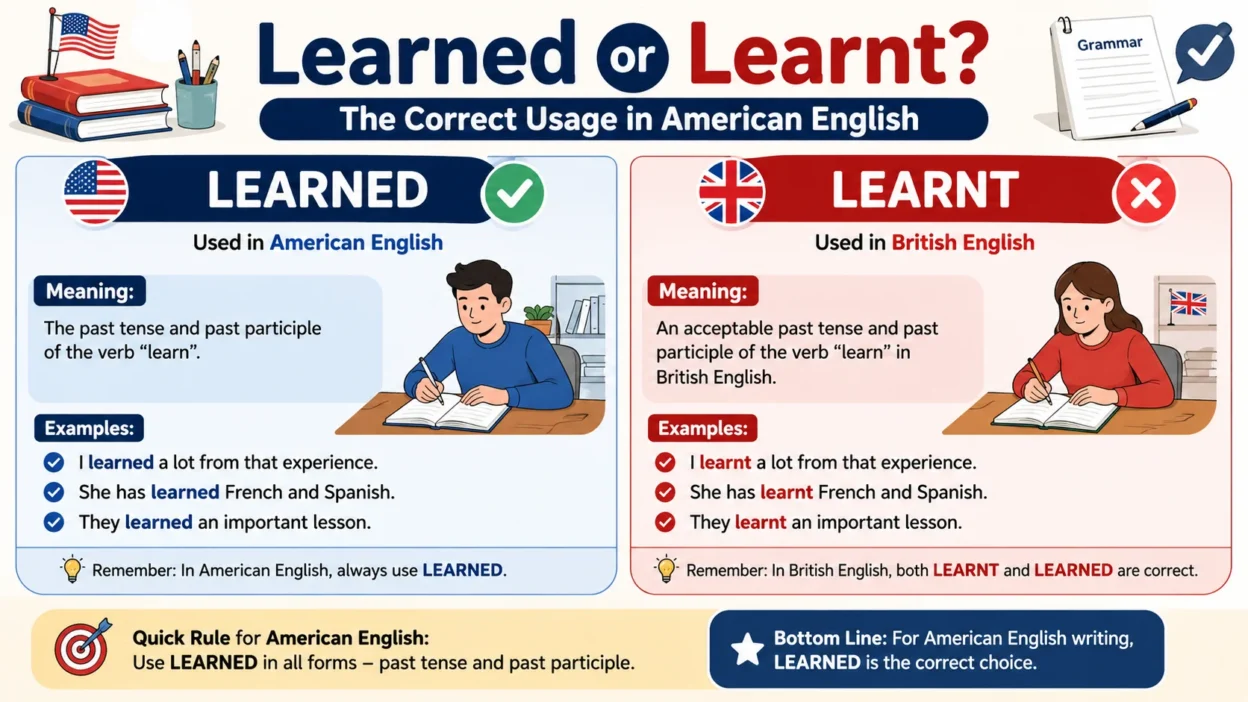
Learned or Learnt are both correct forms of the verb learn, and choosing between them depends on the type of English you use and the audience you are writing for today. If you have ever paused while writing an email, reading articles, or checking websites, you have probably asked which spelling is correct. Both are past tense and past participle forms of the verb, and both have the same meaning of gaining knowledge, skills, and experience. The main difference is regional usage. American English prefers learned as the standard form, while British English and Australian English more commonly use learnt. Across English-speaking countries and global English, your audience preference, context, region, and writing style matter more than the spelling itself.
These verb forms exist because the English language has developed different varieties over time. Each spelling belongs to a recognised standard, so both are grammatically correct, and neither is wrong. Whether you are creating books, emails, websites, or taking part in everyday conversations, speech, schoolwork, or professional communication, the best choice depends on the type of content and the standard English you follow. From my own editing experience, I have found that using one preferred spelling throughout a document improves writing confidence, reduces confusion, and helps readers focus on your message instead of your spelling.
Many people become confused because different sources show different spellings, but the rules, patterns, and explanations are actually simple once you understand how the language behaves. Common mistakes usually happen when writers mix spellings without a reason, so choose one spelling, stick with it, and use it consistently. This grammar guide, usage guide, and writing guide offers a simple explanation for English learners, writers, and anyone searching for answers to common English questions. Looking at real-world examples, comparing language differences, and understanding English grammar, English spelling, correct usage, spelling variation, and spelling differences will help you build confidence and make the right choice every time.
Learned or Learnt: The Quick Answer
If you need the short version, here it is:
- Learned is the preferred form in American English
- Learnt is more common in British English
- Both can mean the same thing when used as the past tense or past participle of learn
- Learned can also work as an adjective, but that use has a different meaning and pronunciation
For American writing, learned is the safest choice almost every time.
Quick comparison
| Feature | Learned | Learnt |
| American English | Standard | Uncommon |
| British English | Accepted | Common |
| Past tense of learn | Yes | Yes |
| Past participle of learn | Yes | Yes |
| Adjective meaning “educated” | Yes | No |
| Best choice for U.S. writing | Yes | No |
The Difference Between Learned and Learnt
At the core, the difference is not about meaning. It is mostly about regional preference.
Both words can function as the past tense of learn:
- I learned something new yesterday.
- I learnt something new yesterday.
Both can also work as the past participle:
- She has learned a lot this year.
- She has learnt a lot this year.
In many cases, the meaning stays the same. The difference comes from the variety of English being used. American English leans toward learned. British English often uses both forms, though learnt is common in everyday speech and writing.
Meaning of learned
Learned is the more familiar form in the United States. It usually appears when someone talks about gaining knowledge, skills, or experience.
Examples:
- He learned how to code.
- They learned from the mistake.
- I learned a valuable lesson.
Meaning of learnt
Learnt means the same thing. It is just more closely tied to British English and other varieties influenced by it.
Examples:
- She learnt French in school.
- We learnt the truth later.
- They learnt quickly.
Is It Learned or Learnt in American English?
For American English, learned is the clear winner.
That does not mean learnt is impossible to understand. Americans understand it just fine. Still, if you are writing for readers in the U.S., the more natural, polished choice is learned.
This matters in a few places:
- school essays
- business emails
- news writing
- website copy
- resumes
- academic papers
- professional documents
Using learned keeps your writing consistent with American norms. That consistency matters more than people think. Readers notice it even when they do not consciously stop to analyze it.
Why Americans almost always use learned
American English tends to simplify some verb forms. In this case, learned stayed regular, while learnt became less common. The regular form won out in the United States.
That same pattern shows up in other verbs too:
- burned is more common than burnt
- dreamed is more common than dreamt
- learned is more common than learnt
Language often follows habit more than logic. Once a form becomes standard in a region, people keep using it because it sounds right to them.
A simple rule for American writing
If you are writing for:
- an American school
- an American employer
- an American publication
- a U.S. audience
use learned.
That one habit will save you from a lot of unnecessary edits.
Is Learnt Correct in British English?
Yes. In British English, learnt is widely accepted and commonly used.
British English often allows both forms, but in casual use, learnt appears frequently. It sounds natural in the U.K., Australia, New Zealand, and several other places where British-style spelling remains influential.
That said, learned is also correct in British English. So the question is not whether learnt is valid. It is. The real question is which form fits your audience and tone.
Where learnt is common
You are more likely to see learnt in:
- the United Kingdom
- Australia
- New Zealand
- Ireland
- South African English
- other Commonwealth-influenced writing
Where learned is also common
Even in those regions, learned still appears often. Many writers use it without issue, especially in formal writing or when they want a more neutral international style.
Learned or Learnt: Side-by-Side Comparison
Here is a clear look at both forms.
| Category | Learned | Learnt |
| Meaning | Acquired knowledge or skill | Acquired knowledge or skill |
| Grammar role | Past tense, past participle, adjective | Past tense, past participle |
| American English | Standard | Uncommon |
| British English | Accepted | Common |
| Formal U.S. writing | Best choice | Usually avoided |
| Casual U.K. writing | Common | Common |
The table makes one thing obvious: the difference is mostly about usage tradition, not meaning.
Why American English Prefers Learned
American English favors learned because it follows the language’s preference for regular verb forms and has been the standard spelling for generations. It is the form taught in U.S. schools, used by American publishers, and recommended in professional and academic writing. Choosing learned helps your writing match American language conventions and ensures it sounds natural to U.S. readers.
Historical development
English developed with plenty of variation. Over time, different regions settled on different forms. Some of those differences came from printing habits. Some came from education systems. Some came from writers and editors choosing one form over another until it became standard.
In the United States, learned became the dominant choice because it fit the regular past tense pattern more smoothly.
Webster’s influence
Noah Webster played a major role in shaping American spelling norms. He wanted U.S. English to be simpler and more consistent than British English in some areas. While Webster is better known for spellings like color and center, his broader influence encouraged Americans to favor more regular patterns where possible.
That spirit matches learned. It looks like the regular past tense of a verb, which makes it feel clean and predictable.
Modern usage in American writing
Today, American style guides, editors, publishers, and teachers usually expect learned. That expectation matters because style often drives correctness in real life.
A form can be understandable and still look off in a given context. Writing is not just about grammar. It is also about matching the reader’s expectations.
Grammar Rules for Learned and Learnt
From a grammar standpoint, both learned and learnt are correct as the past tense and past participle of the verb learn. The key difference is regional usage, not grammatical accuracy. In American English, learned is the standard form, while British English accepts both learned and learnt. Choosing the appropriate form for your audience keeps your writing clear, consistent, and professional.
Past tense use
Use either form to describe something that happened in the past.
- I learned the rule yesterday.
- I learnt the rule yesterday.
Past participle use
Use either form with helper verbs like have, has, or had.
- She has learned the lesson well.
- She has learnt the lesson well.
- They had learned enough by noon.
- They had learnt enough by noon.
Common sentence patterns
Here are the most natural patterns:
- learned/learnt + noun
- I learned new facts.
- learned/learnt + to + verb
- She learned to drive.
- have/has/had + learned/learnt
- We have learned from the past.
- learned/learnt from + noun
- He learned from experience.
The grammar is simple once you see it in action.
Learned as an Adjective Has a Different Meaning
This is where many people get confused.
Learned is not only a verb form. It can also be an adjective. In that case, it does not mean “something you learned.” It means educated, well-read, or knowledgeable.
Example:
- She is a learned scholar.
That sentence does not mean she learned something yesterday. It means she is educated and knowledgeable.
Pronunciation changes
As an adjective, learned is often pronounced with two syllables: learn-ed.
That is different from the verb form, which usually sounds like learnd in fast speech.
Compare:
- Verb: I learned a lot.
- Adjective: He is a learned man.
The pronunciation shift helps show the difference in meaning.
Why learned stands alone as an adjective
This adjective use is old and formal. It appears in writing about scholarship, literature, law, or history. You will not hear it every day, but it still exists.
A few examples:
- a learned journal article
- a learned debate
- a learned professor
That meaning has nothing to do with the spelling learnt. Learnt is not used as an adjective.
Using Learned and Learnt in Different English Varieties
The choice between learned and learnt depends largely on the variety of English you are using. American English strongly prefers learned, while British English, Australian English, and several other Commonwealth varieties commonly use learnt, although learned is also accepted. Understanding these regional preferences helps you write in a way that feels natural, accurate, and appropriate for your audience.
American English
In the U.S., learned is the standard and safest form. It fits naturally in school writing, business writing, and professional communication.
Examples:
- I learned a new skill.
- She learned from the mistake.
- They have learned a lot this semester.
British English
In the U.K., both forms are possible. Many writers still prefer learnt in everyday use, though learned is also accepted.
Examples:
- I learnt a new skill.
- She learnt from the mistake.
- They have learnt a lot this term.
Global English
In international English, the choice often depends on the style guide, the company, or the intended reader. If the audience is mixed, many writers choose learned because it feels more neutral to American readers and still remains acceptable in many other settings.
Real-Life Examples of Learned and Learnt
Seeing learned and learnt in everyday situations makes the difference much easier to understand. In American English, people naturally write and say “I learned something new today,” while British English speakers may say “I learnt something new today.” Both sentences have the same meaning, but choosing the version that matches your audience, location, and writing style helps your communication sound more natural and consistent.
American English examples
- I learned how to swim when I was six.
- The team learned a hard lesson last season.
- We have learned a lot from this project.
- She learned the software in two days.
British English examples
- I learnt how to swim when I was six.
- The team learnt a hard lesson last season.
- We have learnt a lot from this project.
- She learnt the software in two days.
Academic writing examples
- Students learned how to analyze the data.
- Researchers learned that the pattern repeated over time.
In American academic writing, learned is expected. In British academic writing, either form may appear, though consistency matters more than personal preference.
Business communication examples
- I learned about the issue during the meeting.
- Our team learned the new process quickly.
- We have learned valuable lessons from the rollout.
These sound natural in U.S. business writing. Learnt would feel less standard in that setting.
Common Mistakes People Make
One of the most common mistakes is mixing American and British English in the same piece of writing. Many writers also use learnt in documents intended for an American audience, where learned is the preferred form. Another frequent error is confusing learned as a verb with learned as an adjective, which has a different pronunciation and meaning. Staying consistent with your chosen English variety helps your writing look polished and professional.
Mixing varieties in the same document
One paragraph uses American spelling. The next paragraph uses British spelling. That can distract readers.
Example:
- We learned the system yesterday.
- Later, we learnt how it worked.
That mix may look careless unless you are intentionally writing for a global audience and switching is part of the style.
Using learnt in American resumes
A resume should feel clean and consistent. In American resumes, learned is the better choice.
- Learned new sales software in one week
- Learned to manage a team of five
- Learned industry-standard reporting tools
These sound natural to U.S. employers.
Confusing the adjective with the verb
This is another common slip.
Correct:
- He is a learned professor.
- She learned quickly.
The first uses the adjective. The second uses the verb.
Style Guides and Dictionaries on Learned vs Learnt
Most major references agree on the broad picture.
| Source type | General guidance |
| American dictionaries | Prefer learned |
| British dictionaries | Accept learned and learnt |
| U.S. style guides | Use learned |
| British style guides | Often allow learnt |
This is one reason the answer depends on context. Dictionaries usually record usage. Style guides often recommend a choice for consistency.
A Case Study: Editing a U.S. Website
Imagine a company based in Chicago writing a blog about workplace skills. The draft includes this sentence:
We learnt that communication problems slowed the project.
An American editor would likely change it to:
We learned that communication problems slowed the project.
Why? Not because learnt is incorrect in every sense. The reason is audience fit.
The audience expects American English. The company wants smooth, familiar language. The edit makes the text feel more native to the reader.
That same logic applies to:
- product descriptions
- onboarding guides
- training manuals
- support articles
- marketing pages
Small language choices can change how polished the writing feels.
Usage Trends and Language Change
Language continues to evolve over time, and the use of learned and learnt reflects that change. Today, learned overwhelmingly dominates American English, while learnt remains a familiar and accepted form in British English and several Commonwealth countries. As English becomes more global, both forms continue to coexist, but choosing the version that matches your audience is still the best practice for clear and consistent writing.
What trends suggest
The broad trend in American English is clear: learned dominates. Learnt appears rarely in U.S. writing. In British English, learnt remains healthy and familiar.
The lesson is simple. A word does not need to disappear to become less common in one region. It only needs to lose the competition there.
Will learnt survive?
Yes, very likely. Learnt is deeply established in British English and still makes sense to millions of speakers and writers. It is not fading away. It is just living a different life in a different language community.
Easy Ways to Remember the Difference
Remembering the difference between learned and learnt is easier than it seems. Think of learned as the standard spelling in American English, while learnt is more common in British English. If you’re writing for an American audience, always choose learned. Matching your spelling to your readers and staying consistent throughout your writing will help you avoid mistakes and communicate more clearly.
Match the audience
- American audience = learned
- British audience = learnt or learned
Think of regular patterns
American English often prefers the more regular-looking form. Learned fits that habit.
Use one form consistently
If you are not sure, choose learned for American writing and stay with it throughout the piece.
Quick memory line
Learned is the American standard. Learnt is the British option.
That single sentence is enough for many writers.
Quick Decision Chart
Are you writing for American readers?
│
┌───────────┴───────────┐
│ │
Yes No
│ │
Use LEARNED Are you writing
for British readers?
│
┌─────────┴─────────┐
│ │
Yes Mixed
│ │
Use LEARNT or LEARNED Use LEARNED
and stay consistent for wider U.S.-friendly clarity
Practical Examples You Can Use
The easiest way to remember the difference between learned and learnt is to see them in real sentences. In American English, use learned in everyday conversations, academic writing, and professional documents. In British English, learnt is also correct and commonly used. Reviewing practical examples helps you recognize the right form for your audience and write with greater confidence.
For school
- I learned the formula during class.
- We learned how to solve the problem.
For work
- I learned the new workflow quickly.
- Our team learned how to reduce errors.
For daily conversation
- I learned something new today.
- She learned the hard way.
For formal writing
- The study found that participants learned the skill more effectively with practice.
- The report showed that the team learned from prior failures.
These examples stay clear and natural.
Conclusion
Choosing between learned and learnt is easier once you know that both forms are correct. The only real difference is regional preference. If you write in American English, learned is the standard choice. If you follow British English or similar varieties, learnt is more common. The most important rule is to stay consistent throughout your writing so your content looks clear, professional, and natural for your audience.
FAQs
Q1.Is learned or learnt correct?
Both are correct. Learned is the preferred form in American English, while learnt is more common in British English and other English varieties.
Q2.Why do Americans use learned instead of learnt?
American English generally prefers regular -ed verb endings. That is why learned became the standard form in the United States.
Q3.Is learnt considered incorrect?
No. Learnt is a grammatically correct past tense and past participle form of the verb learn. It is simply less common in American English.
Q4.Should I use learned or learnt in formal writing?
Use the form that matches your audience. For American English, choose learned. For British English, learnt is equally correct. The key is to remain consistent throughout your document.
Q5.Do learned and learnt have different meanings?
No. Learned and learnt have the same meaning. Both describe gaining knowledge, skills, or experience. The only difference is regional usage, not meaning.