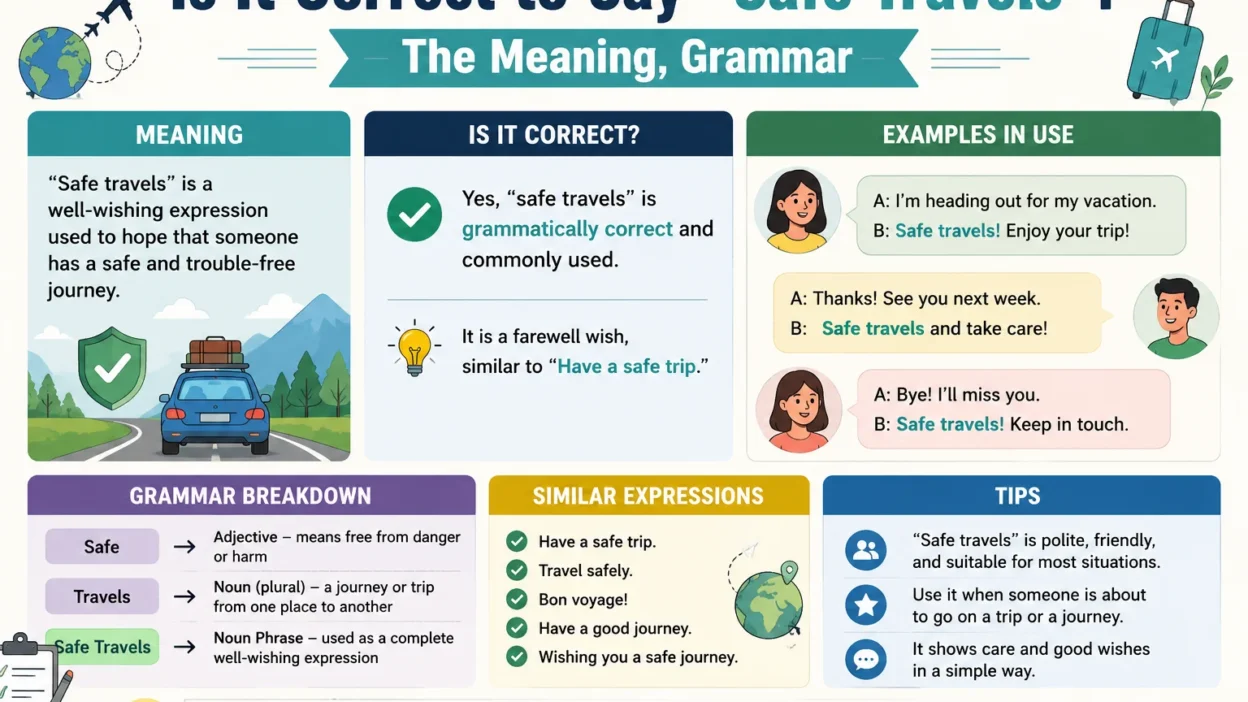
Safe Travels is a widely accepted English farewell used by native speakers to wish someone a safe trip too now. The phrase is a common way to express good wishes before a journey, whether someone is boarding a plane, starting a road trip, travelling overseas, going on vacation, or leaving for business. It sounds natural in modern English and works well in personal and professional situations, including emails, messages, and everyday conversations with a friend, coworker, or family member.
Although Safe Travels is an elliptical expression without a verb or a complete sentence structure, it remains grammatically correct because English often accepts shortened phrases in daily communication. When saying goodbye, people sometimes search for the perfect phrase that conveys well wishes without sounding too cliche. This common scenario appears at airports, train stations, and whenever someone is ready to embark on a journey. The phrase reflects how language continues to evolve, adapt, and change according to the needs of its speakers.
The English language is a living system that grows through usage, communication, and human connection. Traditional rules may sometimes be questioned, but modern expressions are often embraced for their simplicity and warmth. The meaning of Safe Travels connects with care, emotion, intention, and context because words are more than syntax and semantics. Whether it is a short farewell before a departure, a message before reaching a destination, or a wish during travel, traveller experiences, transportation, holiday, voyage, adventure, and every route become part of a shared human experience.
The Short Answer: Is “Safe Travels” Grammatically Correct?
Yes. “Safe travels” is completely grammatically correct. It has been used by native English speakers for decades and appears naturally in conversations, emails, greeting cards, travel blogs, and social media posts.
Although the phrase isn’t a complete sentence, English allows many short expressions that omit words everyone already understands. These are called elliptical expressions. Instead of saying:
- I wish you safe travels.
- May you have safe travels.
- I hope your travels are safe.
People simply shorten the message to:
Safe travels!
The meaning stays exactly the same while the expression becomes quicker and warmer.
English uses this pattern frequently.
For example:
- Good luck!
- Best wishes!
- Happy birthday!
- Take care!
- Have fun!
None of these expressions need additional words because native speakers immediately understand the intended meaning.
Why “Safe Travels” Is Correct
Many learners assume travels should be singular because travel often acts as an uncountable noun.
For example:
- I love travel.
- Air travel has changed dramatically.
- Business travel is increasing.
Those examples refer to travel as a general activity.
However, travels has another meaning. As a plural noun, it refers to journeys, trips, or movements from one place to another. That older usage remains common in farewell expressions.
When someone says:
Safe travels!
they’re really wishing that every part of your journey goes safely, not just the act of traveling itself.
What “Safe Travels” Actually Means
The expression simply means:
- Have a safe journey.
- Travel safely.
- I hope everything goes well during your trip.
- May you arrive safely at your destination.
It’s both practical and thoughtful. Instead of focusing only on reaching the destination, it wishes someone safety throughout the entire trip.
For that reason, the phrase remains one of the most popular travel farewells in English.
What Does “Safe Travels” Mean?
At its core, safe travels is a goodwill expression. It communicates care, kindness, and hope that someone’s journey will be free from accidents, delays, illness, or other problems.
Unlike a simple goodbye, it specifically relates to traveling.
Imagine these situations:
- Your friend is flying to Europe.
- Your coworker is driving across several states.
- Your cousin is leaving for college.
- Your parents are boarding a cruise ship.
In every case, “Safe travels!” tells the traveler that you genuinely hope everything goes smoothly.
Definition in Everyday English
In modern American English, safe travels means:
A friendly wish that someone’s journey will be safe, pleasant, and successful.
The phrase doesn’t promise safety. Instead, it expresses goodwill and concern.
It’s similar to saying:
- Stay safe.
- Take care.
- Have a wonderful trip.
The difference is that safe travels focus specifically on the journey.
Why English Speakers Use It as a Farewell
People naturally want to wish others well before they leave.
Travel involves uncertainty.
Flights may be delayed.
Road conditions can change.
The weather may become dangerous.
Unexpected situations happen.
A short farewell such as safe travels acknowledges those possibilities while expressing optimism instead of fear.
That’s one reason the phrase feels sincere rather than dramatic.
Is It a Wish, a Blessing, or a Greeting?
Interestingly, safe travels combine elements of several different speech acts.
It can function as:
| Type | Explanation |
| Wish | Hoping someone enjoys a safe journey. |
| Farewell | A goodbye before traveling. |
| Blessing | Expressing care and protection, especially among family members. |
| Courtesy expression | A polite social phrase used in everyday conversation. |
Most of the time, native speakers don’t think about these distinctions. They simply recognize safe travels as the natural thing to say before someone leaves.
The Grammar Behind “Safe Travels”
Grammar often creates confusion because travel behaves differently depending on how it’s used.
Understanding this distinction makes the expression much easier to remember.
Why “Travels” Is Plural
The noun travel has multiple grammatical functions.
It can be:
- An uncountable noun
- A verb
- A plural noun with a different meaning
Compare these examples:
| Sentence | Grammar |
| Travel broadens your mind. | Uncountable noun |
| They travel every summer. | Verb |
| His travels through Asia lasted two years. | Plural noun meaning journeys |
When you say safe travels, you’re using the third meaning.
Here, travels refers to the collection of journeys that make up one trip.
Even a single vacation often includes many smaller journeys.
For example:
- Driving to the airport
- Taking a flight
- Riding a train
- Walking through a city
- Returning home
Together, those movements become your travels.
Why We Don’t Usually Say “Safe Travel”
Although safe travel isn’t always incorrect, it usually appears in different contexts.
For example:
- Safe travel practices
- Safe travel policies
- Safe travel guidelines
- Safe travel insurance
Here, travel describes the general activity rather than wishing someone well.
When addressing an individual who’s leaving, native speakers overwhelmingly prefer:
- Safe travels!
- Have a safe trip!
- Travel safely!
Those expressions sound more natural.
Is “Safe Travels” a Complete Sentence?
Technically, no.
A complete sentence needs both a subject and a verb.
For example:
- I wish you safe travels.
- We hope you travel safely.
The shorter version leaves those words unstated because English allows them to be understood.
This omission is perfectly normal.
In fact, everyday English is full of similar expressions.
Examples include:
- Congratulations!
- Welcome aboard!
- Good luck!
- Happy holidays!
- Best wishes!
None of these requires a full sentence to communicate the intended message.
Why the Phrase Works Without a Verb
English often drops predictable words in greetings, announcements, and farewells.
Linguists call this ellipsis.
Instead of repeating the obvious, speakers shorten expressions for speed and friendliness.
Compare these examples:
| Full Expression | Common Short Form |
| I wish you good luck. | Good luck! |
| I hope you have fun. | Have fun! |
| I wish you safe travels. | Safe travels! |
| I hope you enjoy your meal. | Enjoy your meal! |
The shortened versions feel warmer because they sound conversational.
That’s exactly why safe travels have remained popular.
The Origin of the Expression “Safe Travels”
The desire to wish travelers well is far older than modern English.
Long before airplanes and highways existed, travel involved genuine danger.
People faced rough roads, harsh weather, disease, wild animals, shipwrecks, and robbery. Leaving home often meant entering an uncertain world where returning safely wasn’t guaranteed.
Because of those risks, many cultures developed traditional expressions that wished travelers protection.
English eventually adopted similar farewell phrases, including safe journey, Godspeed, and safe travels.
Historical Development of the Phrase
The noun travels has existed in English for centuries.
Earlier forms of English regularly used travels to describe a person’s journeys or adventures.
Examples include expressions such as:
- His travels through Europe
- Their travels abroad
- The explorer’s travels across Africa
Over time, people naturally began wishing others safe travels, meaning they hoped every stage of those journeys would be successful and free from harm.
Unlike many old expressions that disappear, this one remained useful because travel itself never stopped being important.
How Travel Wishes Evolved in English
As transportation improved, the dangers of travel changed.
Instead of worrying about horse-drawn wagons or sailing ships, people began thinking about:
- Flight delays
- Heavy traffic
- Severe weather
- Lost luggage
- Long-distance driving
- International connections
Even though modern travel is generally much safer than it once was, people still appreciate hearing safe travels before leaving.
The phrase evolved without losing its original purpose: expressing genuine care for someone during their journey.
Why the Expression Remains Popular Today
Few farewell expressions are as versatile as safe travels.
It works equally well whether someone is:
- Flying across the country
- Driving to another city
- Backpacking through Europe
- Leaving for a business conference
- Taking a family vacation
- Starting a study-abroad program
- Embarking on a cruise
- Returning home after visiting friends
Because the phrase is short, warm, and universally understood, it continues to appear in conversations, emails, postcards, farewell speeches, and social media messages.
Its simplicity is one of its greatest strengths. In just two words, it expresses kindness, encouragement, and hope that every mile ahead goes smoothly.
When Should You Say “Safe Travels”?
One reason “safe travels” remains so popular is its flexibility. You can use it in almost any situation where someone is about to begin a journey. Whether the trip lasts an hour or several months, the phrase sounds natural because it expresses genuine concern for the traveler’s well-being.
Unlike some farewell expressions that fit only formal or casual situations, safe travels work comfortably in both. The tone depends more on how you deliver it than on the phrase itself.
Let’s look at the most common situations where saying “safe travels” feels appropriate.
Before Someone Leaves for a Trip
This is the classic situation.
Whenever someone is preparing to leave, safe travels serve as a warm goodbye that goes beyond simply saying “bye.”
For example:
- Safe travels! I can’t wait to hear about your vacation.
- Have an amazing time in Italy. Safe travels!
- Safe travels, and don’t forget to send pictures.
The phrase works whether the trip is for leisure, family visits, education, or work.
During Business Travel
Professional communication often benefits from being polite without sounding overly personal. Safe travels strike that balance perfectly.
Managers frequently use it when employees travel for meetings, conferences, training sessions, or client visits.
Examples include:
- Safe travels, and we’ll see you at Monday’s meeting.
- Thanks again for representing the company. Safe travels.
- Have a productive conference and safe travels home.
Because the phrase is professional yet friendly, it appears regularly in workplace emails and internal messages.
Before International Travel
International trips usually involve longer flights, immigration procedures, multiple connections, and unfamiliar destinations.
As a result, wishing someone safe travels feels especially meaningful.
You might say:
- Safe travels to Japan. I hope you have an unforgettable experience.
- Enjoy your semester abroad. Safe travels!
- Safe travels across Europe, and stay in touch.
The expression acknowledges that long-distance travel often requires extra preparation.
Before Road Trips, Flights, Cruises, and Train Journeys
The beauty of safe travels is that it isn’t limited to one type of transportation.
You can say it before someone:
- Drives across the country
- Takes a domestic flight
- Boards an international flight
- Starts a motorcycle tour
- Goes on a cruise
- Travels by train
- Takes a bus between cities
- Begins a hiking expedition
Regardless of how someone reaches their destination, the phrase remains appropriate.
In Professional Emails and Messages
Many people wonder whether safe travels sound professional enough for business writing.
The answer is yes.
It appears frequently at the end of emails because it’s polite, concise, and sincere.
For example:
Thank you for meeting with our team today. We appreciate your time and look forward to working together. Safe travels home.
Or:
We hope your conference goes well. Safe travels, and we’ll speak again next week.
Notice that the phrase doesn’t feel overly formal or overly casual. It sits comfortably in the middle.
In Casual Conversations with Friends and Family
Among friends and relatives, safe travels often become even warmer.
People commonly pair it with additional well wishes.
Examples include:
- Safe travels! Have the best vacation ever.
- Drive carefully and safe travels.
- Enjoy every minute. Safe travels!
- Safe travels. We’ll miss you while you’re away.
Adding a personal message makes the farewell feel more heartfelt.
When “Safe Travels” May Not Be the Best Choice
Although safe travels works in many situations, it isn’t always the most natural expression.
English offers several travel-related farewells, each with slightly different shades of meaning.
Choosing the right one depends on the situation.
Situations Where Another Farewell Sounds More Natural
Sometimes another expression fits the context better.
For example:
| Situation | Better Choice |
| Someone has already arrived safely | Glad you made it safely. |
| You’re emphasizing enjoyment instead of safety | Have a great trip! |
| Someone is leaving for only a few hours | Have a good day! |
| Someone is moving permanently | Best of luck in your new home! |
The goal is to match the farewell to the moment.
Formal vs. Informal Communication
Fortunately, safe travels adapt well to different levels of formality.
Here’s a quick comparison.
| Context | Appropriate? |
| Business email | ✅ Yes |
| Friendly text message | ✅ Yes |
| Academic email | ✅ Yes |
| Customer service email | ✅ Yes |
| Wedding speech | ✅ Yes |
| Formal government document | ❌ Usually unnecessary |
Highly formal documents rarely include conversational farewells.
However, people within professional organizations regularly use safe travels.
Regional and Cultural Preferences
English-speaking countries share many expressions, but preferences vary slightly.
For example:
- Americans often say Have a safe trip and Safe travels.
- British speakers frequently use Safe journey alongside Safe travels.
- Australians commonly use Safe travels in casual conversation.
- Canadians comfortably use both Safe travels and Have a safe trip.
Despite these regional differences, every version is widely understood across the English-speaking world.
“Safe Travels” vs. “Safe Travel”: Which One Is Correct?
This question causes more confusion than almost any other.
The answer depends entirely on how travel functions in the sentence.
Key Grammar Differences
Compare these examples.
| Phrase | Correct? | Explanation |
| Safe travels! | ✅ Yes | Farewell expression. |
| Safe travel practices | ✅ Yes | Travel as an activity. |
| Safe travel insurance | ✅ Yes | General noun. |
| I wish you safe travel. | ⚠️ Understandable but uncommon. | |
| I wish you safe travels. | ✅ Natural and preferred. |
The plural form sounds more idiomatic when wishing someone well.
Which Sounds More Natural to Native Speakers?
Native speakers overwhelmingly choose:
- Safe travels
- Have a safe trip
- Travel safely
Those phrases appear naturally in speech and writing.
Although safe travel isn’t always grammatically wrong, it usually refers to policies, safety campaigns, or transportation in general rather than an individual’s journey.
Examples Showing the Difference
Correct:
- Safe travels!
- We wish you safe travels.
- Safe travels to everyone attending the conference.
Also correct, but with a different meaning:
- The government promotes safe travel during winter.
- Safe travel guidelines help reduce accidents.
Notice how the meaning changes from wishing someone well to discussing travel safety as a topic.
“Safe Travels” vs. Similar Farewell Expressions
English gives speakers plenty of options.
Each expression carries a slightly different tone.
Safe Journey
This expression focuses on one journey rather than multiple stages.
Example:
Safe journey home.
It sounds slightly more common in British English.
Have a Safe Trip
One of the most popular alternatives in American English.
Example:
Have a safe trip to Chicago.
It emphasizes the trip as a single event.
Have a Good Trip
Here, the focus shifts from safety to enjoyment.
Example:
Have a good trip and take lots of photos.
Many speakers combine both ideas:
Have a good trip and safe travels!
Travel Safely
This version uses an adverb instead of a noun phrase.
Example:
Travel safely, and call when you arrive.
It sounds slightly more direct because it resembles advice.
Bon Voyage
Borrowed from French, Bon Voyage literally means good journey.
Although still common, it often sounds slightly more elegant or celebratory.
Godspeed
This traditional farewell expresses hope that God protects someone during an important journey or mission.
Today, it usually appears in formal speeches, historical writing, literature, or ceremonial occasions.
Take Care
Although not specifically about travel, taking care naturally fits when someone leaves.
Many people combine it with safe travels.
Example:
Take care and safe travels!
See You Soon
When you know you’ll meet again shortly, seeing you soon often accompanies travel wishes.
Example:
Safe travels. See you next week!
Which Farewell Should You Use?
The best expression depends on the situation.
| Expression | Best Situation | Formality | Common in American English | Common in British English |
| Safe travels | Any type of journey | Neutral | Very Common | Very Common |
| Have a safe trip | Vacation or business travel | Neutral | Very Common | Common |
| Safe journey | Any journey | Neutral | Common | Very Common |
| Travel safely | Giving advice | Neutral | Common | Common |
| Bon Voyage | Celebratory departures | Semi-formal | Common | Common |
| Take care | Everyday farewell | Informal | Very Common | Very Common |
| See you soon | Temporary goodbye | Informal | Very Common | Very Common |
Each expression is correct. The difference lies in tone rather than grammar.
Conclusion
Safe Travels is a simple yet meaningful farewell expression that has become a natural part of modern English communication. Although it does not follow a complete sentence structure, it is still grammatically accepted and widely used by native speakers and learners. The phrase carries a sense of care, warmth, and good intention, making it suitable for personal conversations, professional messages, and everyday situations.Whether someone is starting a new journey, leaving for a vacation, traveling for business, or simply heading home, saying Safe Travels is a thoughtful way to express positive wishes. Language continues to evolve, and expressions like this show how English adapts to reflect human emotions, relationships, and real-life communication.
FAQs
Q1. Is “Safe Travels” grammatically correct?
Yes, “Safe Travels” is grammatically correct and widely accepted in modern English. It is an elliptical expression, meaning some words are left out, but the meaning remains clear.
Q2. When should I use “Safe Travels”?
You can use Safe Travels when someone is about to go on a trip, journey, vacation, business travel, or any type of departure. It works well in both casual and professional situations.
Q3. Is “Safe Travels” only used for long trips?
No. Safe Travels can be used for short or long journeys. It can apply to a local trip, a road journey, an overseas adventure, or any situation where you want to wish someone well.
Q4. Can I use “Safe Travels” in a professional email?
Yes, Safe Travels can be appropriate in professional emails, especially when a colleague, client, or business partner is traveling. It adds a polite and friendly tone to your message.
Q5. What is the difference between “Safe Travels” and “Have a Safe Trip”?
Both expressions have the same purpose: wishing someone a safe journey. Safe Travels sounds slightly more general and warm, while Have a Safe Trip directly refers to a specific trip. Both are natural expressions in English.