The phrase Dear All is a professional email greeting used in group messages, helping writers address recipients with clarity, respect, and tone. Many professionals choose this opening line when communicating with a team, department, or wider audience because it feels comfortable and polite. However, selecting the right email greeting requires understanding context, grammar, and professional writing standards. A suitable greeting creates a positive first impression and helps improve effective communication by making messages easier to understand.
In workplace situations, Dear All can be useful for announcements, updates, and general information shared through a group email. It provides a simple way to connect with multiple people while maintaining a formal and respectful approach. Still, writers should consider audience awareness, context-awareness, and the relationship with recipients before using it. In some cases, personalised greetings or other alternatives may create a warmer connection. Understanding proper usage, tone, and clarity-in-writing helps professionals choose greetings that match their communication goals.
Strong email writing depends on more than selecting a phrase; it requires attention to structure, clarity-of-expression, and email etiquette. A thoughtful writing-strategy includes considering context-appropriateness, professional standards, and the purpose of the message. Whether choosing Dear All or other standard greetings, writers can improve readability, comprehension, and overall effectiveness by using respectful language, accurate phrasing, and a consistent communication style.
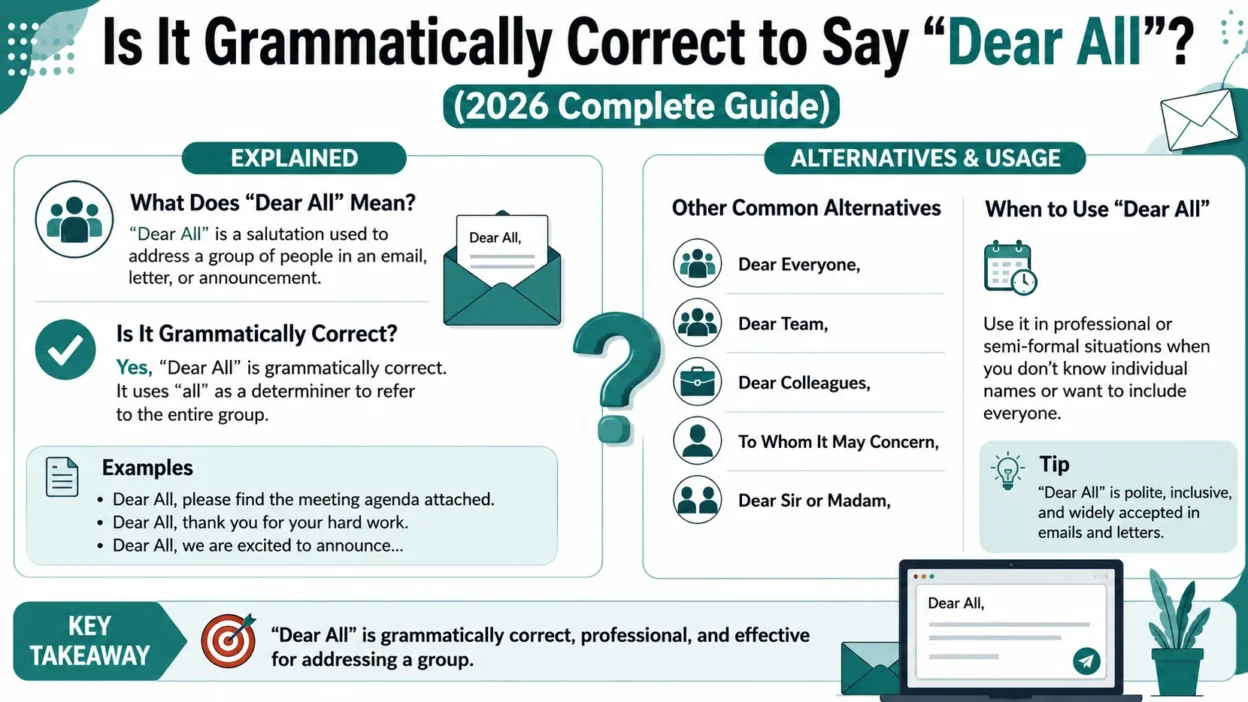
Is “Dear All” Grammatically Correct?
Yes, “Dear All” is grammatically correct in English.
The phrase follows a traditional greeting structure where “Dear” works as a salutation word and “All” refers to every person receiving the message. It functions similarly to other greetings such as:
- Dear John
- Dear Team
- Dear Colleagues
- Dear Members
In “Dear All,” the word “All” acts as a pronoun that represents a complete group of people. It does not refer to a specific individual but includes everyone in the audience.
For example:
Dear All,
Please find attached the updated company policy document.
This sentence is grammatically acceptable because the writer is directly addressing everyone who receives the email.
The confusion usually happens because some writers believe greetings must always include a name or specific group. However, English allows general greetings when the audience is large or not individually addressed.
For example:
Dear Customers,
Thank you for your continued support.
Dear All,
We would like to announce changes to our office schedule.
Both examples follow correct English grammar.
However, grammatical correctness does not always mean something is the best choice. A phrase can be correct but still feel less natural depending on the situation.
Think of it like clothing. A formal suit is not wrong, but wearing one to a casual picnic may feel out of place. The same idea applies to email greetings.
“Dear All” is correct, but the situation decides whether it is appropriate.
What Does “Dear All” Really Communicate?
The phrase “Dear All” communicates respect toward a group of people. It shows that the writer wants to address everyone equally instead of focusing on one person.
The greeting usually creates a tone that feels:
- Professional
- Respectful
- Neutral
- Organized
- Slightly formal
It is commonly used when the sender wants to communicate with a group without making anyone feel excluded.
For example, a manager sending an update to an entire department might write:
Dear All,
I would like to inform you about the upcoming changes to our project timeline.
Here, the greeting works because the message targets everyone equally.
However, “Dear All” can also create emotional distance. Since it does not mention names or specific roles, some readers may feel that the message was sent as a general announcement rather than a personal communication.
Compare these two examples:
Example 1:
Dear All,
The meeting has been moved to Friday.
Example 2:
Dear Marketing Team,
Thank you for your hard work during the recent campaign. I’d like to share the next steps with you.
The second greeting feels more connected because it identifies the audience and creates a stronger sense of belonging.
This difference matters because professional communication is not only about delivering information. It is also about building relationships.
When Does “Dear All” Work Well?
Although some people avoid “Dear All,” the phrase remains useful in many professional situations. The key is understanding when a general greeting makes sense.
When “Dear All” Works Well
“Dear All” works well when you are addressing a group of people in a professional or formal setting, such as workplace emails, team announcements, or group messages. It is a simple and respectful greeting that clearly shows the message is intended for everyone. However, it is best used when the audience is general and not when a more personal or specific greeting would create a better connection.
Internal Company Announcements
One of the most common uses of “Dear All” is inside organizations.
Large companies often need to communicate with:
- Entire departments
- Multiple teams
- All employees
- Organization members
In these situations, addressing every person individually is impossible.
Example:
Dear All,
We are pleased to announce the launch of our new employee training program starting next month.
The greeting fits because the message has a broad audience.
Team Updates and Workplace Notices
Managers and employees often use “Dear All” for routine updates.
Examples include:
- Schedule changes
- Policy updates
- Office announcements
- Meeting reminders
- System maintenance notices
Example:
Dear All,
Please remember that the office will remain closed on Monday due to the public holiday.
The phrase sounds professional without being overly formal.
Messages Sent to Large Groups
When you do not personally know every recipient, “Dear All” can be a practical choice.
For example:
- University announcements
- Community organization emails
- Professional association updates
- Training notifications
A sender cannot realistically write:
Dear Sarah, John, Michael, David, Lisa, and everyone else…
A group greeting solves this problem.
Situations Where “Dear All” Sounds Out of Place
While “Dear All” is correct, it does not fit every professional situation.
Some situations require a more personal approach.
Emails to Clients or Customers
Customer communication usually benefits from personalization.
A client receiving:
Dear All,
may wonder whether the email was copied to many unrelated people.
A better option would be:
Dear Mr. Johnson,
or:
Hello Customer Support Team,
Personalized greetings help create trust and show attention.
Job Applications and Cover Letters
Using “Dear All” in a job application sounds inappropriate because the message usually has a specific recipient.
Instead of:
Dear All,
use:
Dear Hiring Manager,
or:
Dear Recruitment Team,
A job application represents your professionalism. A specific greeting shows effort and awareness.
Sensitive or Emotional Messages
Certain messages need warmth and empathy.
For example:
- Condolence announcements
- Personal appreciation messages
- Employee recognition
- Important organizational changes
A generic greeting may feel too distant.
Instead of:
Dear All,
We are sorry to announce…
A warmer option may be:
Dear Team Members,
We wanted to personally share this important update with you.
Formal vs. Informal Uses of “Dear All”
The tone of “Dear All” falls between formal and semi-formal communication.
It is more formal than:
- Hi everyone
- Hello team
- Hey all
But it is less formal than:
- Dear Sir or Madam
- Dear Esteemed Members
- To Whom It May Concern
The right choice depends on the relationship between the sender and receiver.
| Greeting | Formality Level | Common Use |
| Dear All | Professional/Formal | Workplace announcements |
| Dear Colleagues | Professional | Office communication |
| Hello Everyone | Neutral | General emails |
| Hi Team | Friendly Professional | Internal messages |
| Hey Everyone | Casual | Informal team chats |
Modern workplaces often prefer greetings that feel professional but approachable. Because of this, many organizations now use alternatives like “Hello Team” or “Hi Everyone.”
However, “Dear All” remains acceptable, especially in international business communication.
Audience Assessment: Who Are You Actually Addressing?
Before choosing “Dear All” as an email greeting, consider one important question: Who will read this message?
A greeting should match the people receiving your email. The same phrase can sound professional in one situation and unsuitable in another.
For example, imagine you are sending an update to 500 employees across a company. Writing individual names is unrealistic, so “Dear All” makes sense because it addresses the entire audience equally.
However, if you are emailing three clients you have worked with for months, a general greeting may feel disconnected. In that case, using names creates a stronger professional relationship.
Before writing Dear All in an email, think about these factors:
| Question | Why It Matters |
| Do I know the recipients personally? | Personal greetings often create better connections |
| Is the audience large? | Group greetings become more practical |
| Is the message formal or casual? | The greeting should match the overall tone |
| Are the recipients inside or outside my organization? | Internal and external communication follow different expectations |
A simple rule works well:
Large group + professional announcement = “Dear All” can work.
Small group + personal relationship = use names whenever possible.
The goal is not just to write a grammatically correct greeting. The goal is to make readers feel that the message was created for them.
Alternatives to “Dear All” That Sound Natural and Professional
Although “Dear All” is grammatically correct, many writers look for alternatives that sound warmer, more modern, or more specific.
The best replacement depends on your audience and the level of formality you need.
Formal Alternatives to “Dear All”
When writing official communication, these options often sound polished and professional.
Dear Colleagues
This greeting works well when addressing coworkers.
Example:
Dear Colleagues,
I would like to share an important update regarding our upcoming project.
It creates a professional but respectful tone.
Dear Team Members
This option works well for internal company communication.
Example:
Dear Team Members,
Thank you for your continued dedication and effort.
It feels more personal than “Dear All” because it identifies the relationship between the sender and recipients.
Dear Members of the [Organization/Department]
This works well for formal groups.
Example:
Dear Members of the Finance Department,
Please review the updated procedures attached to this email.
Semi-Formal and Neutral Alternatives
Many modern workplaces prefer greetings that feel professional without sounding overly traditional.
Hello Everyone
This greeting feels welcoming and natural.
Example:
Hello Everyone,
I hope you are doing well. I am sharing the latest project updates below.
Hi Everyone
This option works well for everyday workplace communication.
Example:
Hi Everyone,
Just a quick reminder about tomorrow’s meeting.
Hello Team
This is especially common in companies where employees communicate regularly.
Example:
Hello Team,
We have completed the first phase of the project successfully.
Informal Alternatives for Internal Communication
For close teams with a relaxed culture, these greetings may work:
- Hi Team
- Hey Everyone
- Hello All
- Team,
However, these options may not suit formal business situations. Always consider your workplace culture before choosing a casual greeting.
The Nuance of “All” vs. “Everyone” in Email Greetings
Many writers wonder whether they should use “Dear All” or “Dear Everyone.”
Both phrases communicate the same basic idea, but they create slightly different impressions.
“All” sounds more formal and traditional.
“Everyone” sounds more conversational and modern.
Compare these examples:
Dear All,
Please review the attached document.
Dear Everyone,
Please review the attached document.
The first example feels more like an official announcement. The second feels slightly friendlier.
In professional emails, both can work. The better choice depends on your company culture and audience.
| Greeting | Tone | Impression |
| Dear All | Formal, traditional | Official group message |
| Dear Everyone | Friendly, neutral | More conversational |
| Hello Everyone | Warm, professional | Modern workplace style |
For many modern workplaces, “Hello Everyone” sounds more natural than “Dear All.” However, “Dear All” remains widely accepted.
Email Etiquette for Addressing Multiple Recipients
Using the right greeting is only one part of professional email etiquette. The entire message should maintain the same level of respect and clarity.
When sending group emails:
Use a Clear Subject Line
A strong subject line helps recipients understand the purpose immediately.
Weak:
Update
Better:
Updated Office Schedule for March 2026
Keep the Opening Appropriate
Your greeting sets the tone for the entire message.
For example:
Dear All,
followed by a casual sentence like:
Hey guys, just wanted to let you know…
creates a mixed tone.
The greeting and message should feel consistent.
Avoid Unnecessary Group Greetings
If only two or three people receive the email, using “Dear All” may feel excessive.
Instead:
Dear Sarah and Michael,
sounds more thoughtful.
Personalization Strategies in Group Emails
A group email does not have to feel cold or automatic.
Small adjustments can make Dear All emails more engaging.
Instead of:
Dear All,
The project has been completed.
Try:
Dear Marketing Team,
Thanks to everyone’s hard work, we have successfully completed the project.
The second version recognizes the audience and creates a stronger connection.
Useful personalization methods include:
- Mentioning the department name.
- Referring to a shared goal.
- Recognizing previous efforts.
- Explaining why the message matters.
Even when addressing many people, readers appreciate feeling included.
Case Study: When “Dear All” Works and When It Backfires
Real situations show why context matters more than grammar alone.
Case Study 1: Internal Policy Update
Situation:
A company sends an email to all employees explaining a new remote work policy.
Greeting:
Dear All,
Result:
This greeting works well because the message targets a large internal audience.
The sender does not need to personalize hundreds of names. The phrase feels organized and professional.
Better alternative:
Dear Colleagues,
could also work because employees share a professional relationship.
Case Study 2: Email to External Clients
Situation:
A business sends an important update to customers.
Greeting:
Dear All,
Result:
The greeting may feel too general.
Clients usually expect a more personalized approach because they represent an external relationship.
Better choices:
Dear Valued Customers,
or:
Hello [Client Name],
These greetings create a stronger sense of attention and trust.
Case Study 3: Cross-Department Collaboration
Situation:
Employees from different departments work together on a company project.
Greeting:
Dear All,
Result:
This depends on the group size.
If 50 people from different teams receive the email, “Dear All” is acceptable.
If only six people are involved, a more specific greeting works better:
Hello Project Team,
This small change makes the message feel more connected.
Quick Reference: Should You Use “Dear All”?
| Situation | Is “Dear All” Appropriate? |
| Company-wide announcement | Yes |
| Department update | Yes |
| Large professional group | Yes |
| Email to close coworkers | Optional |
| Email to clients | Usually avoid |
| Job application | No |
| Personal message | No |
Conclusion
Choosing the right greeting in a professional email can influence how your message is received. Dear All remains a useful and respectful option for addressing a group audience, especially in workplace announcements, team updates, and general communications. However, effective email writing requires more than using a common phrase. Considering context, tone, audience awareness, and professional standards helps ensure your message feels appropriate and clear. By understanding when to use Dear All and when to choose personalised alternatives, you can create emails that are professional, engaging, and easy for readers to understand.
FAQs
Q1. Is “Dear All” professional in an email?
Yes, Dear All is considered a professional greeting when writing to a group of people, especially in workplace emails, announcements, and team communications. It is polite, simple, and appropriate for many formal situations.
Q2. When should I use “Dear All” in a work email?
You can use Dear All when sending a message to multiple recipients, such as a department, project team, organisation, or large group where addressing each person individually is not practical.
Q3. Is “Dear All” too formal for everyday communication?
In some casual workplaces, Dear All may feel slightly formal or distant. In these situations, alternatives like Hello everyone or Hi team may create a more friendly and approachable tone.
Q4. What are some alternatives to “Dear All”?
Common alternatives include Hello everyone, Hi team, Dear colleagues, Hello all, or addressing a specific group by name. The best choice depends on your relationship with the audience and the purpose of your email.
Q5. Should I capitalize “Dear All” in an email greeting?
Yes, the standard format is to capitalise both words as Dear All because it is part of a formal greeting. Proper capitalisation helps maintain professional writing standards and improves the appearance of your email communication.