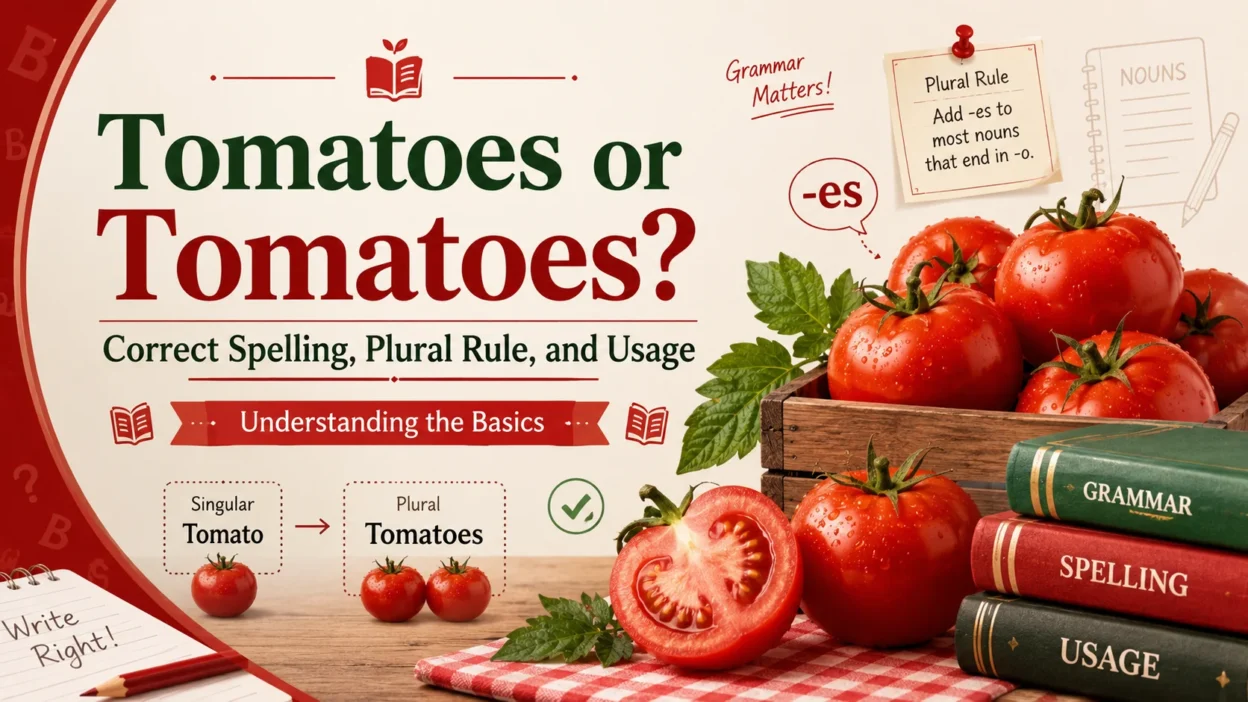
When you compare Tomatoes or Tomatoes, the correct form is tomatoes. The word tomatoes is an incorrect and common spelling error. If you’ve ever typed the word and wondered whether it looked a little off, you’re not alone. Even native speakers may second-guess the spelling because both forms can seem logical at first glance. The simple rule is that tomato is the singular form, while tomatoes is the standard plural form.
The confusion comes from English spelling rules for words ending in -o. Some nouns form their plural with -s, while others take -es, so the pattern isn’t always easy to predict. Tomato follows the -es pattern, which gives us tomatoes. The history of English helps explain these differences because the language has absorbed words from many languages over centuries. As a result, English has several plural rules and exceptions rather than one perfectly consistent pluralisation pattern. This is why spelling, vocabulary, English grammar, and usage sometimes require careful attention.
A useful way to remember the correct form is to connect tomato with tomatoes as a familiar pair. If you hesitate mid-sentence, focus on the grammatical form: singular tomato, plural tomatoes. Pronunciation can help you recognise the word, but written English confirms the correct spelling. This distinction matters when you’re writing a recipe, preparing a school assignment, editing a menu, or creating content. Once you recognise the pattern, tomatoes become much easier to use correctly, and tomatoes stand out as the misspelled form.
Quick Answer: Is It “Tomatoes” or “Tomatos”?
Tomatoes is the correct plural spelling.
Tomatoes are incorrect in standard English.
The singular-to-plural change is:
tomato → tomatoes
The word adds -es, not simply -s.
For example:
- I bought one tomato.
- I bought six tomatoes.
- The tomatoes are ripe.
- She added three tomatoes to the salad.
Major dictionaries confirm tomatoes as the plural form. Cambridge Dictionary, for example, lists tomatoes directly as the plural of tomato.
| Form | Correct? | Example |
| tomato | Yes | I sliced one tomato. |
| tomatoes | Yes | I sliced several tomatoes. |
| tomato’s | Yes, when possessive | The tomato’s skin was thick. |
| tomatoes’ | Yes, plural possessive | The tomatoes’ color was unusual. |
| tomatoes | No | Incorrect standard plural |
So, if you’re wondering “tomatoes or tomatoes?”, choose tomatoes every time in standard English.
What Does the Word “Tomato” Mean?
A tomato is the fruit of a tomato plant. In everyday English, people commonly eat it raw or cooked and use it in salads, sauces, soups, sandwiches, and countless other dishes.
Cambridge Dictionary defines tomato as a round fruit containing many seeds that people eat cooked or uncooked. It also uses tomatoes as its plural form.The word can refer to either the fruit or, depending on context, the plant that produces it.
For example:
- The tomato is still green.
- This tomato tastes sweet.
- The tomato plant needs plenty of sunlight.
- These tomatoes are ready to harvest.
The grammatical distinction is simple:
One = tomato
More than one = tomatoes
That distinction matters because English readers expect the plural spelling tomatoes. Writing tomatoes immediately looks like a typo to most proficient English speakers.
Why Is the Plural “Tomatoes” Instead of “Tomatoes”?
Here’s where English gets a little unruly.
Many English nouns form their plurals by adding -s:
- book → books
- car → cars
- apple → apples
- chair → chairs
However, some nouns require -es or undergo a spelling change when forming the plural. Words ending in -o are especially inconsistent.
That’s why you can’t safely assume that every word ending in -o simply takes -s.
Compare these examples:
- tomato → tomatoes
- potato → potatoes
- hero → heroes
- echo → echoes
Now compare them with:
- photo → photos
- piano → pianos
- radio → radios
- video → videos
English doesn’t offer one universal rule that perfectly predicts every plural ending in -o.
The safest approach is to learn common patterns while recognizing that usage and word history also matter.
Tomatoes or Tomatoes: Which Spelling Is Correct?
Tomatoes is the correct spelling; Tomatos is a common misspelling, so use tomatoes in standard English.
Tomatoes Is the Correct Spelling
Tomatoes is the standard plural form of tomato in English.
You’ll find it in dictionaries, books, recipes, journalism, academic writing, and everyday communication.
Examples include:
- The tomatoes are growing quickly.
- We bought fresh tomatoes at the market.
- These tomatoes taste sweeter than the canned ones.
- She chopped the tomatoes for the salsa.
- The farmer harvested thousands of tomatoes.
The spelling contains the extra e:
tomato + es = tomatoes
That small e is the detail writers often forget.
Tomatoes Is Incorrect in Standard English
Tomatos isn’t the accepted standard plural of tomato.
It usually appears because someone applies a simple plural rule:
tomato + s = tomatos
That looks logical at first glance. Unfortunately, English doesn’t use that form for the standard plural of tomato.
If you’re writing professionally or academically, use tomatoes.
How to Form Plurals of Words Ending in -O
Words ending in -o are a classic example of why English spelling can’t always be reduced to one tidy formula.
When -ES Is Commonly Used
Several familiar nouns ending in -o form their plurals with -es.
Examples include:
- tomato → tomatoes
- potato → potatoes
- hero → heroes
- echo → echoes
- veto → vetoes
- torpedo → torpedoes
The pattern is especially noticeable with some words ending in a consonant followed by o.
That gives learners a useful pattern, but it isn’t an absolute law.
When Only -S Is Used
Other nouns ending in -o form their plurals by adding only -s.
Consider:
- photo → photos
- piano → pianos
- radio → radios
- video → videos
- memo → memos
- logo → logos
So this rule isn’t reliable:
“Every word ending in -o takes -es.”
It doesn’t.
A better explanation is that English has several established plural patterns for -o nouns. Some words use -es, some use -s, and individual word history and convention often help explain the difference.
Why the Rule Isn’t Completely Predictable
English vocabulary is a linguistic patchwork. It contains words inherited from older forms of English alongside words borrowed from French, Spanish, Italian, Greek, Latin, and many other languages.
As borrowed words entered English, their spellings and plural patterns didn’t always develop in identical ways.
That’s why photos and tomatoes can coexist without either spelling being strange.
In practical writing, the goal isn’t to invent a universal rule. It’s to recognize established forms.
The Linguistic History of “Tomato”
The history of tomato helps explain why its spelling looks the way it does.
The English word ultimately traces back through Spanish tomate to Nahuatl tomatl, a word associated with the tomato. English adopted an earlier form, tomate, around the beginning of the 17th century before the modern spelling tomato became established.
One particularly interesting detail is that the spelling of tomato was probably influenced by potato. Etymological records connect the modern spelling with this older English word pattern. That connection is useful because potato and tomato later developed matching standard plurals:
- potato → potatoes
- tomato → tomatoes
So the familiar pair isn’t merely a classroom spelling trick. It reflects the historical development of these words in English.
A Quick History Snapshot
| Stage | Form or influence |
| Earlier source | Nahuatl tomatl |
| Spanish | tomate |
| Early English | tomate |
| Modern English | tomato |
| Modern plural | tomatoes |
History doesn’t give you a perfect rule for every -o word. It does explain why English spelling sometimes carries traces of earlier linguistic influences.
Examples of “Tomatoes” Used Correctly in Sentences
Seeing the word in context makes the rule easier to remember.
Singular Examples
Use tomato when you’re talking about one:
- I sliced a tomato for the sandwich.
- That tomato is unusually large.
- She planted a tomato in the garden.
- The recipe calls for one tomato.
Plural Examples
Use tomatoes when you’re talking about two or more:
- The tomatoes are ready to pick.
- We bought five tomatoes from the market.
- Fresh tomatoes make this sauce taste better.
- The farmer grows several varieties of tomatoes.
- I chopped the tomatoes into small pieces.
Possessive Forms
A different issue appears when ownership or association is involved.
Tomato’s is the singular possessive:
The tomato’s skin was slightly wrinkled.
Here, one tomato possesses or is associated with something.
Tomatoes’ is the plural possessive:
The tomatoes’ bright color made the dish look fresh.
The difference is easy to overlook:
- tomato = singular
- tomatoes = plural
- tomato’s = singular possessive
- tomatoes’ = plural possessive
Common Mistakes With “Tomatoes”
Common mistakes with “tomatoes” include writing “tomatoes,” confusing singular and plural forms, and misusing possessive forms.
Writing “Tomatoes”
This is the most obvious error.
The writer knows the plural usually requires -s, then writes:
tomato + s = tomatos
The problem is that tomato belongs to the group that uses the established plural tomatoes.
Confusing “Tomatoes” With Similar -O Words
Another mistake happens when learners notice words such as photos and pianos.
They may reason:
“Photos become photos, so tomatoes should become tomatoes.”
That conclusion doesn’t work because English plural formation isn’t completely uniform for words ending in -o.
Compare:
| Singular | Correct plural |
| tomato | tomatoes |
| potato | potatoes |
| hero | heroes |
| photo | photos |
| piano | pianos |
| radio | radios |
The best strategy is to learn each common word in its standard form.
Confusing Singular and Plural Forms
Sometimes the error isn’t spelling at all. It’s a number.
For example:
Incorrect: I bought three tomatoes.
Correct: I bought three tomatoes.
The noun must agree with the quantity.
If you’re talking about one, use tomato. If you’re talking about more than one, use tomatoes.
Confusing Plural and Possessive Forms
Apostrophes can create another layer of confusion.
Compare:
- The tomatoes are ripe.
- The tomatoes’ skins are thin.
In the first sentence, tomatoes is simply plural.
In the second, tomatoes’ is plural possessive.
The apostrophe comes after the s because the noun is already plural.
Tomatoes or Other Common -O Plurals
A comparison table makes the pattern much easier to see.
| Singular | Plural | Plural pattern |
| tomato | tomatoes | -es |
| potato | potatoes | -es |
| hero | heroes | -es |
| echo | echoes | -es |
| veto | vetoes | -es |
| photo | photos | -s |
| piano | pianos | -s |
| radio | radios | -s |
| video | videos | -s |
| memo | memos | -s |
| logo | logos | -s |
This table reveals the important point: the ending -o doesn’t automatically determine the plural.
That’s why the statement “all consonant + o words take -es” is too simplistic. It can help explain some common forms, but it doesn’t cover the whole vocabulary.
Words That Follow the Same Plural Pattern as “Tomatoes”
If you want useful comparisons, start with these familiar words:
Potato → Potatoes
We planted potatoes in the garden.
This is probably the easiest comparison because potato and tomato share the same -o → -oes pattern.
Hero → Heroes
The movie’s heroes saved the city.
Echo → Echoes
The echoes continued through the valley.
Veto → Vetoes
The president issued several vetoes.
Torpedo → Torpedoes
The ship carried torpedoes.
These examples show that tomatoes aren’t an isolated oddity. Several established English nouns form plurals with -es.
Conclusion
The correct spelling is tomatoes, not tomatos. Although English has several plural rules for words ending in -o, tomato follows the -es pattern. Remembering tomato → tomatoes can help you avoid this common spelling error in everyday writing, recipes, assignments, and professional content.
FAQs
Q1. Is “tomatoes” or “tomatos” correct?
Tomatoes is the correct standard English plural of tomato. Tomatoes is a spelling error.
Q2. Why does tomatoes become tomatoes?
The word tomato takes the -es ending when it becomes plural, giving us tomatoes.
Q3. Is “tomatoes” ever correct?
No. In standard English, tomatoes is considered an incorrect spelling of the plural noun.
Q4. What is the singular form of tomatoes?
The singular form is tomato. The plural form is tomatoes.
Q5. How can I remember the spelling of tomatoes?
A simple way to remember it is tomato → tomatoes. Think of the plural ending as -es, not -s, so you don’t accidentally write tomatoes.