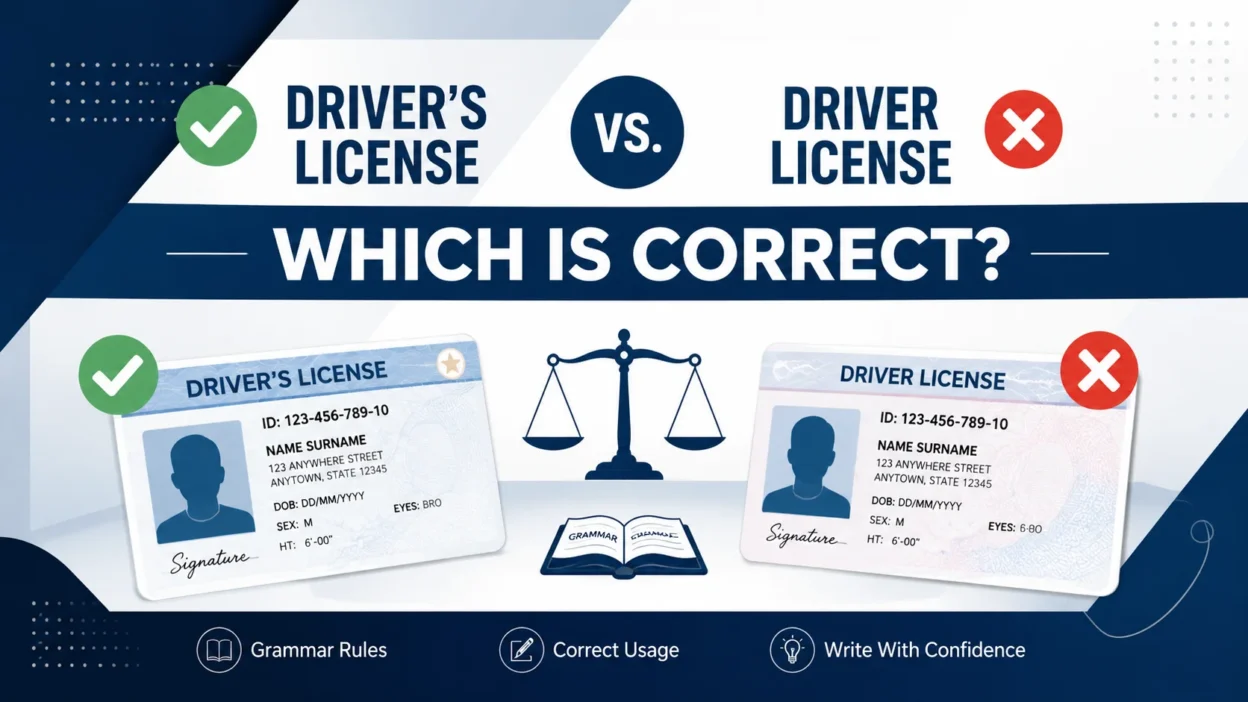
Driver’s License vs Drivers License can confuse writers because the small apostrophe changes the grammatical status of the phrase and affects its correct usage in standard US English. In most general writing, driver’s license is the usual form and the preferred form. The apostrophe mark shows a singular possessive relationship between a driver and a license. Although the license doesn’t literally belong to one driver, this form is widely accepted as the grammatically correct choice. Driver license may also be correct in certain official settings, while drivers license is usually considered a common mistake. Writers, students, bloggers, and professionals may encounter all three forms, which can create confusion when choosing the correct form.
The choice becomes more interesting when you consider official status, legal usage, and official government terminology. A government may use driver license on government forms, signs, databases, and websites because it has selected that wording as its official terminology. This can make the form legally or officially correct within a particular jurisdiction, even though driver’s license remains the more natural choice in everyday English. Regional differences and legal variations can therefore explain why you see different spellings in real documents. In polished writing, everyday typing, and careful written English, it helps to understand the difference between standard, usual, preferred, official, legal, legally correct, grammatical, everyday, and polished usage before deciding which form fits your context.
From my experience with grammar-focused writing, the easiest way to avoid mistakes is to use driver’s license as your default unless an official source or specific authority uses another form. That tiny apostrophe may seem minor, but paying attention to it can make your writing more clear, simple, and correct, especially when you want to avoid having to second-guess your wording. A comprehensive guide should consider the term, topic, practical advice, examples, and tables that make the difference easier to understand. A conversational explanation can also show that the issue is not simply about whether something can belong to a driver; it is about grammar rules, spelling, punctuation, language, and context. When you encounter driver license, check whether it comes from an official government source, and when you are writing generally, driver’s license is the safer and more familiar choice.
Driver’s License vs. Drivers License: Quick Answer
Driver’s license is the standard choice in general US English.
The word driver’s is a singular possessive noun. It describes a license associated with one driver. This follows the same basic pattern found in expressions such as student’s ID, teacher’s guide, and doctor’s office.
| Form | Typical use | Example |
| driver’s license | Standard US English | I renewed my driver’s license. |
| driver license | Official or institutional terminology | Check the driver license requirements. |
| drivers license | Generally nonstandard | Avoid this in polished writing. |
| driver’s licenses | Standard plural | The office issues driver’s licenses. |
| drivers’ licenses | Plural possessive | The drivers’ licenses were checked. |
The easiest rule is this: Use “driver’s license” in ordinary US writing unless you’re following an official name that uses “driver license.”
Driver’s License vs. Drivers License: The Grammar Behind the Apostrophe
The apostrophe in driver’s license isn’t simply a punctuation mark added for appearance. It tells you something about the grammatical relationship between the words.
“Driver’s” Is a Singular Possessive
In driver’s license, driver’s is the singular possessive form of driver.
English often uses possessives to show association rather than literal ownership. A driver doesn’t necessarily “own” a license in the same sense that someone owns a car. Instead, the license is connected with that driver.
Consider these familiar examples:
- driver’s license
- driver’s seat
- student’s ID
- teacher’s desk
- customer’s account
- doctor’s office
The same grammatical pattern appears in each expression.
For example:
She left her driver’s license in her wallet.
Here, driver’s identify the relationship between the driver and the license.
Why “Drivers License” Is Usually Incorrect
Without an apostrophe, drivers is normally the plural form of driver.
For example:
Several drivers were waiting outside.
The word drivers refers to more than one person.
When you write drivers license, you’re using the plural noun drivers without the apostrophe that would normally show possession or association.
Compare these sentences:
He forgot his driver’s license. ✅
He forgot his drivers license. ❌
The first follows the standard possessive construction used in general US English.
Why “Driver License” Is Different
Driver license needs a little more explanation.
It isn’t simply a misspelled version of driver’s license. Some government agencies and institutions use driver license as their established official terminology.
That means you may see both forms in legitimate contexts.
For general prose, driver’s license is the familiar standard form. But when an agency officially calls its document a driver license, reproducing that terminology can be appropriate.
This distinction is important because official terminology and ordinary grammar don’t always follow exactly the same pattern.
Why Do You Keep Seeing “Drivers License” Everywhere?
If drivers license is generally considered incorrect in polished writing, why does it appear so often?
There are several practical reasons.
People Type Fast
Apostrophes are easy to miss. When someone types quickly, punctuation often gets dropped.
This happens in text messages, social media posts, search queries, online comments, and informal notes.
Because drivers license remains easy to understand, readers usually know what the writer means. That doesn’t make it the preferred spelling for formal writing.
Signs Often Use Short Forms
Signs and labels don’t always follow the same conventions as complete sentences.
A government building might display a short service label such as:
Driver License Services
That’s not necessarily evidence that driver license should replace driver’s license everywhere.
Signs often use compact wording because space is limited. They may also reproduce an agency’s official terminology.
Software Systems Can Remove Apostrophes
Online forms, databases, and computer systems sometimes use simplified labels.
A database field might contain driver license number because the system follows a standardized naming convention. Technical labels often prioritize consistency and compatibility over traditional punctuation.
The same thing happens with file names, usernames, database columns, and form fields.
So, seeing drivers license or driver license inside a technical system doesn’t automatically establish a general grammar rule.
What Do Government Agencies Actually Call It?
Government terminology is one of the biggest reasons this spelling question causes confusion.
In the United States, driver licensing is handled through state-level systems. As a result, terminology can differ between jurisdictions.
Some official materials use driver license, while other government materials use driver’s license.
Why Official Terminology Varies
Government agencies often create their own names for documents, services, programs, and forms.
An agency might officially call something:
Driver License Services
Another organization might use:
Driver’s License Services
Both can appear in legitimate government contexts.
The important point is that an official label doesn’t necessarily establish a universal rule for standard English.
Official Name vs. General Writing
Imagine that a state agency officially names a service Driver License Renewal.
If an article says:
Visit the agency’s Driver License Renewal page.
keeping the official name makes sense.
But if you’re writing a general sentence such as:
You need a valid driver’s license to drive legally.
there’s no reason to replace the standard possessive form with the official terminology of one particular agency.
Context determines the best choice.
Singular and Plural Forms of Driver’s License
The apostrophe becomes especially important when you start talking about more than one driver or more than one license.
One Driver’s License
When referring to one license, use:
driver’s license
For example:
Maria renewed her driver’s license last week.
The structure is straightforward:
driver + ’s + license
Multiple Driver’s Licenses
When you have several licenses, make license plural:
driver’s licenses
For example:
The office processes thousands of driver’s licenses every month.
Notice that driver’s doesn’t become plural here. The thing being pluralized is licenses.
This is a common point of confusion.
Drivers’ Licenses
Drivers’ licenses have a different structure.
Here, drivers is plural, and the apostrophe comes after the s.
For example:
The police checked the drivers’ licenses at the checkpoint.
This construction emphasizes multiple drivers.
Compare the three forms:
- driver’s license — one driver, one license
- driver’s licenses — one-driver possessive form used with multiple licenses
- drivers’ licenses — multiple drivers and their licenses
The difference may look tiny, but the apostrophe tells readers how the phrase is structured.
Is Driver’s License Capitalized?
In ordinary writing, driver’s license is usually lowercase.
For example:
I need to renew my driver’s license tomorrow.
There’s no reason to capitalize the phrase simply because it refers to an important government document.
However, capitalization can appear when the phrase is part of an official title, heading, form label, or named service.
For example:
Driver License Renewal
The exact capitalization depends on the organization and its style.
A useful rule is simple: Use lowercase when you’re using the phrase as a common noun. Follow the capitalization of an official name when you’re reproducing that name.
Driver’s License vs. Driver License Around the World
The terminology isn’t identical across English-speaking countries.
United States
In general US English, driver’s license is the familiar standard form.
However, some government agencies use driver license as official terminology.
United Kingdom
British English generally uses driving licence rather than driver’s license.
There are two noticeable differences:
- driving instead of driver’s
- licence instead of the American license
For example:
You need a valid driving licence.
This is standard British usage.
Canada
Canadian English commonly uses driver’s licence, although exact terminology can vary by province and official context.
Canada also uses the British spelling licence for the noun.
Australia
Australian English commonly uses driver licence.
This makes Australian usage particularly interesting because driver licence can be standard terminology there rather than simply an American government-style variant.
Quick Global Comparison
| Country or region | Common term |
| United States | driver’s license |
| United Kingdom | driving licence |
| Canada | driver’s licence |
| Australia | driver licence |
This variation shows why you shouldn’t assume that one English-speaking country uses the same terminology as another.
A Short History of the Term “Driver’s License”
The expression developed alongside modern motor-vehicle regulation.
As automobiles became more common, governments introduced systems to identify drivers and regulate who could legally operate vehicles. Licensing created a need for official documents that demonstrated a person’s authorization to drive.
English naturally formed expressions using the possessive construction driver’s license, much like other terms describing something associated with a particular person.
Over time, government agencies also developed shorter administrative terms. That’s one reason driver license can appear in official terminology today.
The modern variation isn’t necessarily the result of people suddenly forgetting the apostrophe. In many cases, it reflects differences in institutional naming and style.
Writing “Drivers License”
This is the most common mistake.
Incorrect:
You must show your drivers license.
Correct:
You must show your driver’s license.
Using “Drivers’ License” for One Person
The plural possessive is unnecessary when you’re talking about one driver.
Incorrect:
I lost my drivers’ license.
Correct:
I lost my driver’s license.
Forgetting to Pluralize “License”
When referring to several licenses, license should normally become plural.
Correct:
The department issued hundreds of driver’s licenses.
Not:
The department issued hundreds of driver’s licenses.
Capitalizing Every Word
Don’t automatically write:
I renewed my Driver’s License.
In ordinary prose, lowercase is standard:
I renewed my driver’s license.
“Correcting” an Official Name
If a government agency officially uses Driver License, don’t change its name simply because driver’s license is more common in general writing.
When quoting or identifying an official service, accuracy comes first.
Practical Advice: What Should You Use?
The best choice depends on what you’re writing.
If You’re Writing for General Readers
Use driver’s license.
It is the clearest and most familiar choice in standard US English.
Please bring your driver’s license with you.
If You’re Writing Legal or Government Material
Check the terminology used by the relevant jurisdiction or agency.
If the official document is called a driver license, use that exact term when referring specifically to it.
If You’re Writing for SEO
Use driver’s license as the primary term in normal writing.
People may search for variations such as drivers license or driver license, but there’s no need to repeatedly use a nonstandard spelling just because people search for it.
A strong article can explain the variants naturally while maintaining correct grammar.
If You’re Unsure
For ordinary US English, choose:
driver’s license
It’s the safest default.
Driver’s License vs. Drivers License: Quick Reference
| Form | Correct? | When to use it |
| driver’s license | Yes | General US English |
| driver license | Yes, in specific contexts | Official or institutional terminology |
| drivers license | Generally no | Avoid in polished writing |
| driver’s licenses | Yes | Multiple licenses |
| drivers’ licenses | Yes | Plural possessive involving multiple drivers |
Case Study: Everyday Writing
Someone writing an email might say:
Please bring a copy of your driver’s license.
There’s no official title involved, so driver’s license is the natural choice.
Case Study: Government Services
Suppose a state agency names a webpage Driver License Renewal.
When referring specifically to that service, keeping the agency’s wording is appropriate.
The phrase is functioning as an institutional label rather than ordinary prose.
Case Study: A Blog Article
A blogger writing about the document should normally use:
A driver’s license is a government-issued credential that authorizes a person to operate certain motor vehicles.
The article can then explain why readers may also encounter driver license and drivers license.
Case Study: A Teacher Grading an Essay
If a student writes:
I forgot my drivers license.
A teacher correcting standard US English would normally change it to:
I forgot my driver’s license.
The apostrophe belongs because driver’s is functioning as a singular possessive.
Conclusion
Choosing between driver’s license, driver license, and drivers license becomes easier once you understand the difference between standard grammar and official terminology. In most standard US English writing, driver’s license is the preferred form because the apostrophe marks a singular possessive relationship. However, driver license may be the official form used by a particular government or jurisdiction. Drivers license is generally best avoided in careful writing because it leaves out the apostrophe without having the same official reason behind its usage.
FAQs
Q1. Is “driver’s license” grammatically correct?
Yes. Driver’s license is the standard and widely preferred form in US English. The apostrophe indicates a singular possessive relationship.
Q2. Is “driver license” correct?
Yes, in some contexts. Driver license is used as official terminology by certain government agencies and jurisdictions, so it can be correct in those specific settings.
Q3. Is “drivers license” correct?
Generally, no. Drivers license is commonly treated as a misspelling in standard US English because it leaves out the apostrophe used in driver’s license.
Q4. Why does “driver’s license” have an apostrophe?
The apostrophe shows a possessive relationship. The phrase expresses the idea of a license associated with or connected to a driver.
Q5. Which form should I use in general writing?
Use driver’s license in most general US English writing. If you’re copying an official government term, however, follow the spelling used by that specific authority.