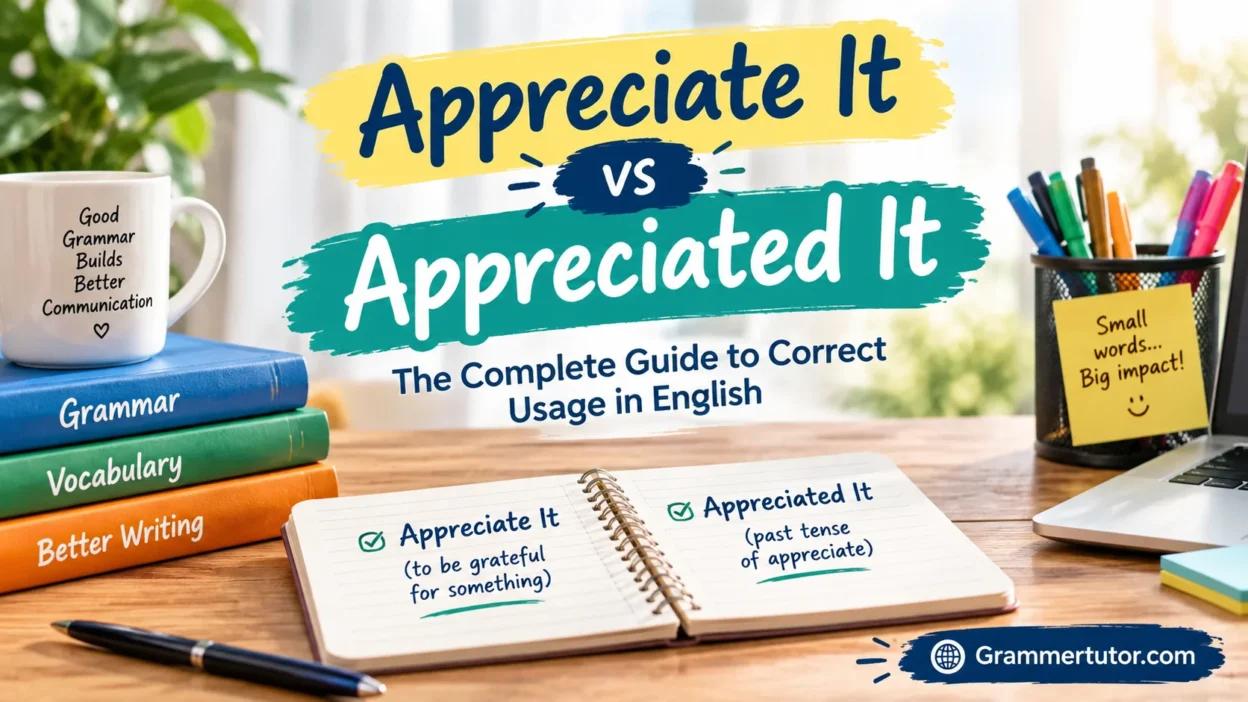
When you compare Appreciate It vs Appreciated It, the key difference is tense, timing, and meaning, especially in everyday English. I appreciate it expresses present gratitude, while I appreciated it places that gratitude in the past. The speaker’s intent and context also guide the correct usage. For example, you might thank someone today for a favour they did yesterday and still say, “I appreciate it.” If you’re describing your reaction at that earlier time, “I appreciated it” is more precise.
In natural English, native speakers usually make this choice without consciously analysing the grammar. Although the two expressions are almost identical, they’re not completely identical in meaning. A small tense difference creates a meaning shift that can change the tone and purpose of the expression. I appreciate it sounds immediate and connected to the present perspective, while I appreciate it creates a more reflective or distant past perspective. In conversational English, people frequently say they appreciate it after someone helps them or does a favour, showing kindness or providing assistance.
The best way to avoid confusion is to consider the speaker, the situation, and the intended timing before making your choice. Correct usage depends on the context, while incorrect usage often results from assuming that a past action always requires a past verb. If you use the exact form that matches your intended meaning, your sentence becomes more clear, precise, and natural. Understanding tense control, interchangeability, native usage, and speaker intent also makes your verbal expression less awkward and more effective. Frequently, everyday speakers switch between the forms instinctively because the surrounding situation already makes the intended meaning clear.
Quick Answer: Appreciate It vs Appreciated It
“I appreciate it” is the present tense. Use it when you’re expressing gratitude now, including after someone has just helped you.
“Thanks for staying late. I really appreciate it.”
“I appreciated it” is past tense. Use it when you’re describing gratitude you felt at an earlier time.
“I appreciated it when you stayed late to help me last week.”
Here’s the simplest comparison:
| Phrase | Tense | Main Time Reference | Example |
| I appreciate it | Present | Now or current relevance | “I appreciate it.” |
| I appreciated it | Past | Earlier or completed situation | “I appreciated it yesterday.” |
| I really appreciate it | Present | Gratitude felt now | “I really appreciate your help.” |
| I really appreciated it | Past | Gratitude felt then | “I really appreciated your advice.” |
The important point is this: the fact that a favor happened in the past doesn’t automatically require “appreciated.” You can still say “I appreciate it” because your gratitude exists in the present.
That distinction causes most of the confusion.
Understanding “Appreciate It” and “Appreciated It”
Before comparing the two phrases, it helps to understand what appreciate actually means.
The verb has several meanings. It can mean recognizing the value or importance of something, understanding something clearly, admiring something, or feeling grateful for something. In everyday conversation, however, the meaning of gratitude is especially common.
What “Appreciate It” Means
“I appreciate it” means roughly:
“I’m grateful for what you did.”
The word it usually points to something already understood from context.
For example:
- “Thanks for helping me. I appreciate it.”
- “Could you send me that file? I’d appreciate it.”
- “You stayed late to finish this? I really appreciate it.”
In each case, it represents an action, favor, effort, kindness, or other helpful thing.
What “Appreciated It” Means
“I appreciated it” moves that gratitude into the past.
It means:
“I was grateful for it.”
For example:
“You helped me during a difficult week. I really appreciated it.”
The speaker isn’t primarily expressing gratitude in the current moment. Instead, the speaker is describing a past emotional response.
That distinction matters when you’re telling a story, writing about an earlier experience, or explaining how you felt about something that happened before.
The Main Difference in Tense and Time
The grammatical difference is straightforward:
appreciate → present tense
appreciated → past tense
Think of the two forms as two different camera angles:
- I appreciate it → the camera is focused on now.
- I appreciated it → the camera looks backward.
That doesn’t mean the underlying event must happen at exactly the same time as the gratitude. English tense often reflects the speaker’s perspective, not merely the calendar date of an event.
“Appreciate It”: Meaning, Grammar, and Correct Usage
The phrase “I appreciate it” works especially well when you’re directly communicating gratitude to another person.
It’s concise, flexible, and common in both casual and professional American English.
When “Appreciate It” Refers to Present Gratitude
Use “I appreciate it” when your gratitude is something you’re expressing at the moment.
For example:
“Thanks for covering my shift. I appreciate it.”
The shift coverage happened earlier, but your appreciation is being expressed now.
That’s perfectly natural.
You might also say:
- “Thanks for explaining that. I appreciate it.”
- “I appreciate your patience.”
- “I appreciate everything you’ve done.”
- “I really appreciate your help.”
- “I appreciate you taking the time to meet with me.”
Notice something important: the action can be completed while the appreciation remains present.
That’s why the rule “past action = past tense” doesn’t always work.
When “Appreciate It” Refers to a Future or Expected Action
You can also use appreciate in a polite request about something you want someone to do.
For example:
“I would appreciate it if you could send the document today.”
Here, the requested action hasn’t necessarily happened yet.
This structure is especially common in professional communication:
- “I would appreciate it if you could respond by Friday.”
- “We would appreciate it if you could confirm your availability.”
- “I’d appreciate it if you could take another look.”
- “I would greatly appreciate your assistance.”
The phrase doesn’t mean you’re claiming that the favor has already happened. You’re expressing anticipated gratitude.
Using “I Appreciate It” as a Direct Thank-You
Sometimes “I appreciate it” functions almost like thank you.
Compare:
“Thanks for the ride.”
“I appreciate it.”
“Thanks for the ride. I really appreciate it.”
All three can express gratitude, although the final version emphasizes appreciation more strongly.
The expression often sounds warm without becoming overly emotional. That’s one reason it works so well in everyday American English.
Using “Really Appreciate It” in Everyday American English
You’ll frequently hear:
“Really appreciate it.”
This is an informal conversational shortening of “I really appreciate it.”
For example:
“I’ll send you the report tonight.”
“Really appreciate it.”
The subject I is omitted because the conversational context makes it obvious.
In formal writing, however, “I really appreciate it” is usually the safer choice.
Can You Say “Appreciate It” Without “I”?
Yes.
In casual conversation, “Appreciate it” is completely natural.
For example:
“Here’s the information you asked for.”
“Appreciate it.”
The phrase works because English speakers routinely omit predictable subjects in informal speech.
However, the complete form “I appreciate it” is clearer and more appropriate when you’re writing a professional email, formal letter, or other polished communication.
“Appreciated It”: Meaning, Grammar, and Correct Usage
The phrase “I appreciated it” is equally grammatical. It simply places your appreciation in the past.
When “Appreciated It” Refers to a Completed Past Action
Use “I appreciated it” when you’re describing how you felt about something at an earlier point.
For example:
“I appreciated it when my manager gave me extra time.”
The sentence describes a past situation and your reaction to it.
Other examples include:
- “I appreciated your advice last year.”
- “I appreciated everything you did for me.”
- “I really appreciated your help during the project.”
- “I appreciated the opportunity to speak with the team.”
- “I appreciated how carefully you handled the situation.”
These sentences look backward.
How “I Appreciated It” Works in a Past Situation
Consider this exchange:
“Why did you thank Sarah?”
“Because she helped me move. I really appreciated it.”
The speaker is recounting an earlier event.
Now compare it with:
“Sarah helped me move yesterday.”
“Yeah, I really appreciate it.”
The favor happened yesterday, yet appreciation can still be correct because the speaker is expressing gratitude now.
That’s the subtle point many grammar explanations overlook.
When “I Really Appreciated It” Is More Natural
“I really appreciated it” works particularly well when you’re reflecting on a past experience.
For example:
“When I was starting my first job, my supervisor took the time to train me. I really appreciated it.”
The sentence isn’t functioning as a direct thank-you at that moment. It’s part of a recollection.
Why “Appreciated It” Usually Needs a Past-Time Context
Past tense doesn’t always require an explicit word such as yesterday or last year. Context can establish the time.
Compare:
“I appreciated it.”
That can be grammatical, but without context it may leave the listener wondering when you felt that appreciation.
Now consider:
“When you helped me move last weekend, I appreciated it.”
The timeline becomes clear immediately.
Common past-time markers include:
- yesterday
- last week
- last month
- last year
- when I was younger
- at the time
- back then
- during the project
- after the meeting
- when we worked together
Appreciate It vs Appreciated It: Grammar Comparison
The two expressions differ primarily in tense, not in whether one is grammatically correct.
| Feature | I Appreciate It | I Appreciated It |
| Verb form | Present | Past |
| Time perspective | Current | Earlier |
| Common function | Direct gratitude | Reflection or narration |
| Can follow a completed favor? | Yes | Yes |
| Works in conversation? | Very common | Common when discussing the past |
| Works in professional writing? | Yes | Yes |
| Basic meaning | I’m grateful | I was grateful |
Present Tense vs Past Tense
The verb appreciate is a regular verb.
Its basic forms are:
- Present: appreciate
- Third-person singular: appreciates
- Past: appreciated
- Past participle: appreciated
- Present participle: appreciating
How the Verb Changes the Meaning
Compare these sentences:
“I appreciate your honesty.”
This expresses a current judgment or feeling.
“I appreciated your honesty during that meeting.”
This describes your reaction to a past situation.
The noun or pronoun after the verb doesn’t create the tense difference. The verb does.
Why “It” Usually Refers to an Action, Favor, or Help
In “I appreciate it,” it is a pronoun. Its exact meaning depends on context.
For example:
“Thanks for picking me up. I appreciate it.”
Here, it refers to picking me up.
“You explained the process clearly. I appreciate it.”
Here, it refers to the explanation or effort.
“Thanks for checking on me. I really appreciated it.”
Here, it refers to the act of checking on the speaker.
The pronoun keeps the expression compact because the listener already knows what it represents.
Conclusion
The difference between “I appreciate it” and “I appreciated it” comes down to time and perspective. Use “I appreciate it” when you’re expressing gratitude now, even if the favor happened earlier. Use “I appreciated it” when you’re describing gratitude you felt in the past.The easiest rule is to focus on what you mean, not simply when the action happened. If you’re thanking someone directly, “I appreciate it” will usually sound natural. If you’re looking back on a past experience, “I appreciated it” often fits better. Once you understand this distinction, choosing the right phrase becomes much easier.
FAQs
Q1.Is “I Appreciate It” Correct?
Yes. “I appreciate it” is grammatically correct and commonly used to express gratitude in the present.
Q2.Is “I Appreciated It” Correct?
Yes. “I appreciated it” is also grammatically correct. It describes appreciation connected to a past situation or past perspective.
Q3.Should I Say “I Appreciate It” or “I Appreciated It”?
Use “I appreciate it” when you’re expressing gratitude now. Use “I appreciated it” when you’re describing how you felt about something in the past.
Q4.Can I Say “I Appreciate It” for Something That Happened Yesterday?
Yes. For example:
“Thanks for helping me yesterday. I appreciate it.”
The favor happened yesterday, but you’re expressing your gratitude today.
Q5.Is “I Appreciated It” More Formal Than “I Appreciate It”?
No. The difference isn’t primarily about formality. It’s about tense and perspective. Both forms can work in casual conversations, professional messages, and formal writing when the context supports them.