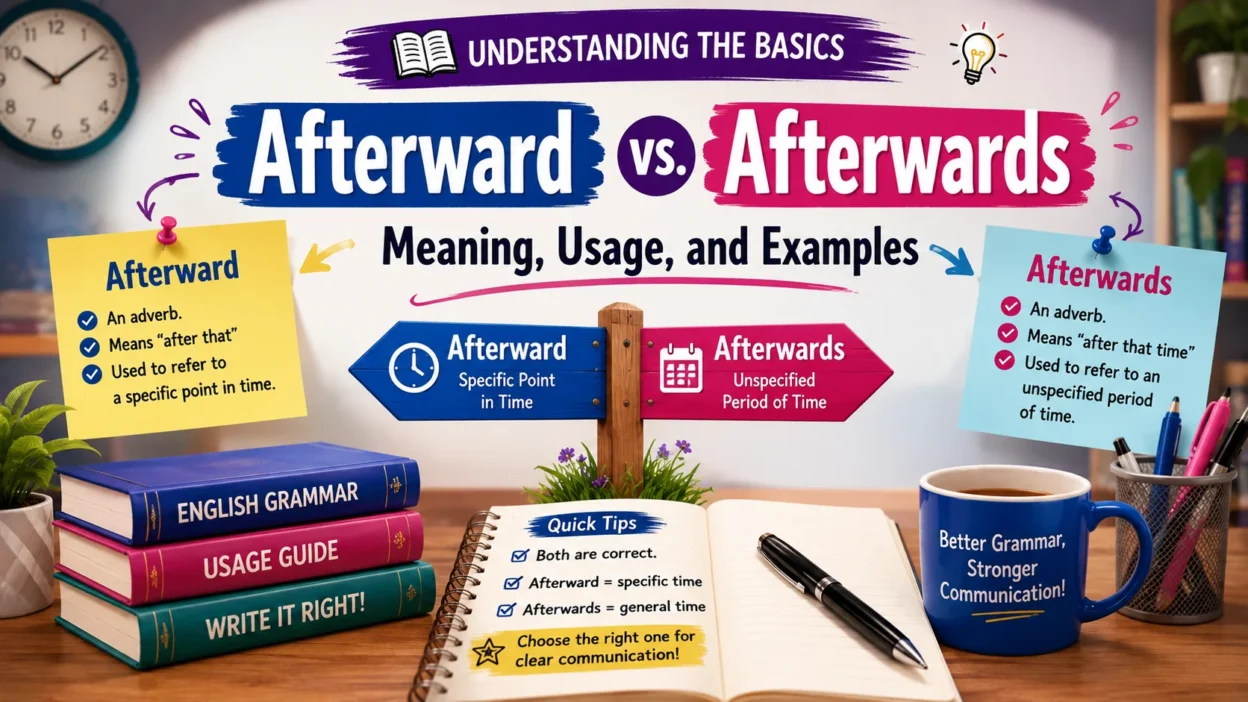
Afterward vs. Afterwards is a common English spelling question because both forms have the same basic meaning and describe a later time or something that happens after an event. The main difference is regional preference: American English generally favors afterward, while British English, Australian English, and other Commonwealth varieties commonly use afterwards. Both forms function as adverbs, and neither is a grammatical mistake. The two spellings may look slightly different because of the final s, but that small difference doesn’t create a new meaning. Major dictionaries such as Cambridge and Oxford recognise both forms. This means you don’t need to invent a complicated grammar rule or worry that one version is automatically more correct. Instead, think about your audience, context, writing style, and regional usage. For example, you might finish dinner, take a walk, and return afterward or afterwards. The sentence remains accurate either way. This is especially useful for learners who often confuse similar spellings and hesitate when choosing the correct form. In formal writing, exams, emails, and everyday communication, either word can work naturally. Your goal should be accurate English, natural English, and consistent word choice, rather than trying to find a difference that isn’t actually there.
The history and structure of these words provide another useful way to understand their spelling differences. Afterward follows the -ward pattern, similar to forward, while afterwards follows the -wards pattern seen in forwards, toward, and towards. These directional adverbs show how English spelling conventions can vary across different regions and continents. North American writers, particularly in the U.S. and Canada, often favor afterward, whereas many English speakers outside North America lean toward afterwards. This is a matter of usage patterns, not a strict grammar rule. Seasoned writers usually understand that the terms are nearly identical, even though regional preferences create subtle differences in frequency. If you’re preparing an important email, report, or blog post, choose the version that suits your expected readers and keep it consistent throughout your documents. For an international audience, either form is understandable, but a suitable style guide can improve clarity and professionalism. Online debates, grammar threads, and questions about whether “afterward vs afterwards is there any difference” can make the issue seem more complicated than it is. The short answer is that there is generally no difference in meaning. Regional spelling, audience, and writing goals may influence your choice, but both forms remain correct and interchangeable in most contexts.
One important point is to avoid confusing afterward with afterword. Although the words look alike, afterword has a completely different meaning. It refers to a specific section at the end of a book, often containing an author’s insights, comments, or explanations about the main text. By contrast, afterward and afterwards describe a subsequent time or what happens after a particular point, period, or event. Understanding this distinction can make your writing more precise. In real-life contexts, seeing these words in complete sentences is often more useful than memorising an isolated grammar rule. You can finish a meeting, send an email, review your work, and then continue afterward or afterwards. Once you’ve figured out this small nuance, the choice becomes much easier. The broader history of English also explains why American, British, and Australian preferences don’t always match. Language evolves differently across regions, creating different spelling conventions without changing the core meaning of the words. For language learners, writers, and anyone studying vocabulary or grammar, this is a useful example of language evolution, regional usage, and interchangeability. Whether you’re exploring the origins, checking an article, preparing for exams, or improving your professional writing, remember that both forms are accepted. The best choice depends on geography, preference, style, context, audience, and consistency.
Quick Answer: Afterward vs. Afterwards
Afterward and afterwards are both correct adverbs meaning “later” or “after that.”
- Afterward is the usual preference in American English.
- Afterwards is especially common in British English.
- Both can describe an action that happens after an earlier event.
- Neither word is inherently more grammatically correct.
- Afterword is completely different. It means a concluding section of a book or other written work.
- For US English, afterward is usually the best default.
For example:
US English: We had dinner and talked afterward.
British English: We had dinner and talked afterwards.
The meaning doesn’t change. Only the preferred regional form does.
What Does “Afterward” Mean?
Afterward is an adverb that means at a later time or after an event that has already been mentioned.
It normally connects two points in time. First, something happens. Then another action occurs afterward.
For example:
- We finished the meeting and went home afterward.
- She apologized afterward.
- He felt much better afterward.
- They discussed the problem afterward.
- I’ll explain everything afterward.
The word doesn’t tell you exactly how much later something happens. The gap could be a few seconds, several hours, or even years depending on the context.
The team celebrated afterward.
That sentence could describe a celebration immediately after a victory or one that happened later that evening. The surrounding context supplies the timing.
Examples of “Afterward”
Consider how naturally the word works in different situations:
Everyday conversation:
We can grab coffee afterward.
Workplace writing:
The team reviewed the proposal afterward.
Narrative writing:
She realized her mistake only afterward.
Academic or historical writing:
The policy was revised several years afterward.
In each example, afterward points backward to an earlier event and places the new action later in time.
What Does “Afterwards” Mean?
Afterwards has essentially the same meaning as afterward.
It means later, after that, or at a later time following an event.
For example:
- We went shopping afterwards.
- She called me afterwards.
- They went home afterwards.
- He regretted the decision afterwards.
- We talked about it afterwards.
So if you write:
We watched the movie and went for dinner afterward.
and someone else writes:
We watched the movie and went for dinner afterwards.
Neither sentence changes the basic meaning.
That’s the key point.
Are Afterward and Afterwards Interchangeable?
In ordinary standard English, yes. When they mean “later” or “after that,” you can generally substitute one for the other.
Compare these pairs:
| Afterward | Afterwards |
| We talked afterward. | We talked afterwards. |
| She called afterward. | She called afterwards. |
| He apologized afterward. | He apologized afterwards. |
| They left shortly afterward. | They left shortly afterwards. |
| I’ll explain it afterward. | I’ll explain it afterwards. |
The meaning remains the same.
The important distinction is usage preference, not meaning.
Afterward vs. Afterwards in American English
If you’re writing for an American audience, afterward is usually the safest and most natural choice.
For example:
We discussed the proposal afterward.
She went home shortly afterward.
I’ll call you afterward.
This doesn’t mean Americans never use afterwards. They do. However, afterward is the usual American preference.
Why “Afterward” Works Well in US Writing
American English often favors the shorter -ward form in several words.
For example:
- afterward
- toward
- forward
- backward
That pattern can make afterward feel especially natural to American readers.
Still, don’t turn this observation into a hard rule. English has plenty of exceptions, and regional preferences aren’t mechanical formulas.
Afterward vs. Afterwards in British English
In British English, afterwards is particularly common.
For example:
We had lunch and went for a walk afterwards.
She wasn’t worried about it until afterwards.
They met again shortly afterwards.
However, afterward isn’t wrong in British English. The British preference for afterwards doesn’t make the shorter version ungrammatical.
That’s an important distinction:
Preferred ≠ required.
Regional Usage at a Glance
| Variety | More Common Choice | Other Form |
| American English | afterward | Correct but less typical |
| British English | afterwards | Correct |
| Canadian English | Both occur | Depends on context and style |
| Australian English | Both occur | Depends on context and style |
| International English | Both are understood | Choose consistently |
Regional English isn’t divided by a brick wall. People read international books, watch foreign media, work with global teams, and communicate across borders every day.
As a result, you’ll encounter both spellings outside their strongest regional preferences.
Why Are There Two Forms?
The difference comes partly from the history of English word formation.
The word afterward has a long history in English. Its development is connected with older forms combining the idea of after with an ending related to direction or position.
The form afterwards also has a long history. The extra s isn’t a modern spelling mistake or an accidental addition.
The “-ward” Ending
You can see a similar pattern in words such as:
- forward
- backward
- homeward
- eastward
- westward
The ending can express direction or orientation.
In afterward, the idea developed into a temporal sense: something happens after a particular point or event.
What About the “-s” in “-wards”?
English also developed forms ending in -wards, including:
- afterwards
- towards
- backwards
- forwards
- homewards
The additional s doesn’t normally create a completely different meaning.
Instead, it belongs to a long-established variation in English word formation and usage.
So don’t look at afterward and afterwards as two separate vocabulary words that happen to have similar definitions. They’re closely related forms that have developed different regional preferences.
How to Use Afterward and Afterwards in a Sentence
Afterward and afterwards have the same meaning and can be used interchangeably to describe something that happens later or following an event.
At the End of a Sentence
This is one of the most common positions.
We went home afterward.
We went home afterwards.
Both sentences are natural.
After a Main Clause
You can also use the adverb after a clause describing the earlier event.
She finished her presentation and answered questions afterward.
She finished her presentation and answered questions afterwards.
The first action establishes the reference point. The adverb then tells the reader that the second action happened later.
At the Beginning of a Sentence
Both forms can appear at the beginning of a sentence.
Afterward, we went back to the hotel.
Afterwards, we went back to the hotel.
This position can work particularly well in narrative writing because it creates a clear transition between events.
With “Shortly”
Shortly afterward and shortly afterwards are both standard.
The company announced the change. Shortly afterward, several employees resigned.
The company announced the change. Shortly afterwards, several employees resigned.
The word shortly adds useful information. It tells the reader that the second event followed relatively soon.
With “Soon”
You can also write:
- soon afterward
- soon afterwards
For example:
They reached an agreement and soon afterward signed the contract.
This construction is especially useful when you want to emphasize sequence without giving an exact time.
Grammar: What Part of Speech Is “Afterward”?
Both afterward and afterwards function as adverbs.
They provide information about when an action occurs.
Consider:
Maria called me afterward.
The verb is called. The adverb afterward tells us when she called.
Likewise:
Maria called me afterwards.
Here, afterwards performs the same grammatical job.
Common Sentence Patterns
You can use these forms in several useful structures:
- Verb + afterward
- We talked afterward.
- Verb + afterwards
- We talked afterwards.
- Shortly + afterward
- He left shortly afterward.
- Shortly + afterwards
- He left shortly afterwards.
- Soon + afterward
- She returned soon afterward.
- Soon + afterwards
- She returned soon afterwards.
Afterward vs. Afterword: The Confusion That Actually Matters
Here’s where things get interesting.
Afterward and afterwards are closely related. Afterword is not.
What Does “Afterword” Mean?
An afterword is a concluding section of a book or other written work.
For example:
The historian wrote an afterword explaining the book’s research process.
The word refers to writing, not time.
Think of it this way:
Afterward = when?
Afterword = what part of a book?
That’s the easiest distinction to remember.
Side-by-Side Comparison
| Word | Part of Speech | Meaning | Example |
| afterward | Adverb | Later | We talked afterward. |
| afterwards | Adverb | Later | We talked afterwards. |
| afterword | Noun | A concluding section of a book | The author added an afterword. |
Why Writers Mix Them Up
The first five letters are identical, and the words look almost interchangeable at a glance.
But their jobs are completely different.
We discussed the chapter afterward.
Here, the meaning is later.
The editor wrote an afterword.
Here, the meaning is a concluding section.
A useful memory trick is simple:
“Word” points to writing. “Ward” points to later time.
Common Mistakes With Afterward and Afterwards
Writers often confuse afterward and afterwards, even though both are correct and generally have the same meaning.
Mistake: Calling “Afterwards” Incorrect
This is probably the biggest misconception.
Afterwards is not an incorrect version of afterward. It’s a standard English form with a strong association with British usage.
Mistake: Calling “Afterward” Incorrect in British English
The reverse claim is also too strong.
British English is commonly used afterwards, but afterward is still a valid English form.
Mistake: Assuming the Extra “S” Changes the Meaning
It doesn’t normally do so.
We talked afterward.
and
We talked afterwards.
mean the same thing.
Mistake: Confusing “Afterword” With “Afterwards”
This creates a genuine meaning error.
The author added an afterword.
doesn’t mean the author added something “later.”
Mistake: Mixing Regional Styles Randomly
Imagine an article that uses afterward twenty times and suddenly switches to afterwards without a reason.
Readers probably won’t misunderstand it. Still, the inconsistency can make the writing look less carefully edited.
Consistency is the better practice.
Afterward vs. Afterwards: Real-World Examples
Afterward and afterwards both mean “later” or “at a later time,” and the choice usually depends on regional preference and writing style.
Everyday English
We can talk about it afterward.
I’ll clean the kitchen afterwards.
Let’s finish dinner first and decide afterward.
What are you doing afterwards?
These sentences sound natural in ordinary conversation.
Workplace Writing
The manager met with the employees afterward.
The team reviewed the results shortly afterward.
We can discuss the budget afterward.
In American professional writing, afterward is generally the more natural default.
British English
We went for coffee afterwards.
She spoke to the manager afterwards.
They discovered the problem shortly afterwards.
Here, afterwards fits the expected British preference.
Narrative Writing
He closed the door. Only afterward did he realize he’d forgotten his keys.
This structure gives afterward extra emphasis.
You can also write:
Only afterwards did he realize he’d forgotten his keys.
The grammatical structure remains sound.
Afterward vs. Afterwards in Formal Writing
Neither form is inherently informal.
You can use both in:
- academic writing
- business writing
- journalism
- essays
- reports
- professional emails
- fiction
- everyday conversation
The bigger question is which variety of English you’re writing in.
If you’re producing content specifically for a US audience, afterward is usually the cleaner default. If you’re writing for a British publication, afterwards may fit the publication’s established style better.
What About “Subsequently”?
You might wonder whether formal writing should be replaced afterward with something more sophisticated.
Not necessarily.
Subsequently is a formal alternative meaning “after something else has happened.”
Compare:
The committee met afterward.
with:
The committee subsequently met.
These aren’t always perfect substitutes because subsequently can sound more formal and can emphasize a later development rather than simply “after that.”
There’s no prize for making a simple sentence sound like a legal document.
If afterward communicates the idea clearly, use it.
A Practical Case Study: Standardizing a Company Website
Imagine a US-based company has hundreds of help-center articles.
One article says:
Customers receive a confirmation email afterward.
Another says:
Customers can update their information afterwards.
A third says:
The system sends a notification shortly afterward.
A fourth says:
Users can contact support afterwards.
Nothing is grammatically broken. The problem is style consistency.
A Better Editorial Decision
If the company’s content follows US English, its style guide could specify:
Use “afterward” as the preferred US English form.
Editors could then standardize new and revised content around that preference.
The result isn’t “more correct” because afterwards was wrong. It’s simply more consistent with the publication’s chosen variety of English.
What This Teaches Writers
When two forms are both standard, the best editorial choice often comes from:
- Audience
- Regional English
- Existing house style
- Consistency
- Reader expectations
That’s a much better approach than searching for a grammar rule that doesn’t exist.
Afterward vs. Afterwards: Quick Comparison
| Question | Answer |
| Do they mean the same thing? | Yes, generally. |
| Are both adverbs? | Yes. |
| Is afterward standard English? | Yes. |
| Is afterwards standard English? | Yes. |
| Which is preferred in US English? | Afterward |
| Which is especially common in British English? | Afterwards |
| Is afterwards wrong in American English? | No. |
| Is afterward wrong in British English? | No. |
| Is afterword the same word? | No. |
| Does afterword mean “later”? | No. |
| Should writers stay consistent? | Yes. |
Easy Ways to Remember Afterward vs. Afterwards
A simple way to remember afterward vs. afterwards is to focus on meaning: both mean “later” or “at a later time,” with afterward more common in American English and afterwards more common in British English.
The “S for British English” Trick
Think:
S = UK preference
So afterwards can remind you of British English.
It’s only a memory trick, not a grammatical law.
The “Shorter for US English” Trick
Think of afterward as the shorter American preference.
Again, this helps you remember the tendency without pretending that every American writer follows it.
The “Time vs. Book” Trick
This one is even more useful:
- Afterward/afterwards → time
- Afterword → book
If you’re talking about something that happens later, choose afterward or afterwards.
If you’re talking about a section at the end of a book, choose afterword.
The Sentence-Swap Test
Try replacing one with the other.
We spoke afterward.
→ We spoke afterwards.
If the sentence still means exactly the same thing, you’re dealing with a regional or stylistic variation.
Conclusion
Afterward and afterwards have the same basic meaning, and both are grammatically correct. The main difference is regional usage: afterward is more common in American English, while afterwards is especially common in British English and other varieties. Neither form is wrong, so choose the one that fits your audience, writing style, and regional preference. Most importantly, don’t confuse either word with afterword, which refers to a section at the end of a book.
FAQs
Q1. Is “afterward” or “afterwards” correct?
Both afterward and afterwards are correct. They function as adverbs and generally have the same meaning.
Q2. What is the difference between afterward and afterwards?
The main difference is regional preference. Afterward is more common in American English, while afterwards is more common in British English.
Q3. Is “afterwards” more correct than “afterward”?
No. Neither form is more grammatically correct. The choice usually depends on regional usage, audience, and writing style.
Q4. Can I use afterward and afterwards interchangeably?
Yes. In most sentences, you can use them interchangeably without changing the meaning.
Q5. Is “afterword” the same as “afterward”?
No. Afterword is a noun referring to a section at the end of a book, while afterward means later or after something happens.